A fresh ear piercing is a small wound that needs time, clean hands and the right jewellery. The earrings you wear in the first weeks matter more than the ones you wear later, because a heavy, rough or reactive earring can slow healing, trap moisture or irritate the skin around the hole. Choosing well at the start is the difference between a piercing that settles quietly and one that stays sore for months.
That is why this guide is organised by healing stage, not just by style. A tiny titanium ball stud is the safest first choice for most new piercings, while a flat-back labret stud stays comfortable overnight and a small gold bead stud suits a lobe that is already settling. Price is a poor guide on its own. Some of the most reliable first earrings are simple and inexpensive, and some of the prettiest are the worst choice for a fresh piercing.
Below are nine earrings worth considering for newly pierced ears in 2027, from the simplest implant-grade studs to the first pretty pieces you can move to once healing is under way. Each one is described by what it is good at, what to watch for, and who it suits best, so you can choose with healing in mind, not just looks.
Key takeaways
- A fresh piercing needs light, smooth, implant-grade jewellery. Titanium or implant-grade steel is the safest starting point for most people.
- Flat-back studs are the most comfortable choice for sleeping and for the first weeks, because nothing sharp presses into the skin behind the ear.
- Leave the first earrings in for the full healing period your piercer advises, usually six weeks for lobes and longer for cartilage, and do not change them early.
- Clean hands before touching a new piercing, and clean the piercing itself only as your piercer advised, with a sterile saline solution.
- No earring heals a piercing on its own, and a piercing that is hot, very swollen, or leaking coloured discharge should be checked by your piercer or a clinician, not left to settle.
What newly pierced ears actually need
A new piercing is an open channel through the skin, and the jewellery inside it is in constant contact with healing tissue. That is why the metal matters so much. Implant-grade titanium and implant-grade steel are polished to a very smooth finish and contain very little nickel, which is why professional piercers use them for first jewellery. A rough surface, a plated finish that flakes, or a metal with a high nickel content can all irritate a healing piercing, even if the same earring would be fine in a healed ear.
Weight matters too. A fresh piercing is tender, and a heavy earring pulls on the hole every time you move your head. That pulling slows healing and can stretch the hole out of shape. Light studs are the right choice for the first weeks. Dangling earrings, large hoops and statement pieces all have their moment, but that moment comes after healing, not during it.
The backing matters as much as the front. A traditional butterfly back has a sharp post end and a small cup that can trap moisture and crust. A flat-back labret stud, by contrast, has a smooth disc that sits flat against the skin behind the ear. It does not poke, it does not catch on hair or pillows, and it is much easier to sleep on. For a new piercing, comfort is not a luxury. It is what lets you leave the earring alone, and leaving it alone is half of healing.
How we chose these earrings and what to look for
Look first at the metal and the finish. The earring should be made from implant-grade titanium or implant-grade steel, with a mirror-polished surface and no rough edges. Solid gold is also an option once the piercing has settled, but plated jewellery is a poor choice for a fresh piercing, because the plating can wear and expose a reactive base metal underneath.
Look next at the size and the fit. The post should be long enough to allow for the slight swelling that is normal in the first days, but not so long that the earring wobbles and moves around. A stud between three and five millimetres across is a sensible size for a new lobe piercing. Anything much larger adds weight and movement without adding anything to healing.
Finally, look at the backing and the closure. A flat back is the most comfortable choice for sleeping, and a threadless or internally threaded fitting is gentler to insert and remove than an externally threaded post, which can scratch the inside of a healing channel. Our guide to earrings for sensitive ears explains why metal choice matters so much, because a piercing that reacts to nickel behaves much like a sensitive ear, only more so.
The 9 best earrings for newly pierced ears 2027
The Classic Titanium Ball Stud
What we like: Implant-grade titanium, a mirror-polished finish, very light, and the stud most professional piercers reach for first. What to consider: Plain to look at, and the ball can feel small if you like a visible sparkle. Best For: A first lobe or cartilage piercing. Material: Implant-grade titanium. Price Range: Under $30. Standout Feature: The safest, most widely recommended first earring.
The Flat-Back Labret Stud
What we like: A smooth disc back that sits flat against the skin, comfortable to sleep on, and available with a tiny gem or ball front. What to consider: The post length needs to suit your ear, so buy from a piercer or a specialist, not a fashion stall. Best For: Anyone who sleeps on their side. Material: Implant-grade titanium or steel. Price Range: $20 to $60. Standout Feature: The flat back that makes sleeping easy.
The Small Gold Vermeil Ball Stud
What we like: Warm gold colour, a small neat ball, and a classic look that suits a lobe that is already settling. What to consider: Vermeil is gold over sterling silver, so it is best once the first soreness has passed, not on day one. Best For: A lobe piercing a few weeks in. Material: Gold vermeil over sterling silver. Price Range: $40 to $90. Standout Feature: A warm gold look in a tiny, light stud.
This is a good second step. Once the piercing is calm and the swelling has gone, a small gold ball stud gives you the look of gold without the weight or the risk of a plated fashion earring.
The Tiny Cubic Zirconia Stud
What we like: A small, bright stone that catches the light, set in implant-grade titanium, with a secure flat or ball back. What to consider: The stone setting must be smooth, with no sharp prongs that can catch on hair or clothing. Best For: A first piercing that still wants a little sparkle. Material: Implant-grade titanium with cubic zirconia. Price Range: $25 to $70. Standout Feature: Sparkle in a healing-safe metal.
A tiny stone is the one decoration that works well in a fresh piercing, as long as the setting is smooth and the metal is implant-grade. Keep the stone small, two to three millimetres, and the earring stays light and calm.
The Pearl Stud with a Flat Back
What we like: A small freshwater pearl on a flat-back post, soft and classic, with no sharp edges anywhere. What to consider: Pearls are soft and should not be soaked in cleaning solutions, so clean around the piercing, not the pearl itself. Best For: A lobe piercing that wants a soft, classic look. Material: Freshwater pearl on titanium. Price Range: $30 to $80. Standout Feature: A pearl that is gentle on a healing ear.
The Implant-Grade Steel Stud
What we like: Implant-grade steel, highly polished, very affordable, and widely available from professional piercers. What to consider: Steel contains a small amount of nickel, so anyone with a known nickel allergy should choose titanium instead. Best For: A first piercing on a budget. Material: Implant-grade steel. Price Range: Under $20. Standout Feature: The most affordable safe first earring.
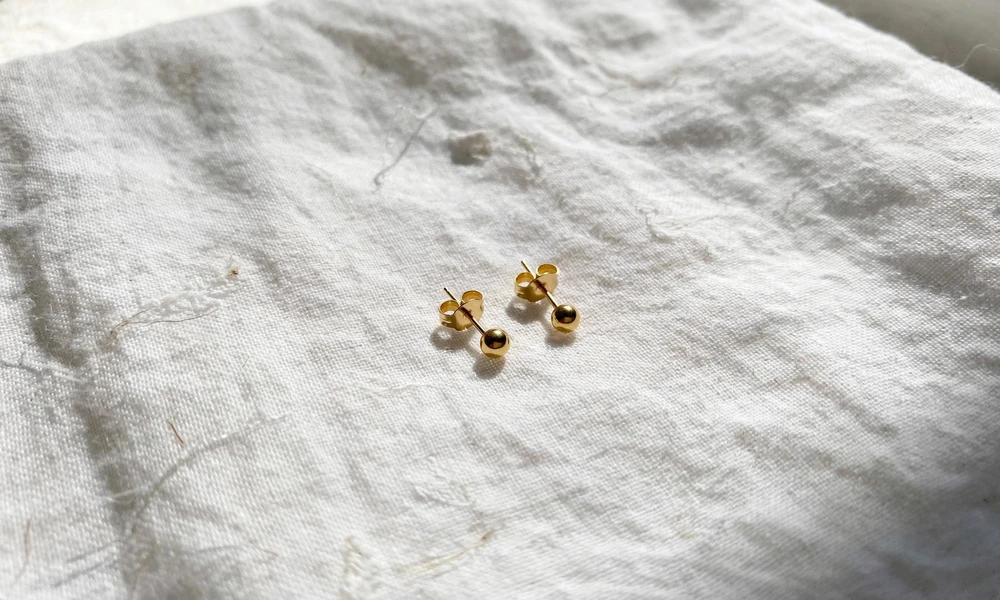
The Small Gold Bead Stud
What we like: Solid gold, a tiny smooth bead, no stone setting to catch, and a warm colour that suits most skin tones. What to consider: Solid gold costs more than vermeil, and the bead should be small, three millimetres or under, to stay light. Best For: A lobe piercing ready for solid gold. Material: Solid 14k gold. Price Range: $80 to $200. Standout Feature: Solid gold in the smallest, safest shape.
A small solid gold bead is the simplest luxury choice for a healing ear. There is nothing to catch, nothing to flake, and nothing to irritate. It is also an earring you will keep wearing long after the piercing has healed.
The Tiny Star Stud
What we like: A tiny star shape in implant-grade titanium, flat and smooth, with a playful look that still sits close to the ear. What to consider: The points of the star must be rounded, not sharp, so buy from a piercing specialist rather than a fashion brand. Best For: A second lobe piercing or a younger wearer. Material: Implant-grade titanium. Price Range: $25 to $60. Standout Feature: A little shape and personality in a safe metal.
The Small Seamless Hoop for Once Healed
What we like: A small, light, seamless hoop in implant-grade titanium, with no clasp or hinge to catch, for the first change after healing. What to consider: Only for a fully healed piercing, never for a fresh one, and the hoop should be small, ten millimetres or under. Best For: The first earring change after healing. Material: Implant-grade titanium. Price Range: $30 to $70. Standout Feature: The safest first hoop.
This is the earring to look forward to, not the one to start with. Once your piercer confirms the piercing is healed, a small seamless hoop is a gentle first change, because there is no hinge to snag and very little weight.
Which earring is right for your healing stage
In the first two weeks, the piercing is at its most tender, and the simplest stud is the right choice. A titanium ball stud or a flat-back labret stud in implant-grade metal gives the piercing the calmest possible start. Do not be tempted by a heavier or more decorative earring in this stage, however pretty it is. The piercing needs stillness, not style.
Between two and six weeks, a lobe piercing usually settles, and the soreness fades. This is when you can move to a small gold vermeil stud, a tiny cubic zirconia stud, or a small pearl, as long as the metal behind it is still implant-grade and the earring is still light. Cartilage piercings take longer, and should stay in their first jewellery for several months.
After healing is confirmed by your piercer, the rules relax. You can try a small seamless hoop, a slightly larger stud, or a light drop earring, and you can start to wear plated or fashion jewellery for short periods. A roundup of titanium earrings is a useful place to look for pieces that stay gentle even after healing, because titanium remains the kindest metal for ears that have ever reacted.
The caveats that matter
The most common mistake with a new piercing is changing the earring too soon. A piercing can look healed on the outside while the channel inside is still fragile. Pulling out the first earring early can tear that channel, and the piercing can close, bleed, or become infected. Wait for the full period your piercer advised, and if you are unsure, ask them to check it before you change anything.
Cleaning is the other place where good intentions go wrong. More cleaning is not better cleaning. Harsh antiseptics, alcohol, hydrogen peroxide and heavy oils can all irritate healing tissue. A sterile saline solution, used as your piercer advised, is enough. Our guide to cleaning gold vermeil earrings is a useful reminder of how gentle jewellery care should be, because the same soft touch that protects gold protects a new piercing.
| Detail | What is known |
|---|---|
| Best first metal | Implant-grade titanium or implant-grade steel, smooth and polished |
| Lobe healing time | Around six weeks before the first change, if healing is calm |
| Cartilage healing time | Several months, often three to six, before changing jewellery |
| Best backing | A flat disc back that sits flush against the skin |
| What to avoid at first | Heavy hoops, dangling earrings, and rough or plated finishes |
| Cleaning | Sterile saline solution, as your piercer advised, with clean hands |
| When to leave it alone | Do not twist, turn, or remove the earring during healing |
| When to get help | Spreading redness, heat, swelling, or coloured discharge |
If your piercing becomes hot, very swollen, or starts leaking coloured discharge, do not wait for it to settle on its own. Keep the earring in, unless a clinician tells you to remove it, and get it checked by your piercer or a clinician promptly. Removing the earring from an infected piercing can trap the infection inside as the hole closes.
Checklist: choosing earrings for a fresh piercing
Use these checks before you buy, and again before you change your first earrings.
- Check the metal: implant-grade titanium or implant-grade steel, not plated fashion jewellery.
- Check the finish: mirror-polished and smooth, with no rough edges, sharp prongs, or flaking plating.
- Check the weight: light enough that you forget it is there, with a stud no larger than five millimetres across.
- Check the back: a flat disc back if you sleep on your side, and a secure fitting that will not fall out.
- Check the timing: wait the full healing period your piercer advised before changing anything.
- Check your hands: wash them before touching the piercing, and touch it as little as possible.
Frequently asked questions
When can I change my earrings after a piercing?
For a lobe piercing, usually after about six weeks, if healing has been calm. For cartilage, it is often three to six months. Always ask your piercer to confirm before you change the first earring, because a piercing can look healed before the channel inside is ready.
Can I wear gold earrings in a new piercing?
Solid gold is generally fine, but it is best once the first soreness has passed. Gold-plated or gold vermeil jewellery is better saved for later, because plating can wear and expose a reactive base metal. If you want gold from day one, choose solid gold in a small, smooth stud.
Are hoops safe for newly pierced ears?
Not at first. Hoops move more than studs, and that movement irritates a healing channel. They also catch on hair, clothing and pillows. Wait until the piercing is fully healed, then start with a small, light, seamless hoop.
What should I do if my piercing gets sore?
Leave the earring in, wash your hands, and clean the piercing with sterile saline as your piercer advised. Do not twist or turn the earring, and do not add creams or oils. If the soreness gets worse, or you see spreading redness or coloured discharge, get it checked by your piercer or a clinician.
Can I sleep with my new earrings in?
Yes, and you should. Removing them lets the hole start to close. A flat-back stud is the most comfortable choice for sleeping, especially if you sleep on your side. A clean pillowcase helps too, and it is worth changing it more often while the piercing heals.
How do I clean my new piercing?
Use a sterile saline solution, as your piercer advised, with clean hands. Do not use alcohol, hydrogen peroxide, or harsh antiseptics, and do not scrub the piercing. A gentle rinse and a pat dry is enough, and the less you touch it, the faster it heals.
The bottom line
The best earrings for newly pierced ears in 2027 are not the prettiest or the most expensive. They are the lightest, smoothest, and kindest to healing skin: a tiny titanium stud, a flat-back labret, or a small solid gold bead, chosen for the metal first and the look second. A calm first six weeks is worth far more than a sparkle.
Choose one safe stud, leave it alone, clean it gently, and wait for your piercer to say the piercing is ready before you change it. That is the honest way to end up with a piercing you can enjoy for years, instead of one you spend months trying to calm down.