Two people can try on the same pair of sunglasses and look completely different in them. On one face the frames look sharp and balanced; on the other they look too wide or simply wrong, though nothing about the sunglasses has changed. The difference is geometry: the shape of the frames against the shape of the face underneath them.
That is why face shape is the most useful thing to know before you buy. Trends change every season, but the width of your forehead, the line of your jaw and the length of your face stay the same. Once you know those measurements, you can rule out most pairs in seconds and stop guessing.
This guide shows you how to work out your face shape with a mirror and a tape measure, explains the one rule behind every good match, and gives each of the five main face shapes — oval, round, square, heart and oblong — its own playbook.
Key takeaways
- Choose frames that contrast with your face: angular frames add structure to round faces, while curved frames soften square faces.
- Find your shape by measuring forehead, cheekbones, jaw and face length, and comparing the ratios.
- Oval faces suit almost every frame; the only real mistake is a frame wider than the broadest part of the face.
- Round faces need angles, square faces need curves, heart-shaped faces need chin balance, oblong faces need width and depth.
- Frames should sit as wide as your face at its broadest point, eyes roughly centred in each lens.
How to Find Your Face Shape in Five Minutes
Face a mirror in even daylight, hair pulled back, face relaxed — no smiling or raised eyebrows. With a soft tape, measure four things in centimetres: forehead at its widest, cheekbone to cheekbone, jaw from below one ear across the chin to the other, and face length from hairline to chin tip.
Length 1.3–1.5 times width, cheekbones widest, jaw gently rounded: oval. Length and width nearly equal, full cheeks, soft jaw: round. Forehead, cheekbones and jaw roughly equal, with a jaw that has clear corners: square. Forehead widest, narrowing to a smaller, often pointed chin: heart-shaped. Length 1.5 times width or more, straight sides: oblong. Between two shapes? Follow the one you are closest to and read both sections; many faces are hybrids.
The Contrast Rule: The One Idea Behind Every Good Match
Almost all face-shape advice comes down to one principle: contrast, not matching. Frames that echo your face shape exaggerate what is already there — round frames make a round face look rounder; square frames make a square jaw look harder. Contrasting frames do the opposite: angles define round faces, curves soften square jaws, and wide frames give long faces width.
The second half is proportion: whatever the shape, the frame should be about as wide as your face at its broadest point — no wider, and not much narrower. A frame past your temples makes your face look smaller; one well inside your cheekbones makes it look wider. Your eyes should sit in the centre of each lens, with the frame top just below your brow line.

Face Shape at a Glance
| Face shape | How to recognise it | Best frames | Frames to avoid |
|---|---|---|---|
| Oval | Length 1.3–1.5 times width; cheekbones widest; rounded jaw | Square, rectangle, aviator, cat-eye, geometric, oversized | Frames wider than your face; oversized pairs that hide cheekbones |
| Round | Length and width nearly equal; full cheeks; soft jaw | Square, rectangle, wayfarer, browline, angular cat-eye | Round and small frames that repeat your face’s curve |
| Square | Forehead, cheekbones and jaw roughly equal; angular jaw | Round, oval, aviator, soft cat-eye, rimless | Square and boxy frames; heavy straight browlines |
| Heart | Forehead widest; narrows to a smaller, pointed chin | Aviator, cat-eye, round, oval, bottom-heavy frames | Top-heavy and very wide frames; tiny frames |
| Oblong | Length 1.5 times width or more; straight sides | Oversized, wide and deep frames; round, oval, aviator | Narrow slim rectangles; small lenses that add length |
| Diamond | Cheekbones widest; forehead and jaw narrower | Oval, rimless, cat-eye, browline | Frames wider than your cheekbones; narrow frames |
| Between two shapes | Measurements close to two shapes at once | Try one recommended pair from each shape | Buying before trying both |
Sunglasses for an Oval Face
An oval face is the most forgiving shape to buy for: length about one and a third to one and a half times width, cheekbones widest, jaw gently rounded. Almost every frame works — square, rectangular, aviator, cat-eye, geometric and oversized. The one limit is width: choose frames as wide as the broadest part of your face and no wider, or oversized pairs will swallow your cheekbones.
Sunglasses for a Round Face
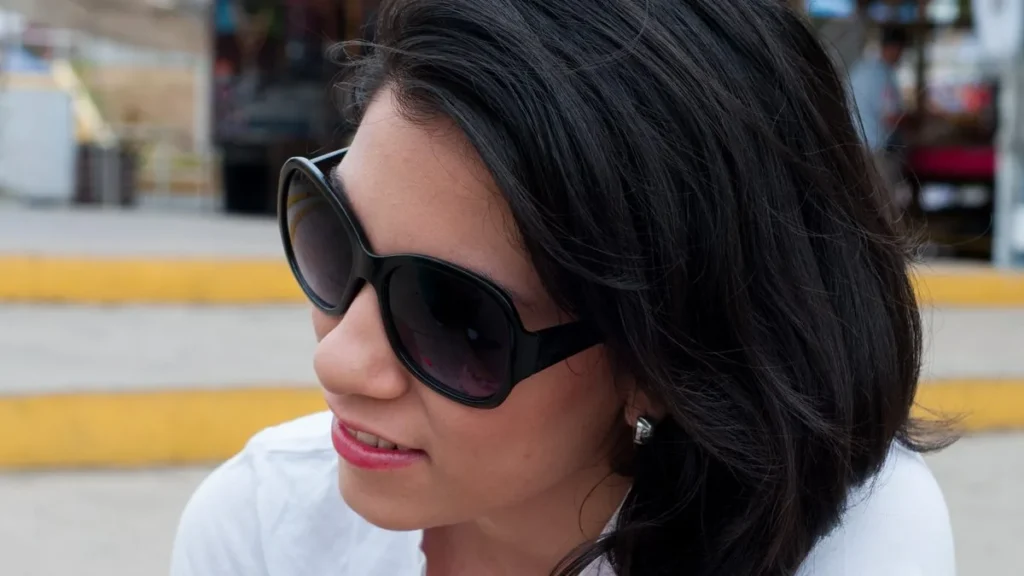
A round face is about as long as it is wide, with full cheeks and a soft, curved jaw. The frame’s job is to add structure and a little length — so choose angles. Square, rectangular and wayfarer frames are the classic answer: their straight lines contrast with soft curves, and a frame slightly wider than your cheekbones makes the face look slimmer. Browline frames lift the eye line, and an angular cat-eye lifts and lengthens at once. Avoid anything that repeats your face: round frames, small ovals and rimless circles echo your cheeks and make the face look rounder. Try the bug-eye sunglasses from the oversized trend too — their bold, angular coverage adds the structure a round face needs.
Sunglasses for a Square Face
A square face has a strong, defined jawline and a broad forehead, with forehead, cheekbones and jaw all roughly the same width. The frame job is the exact inverse of the round-face job: soften the angles. Round and oval frames are the classic match — a round metal frame on a square face is one of the most reliable combinations in eyewear, because the circle breaks up the straight lines of the jaw. Aviators suit square faces for the same reason, a soft cat-eye lifts without adding harsh angles, and thin tortoiseshell or metal rims beat chunky black acetate. Avoid the square-on-square match: boxy frames and heavy straight browlines repeat your jawline and make the face look harder.
Sunglasses for a Heart-Shaped Face
A heart-shaped face has a wider forehead and cheekbones that taper to a narrower, often pointed chin — an upside-down triangle. The goal is to balance the two halves: take a little visual weight away from the forehead and add a little to the lower half. Frames wider at the bottom than at the top do this naturally, which is why aviators work so well here — the teardrop lens is narrow at the brow and fuller below, drawing the eye toward the chin. Cat-eyes suit this shape too, and round and oval frames complement a delicate chin without adding weight above. Choose a frame about as wide as your forehead, and avoid top-heavy frames with thick brow bars. To play down a broad forehead, the best hairstyles for bigger foreheads balance the same proportions from above.
Sunglasses for an Oblong Face
An oblong face is clearly longer than it is wide — one and a half times or more — with forehead, cheekbones and jaw roughly equal and fairly straight sides. The frame job is to add width and shorten the length, which means depth and coverage. Oversized frames are your best friend: wide, deep lenses cover more of the mid-face and break up its length, and a frame that extends toward the temples adds the horizontal line your face lacks. Round and oval frames are a natural match, and aviators are ideal too — the teardrop lens covers more of the mid-face and the double bridge adds a horizontal line across it. Avoid slim rectangular frames, small lenses and narrow ovals, which all add length to a face that already has plenty of it.
If You Are Between Two Shapes
Sitting between two shapes is normal. The usual pairs are oval-round, square-oblong and heart-oval: read both sections, pick one recommended frame from each, and try them side by side in the same mirror, in the same light. The right pair will look like it belongs on your face; the wrong one will look like it is sitting on it.
Mistakes That Make the Wrong Frame Look Worse
The most common mistake is buying the shape instead of the fit — falling for a dramatic frame and ignoring that it is wider than your face or pinches at the temples. Second, matching instead of contrasting: round frames on a round face, square frames on a square jaw. Third, buying too small, which makes a broad face look broader and a long face look longer. Fourth, mind the brow line: frames far above your eyebrows leave a gap that breaks the line of your face. Finally, do not buy a pair you have only seen in a photograph — a two-minute fitting, or free returns, confirms the geometry works on your face rather than on a model. Once the shape is right, the best luxury fashion brands show how the same frame shapes are interpreted at the top of the market.
Your Face-Shape Checklist
- Measure forehead, cheekbones, jaw and face length, and compare the ratios before you shop.
- Choose frames that contrast with your face: angles for round faces, curves for square faces, width and depth for oblong faces.
- Check the width: frames should sit about as wide as your face at its broadest point, never past your temples.
- Check the eyes: they should sit in the centre of each lens, with the frame top just below your brow line.
- If you sit between two shapes, try one pair from each section side by side in the same mirror and light.
- Confirm the fit in person or through free returns: level frames, no pinching, no sliding when you look down.
Frequently Asked Questions
How do I know my face shape for sunglasses?
Measure forehead width, cheekbone width, jaw width and face length from hairline to chin, then compare the ratios. Length 1.3 to 1.5 times width with cheekbones widest: oval. Length and width nearly equal with a soft jaw: round. All three widths roughly equal with an angular jaw: square. Forehead widest with a narrow chin: heart-shaped. Length 1.5 times width or more with straight sides: oblong.
What sunglasses suit a round face?
Square, rectangular and wayfarer frames suit round faces best, because their straight lines add the structure a round face lacks. Browline frames and angular cat-eyes also work well. Avoid round and small frames, which repeat the curve of your cheeks.
What sunglasses suit a square face?
Round, oval and aviator frames suit square faces — their curves soften a strong jawline. Soft cat-eyes and rimless styles work too. Avoid square and boxy frames, which repeat your jawline.
What sunglasses suit a heart-shaped face?
Aviator, cat-eye, round and oval frames suit heart-shaped faces. Aviators work best because the teardrop lens is wider at the bottom, balancing a broad forehead against a narrower chin. Choose a frame about as wide as your forehead, and avoid top-heavy frames.
What sunglasses suit an oblong face?
Oversized, wide and deep frames suit oblong faces, because they add width and cover more of the mid-face, breaking up its length. Round, oval and aviator frames are all strong choices. Avoid narrow and slim rectangular frames and small lenses, which add length.
Can I wear any sunglasses if I have an oval face?
Almost. Oval faces suit square, rectangular, aviator, cat-eye, geometric and oversized frames, because their proportions are already balanced. The one rule is width: frames should be as wide as the broadest part of your face and no wider.
The bottom line
Choosing sunglasses for your face shape is simpler than a shop wall of frames makes it look. Measure once, remember the contrast rule, and let it filter for you: angles for round faces, curves for square faces, balance at the chin for heart-shaped faces, width and depth for oblong faces, and almost anything — in the right width — for oval faces. Try the recommended shapes side by side, check width and brow line, and trust the mirror over the trend pages. The right pair will look made for your face: its geometry answers yours.
Note: Face shape is a guide to what usually flatters, not a rule. If a pair you love breaks the guidance above and looks good in the mirror, trust the mirror — confidence wears better than any formula.