
What Is a Choker? 2027
A choker is a necklace that sits high on the neck, close to the throat, rather than falling down the chest. It is one of the oldest jewellery shapes in the world, and also one of the most misunderstood. Ask ten people what a choker is and you will get ten different answers: a velvet ribbon, a gold chain, a pearl strand, a diamond collar, or a piece of 1990s nostalgia. All of them can be right, because the word describes where a necklace sits, not what it is made of.
That simple definition is what makes the choker so useful. It frames the face, finishes a neckline, and adds polish to an outfit without needing a long chain or a heavy pendant. A thin gold chain worn every day and a diamond choker worn once at a wedding are both chokers, and they obey the same basic rules about fit, length, and proportion.
Below are nine facts that explain what a choker actually is, how it should fit, which materials last, and how to choose one that suits you in 2027.
Key takeaways
- A choker is any necklace that sits high on the neck, close to the throat, usually 14 to 16 inches long.
- Fit matters more than price: a choker should feel snug and comfortable, never tight, and it should not twist or ride up.
- Velvet, ribbon, and silk suit soft looks; gold, silver, and pearls suit everyday wear and hold their value better.
- A choker frames the face and works best with open necklines, collars, and high-neck tops that leave the neck visible.
- No choker suits every neckline or every occasion, and a poor fit or a cheap clasp can make even a beautiful piece unwearable.
What a choker actually is
A choker is defined by its position. It rests at the base of the neck, just above the collarbone, and it stays there. A standard necklace hangs lower, a pendant hangs lower still, and a collar necklace sits wider and flatter across the collarbone. A choker is the shortest of the common necklace lengths, and that shortness is what gives it its character. It draws the eye to the face, it shortens the visual line of the neck, and it makes even a plain top look finished.
The name comes from the way it sits close to the neck, but a well-fitting choker should never actually choke. It should rest lightly, with enough room to slide one finger between the band and the skin. If you can fit two fingers easily, it is probably a short necklace rather than a choker. If you cannot fit one finger, it is too tight and will be uncomfortable within an hour. That one-finger test is the simplest way to judge a choker in a shop, and it works for velvet, gold, pearls, and leather alike.
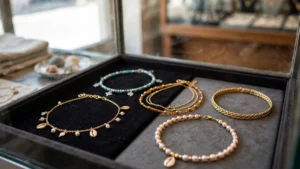
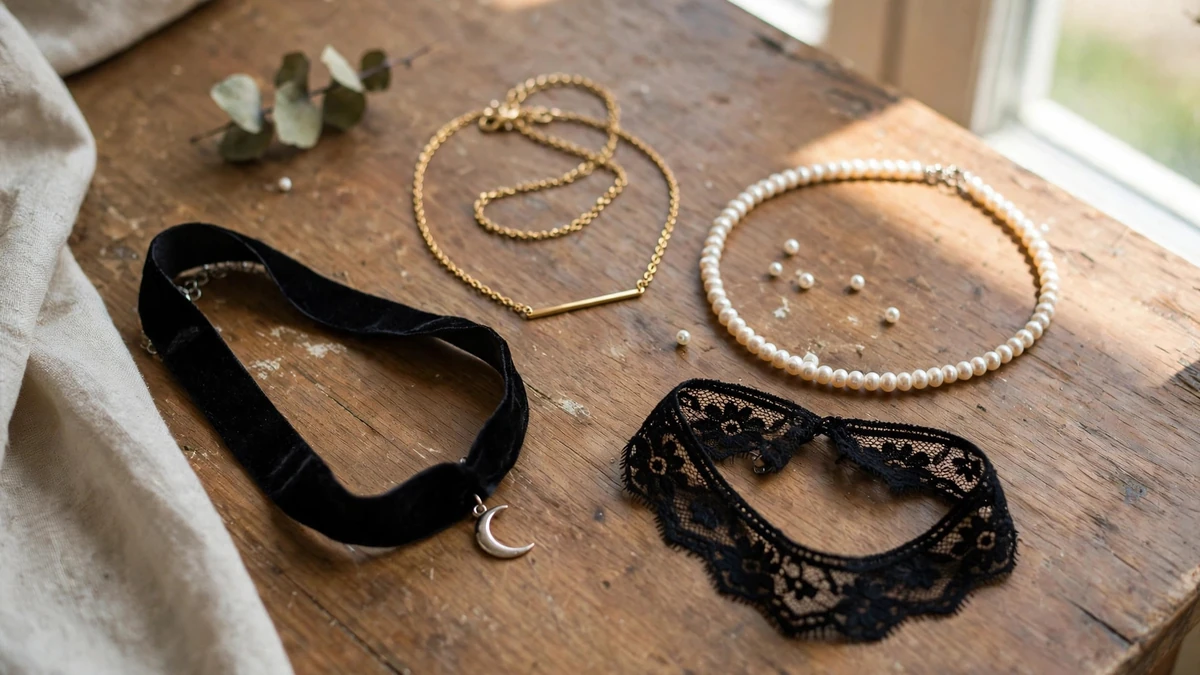
Chokers come in two broad families. The first is the soft choker: velvet ribbon, silk, lace, or fabric, often tied or fastened with a small clasp, sometimes with a charm or a small pendant at the front. The second is the hard choker: a gold or silver chain, a strand of pearls, a row of diamonds, or a rigid collar that holds its shape. Soft chokers are relaxed and romantic. Hard chokers are formal, structured, and often more expensive.
How we chose these facts and what to look for
Look first at the length. Most chokers measure 14 to 16 inches, including the clasp, and most necks suit a length in that range. A 14-inch choker sits very high and suits a slim neck and a high neckline. A 16-inch choker sits a little lower and suits a broader neck or a lower neckline. If you are between sizes, choose the longer one. A choker that is slightly loose is comfortable; a choker that is slightly tight is not, and you will stop wearing it.

Look next at the clasp and the adjuster. A good choker has a secure clasp that you can fasten yourself, and ideally a short extender chain of one or two inches so you can adjust the fit. A clasp that is fiddly, weak, or too heavy for the band will make the choker twist, so the clasp ends up at the front and the decoration ends up at the side.
Finally, look at the material against your skin. Gold and silver suit most skin and rarely cause irritation. Pearls are gentle and cool against the skin. Velvet and ribbon are soft but can feel warm in summer. Nickel and cheap plated metals are the ones to watch: they can irritate sensitive skin and they tarnish quickly. Our guide to the best necklaces for women explains how to weigh material, length, and price together, because a choker is only a good buy if you can wear it comfortably for a whole evening.
The 9 facts about chokers in 2027
1. A choker sits high on the neck, not low on the chest
What we like: The high position frames the face, shortens the neck visually, and makes a plain outfit look finished in seconds. What to consider: The same high position means there is no room for error: a choker that is half an inch too short feels tight, and one that is half an inch too long looks like a short necklace. Best for: Open necklines, collars, and high-neck tops. Cost: From around £10 for ribbon to several hundred pounds for gold. Time needed: A few minutes to measure your neck and check the fit.
2. A choker comes in many materials, from velvet to gold
What we like: The range is enormous: velvet, silk, lace, leather, beads, pearls, gold, silver, and diamonds all work as chokers, so there is a version for every budget and every occasion. What to consider: Soft materials crease, stain, and wear out faster than metal, while hard materials cost more and need proper storage. Best for: Anyone who wants one necklace shape in several moods. Cost: Around £10 to £40 for fabric and beads, £50 to £300 for silver and pearls, more for gold and diamonds. Time needed: A few minutes to choose a material that suits your skin and your wardrobe.
3. The fit is the whole point: snug, not tight
What we like: A well-fitting choker stays put all evening, does not twist, and feels like nothing at all after a few minutes. What to consider: A choker that is too tight leaves a mark, causes discomfort, and can make you look uncomfortable in photographs. Best for: Anyone willing to measure before buying. Cost: Nothing extra, if you measure first. Time needed: Five minutes with a tape measure.
4. A choker works with almost every neckline, but not every one
What we like: A choker looks best with a V-neck, a scoop neck, a boat neck, a shirt collar, or a strapless dress, where the neck is visible and the choker has space to sit. What to consider: It fights with a high ruffle, a heavy scarf, a turtleneck worn up, or a necklace worn at the same time. Best for: Dresses and tops that leave the neck clear. Cost: Nothing extra, if you plan the outfit first. Time needed: A few minutes to try the choker with the outfit before the event.
5. The choker has a long history, from the 18th century to the 1990s
What we like: Chokers have been worn for centuries, from ribbon chokers in the 18th century to pearl chokers in the 1950s and velvet chokers in the 1990s, so the shape never really goes out of fashion. What to consider: Because the shape is so old, some styles look dated: a plastic tattoo choker reads as 1990s fancy dress, while a velvet ribbon reads as timeless. Best for: Anyone who likes classic jewellery with a story. Cost: Vintage and antique chokers vary widely, from around £30 to several thousand pounds. Time needed: An hour or so to browse vintage shops or auction listings if you want a period piece.
6. A choker can be the whole look or a quiet accent
What we like: A bold choker, such as a wide velvet band or a diamond collar, can carry an entire outfit, while a thin gold chain can sit quietly under a collar and add polish without drawing attention. What to consider: A bold choker needs a simple outfit around it; a quiet choker needs something else in the outfit to give it context. Best for: Evenings, weddings, and occasions where you want one clear focal point. Cost: Around £15 to £60 for a bold fabric choker, more for metal and stones. Time needed: A few minutes to decide whether the choker or the dress is the star of the outfit.
7. A choker suits short hair and long hair in different ways
What we like: Short hair and tied-back hair show a choker off completely, while long loose hair softens it and makes it look more romantic. What to consider: Long hair can tangle with a chain choker, and a choker can disappear entirely under a curtain of hair. Best for: Updos, bobs, and ponytails, where the neck is visible. Cost: Nothing extra. Time needed: A few minutes to try the choker with your hair up and down.
8. A choker needs the right clasp and the right length
What we like: A good clasp, an extender chain, and a balanced weight mean the choker stays centred, fastens easily, and feels secure all evening. What to consider: A heavy pendant on a light band pulls the choker to one side, and a weak clasp can open without warning. Best for: Anyone buying a choker to wear often, not just once. Cost: A jeweller can add an extender chain for around £10 to £30. Time needed: A few minutes to test the clasp before you buy.
9. A choker keeps its value best in real gold, silver, and pearls
What we like: Real gold, silver, and pearls hold their value, can be repaired, and can be passed on, while plated and costume chokers are cheaper but wear out and cannot be repaired as easily. What to consider: Real materials cost more up front, and pearls need gentle care and regular restringing. Best for: A choker you plan to keep for years. Cost: Around £100 to £500 for a solid silver or gold choker, more for pearls and diamonds. Time needed: A few minutes a month to clean and store it properly.
Which choker is right for you
If you want one choker for everyday wear, choose a thin gold or silver chain, 15 or 16 inches, with an extender. It will go with almost everything, it will not date, and it will survive daily wear. If you want a choker for evenings, choose velvet or pearls: velvet for a soft, romantic look, pearls for a classic, polished one. If you want a choker for a wedding or a formal event, choose a wider band or a jewelled piece, and keep the rest of the outfit simple.
Your neck shape matters too. A long neck suits almost any choker, including wide and rigid styles. A shorter neck suits a thin choker and a V-neckline, which lengthens the line of the neck. A broader neck suits a 16-inch choker rather than a 14-inch one, and a soft material rather than a rigid collar.
Finally, think about how often you will wear it. A choker you wear once a year can be costume, fabric, or fashion jewellery. A choker you wear every week should be real metal or real pearls, with a good clasp, because it will be handled, fastened, and stored far more often. Layered necklaces are a good alternative if you like the high position of a choker but want more length to play with.
The caveats that matter
A choker is a simple piece of jewellery, but it is also an unforgiving one. It sits against the skin for hours, it shows every fitting problem, and it cannot hide behind a neckline. The most common problems are a poor fit, a weak clasp, a material that irritates the skin, and a style that fights the outfit.
| Detail | What is known |
|---|---|
| Usual length | 14 to 16 inches, including the clasp; measure your neck and add half an inch |
| Best fit test | One finger should slide comfortably between the choker and the neck |
| Best materials for daily wear | Gold, silver, and pearls; they are comfortable, durable, and easy to repair |
| Materials to watch | Nickel and cheap plating, which can irritate skin and tarnish quickly |
| Best necklines | V-neck, scoop, boat neck, shirt collar, and strapless styles |
| What to avoid pairing | High ruffles, heavy scarves, and another necklace at the same length |
| Clasp to look for | A secure clasp you can fasten yourself, ideally with an extender chain |
| What it does not do | It does not suit every neckline, and a poor fit cannot be fixed by styling |
If you have sensitive skin, a metal allergy, or a skin condition on your neck, choose gold, silver, or pearls, and avoid plated or nickel-based chokers. If a choker leaves a mark, causes itching, or feels uncomfortable after an hour, take it off and try a different material or a longer length. Discomfort is not something to push through with jewellery.
Checklist: choosing a choker honestly
Use these checks before you buy, and again after wearing the choker for an evening.
- Measure your neck with a soft tape and add half an inch for comfort before choosing a length.
- Do the one-finger test: one finger should slide comfortably between the choker and your neck.
- Test the clasp three times in the shop, and check for an extender chain.
- Check the metal: choose gold, silver, or pearls if your skin is sensitive.
- Try the choker with the actual outfit and hairstyle you plan to wear.
- Store it flat or hung, away from perfume, and clean it gently after wearing.
Frequently asked questions
How tight should a choker be?
Snug, not tight. One finger should slide comfortably between the choker and your neck. If you cannot fit a finger, it is too tight. If two fingers fit easily, it is too loose and will slide down.
Can I wear a choker every day?
Yes, if it is made from gold, silver, or pearls and fits well. A thin metal choker is easy to wear daily. A velvet or fabric choker is better kept for occasions, because it creases and absorbs moisture more easily.
What length choker should I buy?
Most people suit 14 to 16 inches. Measure your neck, add half an inch, and use that as your length. If you are between sizes, choose the longer one, and look for an extender chain so you can adjust the fit.
Can I wear a choker with a necklace?
Yes, if the lengths are different. A choker worn with a longer pendant necklace can look very good. Avoid wearing two necklaces at the same length, because they will tangle and compete with each other.
Do chokers suit everyone?
Almost everyone can wear a choker, but the right width and length vary. A thin choker suits most necks, while a wide or rigid choker suits a longer neck best.
How do I look after a gold choker?
Clean it gently with warm water and mild soap, dry it fully, and store it flat or hung so it does not tangle. Keep it away from perfume and hairspray. Gold jewellery for everyday wear follows the same care rules, and a well-kept gold choker will last for years.
The bottom line
A choker is a necklace that sits high on the neck, and its whole appeal comes from that position: it frames the face, finishes a neckline, and adds polish with very little effort. The shape is centuries old and it keeps coming back, because it works. What matters is not the price or the brand, but the fit, the material, and the outfit around it. Measure first, choose a material your skin likes, and try the choker with the outfit before the event.
Start simple. A thin gold or silver choker, 15 or 16 inches, with a good clasp, will teach you what you like and what you do not, and it will go with more of your wardrobe than a bold fashion piece. Once you know your length and your material, you can add velvet, pearls, or a jewelled choker for occasions, confident that each one will fit, feel comfortable, and earn its place in your jewellery box.