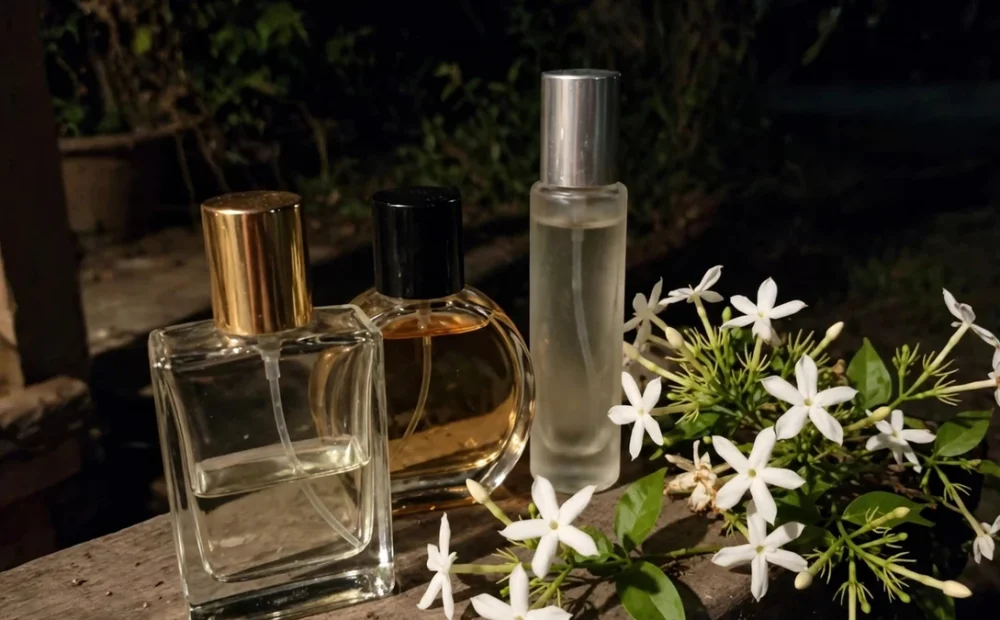
What Is a Frangipani Perfume 2027
A frangipani perfume is a fragrance built around the scent of plumeria, the tropical white flower of Plumeria rubra or Plumeria alba. It is not a perfume made from coconut, and it does not smell like suntan lotion. What it smells of is warm milk, white petals, and sweet almond, all at once, in a creamy, sunlit, slightly milky note.
The note is one of the most recognisable in perfumery, and also one of the least understood by name. It appears in everything from a $25 Zara bottle to a $295 Ormonde Jayne parfum, and in each it does a different job: sometimes it brightens the heart, sometimes it softens the base, sometimes it is barely there at all. The name on the pyramid changes too, from frangipani to plumeria to tropical flower, which is why two people can be wearing the same note and never know it.
This guide explains what frangipani is, where it comes from, how it reaches a bottle, and how to tell it from gardenia and tuberose.
Key takeaways
- A frangipani perfume is built around plumeria, Plumeria rubra or Plumeria alba, and it smells creamy, milky, and sun-warmed, with almond and coconut facets.
- The flower yields almost no oil, so the note usually arrives as an absolute or a rebuilt accord.
- Frangipani and plumeria are the same flower, while gardenia and tuberose are different white florals with heavier, greener smells.
- The flower was named after a 16th-century Italian nobleman whose scented gloves smelled of it.
- The note is warm and gentle on its own, but the chocolate, spice, and citrus notes around it are not always so.
What a frangipani perfume is, in plain terms
A frangipani perfume is any fragrance in which the scent of plumeria plays a named, deliberate part. That sounds wider than it is, because the note is seldom the star. It almost never leads a composition, and that quiet role is why perfumers keep it on hand: it brightens what is around it, softens what is underneath, and adds a creamy, sunlit glow that no other material can quite match.
The smell is simple to recognise once you have met it. Think of a white petal warmed by the sun, a glass of almond milk, and a breeze off a tropical sea. The creaminess is lighter than tuberose, and the sweetness softer than vanilla, with a faint coconut edge underneath that keeps the note from turning flat.
Our earlier guide to violet leaf perfume used the same plain style, and it fits this note too. A frangipani perfume is not a perfume that smells of coconut in any everyday sense. It is a perfume that borrows the flower’s warm, creamy character to lighten the rest of the composition.
How frangipani ends up in a bottle
The flower yields almost no oil, so the note usually arrives as an absolute or a rebuilt accord. A perfumer does not press frangipani petals and pour the result into a bottle. Instead, they use an absolute made from the blossoms, or they combine benzyl salicylate, linalool, and lactones to recreate what the flower smells like. That is why two frangipani perfumes can smell so different: one builds towards fruit and sunshine, another towards vanilla and woods.
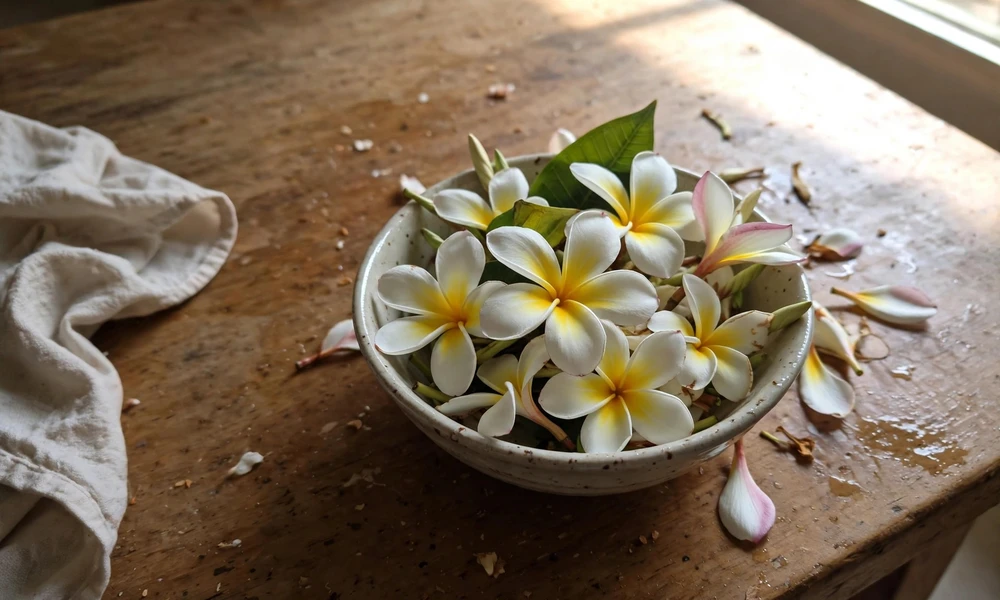
The absolute is then placed in the pyramid, usually in the middle. In the middle it gives the heart a creamy warmth that lasts for hours; in the base it holds the drydown together while the lighter notes evaporate. It is almost never placed at the top, because it is too warm to open a perfume, and a perfume that tried would lose the note entirely within minutes.
Placement matters more than strength. An eau de parfum with frangipani in the heart will carry it for most of the day, while a parfum with frangipani in the base will carry it into the night. That is why the same note can smell brief in one perfume and endless in another.
Nine facts about frangipani perfume
Frangipani is plumeria, a tropical flower in the dogbane family
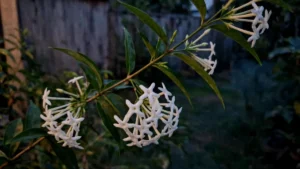
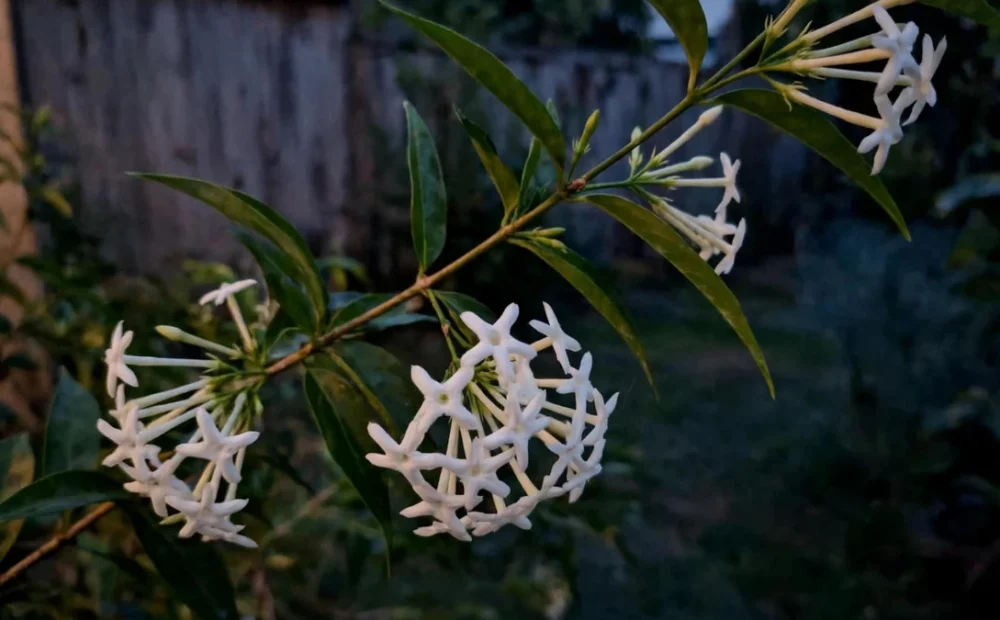
What it shows: Frangipani is what most people call plumeria, a tropical flowering plant in the dogbane family, Apocynaceae, with the species Plumeria rubra and Plumeria alba behind most perfumes. The flowers are white, pink, or yellow, with five petals and a yellow centre, and they grow on small trees that lose their leaves in the dry season and bloom on bare branches.
What to consider: The two names confuse buyers who have only met one of them. If a pyramid says “plumeria”, it means the same flower, and a perfume that lists it is a frangipani perfume under a different label. A pyramid that says only “tropical flower” is not naming it at all.
The flower was named after a nobleman who perfumed his gloves
What it shows: In the 16th century, the Italian nobleman Muzio Frangipani created a scented perfume for gloves, and the flower reminded people of that scent, so it took his name. The plant itself was later named plumeria after the French botanist Charles Plumier, who described it in the Caribbean. One flower, two names, both from the 16th and 17th centuries.
What to consider: The glove story is why the flower smells familiar even to people who have never seen it. The scent was famous before the flower was, and the name stuck because the two smelled alike. A perfume that names frangipani is borrowing a history that is five hundred years old.
Lactones give it the creamy coconut facet, not coconut itself
What it shows: The smell of frangipani comes from a blend of molecules, including benzyl benzoate, farnesol, linalool, geraniol, nerolidol, benzyl salicylate, and citral. The lactones give the creamy, coconut-like facet, the benzyl salicylate gives the solar floral warmth, and the jasmonic compounds give the opulent depth. No coconut is involved at all.
What to consider: The coconut facet misleads buyers who expect a beach scent. A frangipani perfume with no coconut in the pyramid will still smell faintly of coconut, because the flower itself carries that note. If you dislike coconut, test a frangipani perfume on skin before you buy it.
It belongs in the middle, never at the opening
What it shows: Frangipani is too warm and creamy to open a composition, so perfumers place it in the middle, where it can do its work and then stay. In the middle it gives the heart its sunlit warmth, and in the base it holds the drydown together while the lighter notes evaporate. It is almost never placed at the top.
What to consider: Do not expect frangipani to greet you in the first spray. If you love the note, choose a heart placement like Jo Malone Frangipani Flower over a base placement like Ormonde Jayne Frangipani, and give it ten minutes before you judge it.
Hawaii, Bali, and India all claim the flower as their own
What it shows: In Hawaii, plumeria leis welcome visitors and mark celebrations, and the white flower stands for new life. In Bali, the same flower is laid on temple offerings every day, and in India it is champa, the temple flower, offered to gods and worn in hair.
What to consider: The cultural weight is why the note feels calm and ceremonial rather than loud. A frangipani perfume carries that quietness with it, and it suits occasions where a louder floral would feel out of place. Our guide to sweet clover perfume makes the same point about notes that carry a history with them.
Fragrantica lists it as a main accord in seven well-known perfumes
What it shows: Fragrantica names plumeria as a main accord in Chanel Beige, Kenzo Amour, Givenchy Ange ou Demon Le Secret Elixir, Annick Goutal Songes, Giorgio Armani Sun di Gioia, Pierre Guillaume Seychelles, and Ormonde Jayne Frangipani, a list that spans designer classics, niche soliflores, and sun scents.
What to consider: A main accord is not the same as a named note. Some of these perfumes lead with frangipani, others bury it under jasmine or vanilla, so the note will smell louder in some than in others. If you want the flower itself, start with Ormonde Jayne Frangipani or Jo Malone Frangipani Flower, not with a perfume where it is one accord among many.
Coconut and peach brighten it, vanilla and sandalwood ground it
What it shows: The four pairings are the most common, and each one shows a different side of the note. Coconut deepens the tropical warmth, peach brightens it, vanilla softens it, and sandalwood dries it out. Zara Succulent Flower is the classic peach pairing, and Guerlain Terracotta Le Parfum is the classic vanilla pairing.
What to consider: The pairing is what decides who the perfume fits. A coconut pairing is warm and beachy, a peach pairing bright and fruity, a vanilla pairing soft and golden, a sandalwood pairing dry and woody. If you do not like the pairing, you will not like the perfume, even if the frangipani itself is beautiful.
Mainstream shelves skip it, but holiday perfumes lean on it
What it shows: Frangipani almost never appears in a department-store bestseller, but it turns up constantly in summer and holiday perfumes like Guerlain Terracotta Le Parfum and Estée Lauder Bronze Goddess. The note is too tropical, too creamy, and too quiet for a mass-market launch, but it is perfect for a scent that wants to smell like a holiday.
What to consider: The rarity is a strength, not a flaw. A frangipani perfume is unlikely to smell like anything else on the shelf, and it is unlikely to be discontinued for chasing a trend. But it is also harder to track down, and harder to try before you buy.
Skin chemistry keeps it creamy, but heat can turn it sweet
What it shows: Frangipani is a stable note on skin. On most people it stays creamy and sun-warmed, but in high heat it can turn sweeter than expected, like warm milk left too long, and on very dry skin it can fade faster than the pyramid promises. The change comes from the way the lactones interact with warmth and skin oils, and it is more common with this note than with most florals.
What to consider: Wear it on your own skin first, and wait a full day before deciding. A paper strip will not show the sweet turn, and a five-minute shop test will not show the fade. If it goes too sweet on you, try a drier pairing like Seychelles; if it fades, try a parfum strength like Ormonde Jayne Frangipani.
Frangipani vs gardenia vs tuberose
The three white florals cause most of the confusion around this note, so it is worth setting them out plainly. Frangipani is the creamy one, smelling of warm milk, white petals, and sweet almond, with a faint coconut edge. Gardenia is the heavier one, smelling narcotic, buttery, and almost mushroom-like, with a green, waxy depth. Tuberose is the greener one, smelling of white petals and camphor, with a sharp, almost medicinal edge underneath its sweetness.
The three materials do different jobs: frangipani lightens and warms, gardenia deepens and narcotises, and tuberose sharpens and greens. A perfume that names frangipani will smell sunny and creamy, while one that names gardenia will smell rich and heavy. A pyramid that says “tuberose” is using a flower that is louder and greener than either. Our guide to elderflower perfume makes a similar point about names that look alike but mean different things.
When you are unsure, check the rest of the pyramid: coconut, peach, vanilla, and sandalwood point at frangipani. Mushroom, butter, and green leaves point at gardenia, and camphor, green apple, and white musk point at tuberose. And if the pyramid says “plumeria”, it is definitely frangipani, not either of the others.
The caveats that matter
Frangipani is warm and gentle, but buying it well takes care: the name changes from pyramid to pyramid, the note is an absolute or a rebuilt accord rather than a pressed oil, and the scent can turn sweeter than expected in high heat.
| Detail | What is known |
|---|---|
| What it is | A fragrance built around plumeria, Plumeria rubra or Plumeria alba, smelling creamy, milky, and sun-warmed |
| What it is not | Not coconut, which is a separate note, and not gardenia or tuberose, which are heavier, greener white florals |
| How it is made | Usually captured as an absolute from the blossoms, or rebuilt as an accord, because the flower yields almost no oil |
| Where it sits | Heart in most perfumes; it seldom opens a composition |
| Best season | Spring and summer, when its sunlit warmth matches the weather |
| Who should sample first | Anyone who dislikes creamy, milky, or coconut-like notes should wear it for a full day before buying |
| Price range | $25–$30 at the low end, $280–$295 at the high end, for standard bottles |
| What it does not do | It does not make a perfume smell like a beach on its own, and it does not suit every skin chemistry |
If your skin reacts easily, test any new perfume on a small patch first and wait a day. The flower is gentle, but the chocolate, spice, and citrus notes beside it can irritate.
Checklist: telling a true frangipani perfume from the rest
Work through these before you buy.
- Look at the pyramid first: it should name the flower in full, not just “tropical flower” or “white floral”.
- Check the company it keeps: coconut, peach, vanilla, and sandalwood point at frangipani, while mushroom and butter point at gardenia.
- Spray it on your wrist, not a paper strip: warm skin changes how frangipani behaves, and paper hides that change.
- Wear it for a full day before you decide: a heart-note frangipani warms within the hour, while a base-note frangipani is still there at midnight.
- Compare two side by side before you buy one: a peach pairing against a vanilla pairing shows you which side of the note you like.
- If you are unsure, start with the smaller bottle: a 50 ml you finish is better than a 120 ml that sits untouched.
Frequently asked questions
Is frangipani the same as plumeria?
Yes. Frangipani is simply what most people call plumeria, the tropical flowering plant Plumeria rubra or Plumeria alba. A pyramid that says “plumeria” means the same flower, and a perfume that lists it is a frangipani perfume under a different label.
Why is frangipani so rare in mainstream perfumes?
The note is too tropical, too creamy, and too quiet for a mass-market launch. Summer and holiday perfumes use it because it smells like a holiday, but a bestseller needs a note that reads clearly on a first spray, and frangipani takes ten minutes to open.
Does frangipani last long on skin?
Usually a long time, because it lives in the heart or the base and lingers after the top notes fade. A base placement lasts longer than a heart placement, which is why Ormonde Jayne Frangipani carries the note further into the night.
Can frangipani turn too sweet on skin?
Yes, in high heat. The lactones can turn sweeter than expected, like warm milk left too long, depending on warmth and skin oils. A paper strip cannot reveal this, so wear it on skin and wait a full day before you buy.
What does plumeria mean on a pyramid?
It means frangipani. Plumeria is the flower’s botanical name, and a pyramid that lists “plumeria” or “plumeria absolute” is naming the flower itself. A pyramid that lists “tropical flower” is naming nothing in particular, and it will smell different from a true frangipani.
Is frangipani a summer scent only?
It suits spring and summer best, when its sunlit warmth feels natural, but the heavier pairings work in autumn too. A vanilla pairing like Terracotta Le Parfum carries the note into cooler weather better than a peach pairing like Succulent Flower.
The bottom line
A frangipani perfume is a fragrance built around plumeria, Plumeria rubra or Plumeria alba, and it smells creamy, milky, and sun-warmed, with almond and coconut facets. The note usually arrives as an absolute or a rebuilt accord, it sits in the heart, and it goes by two names, while gardenia and tuberose are different white florals.
Whatever you pick, make sure the pyramid names the flower in full, wear it on skin for a full day, and judge it by how the creamy note deepens over hours, not by the first minute. That is how you find one you will actually wear to the end.