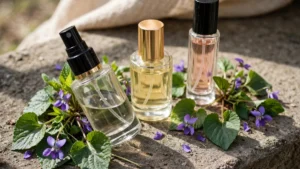
Violet leaf is one of the oldest green notes in perfumery, and one of the least understood. It comes from the leaves of the sweet violet, Viola odorata, the same plant that gives the powdery violet flower, yet it smells nothing like the flower. Crushed between your fingers, a violet leaf smells of cucumber, cut grass, and damp earth, with a faint metallic shine. That smell, bottled as an absolute, has shaped men’s cologne for more than a century.
The note’s power is its freshness. A small amount of violet leaf absolute can cool a heavy leather, lift a dull wood, or stop a sweet floral from turning cloying. It is the green edge in Dior Fahrenheit, the clean lift in Creed Green Irish Tweed, and the quiet polish in dozens of office colognes. It rarely takes centre stage, and that is exactly why perfumers reach for it.
This guide explains what violet leaf is, where it comes from, how it ends up in a bottle, and how to tell it apart from the violet flower and from iris, its closest neighbour. Nine facts cover the plant, the molecules, the history, and the wearing, with the caveats that matter.
Key takeaways
- Violet leaf is a green, watery, slightly metallic note from the leaves of Viola odorata, and it smells nothing like the sweet violet flower.
- It usually sits in the top or the heart, where it cools down leather, woods, and sweet accords.
- The molecules behind it, the ionones, tire the nose quickly, so the note seems to fade in and out.
- Fahrenheit made it famous in 1988, and it still defines the green side of men’s perfumery.
- A pyramid that says “violet” does not always mean violet leaf, and the note is used in tiny doses, so check the full name before you buy.
What violet leaf is, and where it comes from
Violet leaf is the smell of the leaves of Viola odorata, the sweet violet, a low, shade-loving plant that grows across Europe and the Mediterranean. The flowers are picked for their powdery sweetness, and the leaves are picked separately, usually in spring, for a very different material: a dark green absolute that smells of cucumber, grass, and wet earth.
The absolute is made by washing the leaves in a solvent, then removing the solvent to leave a thick, dark concentrate. A small amount goes a long way, because the material is strong and the dose in a finished perfume is usually well under one percent. That low dose is why the note is so hard to pin down: always present, never loud.
Most violet leaf absolute comes from Egypt, where the leaves are grown and processed, and from the hills around Grasse in southern France, where the town of Tourrettes-sur-Loup has a long history with the material. The French absolute is often described as the finer of the two, greener and more refined, while the Egyptian material is earthier and more robust.
How violet leaf ends up in a perfume bottle
The journey starts with the harvest, when the leaves are cut and taken to the extraction plant within hours, before the green smell fades. The leaves are washed in a solvent that pulls out the fragrant compounds, and the solvent is evaporated away, leaving a waxy concrete. That concrete is washed again with alcohol, and the alcohol is removed to leave the absolute: a dark green, almost black liquid that smells intensely of cucumber and cut stems.

Once the absolute exists, the perfumer decides where it sits. In most compositions, violet leaf goes into the top or the heart, where its green freshness can open the scent or bridge the bright top and the dark base. It is rarely a base note, because its molecules are light and evaporate quickly. A related green note, hyssop, is made in a similar way, and comparing the two is a useful way to understand how green notes are built.
The final step is dilution. Because the absolute is so strong, it is diluted to a fraction of a percent before it joins a blend, and the perfumer tests the result on skin over days, not minutes. A little too much, and the perfume smells like a salad; a little too little, and the green disappears entirely.
Nine facts about violet leaf in perfume
One plant, two materials: the leaf smells green, the flower smells sweet
What it shows: Viola odorata gives two materials: the flower, which smells sweet, powdery, and a little like raspberry, and the leaf, which smells green, watery, and slightly metallic. The flower is picked for its softness, the leaf for its freshness, and the two are extracted separately, at different times of the year.
What to consider: Because they share a plant, retailers and even some pyramids use “violet” for both. If the note you want is the green one, look for “violet leaf” in full, and be suspicious of any listing that says only “violet”.
The absolute is made in Egypt and in the hills around Grasse
What it shows: Most violet leaf absolute is produced in Egypt, where the leaves grow in large fields and are processed close to the harvest. A smaller, more expensive quantity comes from the hills around Grasse in southern France, where the town of Tourrettes-sur-Loup has worked with the material for generations.
What to consider: The origin changes the smell: the French absolute is usually greener and more refined, the Egyptian earthier and more robust. A perfume rarely tells you which one it uses, so the only way to know is to smell the finished scent.
The green, metallic character comes from a family of molecules called ionones
What it shows: The green, metallic character comes largely from a family of molecules called ionones, which also give iris and violet flower their powdery character. In the leaf, the ionones sit beside green, cucumber-like compounds, and that combination makes the note smell both floral and freshly cut at once.
What to consider: Ionones are also why the note seems to vanish. They fatigue the nose quickly, so a violet leaf perfume can smell strong, then nothing, then strong again within the same hour. It is not the perfume fading; it is your nose resting.
Some people cannot smell violet leaf at all
What it shows: A small number of people are partly or fully anosmic to the ionones, which means they smell almost nothing of the note, even where it is prominent. For them, a violet leaf perfume smells like its other notes only: the woods, the leather, or the musk, with no green edge at all.
What to consider: If a violet leaf perfume smells flat or empty to you, you may be one of them. Ask someone else to smell it on your skin before you decide it is a bad perfume. The note may be there, and your nose may simply be skipping it.
Violet leaf rarely anchors a base, so it lives in the opening or the middle
What it shows: Violet leaf is a light, volatile material, so perfumers place it in the top or the heart, where it can open the scent or carry the middle hours. As a top note, it is strongest in the first minutes; as a heart note, it stays noticeable for several hours before the woods and musk of the base take over.
What to consider: Because it never anchors the base, a violet leaf perfume changes more over the day than a woody or ambery one. The green you smell in the shop is not the green you will smell at dinner, and that change is normal, not a flaw.
Perfumers use it to cool down leather, woods, and sweet notes
What it shows: The most common job of violet leaf in a formula is temperature control. Added to a warm leather, it makes the leather feel lighter; added to a sweet floral, it stops the sweetness from turning heavy; added to a dry wood, it gives the wood a fresh, outdoor character. It is a seasoning, not a main ingredient.
What to consider: That is why the note is easy to miss. In many perfumes, violet leaf works in the background, and you would only notice it if it were removed. If a leather perfume smells surprisingly fresh, or a woody perfume surprisingly clean, violet leaf is often the reason.
Fahrenheit made it famous in 1988, and Green Irish Tweed made it clean
What it shows: Dior Fahrenheit, launched in 1988, is the most famous violet leaf perfume ever made. Its heart of violet leaf, nutmeg, and honeysuckle over leather and vetiver gave the note its cult reputation, and it is still the reference for the green, leathery style. Creed Green Irish Tweed, from 1985, showed the other side: violet leaf with verbena and iris, clean, grassy, and endlessly wearable.
What to consider: Both are worth smelling even if you never buy them, because together they define the two poles of the note: Fahrenheit is violet leaf turned dark and leathery, Green Irish Tweed is violet leaf turned bright and clean. Every violet leaf perfume since sits between them.
Violet leaf and cucumber share the same green, watery character
What it shows: The cucumber smell in violet leaf is not an accident. Leaf and cucumber share some of the same green, watery aroma compounds, which is why the note reads as cool and fresh rather than herbal or medicinal. It is also why violet leaf pairs so well with aquatic and citrus notes, which share the same watery character.
What to consider: That watery quality is also a limit. In a heavy, sweet, or very warm composition, the cucumber character can smell thin or out of place, which is why violet leaf appears most often in fresh, woody, and leathery scents, rarely in gourmands.
A little goes a long way, and most formulas use less than one percent
What it shows: Violet leaf absolute is one of the strongest materials in the perfumer’s palette, used in tiny doses, usually well under one percent of a finished perfume. At that level it adds freshness and lift; at higher levels it turns harsh, green, and almost metallic, and it crowds out the other notes.
What to consider: The low dose is why the note is hard to learn. You cannot smell violet leaf absolute on its own and expect to recognise it in a perfume, because in a perfume it is always diluted and always blended. Learn it from finished perfumes instead, starting with the clearest examples: Touch for Men for the classic, EGE AIGAIO for the modern.
Violet leaf, violet flower, and iris: telling them apart
The three notes are cousins, and they are confused constantly. Violet flower, from the same plant as the leaf, is sweet, powdery, and a little like raspberry and old lipstick. It sits in the heart and gives a perfume a soft, vintage character. Violet leaf is green, watery, and slightly metallic, and it gives a perfume a fresh, outdoor lift. Iris is powdery too, but colder and more buttery, with a rooty, earthy depth that neither violet note has.
The practical test is simple. Smell the perfume on skin after an hour. If the powdery note is still there and smells sweet, it is probably the flower. If the powder has turned green and fresh, it is probably the leaf. If the powder smells cold, buttery, and a little like raw carrot, it is probably iris. A related green note, mugwort, is greener and more bitter than any of the three, and it is a useful comparison.
On a pyramid, trust only the full name. “Violet” on its own usually means the flower, “violet leaf” means the leaf, and “iris” means iris, though some pyramids say “orris”, the root of the same plant. If a listing is vague, check a second source before you buy.
The caveats that matter
| Detail | What is known |
|---|---|
| What “violet” means on a pyramid | The word alone usually means the flower; the leaf is confirmed only when the pyramid says “violet leaf” in full |
| Where the note usually sits | Usually the top or the heart; by evening, the woods and musk have taken over |
| Anosmia | Some people cannot smell the ionones at all, and the note seems to vanish for everyone at times |
| Best season | Spring and summer suit it best; the lighter perfumes work in heat, the warmer ones in autumn |
| Who should sample first | Anyone who dislikes green or metallic smells should sample the lightest picks first |
| Price range in this guide’s roundup | $32–$42 at the low end, $180–$195 at the high end, for standard 100 ml bottles |
| Discontinued risk | Older classics like Touch for Men are the most likely to become harder to find |
| What it does not do | It cannot fix a short-lived perfume on its own, and it will not suit every nose |
If you are trying a new perfume for the first time, spray it on the inside of your wrist and leave it alone for a full day. The green note changes as it dries down, and the version you smell at noon is the one that matters.
Checklist: smelling a violet leaf perfume honestly
Use these checks before you buy, and again after a full day of wear.
- Read the pyramid twice: the words “violet leaf” must appear in full, not just “violet”.
- Smell it on your wrist, not on paper: the note behaves differently on warm skin.
- Give it six hours: a top-note leaf is gone within the hour, a heart-note leaf is still there at lunch.
- Compare it with a violet flower perfume: the difference between the leaf and the flower is the lesson.
- Ask someone else to smell it: if the green has vanished for you, it may still be there for them.
- Start with a sample or the smallest bottle: a violet leaf perfume you never wear is money in a drawer.
Frequently asked questions
How would you describe the smell of violet leaf?
Green, watery, and slightly metallic, like cucumber skin or a leaf crushed between your fingers, with a damp, earthy undertone. It is not sweet, it is not soft, and it smells nothing like the powdery violet flower.
Is violet leaf the same as the violet flower?
No. They come from the same plant, Viola odorata, but the flower is sweet and powdery while the leaf is green and watery. A pyramid that says “violet” usually means the flower; only “violet leaf” means the leaf.
Why does my violet leaf perfume seem to disappear?
The ionones behind the note tire your nose quickly, so the green fades in and out as you wear it. Someone standing next to you can usually still smell it. Wait an hour and ask a friend before you spray again.
Does violet leaf oil need diluting before it touches skin?
Yes. Violet leaf absolute is far too strong to use neat, and it should only ever be worn as part of a finished perfume, where it is diluted to well under one percent. Never put the absolute directly on your skin.
Why do so many men’s colognes use violet leaf?
Because it makes a warm, sweet, or leathery composition smell lighter and cleaner without adding sweetness. It is the cold edge in the classic fresh woody style, and it has defined that style since Fahrenheit in 1988.
Can I grow violet leaf at home for perfume?
You can grow sweet violets in a shaded bed, and the leaves smell green and cucumber-like when crushed. Making the absolute at home is a different matter: it needs solvent extraction, and it is not a kitchen project. Buy the finished perfume instead. A related green note, wormwood, is easier to grow and just as bitter-green.
The bottom line
Violet leaf is a small note with an outsized job: it cools, freshens, and polishes almost any composition it touches, from a thirty-dollar Azzaro to a niche extrait. It is also a note that rewards patience, because it fades in and out on the nose and changes more over the day than almost any other green material.
If you want to learn it, start with the clearest examples: Touch for Men for the classic, Chrome United for the budget, and EGE AIGAIO for the modern. Check that the pyramid says “violet leaf” in full, wear it for a whole day, and judge it by the green you smell at noon, not the green you smell in the first minute.