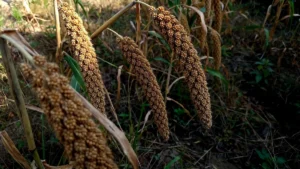
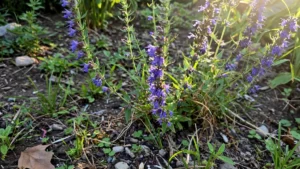
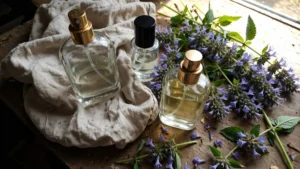
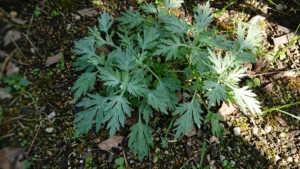
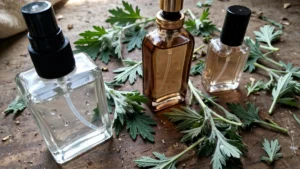
Mugwort is the green herb behind moxibustion and yomogi rice cakes, and in a bottle it smells like that history: herbal, green, and quietly bitter. The plant is Artemisia vulgaris, a roadside herb that grows wild across Europe and Asia, and its name on a note list, or its French name armoise, is one of the rarer sights in modern perfumery.
Its scarcity has a cause. The oil is green, camphoraceous and closely watched by regulators, so most houses pick simpler green materials instead. When it does appear, the dose is small, at the top or in the heart, and it lends a herbal lift that makes everything around it smell fresher and older at the same time.
This guide walks through the plant, the oil, and the names it hides behind, so you can spot a real mugwort perfume and know what to expect from the first spray.
Key takeaways
- Mugwort is Artemisia vulgaris, the roadside herb behind moxibustion, and its French name on a note list is armoise.
- The note smells green and herbal, softer than wormwood, with a camphor warmth and a dusty, almost sweet edge.
- Perfumers dose it lightly, usually at the top or in the heart, where it freshens the blend without taking it over.
- When a note list says armoise, it is naming mugwort in French, and the herb is in the bottle.
- Only a day of wear settles it, because the same mugwort bottle can smell calm on one person and sharp on another.
What mugwort is, and where it comes from
Mugwort is Artemisia vulgaris, a perennial of the daisy family that grows wild on roadsides, riverbanks and waste ground through Europe and Asia, and now grows wild in North America too. The leaves and flowering tops hold the smell, and it is green from the first touch. The leaves are dark green on top and pale silver underneath, and they release their smell when crushed.
The herb’s history is medicinal before it is perfumed. In China, Japan and Korea, dried mugwort is burned in moxibustion, a warming treatment laid on the skin, and the same plant is eaten as yomogi mochi in Japan and ssuk-tteok in Korea.
In perfume, mugwort is the herb behind armoise, and the two names are used almost interchangeably on note lists. Tansy is the nearest comparison in our library: our guide to what a tansy perfume is covers another bitter daisy-family herb with the same thujone chemistry, and the two make a useful pair to smell side by side.
How mugwort ends up in a perfume bottle
It reaches a bottle through steam distillation of the leaves and flowering tops, which gives a dark green oil that smells strongly herbal. Perfumers measure it out in drops rather than in pours.
Once it is blended, mugwort usually settles at the top or in the heart. It is too green and too restless to anchor a base, and its herbal edge is not the warm sweetness that carries a drydown. It works near the opening instead, lifting citrus, freshening lavender, and giving woods a green backbone before it fades. It also steadies the blend, keeping bright citrus from turning sharp and sweet florals from turning heavy.
Thujone in the oil is capped by regulators, so the dose stays tiny by law as well as by taste. That is one more reason the note so rarely leads a bottle.

Nine facts about mugwort in perfume
Moxibustion is built on dried mugwort
Moxibustion, the warming treatment of traditional East Asian medicine, is built on dried mugwort. The herb is rolled into sticks or cones, lit, and held near the skin, and the slow, smoky heat is the treatment. When a perfume lists mugwort, it is naming this same plant in a different form.
What it shows: The medicinal past explains why the note can smell clinical to some wearers. What to consider: The smoky association belongs to the burning herb, not to the oil, so a mugwort perfume rarely smells of smoke.
Armoise is mugwort in French
Perfumers use armoise as shorthand for mugwort on a note pyramid. French houses use the French name because it sounds better than the English one, and because it tells the wearer what to expect: green, herbal, a little bitter. Serge Lutens built the most famous armoise perfume, L’Eau d’Armoise, around the word itself, and the practice is common enough that a note list can say armoise without ever saying mugwort, and the two words mean the same ingredient in practice.
What it shows: Knowing the French word lets you read note lists that never say mugwort at all. What to consider: Artemisia alone, with no species named, could be any cousin, so the scent is not pinned down.
The first sniff is herbal green with a soft bitter edge
The first thing you smell in mugwort oil is green, a dry herbal green with a camphor coolness underneath, not the soft green of cut grass and not the sweet green of basil. There is a dusty softness, a faint sweetness, and nothing sharp enough to sting. That gentleness is what makes mugwort useful: it freshens a composition the way an open window freshens a room.
What it shows: That soft bitterness is what marks mugwort out from sharper green herbs. What to consider: If you dislike herbal smells, mugwort will not win you over with time, because the herbal character is the note, not a phase.
Mugwort is food as well as medicine in East Asia
Mugwort has been eaten for centuries across East Asia. In Japan it flavours yomogi mochi, the green rice cakes of spring; in Korea it goes into ssuk-tteok and ssuk soup; in China it is brewed as ai ye tea. The taste is bitter and herbal, which is why it is used in small amounts, folded into dough or brewed, rather than eaten plain.
What it shows: The long food history is why the note reads as familiar rather than strange. What to consider: Food use does not mean the concentrated oil is safe undiluted on skin, so a patch test still matters.
Mugwort has famous cousins in the Artemisia family
Mugwort is one of more than four hundred species in the genus Artemisia, and its relatives turn up in perfume under their own names. Wormwood is Artemisia absinthium, tarragon is Artemisia dracunculus, and southernwood is Artemisia abrotanum, while sweet wormwood, Artemisia annua, is the source of artemisinin, the antimalarial drug. They share a bitter-green character yet smell distinct, and a list that names artemisia without a species is naming the genus, not the plant.
What it shows: The shared bloodline is why mugwort sits happily beside tarragon and wormwood in a blend. What to consider: Without a species named, the list could point at any cousin, so the smell stays uncertain.
The thujone question matters less than the legend suggests
Mugwort oil contains thujone, the same compound that gave wormwood its dangerous reputation, but in smaller amounts. In the nineteenth century, heavy absinthe drinkers developed tremors and hallucinations, and thujone took the blame, though later work points at the alcohol itself as the main culprit. Perfumery caps thujone in finished products, and the dose in a bottle is a fraction of what the old drinkers consumed, so the scare does not carry over to a perfume.
What it shows: The dangerous reputation belongs mostly to wormwood and to the drink, not to mugwort. What to consider: The oil in a finished bottle is a fraction of a fraction, and its thujone is capped, so the old scare stays in the history books.
A little mugwort goes a long way in a blend
Few perfumers build a scent around mugwort. The note is too green and too restless to carry a composition on its own, and it works best as a lifting agent: a small dose at the top or in the heart that makes the citrus smell brighter, the lavender smell greener, and the woods smell drier. The perfumes that list it most often are fresh, herbal or aromatic compositions where the green reads as freshness rather than as medicine.
What it shows: Mugwort’s job in a blend is to lift, not to lead. What to consider: Top billing on the pyramid does not mean the herb leads the wear; florals and woods can still bury it.
The drydown tells a different story from the opening
The opening is where mugwort is greenest, and the herbal edge eases as the perfume dries down. The camphor coolness fades first, leaving a dry, slightly dusty warmth that sits close to the skin, and by the late drydown the mugwort has often disappeared into the woods and musks underneath it. That arc is why a mugwort perfume can smell sharp on a paper strip and quietly calm an hour later.
What it shows: The softening is the note’s own arc, not a sign of a weak perfume. What to consider: Judge it after an hour of wear, not after the first spray, or it will seem harsher than it is.
Citrus and lavender bring out mugwort’s best side
The brightest materials suit mugwort best: bergamot and mandarin, lavender and sage, cedar and vetiver. The citrus gives the green something sparkling to lean against, the lavender turns it into a calm herbal chord, and the woods keep it from fading too fast. Sweet notes fight it. Vanilla and tonka can make mugwort smell medicinal, and heavy gourmand bases can bury it entirely, so the best mugwort perfumes stay in the fresh half of the palette.
What it shows: Mugwort earns its place in the fresh half of the palette, which is why most mugwort perfumes are herbal or aromatic. What to consider: Sweet gourmand bases pull against the herb, so a mugwort perfume built on one is a gamble.
Mugwort, wormwood, and armoise: telling them apart
Wormwood is the nearest of the three. Same genus, some of the same bitter chemistry, but a drier smell: camphor and green herbs with a smoky edge and no softness underneath, where mugwort stays greener and gentler.
The French name causes the confusion: armoise is mugwort, not a separate ingredient, and our roundup of the best wormwood perfumes of 2027 shows what the sharper cousin smells like when it leads a bottle. Green and bitter with a sweet liquorice edge means anise is doing the talking; dry and herbal with no sweetness at all means wormwood is. Mugwort, by contrast, keeps a dusty softness even at full strength.
Tansy is the third herb in this family portrait, and the harshest of the three. It shares the thujone chemistry and the dry herbal character, but it has none of mugwort’s softness, which is why it almost never appears in a modern bottle. If a green herbal perfume smells acrid rather than calm, tansy is the likelier suspect; mugwort, by contrast, stays gentle even when it is dosed generously.
The caveats that matter
A note list tells you little about what a mugwort perfume will actually smell like. Dose, placement and skin behaviour are all missing, so it cannot say how much mugwort is inside, whether the herb leads or hides, or how the herbal edge will read on you. Wearers split into two camps over this note, a fresh green lift for some and a clinical herbal smell for others, and the split shows only after a day of wear. Chervil raises the same questions, so our guide to what a chervil perfume is is worth reading beside this one.
| Detail | What is known |
|---|---|
| What mugwort is | Artemisia vulgaris, a green herbal plant in the daisy family |
| The key molecules | Thujone, camphor, 1,8-cineole and borneol |
| Where it usually sits | Top or heart note in most perfumes, rarely in the base |
| How long it lasts | The green herbal edge fades within two hours |
| How it differs from wormwood | Softer and less bitter, with a dusty sweetness instead of a smoky edge |
| How it differs from armoise | No difference at all — armoise is simply French for mugwort |
| What it pairs with | Lavender, sage, cedar, citrus, iris and green tea |
| How to test it | A single spray on the wrist, worn from morning to night, tells you more than any note list |
Checklist: smelling a mugwort perfume honestly
- Look for mugwort or armoise in the printed note pyramid, and ignore adverts that name the herb without listing it.
- Check the pyramid position first: top means a quick green flash, heart means the herb shapes the middle of the wear.
- Wear a single spray for a full day before deciding anything, because the first hour is the greenest hour.
- Smell it next to a wormwood perfume; the pair teaches the difference faster than any description.
- Test it in warm weather and in cool weather; heat brings the camphor forward and can turn the green medicinal.
- Start with the smallest bottle on offer; a herbal note you dislike is a bottle you will never finish.
Frequently asked questions
How would you describe mugwort to someone who has never smelled it?
Green and herbal, like crushed leaves after rain, with a camphor coolness and a dusty softness underneath. It is less bitter than wormwood and less sweet than basil, and it smells more like a garden than like a flower shop. The closest everyday comparison is a handful of dried herbs from a kitchen cupboard, sage and a little camphor, without any sweetness.
If a note list says armoise, is that really mugwort?
Yes. Armoise is the French name for mugwort, the plant Artemisia vulgaris, and a note list that says armoise is naming that plant. The one caveat is a list that says only artemisia, without a species or a French name, because that could be any of the four hundred species in the genus, from wormwood to tarragon. Armoise itself, though, means mugwort.
Why is mugwort so rare on note lists?
The oil is fiddly to dose, the note divides wearers, and regulators cap its thujone content, so most houses pick easier green notes instead. Mugwort is also unfashionable: green herbal notes sell slowly beside florals and gourmands, and a note that smells like a herb garden is a harder pitch than one that smells like a flower. The few houses that use it tend to be niche or artisanal.
Is mugwort perfume safe if ragweed sets me off?
Be cautious, because mugwort belongs to the daisy family, which includes ragweed and chamomile, and cross-sensitivity between them is common. A patch test on the inner arm is wise before a first full wear, and anyone with a known daisy-family allergy should ask a clinician before wearing a mugwort perfume regularly. The risk is real but manageable with a test.
Why does a mugwort perfume change so much by midday?
Because the green herbal edge lives mostly in the top and heart notes, which fade first. By lunchtime the mugwort has usually stepped back and the woods, musk or amber underneath have taken over. That arc is normal for this note, and it is why a mugwort perfume can smell bright and herbal on first spray and warm and woody by the afternoon.
What should I put under a mugwort perfume?
A plain, unscented moisturiser, which lets the herbal green show without competition. A lavender or vetiver base underneath works too, because both flatter mugwort rather than fighting it. Avoid sweet gourmand lotions, which bury the herb, and avoid spraying over another strong perfume, which turns the green medicinal.
The bottom line
Mugwort is a note for wearers who like their green scents soft rather than sharp: a roadside herb with a medicine cabinet past, a French alias, and a smell that rewards patience. Few named notes are this scarce, and the scarcity is half the appeal.
Give it one full day on skin and let the drydown make the call. If the green settles into a calm you keep reaching for, mugwort earns a place on your shelf; if it still smells clinical by evening, it never will.