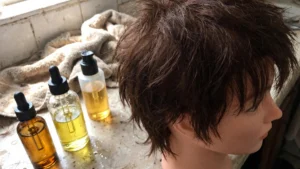

A wolf cut is a short, choppy crown over a long, wispy back, and it shows everything. The top layers are cut to stand up and move, the back falls thin and dry, and there is no spare length to hide a heavy hand behind. Oil suits this cut because it seals the wispy ends and calms the frizz on the layers, without any of the hold or stiffness of a styling product.
The same bottle can also wreck a wolf cut in under a minute. The wrong amount, the wrong place, or the wrong moment is enough, and on a cut this layered everyone in the room can see the result, not just you.
What follows is the full method, in order: the wash, the dose, the placement, the layers, and the mistakes that matter most at each point.
Key takeaways
- Begin on freshly washed hair, towel-dried until damp, with two drops spread across both palms.
- Oil goes on the mid-lengths first, then the ends; the roots and the crown stay completely dry.
- Separate the layers with your fingers, never a comb, so the wolf cut keeps its choppy texture.
- Hands off once the oil is in: the layers set as they dry, and every touch flattens them.
- No amount of oil fixes a wolf cut that has grown out; more oil on a shapeless cut only weighs it down further.
What a wolf cut is and why oil changes it
A wolf cut mixes two haircuts on one head. The top is a shag, with short layers cut to lift and move, and the back is a mullet, with longer, thinner length that dries out first. The cut lives or dies on the contrast between the two: a full, textured crown and a soft, wispy back.
Oil behaves differently on each half. On the crown it is a risk, because the short layers are light and a single drop too many pulls them flat. On the back it is a rescue, because the longer length is the oldest hair on the head and the driest by a clear margin. The method below treats the two halves differently on purpose, giving the back most of the oil and the crown almost none.
The usual error is copying a long-hair routine onto a layered cut. Long hair soaks oil up along its length and hides the excess; a wolf cut has short layers on top that show every drop, and a thin back that drinks oil fast.
How to choose the right oil for your wolf cut
The hair decides, not the price tag. A fine wolf cut goes flat within an hour under anything heavier than a light oil or a thin serum, while a thick wolf cut is happy with a medium to rich oil in two drops.

Test the texture in the shop if you can. A drop rubbed between two fingers should vanish within seconds; anything that stays sticky will sit on the top layers instead of sinking in. The shag guide runs the same test for a layered style, and the pixie guide shows what changes when the cut is shorter still.
Smell matters on a wolf cut, because the hair frames the face and the back length rests near the nose. A strong scent stays with you all day, so choose one you like or pick a fragrance-free bottle.
How to use hair oil on a wolf cut, step by step
Shampoo first, then squeeze the water out with a towel
What to do: Wash the wolf cut as usual, then press a towel around it and squeeze gently until the hair feels cool and damp, with no water dripping from the back length. What to avoid: Oiling hair that is still dripping, which rinses the oil straight off, or hair that has not been washed, which traps the day’s grease underneath. Best For: Any wolf cut on wash day. Time Needed: Roughly two minutes with a towel. Standout Tip: A towel that is still dripping wet means the hair is not ready.
Wet hair pushes oil away, dry hair catches it in patches, and damp hair lets it slide across the layers. A minute after towelling is the window, and it closes fast on a layered cut.
Spread the dose across both palms until it disappears
What to do: Place two drops in the centre of one palm and press the other palm over it, rubbing slowly until the oil feels thin and warm and you can barely see it. What to avoid: Tipping the bottle over the hair, which drops the oil in one place and leaves a dark patch on the top layer. Best For: Fine and medium wolf cuts, where a spare drop shows. Time Needed: Ten seconds of rubbing. Standout Tip: If your palms still shine after rubbing, the dose is too big.
Straight from the bottle the oil is thick and stays where it lands; once it is warm between the palms it thins and travels, so a single pass of the hands can cover the whole mid-length.
Glide oiled palms down the shaggy mid-lengths
What to do: Glide both palms down from ear level to the ends, covering the mid-lengths, and let the last of the oil reach the back length on the final pass. What to avoid: Starting at the tips, where the oil collects and leaves the ends looking damp for hours. Best For: Wolf cuts whose mid-lengths frizz. Time Needed: Half a minute. Standout Tip: Damp-looking is correct; glossy means too much.
That section deserves the oil first; the tips need only what is left on your palms, and that leftover amount is almost always right.
Seal each wispy tip between thumb and forefinger
What to do: Take the wispy tips a few at a time between thumb and forefinger and press them gently, working along the back length from one side to the other. What to avoid: Raking your fingers through the ends, which separates them and makes the wispy finish look ragged. Best For: Wolf cuts with dry, splitting ends. Time Needed: Twenty seconds. Standout Tip: The tips should feel smooth and cool, not sticky.
The wispy tips are the signature of a wolf cut, and they split faster than any other part of the cut. Pressing them between oiled fingers seals them together just enough to hold the shape, without gluing them into a solid sheet.
Ruffle the top of the cut to bring back its height
What to do: Slide your fingertips into the crown layers and ruffle them upward, lifting the top of the cut away from the head so the height comes back. What to avoid: Smoothing the crown flat with oiled hands, which drags oil toward the roots and kills the lift. Best For: Wolf cuts whose crown goes flat after oiling. Time Needed: Ten seconds of ruffling. Standout Tip: Use dry fingertips for this step, never oiled ones.
The crown is the first thing anyone sees, and it is also the part that oil threatens most. A quick ruffle with dry fingers lifts the layers back up, and the height stays because no oil went near the roots.
Pull the choppy pieces apart with bare hands
What to do: Take the choppy layers a few at a time and pull them gently apart with bare hands, so each piece sits separately instead of clumping together. What to avoid: Using a brush or a comb, which pulls the layers into one smooth sheet and erases the choppy texture. Best For: Wolf cuts that clump together after oiling. Time Needed: Twenty seconds. Standout Tip: Fewer, bigger pieces look better than many tiny ones.
A wolf cut is meant to look piecey, and oil wants to glue the pieces together. Pulling them apart by hand restores the separation, and because your hands are only slightly oiled by now, the pieces stay soft instead of sticky.
Use a second mirror to see the back layers
What to do: Hold a hand mirror behind your head and check the back of the wolf cut in the bathroom mirror, looking for an even coat across the back length. What to avoid: Trusting the front view alone, because the back of a wolf cut is where missed patches and heavy spots hide. Best For: Anyone oiling a wolf cut without help. Time Needed: Twenty seconds. Standout Tip: The back should look one even shade; a darker patch means too much oil landed in one place.
You cannot see the back of your own wolf cut, which is why it goes wrong most often there. A quick look with a hand mirror shows whether the oil reached the back layers or collected on one side, and it takes under half a minute.
Do nothing at all while the cut air-dries
What to do: Once the oil is in, leave the hair completely alone and let it dry in the air at its own pace. What to avoid: Running your fingers through the layers while they dry, which pulls the choppy pieces apart and pushes oil toward the crown. Best For: Wolf cuts with a natural bend or wave. Time Needed: However long the cut takes to dry. Standout Tip: If the layers feel stiff while drying, the oil was too heavy, not too much.
A wolf cut takes its shape as it dries, and every touch during that time changes it. Touching the hair flattens the crown, separates the ends, and pushes oil upward, so doing nothing after oiling is the best choice.
Step into daylight and look at the layers from the side
What to do: Wait five minutes, then step to a window and look at the wolf cut in daylight, front and side, before reaching for the bottle again. What to avoid: Deciding under bathroom lights, which are warm and dim and make every wolf cut look drier than it is. Best For: Anyone tempted to add a second drop out of habit. Time Needed: Five minutes of waiting. Standout Tip: If it looks smooth and shiny in daylight, you are done; if it looks dull, add one more drop to the ends only.
Warm indoor light is kind to everything and hides grease, so it judges badly. Daylight tells the truth: a dry patch looks dry and a greasy patch looks greasy. A wolf cut that passes the daylight test needs nothing more.
Which method fits your wolf cut length
A short wolf cut forgives the least of the three lengths. Two drops is the limit, and the crown decides everything, because there is almost no hair below it to soak up a mistake. If a short wolf cut looks greasy, the oil has almost certainly crept too high.
A medium wolf cut leaves the most room for error. Two drops is the usual amount, and the second one goes on the back length, the oldest and driest hair on the cut. The middle length is the easiest to live with, because the crown still has room to move and the back is long enough to take oil without showing it.
A long wolf cut, past the shoulders, drinks up the most oil of the three, and it also punishes a mistake the fastest. Its back length can take two drops by itself, while the crown stays as off-limits as on a short cut.
The caveats that matter
Heat can turn a good oiling into a bad one faster than anything else. A hot dryer on oiled hair bakes the oil onto the surface and leaves the layers feeling stiff and coated, so if you must blow-dry, use the lowest heat and a nozzle, and keep the dryer moving. Air-drying is the safer choice on a wolf cut, because the layers settle into their natural shape instead of being pushed around.
| Detail | What is known |
|---|---|
| How much a wolf cut takes | Two drops for most wolf cuts, one for fine hair, spread across both palms first |
| The right moment | On freshly washed hair, towel-dried until it is just damp, before it dries out |
| Where the oil goes | The mid-lengths first, then the ends, never the roots or the crown |
| The best tool | Your hands for spreading it, your fingers for separating the layers, nothing else |
| The crown rule | Ruffle the top layers upward after oiling so they keep their height |
| When to stop touching it | After the layers are separated, leave the hair alone until it is fully dry |
| How often to oil | Most wolf cuts do well with oil two or three times a week, tied to wash days |
| What oil cannot do | It cannot bring back the choppy texture, restore lost lift, or replace a fresh cut |
Checklist: oiling a wolf cut without flattening it
Work down this list each time you oil, until you no longer need to think about it.
- Check that the hair is damp, not dripping, before any oil touches it.
- Count the dose: two drops for most wolf cuts, one for fine hair, spread across both palms.
- Place it low: mid-lengths first, ends second, roots never.
- Separate the layers with your fingers, and put the comb away.
- Ruffle the crown upward after oiling so the top layers keep their height.
- Judge the result in daylight before deciding the wolf cut needs more oil.
Frequently asked questions
How many drops does a wolf cut need on wash day?
Two drops for most wolf cuts and one for fine hair, which feels like almost nothing. The reason is the layers: there is so little hair at the crown that a spare drop has nowhere to go, and it shows at the top. If the back length still looks dry after a week, put the second drop on the back alone.
Can oil bring back the lift at the crown?
No, oil cannot bring lift back, because lift comes from the cut, not from a bottle. What oil can do is avoid killing the lift: keep it off the roots, ruffle the crown upward with dry fingers after oiling, and the height the cut already has will stay.
Should the back length get more oil than the top layers?
Yes. The back length is the oldest and driest hair on the cut, so it takes the most oil, while the short top layers take almost none. Put the first drop on the mid-lengths and the back, and let only the residue reach the crown.
Is a comb ever the right tool for a wolf cut?
Almost never. A comb pulls the choppy layers into one smooth sheet and erases the texture the cut is built on. Fingers are the tool for a wolf cut: they separate the pieces without flattening them, and they tell you by touch when the oil is evenly spread.
What is a sensible weekly rhythm for oiling a wolf cut?
Wash days set the rhythm, which for most wolf cuts means two or three times a week. Coarse hair can take oil every day, fine hair needs a rest day between uses, and a clarifying shampoo every fortnight clears the build-up that dulls shine.
Is an overnight oil treatment worth it for a wolf cut?
An overnight treatment works well, and it suits a rich oil that would be too heavy to wear during the day. Coat the lengths at night, wash it out in the morning, and keep the two doses separate: an overnight coat uses far more oil than a styling dose. A classic layered cut faces the same choice, and our pageboy guide shows how an overnight treatment fits a shorter shape.
The bottom line
A wolf cut asks very little of its owner: two drops, kept low, spread by hand, and left to dry. Once the method is familiar it takes under a minute, and the cut keeps looking freshly done for days.
The product matters less than the amount and the placement. Begin with the lightest oil that calms your frizz, use less than feels necessary, and let the layers speak for themselves. A lightly oiled wolf cut looks easy, and easy is the point of the cut.