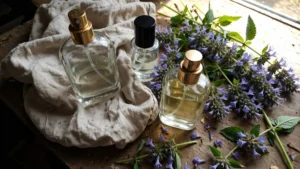
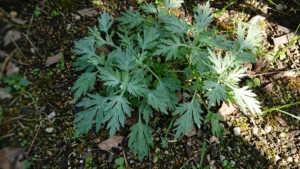
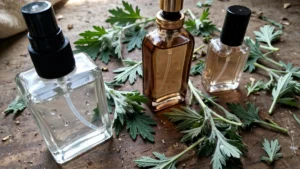
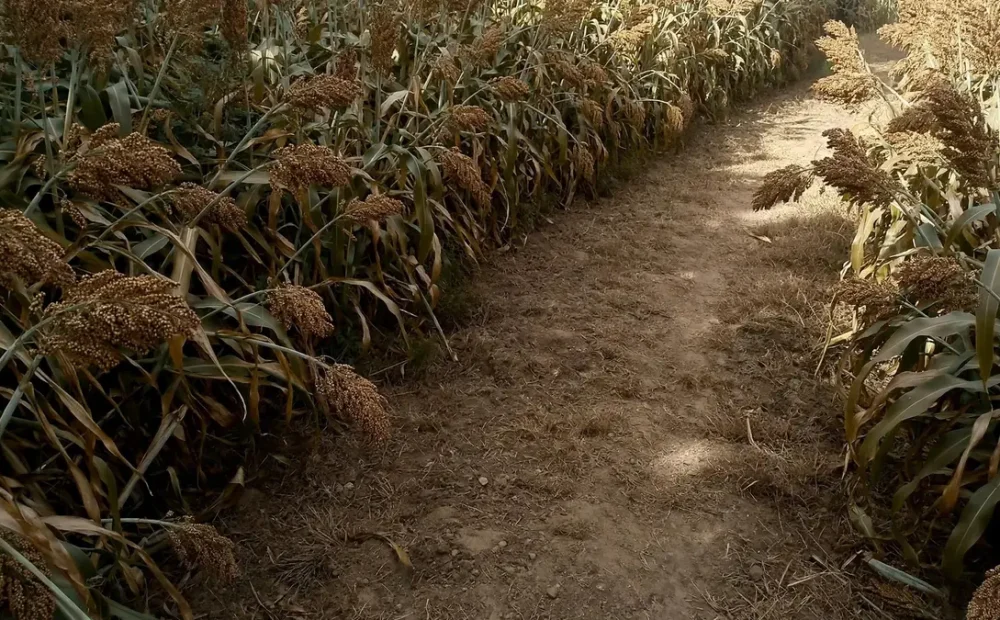
Mugwort is the herb perfumers reach for when they want green without sweetness. The plant is Artemisia vulgaris, common mugwort, a roadside herb that grows wild across Europe and Asia and answers to the name armoise on French note lists. In East Asia it is food and medicine at once, folded into rice cakes in Japan and brewed and burned in Korea and China. In a bottle it smells like that history: green, herbal and faintly bitter, with a camphor warmth and a dusty softness underneath.
That softness is what sets mugwort apart from its famous cousin wormwood. Where wormwood bites, mugwort murmurs. The bitterness is there, but it arrives wrapped in green leaves and dried herbs rather than as a slap, which is why perfumers use it to freshen a composition instead of to shock one. A little mugwort makes citrus brighter, lavender greener and woods drier, and it does all of that without ever smelling sweet.
The nine bottles below all name mugwort, or armoise, in their published note lists, and each price was checked against a retailer listing. Several other mugwort perfumes were left out because no shop anywhere would quote a price for them, so every bottle below is one you can actually buy.
Key takeaways
- Mugwort is Artemisia vulgaris, known as armoise in French, and it usually enters a perfume as a top or heart note.
- The note smells green and herbal, softer and less bitter than wormwood, with a camphor warmth and a dusty, almost sweet edge.
- Mugwort perfumes are uncommon, so the nine below span indie houses and luxury names, from a seven-dollar sample to a three-hundred-dollar extrait.
- Prices run from about $80 for a 30 ml indie bottle to $355 for a 100 ml extrait, and the smallest bottles are often the best way to test the note.
- No note list replaces a skin test, because mugwort’s herbal edge can read very differently on warm skin, and daisy-family allergies are a real consideration.
What mugwort actually smells like in a bottle
Mugwort in a bottle smells like crushed leaves in a dry garden. The first impression is green and herbal, with a camphor coolness and a faintly dusty, almost sweet softness that keeps it from turning medicinal.
Where mugwort sits in the pyramid changes everything about it. At the top it flashes bright green and leaves early; in the heart it steadies the whole wear as the herbal core the rest leans on.
The contrast is clearest beside its sharper cousin: our roundup of the best wormwood perfumes of 2027 puts the bitterest Artemisia in the spotlight, and the gap between the two herbs is plain from the first spray.
How we chose these nine and what to look for
Every pick below names mugwort or armoise in its published note list, verified against Fragrantica entries and brand pages first. Nothing earned a place through a name alone, a slogan, or a guess. Several perfumes on mugwort-note lists were left out because their prices could not be verified anywhere, including a handful of small artisan releases that exist only as samples.
Start by checking where the mugwort sits. Mugwort on top means a bright green opening that leaves early; mugwort in the heart means the herb steadies the middle of the wear.
Finally, test before you commit. One spray on skin, worn for a day, tells you more than any note list.

The 9 best mugwort perfumes of 2027
Tsukiyo-en — DSH Perfumes
What we like: A moonlit Japanese tea garden in a bottle, with mugwort at the top beside mint, shiso leaf, bamboo leaf and satsuma. The heart is Bulgarian rose otto, jasmine sambac and white tea, and the base is hinoki cypress, sandalwood and patchouli, so the whole scent stays green, delicate and close to the skin.
What to consider: It sits close to the skin and fades sooner than the louder bottles here, and the 30 ml bottle is the standard size. Best For: Wearers who want a quiet green tea-garden scent for warm evenings. Material: Mugwort, bamboo leaf, mint, satsuma, shiso leaf, Bulgarian rose otto, jasmine sambac, white tea, hinoki cypress, sandalwood, patchouli. Price Range: $75–$85 for 30 ml. Standout Feature: The only mugwort perfume here built around a Japanese moonlit garden.
Tsukiyo-en is the gentlest way into mugwort, and the best bottle for a warm evening.
Erborista — Chapel Factory
What we like: A monastery herb garden, with mugwort at the top beside sage and bergamot. The heart is rosemary, lavender and iris, and the base is incense, cedar and amber, so the camphor edge of the mugwort has soft herbs and warm woods to lean against.
What to consider: Some wearers report modest longevity, and the incense base can read churchy on skin that runs warm. Best For: Herbal aromatic lovers and anyone who wants mugwort with lavender. Material: Mugwort, sage, bergamot, rosemary, lavender, iris, incense, cedar, amber. Price Range: $95–$105 for 100 ml. Standout Feature: The only mugwort perfume here built as a monastery herb garden.
Erborista smells like a quiet room full of dried herbs, and it is the calmest mugwort on this list.
Iris Palladium — Les EAUX Primordiales
What we like: A powdery iris with mugwort in the heart, from the 2024 version of the scent. The top is cardamom, lavender and cilantro, the heart is iris, violet and mugwort, and the base is sandalwood, vanilla, amber, benzoin, cedar and guaiac wood.
What to consider: The 50 ml bottle is the mid-size, the cilantro opening can surprise, and the price per millilitre is high. Best For: Iris lovers who want a green herbal thread through powder. Material: Mugwort, cardamom, lavender, cilantro, iris, violet, sandalwood, vanilla, amber, benzoin, cedar, guaiac wood. Price Range: $135–$145 for 50 ml. Standout Feature: The only mugwort perfume here built around powdery iris.
Iris Palladium is the most polished mugwort in this list, and the one that smells most like expensive makeup.
Shimotsuki — DSH Perfumes
What we like: A frosty moon over fresh snow, with mugwort beside yuzu, seaweed, hinoki, rice and hawthorn. The heart is iris, orris and white tea, and the base is ambrette seed, sandalwood, frankincense, musk and violet leaf.
What to consider: It is sold as a Voile de Parfum, the house’s oil-based format, and the frosty opening is not for everyone. Best For: Cold-weather wear and anyone who wants mugwort with snow and woods. Material: Mugwort, yuzu, seaweed, hinoki, rice, hawthorn, iris, orris, white tea, ambrette seed, sandalwood, frankincense, musk, violet leaf. Price Range: $140–$150 for 60 ml. Standout Feature: The only mugwort perfume here built around snow and moonlight.
Shimotsuki is the coldest mugwort in this list, and the one that warms up most as it dries down.
L’Eau d’Armoise — Serge Lutens
What we like: The reference bottle for the note, from Serge Lutens’ Les Eaux de Politesse collection. Mugwort, under its French name armoise, sits in the heart beside bergamot and immortelle, with jasmine and white flowers above it and musk, cedarwood and sandalwood below. It is clean, dry and herbal, almost transparent.
What to consider: It is light and quiet, so it needs reapplying through the day, and the herbal character is stark rather than cosy. Best For: Minimalists and wearers who want mugwort without decoration. Material: Mugwort (armoise), bergamot, immortelle, jasmine, white flowers, musk, cedarwood, sandalwood. Price Range: $145–$165 for 100 ml. Standout Feature: The most famous armoise perfume ever made, and the cleanest mugwort in this list.
L’Eau d’Armoise is the reference bottle for the note, and the one every other mugwort perfume gets measured against.
La Cura — Ettore Vico
What we like: The newest bottle here, launched in 2026, with mugwort at the top beside aldehydes, coriander and bergamot. The heart is geranium, lavender and cinnamon leaf, and the base is oakmoss, leather and tonka bean, so the green opening settles into a dark, restorative warmth.
What to consider: It is the darkest mugwort here, and the leather and oakmoss base can feel heavy in heat. Best For: Evening wear and anyone who wants mugwort with leather and moss. Material: Mugwort, aldehydes, coriander, bergamot, geranium, lavender, cinnamon leaf, oakmoss, leather, tonka bean. Price Range: $160–$175 for 50 ml. Standout Feature: The newest mugwort perfume in this list, and the only one built on leather and oakmoss.
La Cura is the darkest mugwort in this list, and the best one for a night when you want the herb to feel serious.
Furari — Phronema
What we like: A wander without a destination, and the strangest bottle here. Mugwort opens the scent beside bergamot, basil, lemon, juniper berry, rosemary, tarragon, bay leaf, patchouli and cinnamon, the heart is ambrette seed, angelica root, cumin, lavender, tobacco, orris and jasmine sambac, and the base is vetiver, petitgrain, oakmoss, rosewood, Mysore sandalwood, labdanum, fir balsam, galbanum and frankincense.
What to consider: It is challenging and strange, so try the sample first, because the full 30 ml extract costs far more than the one-millilitre vial. Best For: Adventurous wearers and collectors of strange green scents. Material: Mugwort, bergamot, basil, lemon, juniper berry, rosemary, tarragon, bay leaf, patchouli, cinnamon, ambrette seed, angelica root, cumin, lavender, tobacco, orris, jasmine sambac, vetiver, oakmoss, Mysore sandalwood, labdanum, frankincense. Price Range: $7 for a 1 ml sample to $195 for a 30 ml extract. Standout Feature: The strangest mugwort in this list, and the only one you can try for the price of a coffee.
Furari is the oddest mugwort in this list, and the one most likely to become a favourite you cannot explain.
Red — Sora Dora
What we like: A gourmand with a bitter-green twist, and the sweetest bottle here. Mugwort sits in the heart beside hazelnut, fig, nutmeg, clove, jasmine, iris and tiare, the top is cardamom, coconut, pink pepper, mandarin, clementine and bergamot, and the base is caramel, sandalwood, woods and musk.
What to consider: The sweetness can bury the mugwort, so this is a gourmand first and a mugwort perfume second. Best For: Gourmand lovers who want a green edge inside the sweetness. Material: Mugwort, cardamom, coconut, pink pepper, mandarin, clementine, bergamot, hazelnut, fig, nutmeg, clove, jasmine, iris, tiare, caramel, sandalwood, musk. Price Range: $198–$220 for 100 ml. Standout Feature: The only mugwort perfume here hidden inside a gourmand.
Red is the sweetest mugwort in this list, and the one where the herb works hardest to be noticed.
Ocean The Rive — Unique’e Luxury
What we like: A sea breeze with mugwort in it, and the grandest bottle here. The top is bergamot, mandarin, grapefruit and sea breeze, the heart is armoise, basil and blue chamomile, and the base is cashmere wood, patchouli, vanilla, musk and amber.
What to consider: It is the most expensive bottle here, the chamomile heart divides opinion, and the extrait strength means one spray goes a long way. Best For: Marine lovers and anyone who wants mugwort by the sea. Material: Mugwort (armoise), bergamot, mandarin, grapefruit, sea notes, basil, blue chamomile, cashmere wood, patchouli, vanilla, musk, amber. Price Range: $340–$355 for 100 ml. Standout Feature: The most expensive mugwort perfume in this list, and the only one built on the sea.
Ocean The Rive is the grandest mugwort in this list, and the one that smells most like a coastline.
Which mugwort perfume is right for you
Starting out, go for the cheapest full bottle or the cheapest sample. Tsukiyo-en is cheap and shows the herb without disguise, and Erborista shows it at its calmest inside lavender and incense.
For an evening, choose the bottles that lean into the note. La Cura darkens it with leather and oakmoss, Red cuts a gourmand with it, and Ocean The Rive freshens a marine extrait with it. The same rule holds for other sharp herbal notes: our roundup of the best star anise perfumes of 2027 starts with the simplest bottles too, because a strong note is easiest to judge when little else competes with it.
The caveats that matter
A note list alone is a poor reason to buy a mugwort perfume. It cannot say how much mugwort is in the bottle, whether the herb was dosed as a whisper or a shout, or how the herbal edge will behave on your skin. Chervil raises the same questions, so our explainer on what a chervil perfume is is worth reading beside this one.
| Detail | What is known |
|---|---|
| What mugwort is | Artemisia vulgaris, a green herbal plant in the daisy family |
| Where it usually sits | Top note in most bottles, heart note in a handful |
| What it smells like | Green and herbal with a camphor warmth, faintly bitter and dusty-soft |
| How long it lasts | The herbal green fades within two hours; the woods and musk underneath last longer |
| What it pairs with | Lavender, sage, cedar, citrus, iris and green tea |
| What to watch for | Warm skin can turn the herbal edge medicinal, and daisy-family allergies apply |
| What it does not do | It never smells sweet or floral by itself |
| How to test it | Try one spray on skin and give it a full day before you buy the bottle |
Checklist: choosing a mugwort perfume honestly
- Check that mugwort, or its French name armoise, appears in the published note list, not only in an advert or a review.
- Note where it sits: a top-note mugwort flashes green and leaves early, a heart-note one steadies the whole wear.
- Give one spray a whole day on skin before you judge it; the opening green is not the drydown.
- Compare prices per millilitre, since these bottles run from 30 ml to 100 ml and the cheapest sticker price is not always the cheapest wear.
- Try it beside a lavender or sage scent you already own, so you can tell what the mugwort itself adds.
- Buy a sample or the smallest bottle first, because green herbal notes divide wearers more than florals do.
Frequently asked questions
What does armoise mean on a perfume note list?
Armoise is the French word for mugwort, so a note list that says armoise is listing the herb under its French name. Niche brands borrow it for the same reason, and one word opens up a whole shelf of green herbal perfumes.
Is mugwort the same plant as wormwood?
No, though they are close cousins. Both belong to the genus Artemisia, but mugwort is Artemisia vulgaris and wormwood is Artemisia absinthium. Mugwort smells softer and greener, with a dusty sweetness underneath, while wormwood is drier, sharper and more bitter.
Can mugwort trigger allergies?
It can, because mugwort belongs to the daisy family, which includes ragweed and chamomile. People with ragweed allergies sometimes react to mugwort too, and the oil is concentrated in a perfume, so a patch test on the inner arm is wise before a first full wear.
What is the best way to test a mugwort perfume before buying?
Buy the smallest size or a sample, spray once on skin rather than on paper, and wear it for a full day. Mugwort changes as it dries down, so the first ten minutes tell you very little.
Why does mugwort smell different an hour after spraying?
Because the green herbal edge lives in the top and heart, and those notes are always the first to leave. After an hour or two, the mugwort has usually stepped back and the woods, musk or amber underneath have taken over.
If I can only try one, which mugwort perfume should it be?
Tsukiyo-en, because it costs the least as a full bottle and shows the note most plainly. If you would rather spend almost nothing, the Furari sample costs about seven dollars and shows the herb at its strangest.
The bottom line
Mugwort is a note for people who like their green scents soft rather than sharp, and their perfume with a little herbal calm in it. Across the nine bottles above, the herb shows every side it has, from a seven-dollar sample to a three-hundred-dollar extrait.
Start with the cheapest bottle or the sample, give it a full day on skin, and then decide whether the herbal green belongs in your collection.