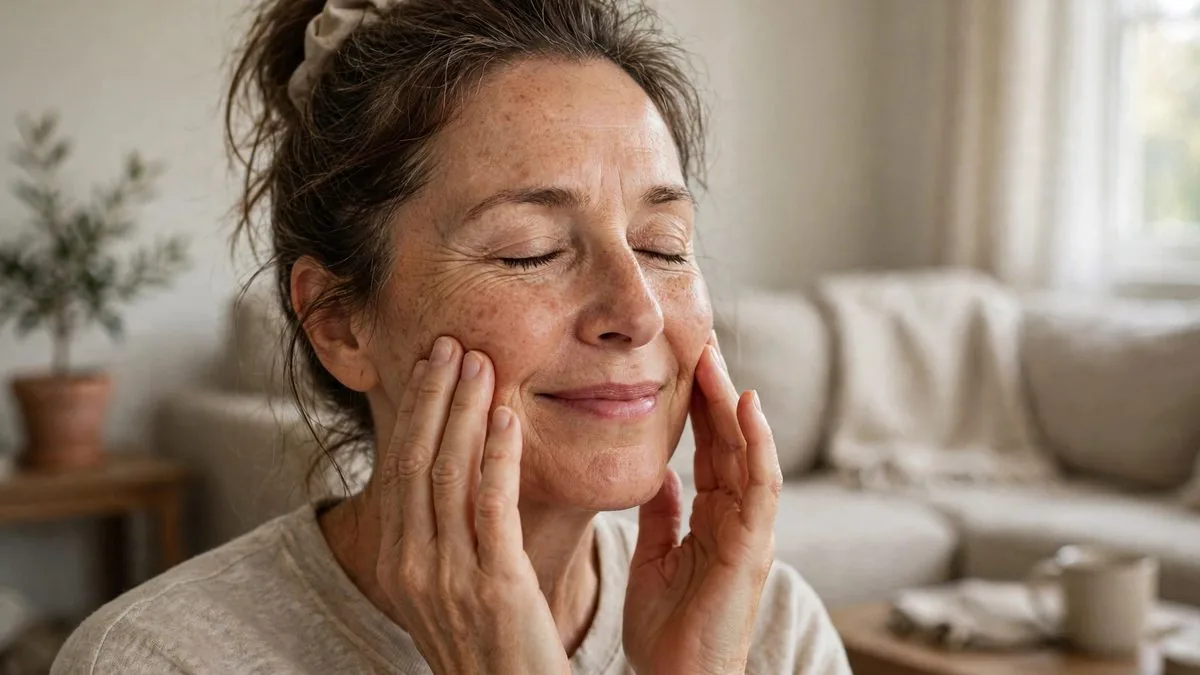

Face yoga is a set of facial exercises and gentle self-massage moves for the muscles of your face and neck, a workout for the more than forty muscles behind every smile, frown and raised brow. Instead of weights, you lift your cheeks with your fingertips and stretch your jaw and neck. A routine takes ten to thirty minutes, needs only clean hands and a mirror, and can be done at home.
The idea is simple. The muscles under your skin shape much of what you see in the mirror, and like the muscles in your arms or legs, they respond to use. Exercised cheek muscles may grow slightly fuller, softening sagging around the mid-face, while stretched forehead and jaw muscles release the tension behind expression lines. Gentle massage boosts blood flow, bringing a temporary glow, and encourages lymphatic drainage, which can reduce morning puffiness.
Face yoga has become one of the most talked-about beauty habits of 2027, helped along by videos showing dramatic transformations. The honest picture is more modest: the best evidence comes from small studies, and the changes were subtle, a little more cheek fullness and a slightly younger-looking face. For many people the ritual itself is the point, since ten quiet minutes of breathing and massage can lower stress.
Key takeaways
- Face yoga combines facial exercises, holds, gentle massage and breathing to work the muscles of the face and neck.
- The strongest evidence is a small 2018 study of sixteen women: twenty weeks of practice improved cheek fullness and made them look about three years younger in photographs.
- Expect subtle, gradual change over eight to twenty weeks, not a dramatic transformation in days.
- It cannot restore lost facial fat or replace injectables and surgery, but it can improve tone, circulation and relaxation.
- Use clean hands, a little facial oil, light pressure and a mirror, and stop if anything hurts.
How face yoga works
Your face is a web of thin muscles attached directly to the skin, and every expression is a contraction of one or more of them. Over years, some become overworked while others barely get used. Many people hold tension in the forehead and jaw all day, clenching their teeth at a screen, while the cheek muscles, the largest in the face, do little beyond smiling and chewing.
Face yoga works on both sides of that imbalance. Strengthening moves ask a muscle to contract against gentle resistance from your fingers, as in the cheek lift: smile broadly, place your fingertips on the tops of your cheeks, and lift upward. Relaxing moves stretch a tight muscle until it lets go, like the forehead smoother, where you press your palms across your brow and slide them outward.
Massage is the third part. Slow, upward strokes increase blood flow, which is why your face looks flushed after a session, and light strokes toward the ears and down the neck follow lymph flow and may clear overnight puffiness. But face yoga cannot grow back the fat pads that shrink with age, only fillers or surgery replace lost volume, and it cannot erase deep wrinkles.
The core face yoga techniques
Most routines use the same handful of moves. Six done well, for about a minute each, cover the eyes, forehead, cheeks and jaw. Work in front of a mirror so you can see whether your forehead is creasing, a sign you are pushing too hard.
Start with the eyes. Place a fingertip on the inner corner of each eye and press very gently for thirty seconds, breathing slowly. Then open your eyes wide, as if surprised, keeping your forehead smooth and your brows still. Hold for ten seconds and release. This wakes the eye muscles without asking the forehead to join in.
For the forehead, rest your fingertips across your brow and press lightly. Raise your brows against that resistance and hold for ten seconds, then relax. Then glide your fingertips from the centre of your forehead outward toward the temples, five or six times, to release the muscle underneath, not to iron the skin flat.
The cheeks are where most visible benefit is found, because they are the largest facial muscles. Smile as widely as you can, place your fingertips on the tops of your cheeks, and lift upward, holding for ten seconds. Repeat five times. Then tap lightly along the cheekbones from the nose outward, which brings blood to the surface.
For the jaw, make a loose fist against its outside and press your jaw gently into it for ten seconds, working the masseter, the muscle that powers chewing. Then drop your jaw open, let your tongue fall toward your chin, and breathe out, the lion pose from yoga. Finish by sweeping your fingertips along the jawline from chin to ears, five slow strokes per side.

What the evidence actually says
The most cited study, published in 2018 in JAMA Dermatology, taught sixteen middle-aged women thirty-two facial exercises, practised thirty minutes a day for eight weeks, then every other day for twelve more. Dermatologists judging before-and-after photographs rated the women about three years younger, with improved fullness in the upper and lower cheeks. Encouraging, but the study was small and had no control group.
A 2025 study measuring muscle properties found that eight weeks of intensive face yoga changed different muscles in different ways: muscles behind forehead and frown lines became more relaxed, while the cheek muscles showed increased tone. Other small studies, with twelve to ninety people over six to twenty weeks, point the same way: regular practice may fill the cheeks a little and ease jaw discomfort, but the effects are modest and the evidence is low quality.
There are no large, long-term trials, and no study shows face yoga prevents ageing or replaces other treatments. Videos promising a sharper jawline in a week are selling a fantasy. Real change takes two to five months of steady practice and is measured in millimetres, not a new face.
Face yoga compared with other options
A jade roller or gua sha stone gives a similar massage and drainage effect in a fraction of the time, but it does not exercise the muscles, so the two pair well. Our guide to jade roller benefits explains how to use one without dragging the skin. At-home microcurrent devices send a tiny current through the muscles to make them contract, another route to tone, and our roundup of the best microcurrent facial devices covers the options. Neither replaces the habit of releasing jaw tension.
Injectables work differently. Botulinum toxin relaxes a muscle by blocking its nerve signal, smoothing the lines it creates, while fillers add volume where fat has been lost. Face yoga cannot do either, and anyone wanting a dramatic or immediate change will be disappointed by exercises alone. Skincare is the foundation everything rests on: a gentle cleanser, a moisturiser that suits your skin, and sunscreen every morning. Our skin barrier guide explains how to keep that barrier healthy before you start pressing and stretching your face every day.
How to build a daily routine
Ten minutes a day is enough to begin, building toward twenty or thirty as the habit sticks. Practise at the same time each day, after morning skincare or before bed, when your face is clean and a few drops of facial oil help your fingers glide. Sit in front of a mirror, shoulders down, breathing slow. Work through the moves in order, eyes, forehead, cheeks, jaw, neck, and finish with a minute of light massage over the whole face.
Consistency matters more than intensity. The studies that found results used daily practice for eight weeks, then every other day to maintain them, so the gains likely fade if you stop. Keep a monthly photograph in neutral light, from the same angle, to judge change honestly. Start with clean hands, use light pressure, and if you have eczema, rosacea, active acne, recent cosmetic work or jaw problems such as TMJ, check with a dermatologist or doctor first.
| Technique | Area worked | What it aims to do | Time per session |
|---|---|---|---|
| Cheek lift | Cheeks | Build fullness and lift in the mid-face | About 2 minutes |
| Forehead smoother | Forehead | Release tension and soften horizontal lines | About 1 minute |
| Eye opener | Around the eyes | Wake up eye muscles without creasing the brow | About 1 minute |
| Jaw release | Jaw and chin | Ease clenching and define the jawline | About 2 minutes |
| Lion’s breath | Whole face and jaw | Release deep tension and relax the face | About 1 minute |
| Neck stretch | Neck and under the chin | Tone the platysma and counter screen posture | About 2 minutes |
| Fingertip tapping | Cheeks and jaw | Boost circulation and bring a healthy glow | About 1 minute |
| Lymphatic sweep | Face and neck | Encourage drainage and reduce puffiness | About 2 minutes |
Your first-week checklist
- Wash your hands and cleanse your face before every session.
- Apply a few drops of facial oil or moisturiser so your fingers glide.
- Practise in front of a mirror, keeping your forehead smooth and shoulders down.
- Use light pressure and stop any move that hurts or causes redness.
- Do ten minutes a day, working through eyes, forehead, cheeks, jaw and neck.
- Take a neutral-light photo on day one and repeat it monthly to track change honestly.
Frequently asked questions
Does face yoga really work?
It can help a little, slowly. A small 2018 study found improved cheek fullness and a younger appearance after twenty weeks, and a 2025 study found eight weeks changed muscle properties, relaxing some muscles and toning others. The effects were modest and the studies small. Treat it as a gentle habit with real but limited benefits, not a facelift.
How long does it take to see results?
Most studies that found a change ran for eight to twenty weeks, with daily practice at the start. You may notice less puffiness and a fresher glow within the first week or two, because circulation and drainage respond quickly, but any change in muscle tone or fullness takes at least two months. If nothing has changed after three months, the routine is probably not going to transform your face.
Can face yoga cause wrinkles?
It can, if it is done badly. Repeatedly dragging, pulling or creasing the skin, especially on the forehead, can deepen the very lines you are trying to soften. The safeguard is technique: light pressure, fingers that glide on oil rather than catch on dry skin, and a mirror to check that your forehead stays smooth. If a move always leaves a line behind, drop it.
Is face yoga better than gua sha?
They do different jobs. Gua sha and rollers are massage tools: they boost circulation, move fluid and feel relaxing, and they take only a few minutes. Face yoga adds active exercise and stretching of the muscles themselves, which tools cannot do. Many people use both, doing a short round of exercises and finishing with a few strokes of a tool.
Can face yoga replace Botox?
No. Botulinum toxin relaxes a muscle by blocking its nerve signal, which smooths the lines that muscle makes far more completely than exercise can. Face yoga strengthens muscles rather than relaxing them, and it cannot replace lost volume the way fillers can. It is best seen as a daily maintenance habit, not as an alternative to a procedure.
What age should you start face yoga?
There is no set age, and the studies focused on women in their forties to sixties, the group most likely to notice changes in fullness and tone. Younger people may still benefit from the relaxation side, particularly if they clench their jaw or furrow their brow. Whatever your age, the same rules apply: gentle pressure, clean hands, and consistency over intensity.
The bottom line
Face yoga is a simple, free, low-risk habit that asks ten to thirty minutes a day for modest rewards: a little more cheek fullness, looser forehead and jaw muscles, better circulation, less puffiness, and a calmer few minutes of your own. The research supports those claims in a small way: no dramatic transformation, no replacement for lost volume, and no substitute for sunscreen, moisturiser and good sleep.
Start small, stay gentle, and judge the results with photographs rather than hope. The best version of face yoga is the one you actually do, most days, with clean hands.
Note: This article is for general information only and is not medical advice. If you have a skin condition, jaw disorder, or recent cosmetic procedure, speak to a dermatologist or doctor before starting face yoga.