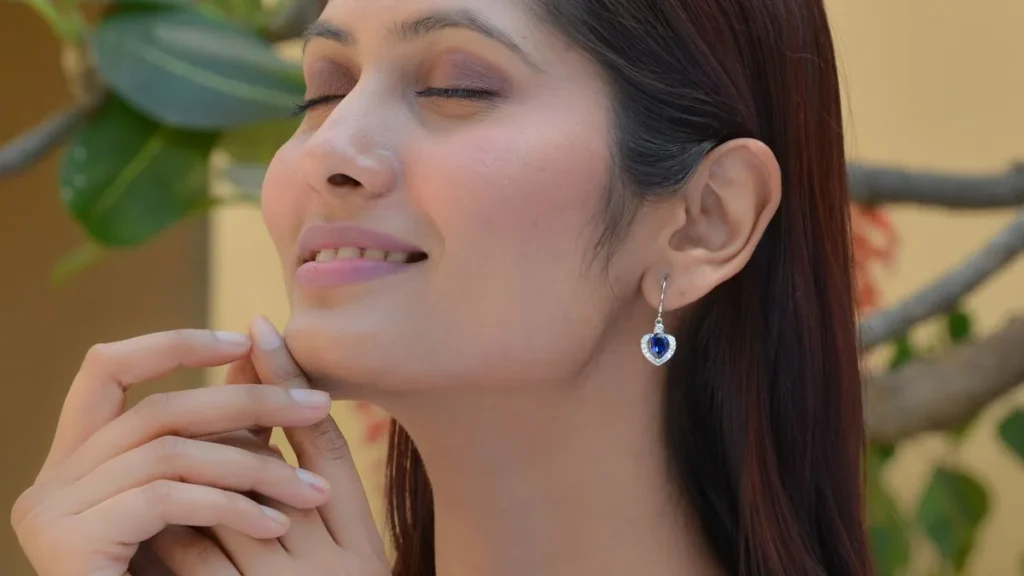
A sapphire earring is the piece of jewellery you will reach for most often, and the one most likely to disappoint if bought carelessly. Unlike a ring, an earring has to look good from the side, feel comfortable for hours, and stay firmly in your ear.
Sapphire is an excellent earring stone. It scores 9 on the Mohs hardness scale, second only to diamond, so it will not scratch, chip or fade with normal wear. Its deep blue suits almost every skin tone, as an everyday stud or an evening drop.
This guide covers colour and pair matching, cut and clarity, styles, the posts and backs that keep earrings safe, metals and sensitive skin, treatments and prices.
Key takeaways
- Colour matters most, but in earrings it must match: both stones should share the same hue, tone and saturation.
- Comfort is a quality issue: a heavy or badly balanced earring will live in a drawer, so check weight and back first.
- Secure backs matter more than sparkle: screw backs or la poussette clasps are worth it, especially for valuable stones.
- Most sapphires are heat-treated, which is standard and permanent, but it must be disclosed.
- Buy the pair, not the stone: judge earrings as a matched set, and ask for a lab report.
Start with colour, and check both stones together
With a sapphire, colour decides almost everything, and earrings add one extra test: the two stones must match. A pair has two stones sitting centimetres apart, and any difference in colour, tone or size shows at once.
Look for a rich, even blue with strong saturation and a medium to medium-dark tone, often called royal blue or cornflower blue. Avoid stones that are too dark, which look inky indoors, or too pale, which look washed out. A greenish or greyish cast lowers the value, as does obvious colour zoning.
Compare the pair side by side in daylight, not just under shop lights. Hold them on a white card and look from the front and the side. A good pair matches so closely you cannot tell which stone belongs in which ear. If one stone looks darker, greyer or larger, ask to see another pair. A mismatched pair is never a bargain.
Cut and clarity at earring scale
Earrings are usually smaller than rings, and that changes what to look for. A small stone hides flaws that would be obvious in a large ring stone, so a slightly included sapphire can be a sensible buy in a stud. Do not accept a stone that looks sleepy, hazy or dull: fine silk can give a velvety look, but too much kills the sparkle.
Cut decides how lively the stone looks when it moves. A well-cut sapphire looks bright and balanced, with colour spread evenly across its face. Watch for windowing, a washed-out patch in the centre of a shallow stone, and dark areas in stones cut too deep. There is no official cut grade for sapphires, so trust your eyes: the stone should look alive when you tilt it.
Studs, drops, hoops and clusters: choose the style first
The style changes everything about how a sapphire is worn, so decide it before you fall in love with a stone. Studs are the most versatile and the easiest to wear every day: a classic round or oval sapphire stud in a four-prong setting sits close to the lobe and suits every face shape.
Drops and dangles give a sapphire room to move, which is why they catch the light so well in the evening. They suit longer necks and hair worn up, but they swing, so they need a secure hook or lever back and a stone light enough not to pull. Clusters, where a sapphire is ringed by small diamonds, make the centre stone look larger, which helps on a smaller budget. Hoops with sapphire accents are softer and more casual, better for daytime than a formal drop.
Think about when you will actually wear them. A pair you love but only wear twice a year is a worse buy than a simpler pair you reach for every morning. Our roundup of the best sapphire earrings of 2027 covers studs, drops and clusters across a range of budgets.
Settings, posts and backs: the part that keeps them on
The most expensive sapphire is worthless if it falls out of your ear on a train. Settings, posts and backs are the least glamorous part of an earring and the most important, so inspect them as carefully as the stone.
In a stud, a four-prong setting shows off the stone and lets in the most light, while a bezel setting, where metal wraps around the stone’s edge, protects the corners. Check that the prongs are even, smooth and tight, with no gaps and no sharp edges. A loose prong is the most common reason a stone is lost.
The post should be straight, smooth and long enough for your lobe, and the back is where most earrings fail. Standard push backs suit light studs, but they loosen over time and can slip off unnoticed. Screw backs, which twist onto a threaded post, are far more secure and worth choosing for any valuable pair. La poussette backs are the most secure of all. For drops, look for a lever back or a hook with a stopper, and test the clasp yourself: it should close with a firm click.

Metal, skin sensitivity and everyday comfort
The metal changes both the look and the feel. Platinum is the most durable and secure for a valuable stone, and its cool white tone suits blue sapphires. White gold gives a similar look for less, though it needs replating. Yellow gold warms blue sapphire, while rose gold flatters pink sapphires.
If your ears are sensitive, the metal matters more than the stone. Nickel is the usual culprit, and it is often present in lower-grade white gold. Look for nickel-free white gold, platinum, or solid 14k or 18k yellow gold, and avoid plated posts, which wear through and expose the base metal. Titanium and niobium posts suit ears that react to almost everything. If a back has ever irritated your lobe, say so before you buy.
Comfort is the test most buyers skip. A heavy earring pulls the lobe down, stretches the piercing, and aches by lunchtime. Try the earrings on and wear them in the shop for ten minutes, not ten seconds. They should sit flat against the lobe, not droop forward. If a drop swings too wildly or a stud feels front-heavy, the balance is wrong. For a comparison of how different stones feel in daily wear, our guide to the best diamond earrings of 2027 covers the same comfort checks.
Treatments: the question that changes the price
Roughly nine in ten natural sapphires have been heat-treated. Heating, usually to around 1,600 to 1,800 degrees Celsius, improves colour and dissolves some inclusions. It is permanent, stable and accepted by every major gemmological laboratory. A heated sapphire is a real, natural sapphire, and there is nothing wrong with buying one if you know it is heated.
Untreated sapphires are a different category: a fine unheated stone carries a premium of often 20 to 50 percent over a comparable heated stone. Always ask whether the stones have been heated, and ask for the answer in writing. Other treatments must also be disclosed: diffusion, which uses beryllium or titanium to create colour, can halve a stone’s value. If a seller cannot explain a stone’s treatment, shop elsewhere.
Natural versus lab-created sapphire
A lab-created sapphire, also called lab-grown or synthetic sapphire, is real corundum: the same composition, crystal structure and hardness of 9 as a mined stone. To the naked eye, a lab-created and a natural sapphire of the same colour are impossible to tell apart.
The difference is price. Lab-created sapphires typically cost a small fraction of a comparable natural stone, so you can have a bigger, cleaner, more vivid pair for the same money. The trade-off is resale value: a lab-created stone will not hold its value the way a fine natural stone can. For earrings, where the stones are small and the pair is the point, many buyers choose lab-created and spend the saving on a better setting or a more secure back. If you are buying your first serious piece, our guide to buying your first fine jewellery explains how to weigh natural against lab-created.
What a sapphire earring should cost in 2027
Price per carat climbs steeply with size and colour quality, but in earrings you are buying two stones, so a pair costs more than a single stone. A smaller pair with better colour is usually a better buy than a larger pair with poor colour.
As a rough guide to 2027, a commercial-grade heated blue sapphire of around half a carat per stone costs roughly $200 to $800 per carat; good-quality heated $800 to $2,500; fine heated with vivid colour $2,500 to $6,000; and premium unheated $6,000 to $10,000 or more per carat. For a finished pair, lab-created studs can start under $500, a natural heated pair typically runs from around $2,000 to $10,000, and a luxury pair with rare unheated stones can exceed $10,000. Set your budget first.
Sapphire earring styles at a glance
| Style | Best for | Stone size | Back to choose | Watch out for |
|---|---|---|---|---|
| Classic stud | Everyday wear | 0.25 to 1 carat each | Screw back or la poussette | Mismatched colour |
| Halo stud | Small stone, bigger look | 0.25 to 0.75 carat each | Screw back | Loose halo stones |
| Drop earring | Evenings and weddings | 0.5 to 2 carats each | Lever back | Weight and swinging |
| Dangle earring | Statement looks | 0.5 to 2 carats per stone | Lever back with stopper | Pulling on the lobe |
| Cluster earring | Sparkle on a budget | 0.5 to 1.5 carats total | Screw back | Uneven cluster layout |
| Hoop with sapphires | Casual daytime wear | Small accent stones | Hinged snap closure | Weak hinge or clasp |
| Chandelier earring | Formal events | 1 to 3 carats total | Lever back | Heaviness, tangling in hair |
| Huggie earring | Everyday sparkle | Small accent stones | Hinged snap closure | Stones set too shallow |
Checklist: what to look for in a sapphire earring
- Check the colour in daylight: both stones the same rich, even blue, no inky darkness, no grey or greenish cast.
- Check the pair matches: same size, shape, cut and colour.
- Check the setting and prongs: even, smooth and tight, with no gaps.
- Check the backs: screw backs or la poussette for studs, lever backs for drops.
- Ask about treatment: heated is standard, unheated costs much more, diffusion or filling must be disclosed.
- Ask for a lab report: an independent GIA, GRS or SSEF report for any expensive pair, verified with the lab.
Frequently asked questions
What is the most important thing to look for in a sapphire earring?
Colour, and that the pair matches. Look for a rich, even blue with strong saturation and a medium to medium-dark tone, compared in daylight.
Are sapphire earrings comfortable for everyday wear?
Yes, with the right style and weight. Studs and huggies are the most comfortable for daily wear, while heavy drops and chandeliers suit occasions better.
How do I keep sapphire earrings from falling out?
Choose secure backs: screw backs or la poussette clasps for studs, lever backs for drops. Check backs regularly and have prongs inspected once a year.
Are heated sapphires bad?
No. Heat treatment is standard, permanent and accepted by every major gemmological laboratory, and roughly nine in ten natural sapphires have been heated.
Can I wear sapphire earrings if I have sensitive ears?
Usually yes. Choose nickel-free white gold, platinum, solid 14k or 18k yellow gold, or titanium posts, and avoid plated posts.
How much should a sapphire earring cost?
Lab-created studs can start under $500, a natural heated pair typically runs from around $2,000 to $10,000, and a luxury pair with rare unheated stones can exceed it.
The bottom line
A good sapphire earring is bought as a pair, not as two stones. Judge the colour side by side in daylight, make sure the stones match in size and cut, and spend as much attention on the setting, post and back as on the stone. Try them on, and ask the treatment question before you ask the price. Do that, and you will end up with earrings that look beautiful, feel comfortable, and stay safely where they belong.
Note: Prices here are indicative 2027 market ranges, not quotes. Always confirm the treatment, identity and price of the exact pair in writing before you pay.