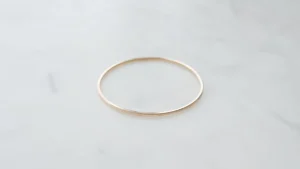
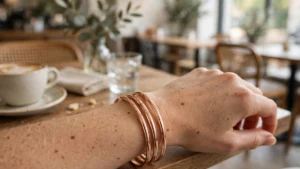
A gold bracelet is one of the easiest pieces of jewellery to buy badly. Yet almost everything that decides whether it lasts five years or fifty is hidden: karat, gold layer, and whether it is solid or hollow.
That matters more for a bracelet than for almost any other piece of jewellery. A bracelet takes more knocks than a necklace, brushing against desks and door frames all day, and its clasp is opened and closed hundreds of times a year.
This guide walks through the checks that matter, in the order a jeweller would make them: karat and hallmark first, then construction, weight, clasp, fit and care. There are no brand recommendations here, only the signs of a well-made bracelet and the warning signs of one that is not.
Key takeaways
- Match the karat to how you will wear it: 14K suits daily wear, 18K brings richer colour, and 22K is soft, best for occasions.
- Always find the hallmark — 585 means 14K, 750 means 18K and 916 means 22K — and treat an unmarked bracelet as unverified.
- Solid, gold-filled, vermeil and plated have very different lifespans, and the label should say which one you are buying.
- Ask for the weight in grams and check whether the piece is hollow: weight is the fairest way to compare two similar-looking bracelets.
- Test the clasp before you pay: it should close with a firm click, show no wobble, and ideally have a safety catch.
Start with karat: what the number really means
Karat measures how much of the metal is pure gold, on a scale of 24 parts. Pure gold is 24 karat, but it is far too soft for a bracelet worn every day, so jewellers mix it with metals such as copper, silver and zinc. Divide the karat by 24 to get the share of pure gold: 18K is 75 percent, and 14K is about 58.3 percent.
The realistic choices are 10K, 14K, 18K and 22K. Ten-karat gold is the hardest and most affordable, with a paler tone. Fourteen-karat gold is the most popular choice for everyday jewellery in the United States, balancing strength, colour and price. Eighteen-karat gold is richer in colour, with 75 percent pure gold, and 22K is 91.7 percent pure, with a deep yellow colour, but it is soft, so it suits bangles better than fine chains.
There is no single best karat, only a best karat for your wrist. For daily wear or stacking, 14K is the sensible default. For the richest colour, handled gently, 18K is a lovely step up.
Read the hallmark before you believe the label
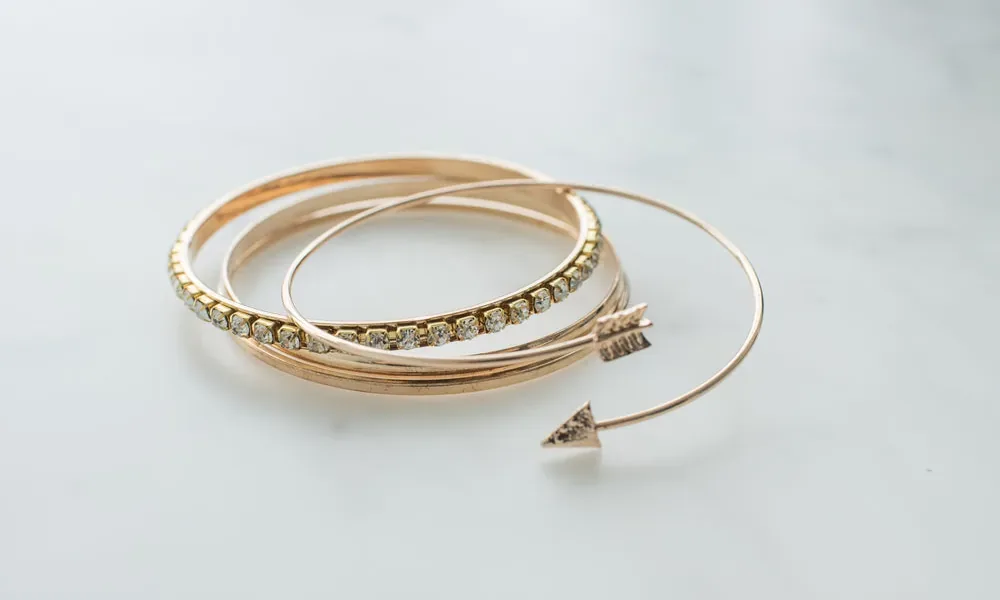
A hallmark is a small stamp, usually inside the clasp or on the inside of a bangle, and it is the one part of a gold purchase that does not depend on trusting the seller. Everything else — the quoted karat, the weight, the description — is a claim.
Two numbering systems are in use. The karat system stamps 10K, 14K, 18K or 22K. The millesimal system stamps parts of gold per thousand: 417 is 10K, 585 is 14K, 750 is 18K, 916 is 22K and 999 is 24K.
Check the stamp itself, not just its presence. A genuine hallmark is usually crisp and evenly struck. Be wary of stamps that look shallow or blurred, and of pieces priced as solid gold with no mark. An unmarked piece is not automatically fake, but its purity is unverified. If you are buying a diamond bracelet as well, read the metal marks first, then the stones. Our diamond buying guide explains how to check stones and settings with the same careful approach.
Solid, filled, plated or vermeil: know what you are paying for
Four bracelets can look identical on the day you buy them and be in completely different condition a year later. The difference is how much gold there is and what lies underneath it. Solid gold means the karat alloy runs through the whole piece, with no base metal core. It can be repaired and resized, and it keeps its metal value.
Gold filled is the next step down, and it is much better than most shoppers expect. A thick sheet of karat gold is bonded to a brass core with heat and pressure, and under US rules the gold layer must be at least 10K and at least one twentieth of the total metal weight. Vermeil is gold over sterling silver, with a layer at least 2.5 microns thick. Ordinary plating can be as thin as 0.175 microns and wears through within weeks or months of daily wear.
| Type | Underneath | Gold layer | Stamp | Lasts | Repairs | Best for |
|---|---|---|---|---|---|---|
| Solid gold | None | Whole piece | 14K, 585, 750 | Generations | Yes | Daily wear |
| Gold filled | Brass core | 1/20 of weight | 1/20 14K GF | Years | Limited | Everyday wear |
| Vermeil | Silver | 2.5 microns | 925 vermeil | Months to years | Replate only | Occasions |
| Heavy electroplate | Brass, steel | 2.5 microns | HGE | Months | Rarely | Occasional wear |
| Gold plated | Brass, steel | 0.175 microns | GP, GEP | Weeks to months | Rarely | Trend pieces |
| Hollow gold | Air | Varies | Karat mark | Shorter than solid | Hard | Big look, low budget |
| Rolled gold plate | Brass core | 1/40 of weight | RGP | Longer than plating | Limited | Vintage styles |
Buy solid gold if the bracelet is meant to last, gold filled if you want the gold look for everyday wear at a lower price, vermeil for occasional pieces over silver, and plated only when you accept that the finish will wear. Whatever the type, the listing should name it plainly.
Weight, hollow versus solid, and why grams matter
Much of the price difference between two similar-looking gold bracelets comes down to weight. Gold is sold by weight and karat, so a heavier bracelet of the same karat contains more gold and costs more. Ask for the weight in grams, and compare the price per gram rather than the headline price.
Hollow gold is formed around air, so a thick chain can look substantial while weighing far less than a solid piece. The trade-off is durability: hollow pieces dent easily and are much harder to repair. A hollow chain made of 10K gold tubing is still real 10K gold in its walls, but it should be disclosed as hollow and not described simply as solid.
Clasps: the small part that loses bracelets
Most lost bracelets are lost at the clasp, not because the chain broke. Before you buy, open and close the clasp several times. It should engage with a firm click, sit flush when closed, and show no wobble.
Lobster clasps are the most common and a good all-round choice: strong, easy to use with one hand, and reliable when the spring is good quality. Box clasps with a safety catch are the most secure option for valuable bracelets, because the catch holds the piece even if the main clasp opens. Check the jump rings are soldered closed, and look for a safety chain.
Fit, comfort and everyday wear
Getting the size right is a measurement, not a guess. Wrap a soft tape measure or a strip of paper just above the wrist bone, where the bracelet will sit, and note the number. Then add a little room: most people add around half an inch to three quarters of an inch for a comfortable chain fit, and less for a bangle that needs to slide over the hand. Most women wear a bracelet between 6.5 and 7.5 inches, but a standard size bought without measuring is a gamble.
Think about how the bracelet will move. A chain should slide a little on the wrist without spinning freely or slipping over the hand. A bangle should pass over the hand with gentle pressure and then sit comfortably. Run a finger along the inside: a well-finished piece feels smooth everywhere.
Colour, style and stacking in 2027
Once the practical checks are done, style is the fun part. The styles that keep coming back are the curb chain, with flat interlocking links that resist kinking; the Figaro chain, with its pattern of long and short links; the rope chain, with twisted links that catch the light; and the tennis bracelet, a line of small stones set in a row.
Stacking is where a gold bracelet earns its place in a wardrobe. Start with one piece you love, then add thinner bangles or a fine chain in a different texture — a hammered bangle beside a polished one. For everyday styling ideas, our guide to gold jewellery for everyday wear shows how a single bracelet fits into a simple daily rotation.
Care, storage and keeping it looking new
Gold does not tarnish the way silver does, but a bracelet still picks up a film of skin oils, soap and dust that dulls the shine. Clean it gently and often: soak it for a few minutes in warm water with a drop of mild dish soap, brush it softly with a soft toothbrush, rinse it in clean water and dry it with a soft, lint-free cloth.
Storage matters as much as cleaning. Keep the bracelet in a soft pouch or a lined box, separate from other pieces, so chains do not tangle and stones do not scratch the gold. Fasten the clasp before you put it away, so the chain stays in a loose loop rather than a knot. A diamond bracelet deserves the same attention to its setting as to its metal, and our guide to diamond necklaces covers stone settings and checks that apply just as well to a bracelet.
Before you buy: a quick checklist
- Find the hallmark: 417, 585, 750, 916 or 999, plus a maker mark.
- Confirm the construction in writing: solid, gold filled, vermeil or plated, hollow or solid.
- Ask for the weight in grams and compare the price per gram with similar pieces.
- Test the clasp several times, check the jump rings are soldered, and look for a safety catch.
- Measure your wrist, check the fit, and run a finger along the inside for rough edges.
- Check the returns policy and keep the receipt and hallmark details together.
Frequently asked questions
What karat is best for a gold bracelet?
For daily wear, 14K is usually the best balance of strength, colour and price. Eighteen-karat gold has a richer colour and suits occasion wear, while 22K is best in a bangle or cuff.
How can I tell if a gold bracelet is real?
Look for a hallmark first: 585 means 14K, 750 means 18K and 916 means 22K. A jeweller can confirm purity with an acid test or an X-ray fluorescence reading.
Is gold filled as good as solid gold?
Gold filled is not the same as solid gold, but it is far better than plating. The gold layer must make up at least one twentieth of the total metal weight, so it can last for years of daily wear. It cannot be resized as easily as solid gold, but at a lower price it is a sensible choice.
What does 585 stamped on a bracelet mean?
The number 585 is a millesimal fineness mark: 585 parts of gold per thousand, or 58.5 percent pure gold, which is 14K. The same system uses 417 for 10K, 750 for 18K, 916 for 22K and 999 for 24K.
Should I buy a hollow or a solid gold bracelet?
A solid bracelet lasts longer, resists dents and is easier to repair, but costs more. A hollow bracelet looks bigger for the price, but dents easily and is hard to repair. For daily wear, solid is safer.
How should a gold bracelet fit?
Measure your wrist just above the wrist bone and add around half an inch to three quarters of an inch for a chain, so it slides a little without slipping over your hand. A bangle needs to pass over the hand with gentle pressure. Most women wear between 6.5 and 7.5 inches, but measuring your own wrist beats guessing.
The bottom line
A good gold bracelet is bought with the eyes and the hands, not with the listing. Read the hallmark, confirm whether the piece is solid or hollow, ask for the weight in grams, and test the clasp.
When those basics are right, the rest is pleasure. A well-chosen gold bracelet needs little care, suits almost everything you own, and only gets better with wear.
Note: karat and hallmark rules vary by country, and a stamp certifies purity, not weight or fair price.