

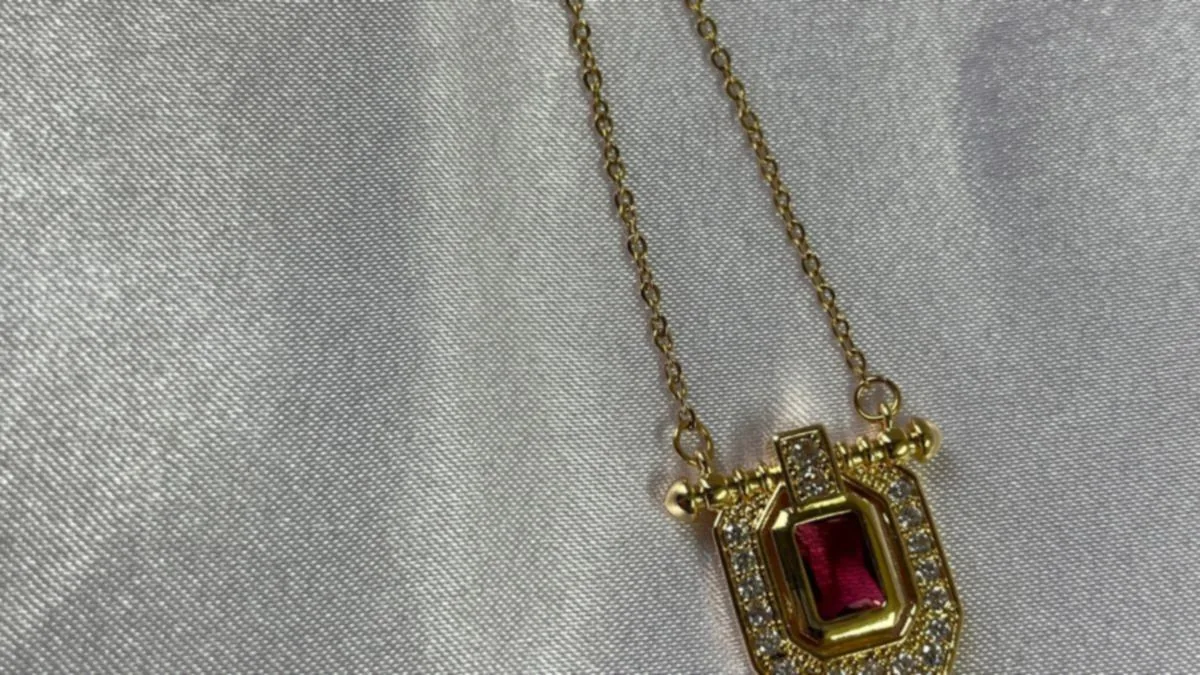

A ruby necklace is judged differently from other ruby jewellery. A ring is inspected at close range, but a necklace is usually viewed from a few feet away. A stone that looks perfect under a loupe can look flat across a dinner table.
The necklace adds decisions a ring never asks for. The chain must carry the pendant safely. The length must suit your neckline. The weight must balance so the pendant stays at the front, not sliding to the back.
This guide covers the stone, the style, the treatments and certificates, the chain and clasp, and a fair price in 2027.
Key takeaways
- Colour matters most: look for a vivid red that stays red in daylight.
- Most rubies are heat treated; avoid lead-glass filling.
- Choose the style first — pendant, line, rivière or lariat — for your neckline.
- Check the chain, clasp and length as carefully as the stone.
- Above a modest price, ask for a laboratory report and get every treatment in writing.
Colour: judge it at necklace distance
With ruby, colour is the most important quality factor, ahead of clarity, cut and size. The finest ruby has a pure, vibrant red to slightly purplish red colour, with vivid saturation, neither too dark nor too light. In a necklace that matters even more.
Step back before you decide. Hold the necklace at arm’s length, look at it in a mirror, then look at it in daylight by a window. Shop lighting flatters gems: a ruby that looks fiery under a lamp can turn dull in ordinary light. A good ruby keeps its colour in daylight and warm indoor light; a poor one goes murky or fades to a pinkish wash.
The most prized ruby colour carries the old trade name “pigeon’s blood”: an intense, pure red with a slight blue undertone. But pigeon’s blood is a trade term, not a grade, so never pay that premium without laboratory wording to support it. Watch for brown and orange undertones, which make a ruby look cheap.
The four qualities, necklace-style
After colour, judge clarity, cut and carat weight as a necklace wearer will see them. Rubies are rarely as clean as diamonds, and that is expected. Most contain inclusions, and fine silk is normal. Avoid large, dark inclusions near the centre or a cloudy look that dulls the red.
Cut matters more than many buyers realise, and in a necklace it shows in the way the stone moves. Rubies are usually cut into ovals, cushions and pears. Check the symmetry and make sure the table, the flat top facet, sits centred.
Carat weight affects price steeply, because fine rubies over two carats are far rarer than small ones. In a necklace, though, size is not everything: a well-cut 1.5-carat ruby with vivid colour will outshine a flat 3-carat stone every time. For a multi-stone necklace, matching is the hidden test: lay it flat and check no stone stands out from its neighbours.
Pendant, line, rivière or lariat: choose the style first
The style of necklace decides how much ruby you need, how much you will pay, and how the piece will be worn. A solitaire pendant is the simplest choice: one ruby, usually oval, cushion or pear-shaped, on a fine chain. It works with almost any neckline, and is the easiest style to buy well, because you only have to judge one ruby.
A line necklace sets a row of matched rubies in a continuous line around the neck. It is the most expensive style, because it needs many matched stones. A rivière is similar but more graduated, with the largest stones at the front. A lariat drops a ruby pendant down the chest. The table below compares the main styles.

A solitaire pendant can cost a few hundred dollars, while a fine line necklace in gold can run into five figures. See the best ruby necklaces for 2027 to compare styles.
| Style | Best for | Stone size | Price range | Watch for |
|---|---|---|---|---|
| Solitaire pendant | First ruby necklace, daily wear | One stone, 0.5–3 carats | From a few hundred dollars | Window or dark centre in the stone |
| Line necklace | Evening wear, statement look | Many matched stones | High; rises fast with size | Mismatched colour along the row |
| Rivière necklace | Classic occasions, graduated look | Graduated, largest at front | High; centre stones cost most | Uneven graduation or weak clasp |
| Lariat / Y-shape | Deep necklines, evening | One pendant or short drop | Moderate to high | Pendant that swings or twists |
| Choker | High necklines, short styles | Small stones, close-set | Moderate | Fit too tight or too loose |
| Station necklace | Everyday layering, gifts | Small stones at intervals | Most affordable | Thin chain and small commercial stones |
| Halo pendant | Extra sparkle, smaller centre stone | Centre stone plus diamond halo | Moderate to high | Halo that overwhelms the ruby |
| Bezel pendant | Active wear, secure setting | One stone, any size | Moderate | Bezel that hides too much colour |
Treatments: the question that changes everything
Almost every ruby on the market has been treated in some way. What matters is which treatment, and whether the seller told you. Heat treatment is the standard: the stone is heated to improve its colour and clarity. A heated ruby is a normal purchase, and the treatment is stable and permanent.
Lead-glass filling is a different story. A heavily fractured ruby is filled with lead glass to hide the cracks and improve transparency, producing what the trade calls composite ruby. These stones look impressive in the shop but are worth only a fraction of a true ruby, sometimes ten to forty dollars per carat. They are fragile: the glass can be damaged by heat and cleaning. A glass-filled ruby has no place in a necklace you wear often.
Natural, lab-created or synthetic is a separate question. Natural rubies formed in the earth over millions of years. Lab-created rubies, also called lab-grown, are real rubies with the same chemical composition and crystal structure, grown in a laboratory. They are not fakes, and they can be beautiful, but they cost far less than natural stones of similar appearance. There is nothing wrong with choosing a lab-created ruby necklace, provided it is sold as lab-grown and priced that way. Ask the seller to state every treatment in writing, and if they cannot or will not, walk away.
Chain, clasp and length: the parts that fail first
A necklace fails at its weakest link, and the chain and clasp deserve as much attention as the stone. The chain must be strong enough for the pendant it carries: a fine cable chain suits a small pendant, but a heavier ruby needs a stronger chain, such as a curb, rope or Singapore link, in 14k or 18k gold. Check the links are even, smooth and soldered closed.
The clasp is the most common point of failure. Look for a lobster clasp or a sturdy spring ring on a fine chain, and a box clasp with a safety catch on a heavier piece. Test it yourself: open and close it several times, tug it gently, and check that it clicks shut firmly. A loose or fiddly clasp is a reason to choose another piece.
Length decides where the ruby sits, and it should be chosen against your neckline. A 16-inch chain sits at the base of the neck like a choker, an 18-inch chain sits at the collarbone and suits most necklines, and a 20-inch chain falls just below the collarbone and works well with a pendant. See our guide to the best pendant necklaces for 2027 for length and styling ideas that transfer directly to ruby pendants. Weight matters too: a heavy pendant on a light chain will slide to the back of your neck, so check in a mirror that the pendant still sits at the centre front. Yellow gold warms red best and is the classic pairing.
Origin and what a ruby necklace should cost in 2027
Ruby origins carry romance and real price differences. Burmese rubies from Myanmar are the most prized, famous for pigeon blood colour. Mozambican rubies from Montepuez have become the most important source in recent years, producing excellent colour at more accessible prices. Origin affects price, but it should never override what your eyes tell you: a fine Mozambican ruby is a better necklace than a dull Burmese one.
Ruby prices span an extraordinary range. At the commercial end, heated rubies of modest colour run from a few hundred to around three thousand dollars per carat, and a solitaire pendant with a small commercial stone in gold can be found from under a thousand dollars. Unheated stones are a different market: fine unheated rubies start around five thousand to twelve thousand dollars per carat for good Mozambican material, while fine unheated Burmese stones can reach fifteen thousand to eighty thousand dollars per carat. That is why unheated should always be proven by a laboratory report, not a seller’s promise. For a broader sense of how ruby pieces are priced and styled, our round-up of the best ruby jewellery for 2027 is a useful comparison before you commit.
Certificates and sellers: the paperwork that protects you
Above a modest price, insist on a report from a major laboratory — GIA, AGL, Gübelin or SSEF — and read it yourself. The report states whether the stone is natural or lab-grown, whether there is evidence of heating, and whether any filling or diffusion was detected. Check that the report matches the stone, and that its number is verifiable with the laboratory. Buy from a seller who answers questions in writing and offers a returns period long enough for you to have the stone checked independently.
Caring for a ruby necklace
Ruby is hard enough for everyday wear at 9 on the Mohs scale, second only to diamond, but a necklace still needs care. Remove it for the gym, swimming, gardening and heavy housework, and keep it away from perfume, hairspray and harsh chemicals — spray first, then put the necklace on. Clean it at home with warm water, mild soap and a soft brush. Never use an ultrasonic cleaner on a glass-filled or fracture-filled stone. Store it flat in a soft pouch, clasp fastened. Have the prongs, bail and clasp checked once a year.
Checklist: what to look for in a ruby necklace
- Colour first: check the ruby in daylight and at arm’s length.
- Style before stone: choose a pendant, line, rivière or lariat that suits your neckline.
- Treatment in writing: ask whether the ruby is unheated, heated or glass-filled.
- Chain and clasp: check the chain strength and test the clasp yourself.
- Laboratory report: above a modest price, ask for a GIA, AGL, Gübelin or SSEF report.
- Paperwork and returns: keep the receipt, report and disclosure together.
Frequently asked questions
How much should I spend on a ruby necklace?
There is no single right figure: prices range from a few hundred dollars for a small heated ruby pendant to tens of thousands per carat for fine unheated Burmese material. Set your budget first.
What length necklace is best for a ruby pendant?
An 18-inch chain suits most people, sitting at the collarbone with the pendant clearly visible. A 16-inch chain sits higher like a choker, while a 20-inch chain falls below the collarbone.
Is a heated ruby worth buying?
Yes, provided the heating is disclosed and the price reflects it. Heat treatment is the industry standard, stable and permanent.
How can I tell if a ruby is glass-filled?
Glass-filled rubies often show gas bubbles and a blue or orange flash in the filled fractures, and they feel suspiciously cheap for their size. The reliable test is a laboratory report.
Are lab-grown rubies a good choice for a necklace?
They can be, if sold honestly: a lab-grown ruby is the same mineral and costs a fraction of the price.
Can I wear a ruby necklace every day?
Yes. Ruby’s hardness of 9 makes it one of the best gemstones for daily wear. Remove it for the gym, swimming and heavy cleaning.
The bottom line
A good ruby necklace is bought with the eyes, the hands and the paperwork. Let your eyes judge the colour at arm’s length and in daylight, let your hands judge the chain, clasp and balance, and let the laboratory report and treatment disclosure confirm it. Buy the best colour you can afford.
Note: Prices in this guide are indicative, based on trade and laboratory guidance from 2026 and 2027. Ruby values vary widely, so confirm the details of any necklace with the seller and a laboratory report.


