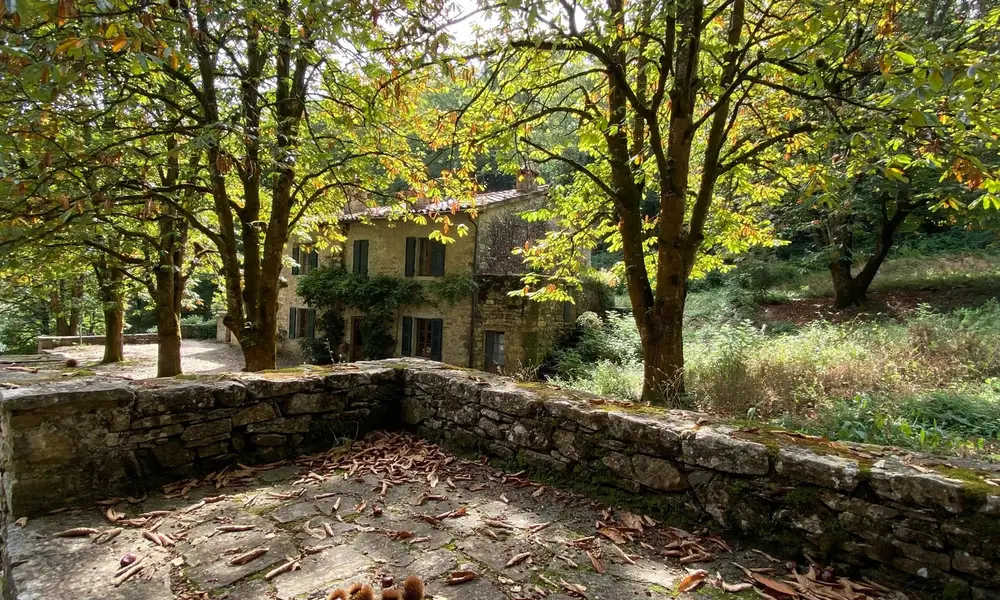
There is a particular kind of quiet that only an old chestnut grove can offer. The trees are broad and slow, their branches knit together overhead, and the ground in autumn is covered with fallen leaves and spiky green husks that split open to reveal glossy brown nuts. It is not the manicured calm of a hotel garden. It is older, wilder, and more seasonal, and that is exactly why travellers are seeking it out in 2027.
A chestnut grove retreat is a stay built around that setting. The best ones are small estates, converted farmhouses, and country hotels set inside or beside working groves, where the chestnut harvest shapes the kitchen, the walks, and the pace of the day. Either way, the point is the same: a slow, rural luxury that feels rooted in a real place.
Below are nine luxury chestnut grove retreats worth considering in 2027, from a Corsican estate to a Tuscan castle and a Dordogne chateau.
Key takeaways
- Chestnut grove retreats are at their best in autumn, from late September to early November, when the harvest, the food, and the colour are all at their peak.
- The strongest stays are small estates and converted farmhouses inside working groves, not large hotels that happen to have a few chestnut trees nearby.
- Book the harvest season early, because the best rooms sell out months ahead, and many estates close or run a reduced service in deep winter.
- A car is almost always essential, as groves sit in rural valleys and hill country, often an hour or more from the nearest station or airport.
- No retreat guarantees a harvest, a festival, or a particular menu, and weather can change the season by weeks, so treat dates and activities as flexible, not fixed.
What a chestnut grove retreat actually is
A chestnut grove retreat is a stay where the grove is the point, not the backdrop. The estate will usually have its own chestnut trees, often centuries old, and the harvest will feed the kitchen in some way, whether that is roasted chestnuts, chestnut flour bread, chestnut honey, or a local chestnut liqueur.
What separates a real grove retreat from a hotel with a nice garden is the connection to the land. The best stays offer guided walks through the groves, a chance to gather chestnuts in season, and meals built around what the estate and its neighbours grow. Others are quieter, offering little more than a beautiful room, a good table, and long walks under old trees.
The season matters more here than at a beach resort. In spring the groves are green and the walking is easy, but the chestnut connection is mostly in the kitchen and the landscape. In autumn the harvest turns the stay into something else entirely, with festivals in many chestnut regions, markets full of fresh nuts, and menus that change week by week.
How we chose these retreats and what to look for
Look first at the grove itself. A retreat should be able to say how old its trees are, how many it has, and what it does with the harvest. Our guide to luxury olive grove retreats follows the same test, because a working grove is what makes this kind of stay different from a generic country hotel.
Look next at the size and the service. The best grove retreats are small, usually under thirty rooms, and the service is personal rather than formal. That does not mean basic. It means a host who knows the walks, a cook who knows the season, and a room that is comfortable without feeling like a city hotel transplanted into the countryside.
Finally, look at the practical side. Most grove retreats need a car, and many sit at the end of a long country lane. Check the distance to the nearest town, the airport, and the station, and check whether the estate offers transfers.
The 9 best luxury chestnut grove retreats of 2027
Domaine de Murtoli, Corsica
What we like: A vast private estate on the Corsican coast with old chestnut groves inland, superb food, and a rare sense of space and privacy. What to consider: One of the most expensive stays on this list, and the estate is large, so a car is useful even inside the grounds. Best for: Couples and families who want privacy and a full estate experience. Style: Rustic luxury, stone bergeries and farmhouses. Price range: From around €600 per night. Standout feature: The estate’s own groves and farmland, with meals built around Corsican produce.
The chestnut groves sit inland from the coast, the food comes largely from the estate’s farms, and the days can be spent walking, riding, swimming, or doing very little at all.
Castello di Spaltenna, Gaiole in Chianti, Tuscany
What we like: A medieval castle and former monastery set among the chestnut woods of the Chianti hills, with a calm, elegant atmosphere and a well-regarded restaurant. What to consider: The castle sits outside the village, so a car is needed, and the dining room is best booked ahead in high season. Best for: Couples who want history, walking, and Tuscan food. Style: Historic castle hotel, stone and timber. Price range: From around €300 per night. Standout feature: The castle setting and the wooded valley walks that start at the door.
Spaltenna feels like a place that has grown out of its landscape rather than been imposed on it. The chestnut woods are part of the walk from the castle, the village of Gaiole is a short drive away, and the restaurant makes good use of the season.
Relais San Maurizio, Santo Stefano Belbo, Piedmont
What we like: A former monastery in the Langhe hills, surrounded by vineyards and chestnut woods, with a refined restaurant and a peaceful, grown-up atmosphere. What to consider: The setting is rural and the nearest town is a drive away, so plan your evenings in advance. Best for: Food lovers and walkers who want the Langhe at a slower pace. Style: Converted monastery, elegant and calm. Price range: From around €280 per night. Standout feature: The chestnut and hazelnut woods that frame the estate, and the autumn menus built around them.
San Maurizio is at its best in autumn, when the Langhe hills turn gold and the kitchen leans into chestnuts, hazelnuts, and truffles.
Château de Codignat, Bort-les-Orgues, Auvergne
What we like: A romantic chateau in the chestnut country of the Cantal, with a park, a lake, and a restaurant that takes the local harvest seriously. What to consider: The location is genuinely remote, and the chateau has a traditional, formal feel that may not suit everyone. Best for: Couples who want a classic French chateau stay in a quiet region. Style: Historic chateau, formal and romantic. Price range: From around €250 per night. Standout feature: The park and the chestnut woods that surround the chateau.
Codignat is the most traditional stay on this list, and that is its charm. The Auvergne is one of France’s great chestnut regions, and the chateau sits in the middle of it, with a park to walk in, a lake to sit beside, and a dining room that understands the local season.
Borgo Santo Pietro, Chiusdino, Tuscany
What we like: A beautiful, secluded estate in the Tuscan hills, with its own farm, gardens, and woodland, and a spa that is genuinely worth the trip. What to consider: Premium pricing, and the estate is deliberately isolated, so a car is essential. Best for: Travellers who want a private, spa-led country escape. Style: Restored borgo, refined and calm. Price range: From around €700 per night. Standout feature: The estate’s farm and gardens, and the sense of being entirely removed from the world.
Borgo Santo Pietro is less about chestnuts specifically and more about the idea of a self-sufficient Tuscan estate, but the chestnut woods are part of that world, and the kitchen uses them well in autumn.
Château de la Treyne, Dordogne
What we like: A fairytale chateau above the Dordogne river, set among the chestnut forests of the Périgord, with a respected restaurant and a peaceful, romantic setting. What to consider: The chateau is small and popular, so book early, and the river valley setting means steep lanes and a car. Best for: Couples who want a romantic chateau stay in chestnut country. Style: Historic chateau, romantic and intimate. Price range: From around €350 per night. Standout feature: The river setting and the chestnut forests that cover the surrounding hills.
La Treyne is the kind of place that makes a short stay feel like an occasion. The Périgord is one of France’s great chestnut regions, and the chateau’s restaurant makes the most of it in autumn, with chestnut dishes, local mushrooms, and duck from the region.
Il Falconaio, Cortona, Tuscany
What we like: A relaxed, family-run hotel in the hills above Cortona, surrounded by chestnut and olive trees, with a pool, a good restaurant, and views across the Val di Chiana. What to consider: The hotel is outside Cortona itself, so a car is needed for the town and for day trips. Best for: Families and couples who want a relaxed Tuscan base with a view. Style: Country hotel, warm and informal. Price range: From around €220 per night. Standout feature: The terrace views and the chestnut-shaded grounds.
Il Falconaio is the most easygoing stay on this list. The grounds are shaded by chestnut trees, the pool is a pleasure in summer, and Cortona is close enough for an evening walk and dinner.
Castello di Gargonza, Monte San Savino, Tuscany
What we like: A medieval village turned into a hotel, set in the chestnut woods of the Tuscan hills, with apartments, a pool, and a genuinely village-like feel. What to consider: The setting is rural and the village is small, so plan meals and day trips ahead. Best for: Families and groups who want space and a village to themselves. Style: Restored medieval village, rustic and spacious. Price range: From around €180 per night. Standout feature: The whole village setting, with chestnut woods all around.
Gargonza is unusual because you stay in a village, not a hotel building. The apartments are spread through the old stone houses, the pool sits in the grounds, and the chestnut woods begin at the edge of the village.
La Bastide de Moustiers, Moustiers-Sainte-Marie, Provence
What we like: A charming village inn in one of Provence’s prettiest villages, at the edge of the Verdon gorge and the chestnut hills of Haute-Provence, with a lovely garden and a well-regarded kitchen. What to consider: The inn is small and the village is popular in summer, so book early and expect company on the lanes. Best for: Couples who want a village stay with walking and good food. Style: Village inn, charming and relaxed. Price range: From around €260 per night. Standout feature: The village setting and the walks into the Verdon gorge and the surrounding hills.
La Bastide de Moustiers is the smallest and most village-like stay on this list, and that is its appeal. Moustiers is a beautiful place to wander, the Verdon gorge is close by, and the chestnut hills rise behind the village.
Which chestnut grove retreat suits you best
If you want the most complete estate experience, start with Domaine de Murtoli or Borgo Santo Pietro. Both are large, private, and self-sufficient, and both are priced accordingly. If you want history and atmosphere at a more moderate price, Castello di Spaltenna, Château de Codignat, and Château de la Treyne offer castles and chateaux in real chestnut country, with good food and a strong sense of place.
If you want a relaxed base for walking and day trips, Il Falconaio and La Bastide de Moustiers are the easiest choices. They are smaller, friendlier, and close to towns and villages worth exploring. If you are travelling with family or a group, Castello di Gargonza is the practical pick, because the village apartments give everyone space. A luxury orchard retreat can be a good alternative if your dates fall outside the chestnut season, because the orchard estates follow a similar rhythm of harvest, food, and slow days.
Whichever you choose, match the stay to the season. Autumn is the obvious choice, but late spring and early summer have their own pleasures: green groves, empty lanes, and warm evenings on a terrace.
The caveats that matter
Chestnut grove retreats are wonderful, but they are not for everyone. They are rural, seasonal, and slow, and that is the point. The best way to enjoy this kind of stay is to accept its pace: long walks, long lunches, and long evenings with very little to do.
| Detail | What is known |
|---|---|
| Best season | Late September to early November for the harvest; late spring for green groves and quiet lanes |
| Typical price | From around €180 to €700 per night, depending on the estate and the season |
| Getting there | A car is almost always essential; many estates are an hour or more from the nearest airport or station |
| How long to stay | Three to five nights is ideal; one night is rarely enough to settle into the pace |
| Who it suits | Couples, food lovers, walkers, and anyone who wants a slow, rural stay |
| Who should think twice | Travellers who want nightlife, shopping, or a beach, and anyone who dislikes driving on country lanes |
| What to check before booking | Harvest dates, restaurant opening days, pool and spa seasons, and whether the estate offers transfers |
| What is not guaranteed | Harvest dates, festivals, and menus can shift with the weather, so treat them as flexible, not fixed |
One practical note: chestnut allergies exist, and chestnut flour, chestnut honey, and chestnut dishes are common in these regions. If you have a nut allergy, tell the estate and the restaurant in advance, and ask about the ingredients in the dishes you are offered.
Checklist: choosing a chestnut grove retreat honestly
Use these checks before you book, and again before you travel.
- Check the grove: ask how old the trees are, how many there are, and what the estate does with the harvest.
- Check the season: confirm the harvest dates, the restaurant opening days, and whether the pool and spa run in your month.
- Check the transport: confirm the drive from the airport or station, and whether the estate offers transfers.
- Check the size: small estates under thirty rooms tend to feel more personal than large hotels.
- Check the food: ask whether the restaurant uses the estate’s own produce and whether it is open every night of your stay.
- Check the walking: ask about the grove walks, the terrain, and whether a guide is available in your season.
Frequently asked questions
When is the best time to visit a chestnut grove retreat?
Late September to early November is the classic season, because that is when the chestnuts fall, the festivals happen, and the menus change to match.
Do I need a car for a chestnut grove retreat?
Almost always, yes. Grove retreats sit in rural valleys and hill country, often an hour or more from the nearest station or airport.
Are chestnut grove retreats suitable for families?
Yes, especially the larger estates and village stays such as Castello di Gargonza and Domaine de Murtoli, which have space, grounds, and activities for children.
What should I pack for a chestnut grove stay?
Sturdy walking shoes, layers for cool mornings and warm afternoons, a light waterproof jacket, and something smart enough for dinner.
Can I take part in the chestnut harvest?
Often, yes, in season. Many estates welcome guests to join a guided harvest walk, and some offer chestnut picking, roasting, and cooking sessions. A luxury garden retreat offers a similar hands-on feel if your dates fall outside the chestnut harvest.
How much should I budget for a chestnut grove retreat?
Rooms on this list start from around €180 per night and rise to around €700 at the most private estates. Add the cost of a hire car, meals outside the estate, and any guided activities.
The bottom line
The best luxury chestnut grove retreat in 2027 is not the most expensive or the most famous. It is the one that matches how you like to travel: a private estate for a long, slow stay, a castle or chateau for history and atmosphere, or a village inn for walking and good food.
Book the autumn season early, hire a car, and give yourself at least three nights. That is the honest way to enjoy a chestnut grove retreat, and it is what makes this kind of stay worth the trip.