A sapphire necklace is the most forgiving sapphire jewel to wear and one of the easiest to buy badly. The stone sits away from knocks, so it rarely chips, and its deep blue suits almost every skin tone. What goes wrong is everything around the stone: a chain too fine for the pendant, a wrong length, or a clasp that gives up.
A necklace is three purchases in one — stone, setting and chain — and the price only makes sense when all three hold up together. A beautiful sapphire on a flimsy chain is a necklace you will lose, not wear.
This guide covers what matters before you buy: colour, clarity and cut, pendant styles, chain length and strength, clasps, treatments, and prices in 2027. A necklace has its own questions — how it hangs, how it moves and how it sits on the neck.
Key takeaways
- Colour matters most: rich, even blue with strong saturation and a medium to medium-dark tone, judged in daylight and against your own skin.
- Buy the chain with the pendant, not after it: the chain must be strong enough for the pendant’s weight, or the necklace will break or be lost.
- Chain length decides how the necklace looks: 16 inches sits at the collarbone, 18 inches is the everyday standard, and longer lengths suit larger pendants.
- Most sapphires are heat-treated, which is standard and permanent, but it must be disclosed — never pay an untreated price for a heated stone.
- Check the clasp, the bail and the way the pendant hangs before you pay: a pendant that constantly flips shows its back, not its face.
What makes a necklace different from a ring or earrings
With a ring, the stone sits still and the setting takes the knocks. With earrings, the pair must match and the backs must hold. A necklace moves all day: the pendant swings, turns, slides along the chain and catches on scarves, collars and seatbelts.
First, the stone is seen against skin, hair and clothing, so a sapphire that looked vivid on a white tray can look almost black against a dark top. Hold the pendant against your own skin in daylight before you decide. Second, the chain is a wear item, and a chain too thin for its pendant will stretch, kink and eventually snap.
Colour: the factor that sets the price
Colour is the single biggest driver of sapphire value, and in a necklace it matters even more than in a ring, because the stone is seen from a distance and against skin. Jewellers judge hue, tone and saturation: the most prized blue is pure to slightly violetish, strongly saturated, and medium to medium-dark in tone — often called royal blue or cornflower blue.
Avoid stones that are too dark, which look inky indoors and nearly black against dark clothing, or too pale, which look washed out on the neck. A greenish or greyish cast lowers the value, as does obvious colour zoning. Check the colour in more than one light: shop lighting flatters every stone, so ask to see it in daylight and then in a dimmer room.
Clarity and cut: what to look for on the neck
Almost every natural sapphire contains inclusions, tiny internal features formed as the crystal grew. Fine silk can give a velvety look, but too much makes a stone hazy. Look for a stone that is eye-clean, with no flaws visible to the naked eye. Surface-reaching cracks can weaken the stone and must be disclosed.
Cut decides how lively the stone looks when it moves. A well-cut sapphire looks bright and balanced, with colour spread evenly across its face. Watch for windowing, a washed-out patch in the centre of a shallow stone, and dark areas in stones cut too deep. Judge pendant size in millimetres rather than carats alone: 8 to 10 millimetres is a delicate everyday size, 12 to 15 millimetres makes a clear statement, and anything above that needs a stronger chain.
Pendant, strand or rivière: choose the style first
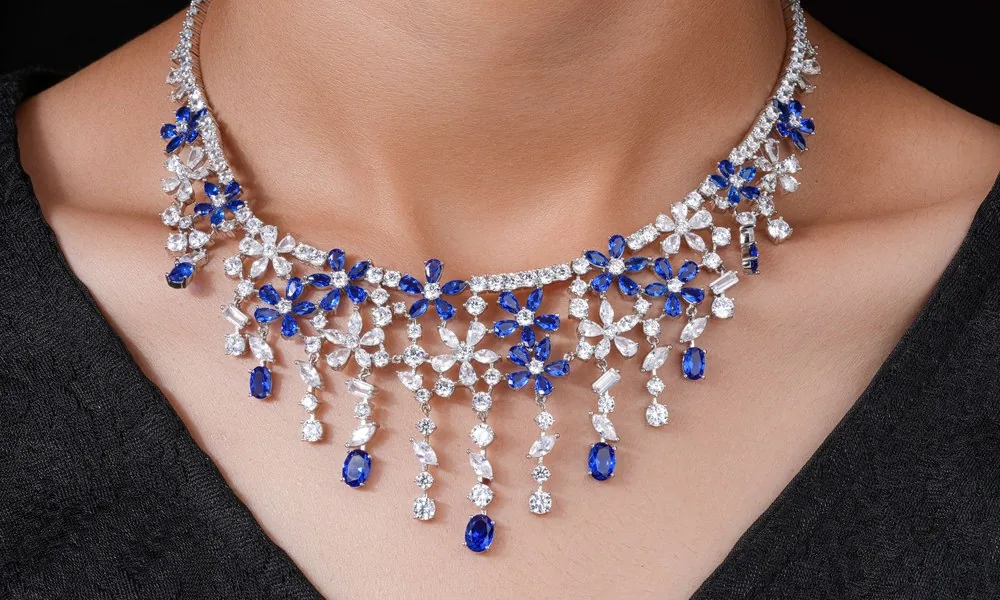
The style changes everything about how a sapphire is worn, so decide it before you fall in love with a stone. A solitaire pendant is the classic choice: one sapphire, cleanly set, on a fine chain. It suits daily wear and layering, and it puts the whole budget into one good stone. A halo pendant, where the sapphire is ringed by small diamonds, makes the centre stone look larger, but it adds cost.
Drop pendants add movement and length, but check that the drop swings freely and does not twist the chain. A rivière, a continuous line of matched sapphires, is the grandest style and the hardest to buy well: every stone must match in colour, tone and size. A prong setting shows more stone; a bezel setting protects it better. The bail should be soldered closed and smooth inside, so it does not wear the chain. For the main designs side by side, see our best sapphire necklaces guide.
Chain length: where the pendant should land
Chain length is a fit question, not a fashion one, and it is the easiest thing to get wrong when buying online. Measure before you order: lay a soft measuring tape where you want the pendant to land, or measure a necklace you already wear well. An extender of two inches is worth having, since it lets one necklace sit right on different necklines. Our best pendant necklaces guide shows how different lengths sit on different necklines.
| Chain length | Where it sits | Best for |
|---|---|---|
| 14 inches (35 cm) | High on the neck, choker length | Small pendants, layering over a base chain |
| 16 inches (40 cm) | At the collarbone | Delicate pendants, crew necks and blouses |
| 18 inches (45 cm) | Just below the collarbone | Everyday wear, most pendant sizes |
| 20 inches (50 cm) | At the top of the bust | Larger pendants, V-necks and open collars |
| 22 inches (56 cm) | Mid-bust | Statement pendants, layering over clothes |
| 24 inches (60 cm) | Below the bust | Long drops, wearing over knitwear |
| 30 inches (76 cm) or more | Opera length, below the bust | Strands and rivières, evening wear |
| Adjustable with extender | Varies by two inches or more | One necklace, several necklines |
Chain strength, clasps and metals
A chain must be matched to the pendant it carries, and this is where most necklaces fail. A large sapphire needs a curb, rope or Singapore chain with real substance. Hold the chain and feel its weight — a chain that feels insubstantial next to its pendant is a chain that will stretch and snap.
The clasp is the part you will touch every day, and the part most likely to fail. A lobster clasp is strong and easy to use, and it is the best default for a valuable necklace. A spring-ring clasp is lighter and cheaper, but it is fiddly and weaker, and it is the wrong choice for a heavy pendant. A magnetic clasp is convenient but risky: it can pull open if the pendant catches on clothing. Test the clasp yourself — open and close it several times and tug it gently. White gold and platinum make blue sapphires look cooler and more vivid; yellow gold warms the blue.
Treatments, natural versus lab-created, and paperwork
Most sapphires on the market have been heat-treated to improve their colour and clarity. Heating is standard, permanent and accepted by every gemmological laboratory, and a heated sapphire is a perfectly good buy — but it must be disclosed and priced accordingly. Untreated sapphires with fine colour cost far more, so ask for a lab report on any expensive stone.
Other treatments are a different matter. Lattice diffusion, where colour is driven into the stone’s surface, and fracture filling, where cracks are filled with glass, both reduce value sharply and can affect durability. A diffused or filled stone should cost far less than a heated one. If a price looks too good for the colour, ask directly whether the stone has been diffused or filled, and walk away if the answer is vague.
Natural and lab-created sapphires can both be good buys, if you know which one you are paying for. Lab-created sapphires are real sapphires, chemically identical to natural ones, grown in a laboratory; they cost far less per carat. What you must never pay is a natural price for a lab-created stone. A report from GIA, SSEF or Gübelin settles the question. If you are buying your first fine necklace, our guide to buying your first fine jewellery explains the paperwork to ask for.
What a sapphire necklace costs in 2027
Sapphire prices vary more than diamond prices. A commercial-grade heated blue sapphire of around one carat typically costs a few hundred dollars per carat, while a fine heated stone of the same weight can cost several thousand per carat. Unheated fine stones cost roughly 40 to 80 percent more.
Prices rise steeply with carat weight, so a three-carat stone is not three times the price of a one-carat stone — it can be five to eight times the price. That is why a necklace with several smaller matched sapphires often costs far less than a single large pendant of the same total weight. Do not forget the metal and the making: a platinum chain and a hand-finished setting can add hundreds, and they should be itemised on the receipt.
Before you buy: the checklist
- Check the colour in daylight and against your own skin, not just under shop lights.
- Hold the pendant at arm’s length and tilt it — it should stay a rich blue, with no washed-out window in the centre.
- Match the chain to the pendant’s weight, and ask for the chain’s weight in grams.
- Test the clasp yourself, open and close it several times, and tug it gently.
- Ask in writing whether the stone is heated, diffused, filled, natural or lab-created.
- Get a lab report for any expensive stone, and check that the receipt matches what you were told.
Frequently asked questions
How much should I spend on a sapphire necklace?
A good everyday sapphire pendant on a solid gold chain can be found for a few hundred pounds, while a fine one- to two-carat pendant with a lab report can cost several thousand. Put most of your budget into the stone and the chain.
What length of sapphire necklace should I buy?
For most people, 18 inches is the safest choice: it sits just below the collarbone, suits most pendant sizes and works with most necklines. Choose 16 inches for a delicate pendant or a crew neck, and 20 inches or more for a larger pendant or a V-neck.
Is a heated sapphire necklace a bad buy?
No. Heating is standard, permanent and accepted by every major laboratory, and the large majority of sapphires on the market have been heated. A heated sapphire is a good buy at a heated price. What matters is disclosure: never pay an untreated price for a heated stone.
Can I wear a sapphire necklace every day?
Yes. Sapphire scores 9 on the Mohs hardness scale, second only to diamond, so it resists scratches and will not fade with normal wear. Take it off for heavy work and the gym, where a swinging pendant can knock against hard surfaces, and store it flat in a soft pouch so the chain does not tangle.
How do I clean a sapphire necklace?
Clean it in warm water with a drop of mild washing-up liquid and a soft brush, then rinse and pat dry. Avoid ultrasonic and steam cleaners if the stone has been fracture-filled or diffused.
Should I choose a natural or a lab-created sapphire necklace?
Choose natural if rarity and resale value matter to you, and lab-created if size and colour matter more than origin. Lab-created sapphires are real sapphires, chemically identical to natural ones, and they cost far less per carat.
The bottom line
A good sapphire necklace is bought in the right order: colour first, judged in daylight and against your skin; then the style that suits how you actually wear jewellery; then a chain and clasp strong enough for the pendant they carry; and finally the paperwork that proves what you paid for. Get those four right and the necklace will still be worth wearing in ten years.
Note: Prices and treatments reflect the market in late 2026 and early 2027, and vary by origin, size and seller. Always ask for the treatment and origin in writing, and get an independent lab report for any expensive stone before you pay.