



Emerald earrings put vivid green right beside the face, where it brightens the eyes and lifts even the simplest outfit. They are also one of the most forgiving fine-jewellery buys: earrings take far fewer knocks than rings.
The trick with earrings is that you are buying two stones, not one. A single emerald only has to be beautiful; a pair has to agree with each other. Colour, size, shape and clarity all have to match, and a mismatch that would pass unnoticed in a pendant is obvious when the two stones sit at the same height, in the same light, a few inches apart.
This guide covers colour, pair matching, clarity, oiling, cut, styles, settings and backs, metal, price, fakes and care, all through the lens of earrings.
Key takeaways
- Judge the pair, not the stone: both emeralds must match in colour, tone, size and shape, checked together in daylight.
- Colour comes first: a vivid, slightly bluish green with strong saturation and a medium to medium-dark tone.
- Expect the jardin: inclusions are normal in emerald, but avoid surface-reaching fractures and stones that look cloudy face-up.
- Ask about oiling: get the treatment grade in writing, with a lab certificate for stones over half a carat each.
- Match the style and back to real wear: bezels and screw backs daily, drops for occasions.
Why earrings are the kindest place for emerald
Emerald is the green variety of the mineral beryl, coloured by chromium and sometimes vanadium. It is the birthstone of May and the traditional gem for 20th and 35th wedding anniversaries. It measures 7.5 to 8 on the Mohs hardness scale, but almost every natural emerald carries internal fractures, so it is more brittle than its hardness suggests.
A ring knocks against doors, desks and car keys all day; an earring rarely touches anything harder than a hairbrush or a phone. That is why jewellers often steer first-time emerald buyers towards earrings: the stone is protected by its position, so you can spend more of your budget on colour and less on armour.
Start with the pair, not the stone
Pair matching is the single biggest difference between buying emerald earrings and buying any other emerald jewel. Because the two stones are worn at the same height and in the same light, any difference in shade, saturation or undertone is instantly noticeable, and no setting can hide it.
Reputable makers source pairs from the same rough lot, cutting both stones from material that shared a colour, rather than matching two separate stones that happen to meet the same grade. Ask how the pair was matched. If the seller cannot answer, that is useful information in itself.
Check the pair the way you will wear it: hold both earrings side by side in natural daylight, against a white background, at arm’s length. Shop lighting flatters both stones equally, which hides a mismatch.
Colour at face level
Colour is the most important value factor in emerald, outranking carat weight, clarity and even cut. The finest stones show a vivid, slightly bluish green with strong saturation and a medium to medium-dark tone. Stones that are too pale look washed out, while stones that are too dark turn blackish in indoor light.
Earrings add one extra consideration: the stone sits against skin, hair and clothing, and all three change how the green reads. Try them on and judge them in daylight, not under shop lights. Yellow gold warms the green; white gold or platinum makes it look cooler and brighter.
Clarity, oiling and the jardin
Unlike diamonds, where a loupe-clean stone is the ideal, virtually every natural emerald contains inclusions. Gemmologists call them the jardin, French for garden: tiny crystals, veils and healed fractures that can look like moss or foliage under magnification.
That does not mean any inclusion is acceptable. Avoid heavy clouding, obvious cracks and surface-reaching fractures, because in a brittle stone a fracture at the surface is a weak point that can grow with a knock.
Most natural emeralds, up to nine in ten, have been oiled: colourless cedar oil or a synthetic resin fills surface-reaching fractures and improves the stone’s apparent clarity. What matters is the degree, stated on a laboratory report from insignificant or minor oil through moderate to significant. Minor oiling is the sweet spot. Heavily oiled stones sell for much less, and coloured resins are the red line. Ask for a lab report (GIA, Gübelin, SSEF or AGL) for any expensive pair, and get the treatment in writing.
Cut and shape for earrings
Emerald is most often cut in the emerald cut, a rectangular step cut with truncated corners designed for this stone: the cut corners protect the edges from chipping, and the broad, flat facets show off colour and clarity.
A well-cut emerald shows even colour and lively reflections. A shallow one looks flat, with a pale, lifeless patch in the centre called a window, while a stone cut too deep can show dark, dead zones. In a pair, the two cuts must match as well, or the stones will catch the light differently.
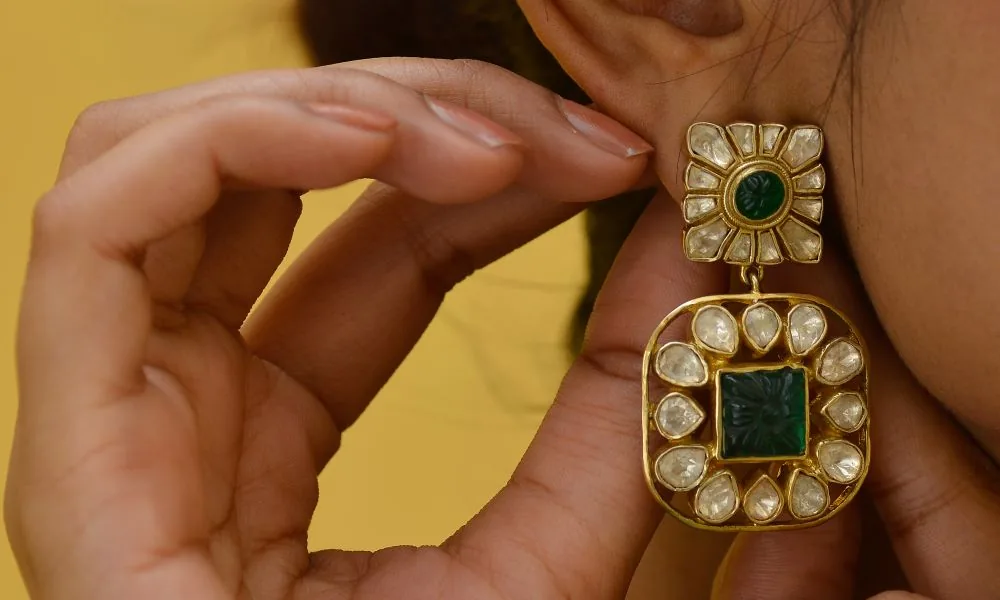
Choose the style first
The style decides how the emerald is seen, how it moves and how often you will reach for it. Studs are the everyday choice: they sit flat against the ear, stay out of the way of scarves, collars and phones, and put all the attention on the stone. Drops let the stone move and catch the light, which can intensify the depth of the green.
| Style | Best for | What to check |
|---|---|---|
| Studs | Everyday wear, work, first pair | Pair match, secure backs, stone sits flat |
| Drops | Evening, occasions, longer hair | Length suits your face, hook or leverback holds |
| Hoops and huggies | Daily colour, casual outfits | Clasp clicks firmly, stones sit low in the metal |
| Halos | Extra sparkle, smaller centre stones | Accent stones are even and tightly set |
| Chandeliers | Formal events, statement looks | Weight, balance, and that nothing snags |
| Clusters | Vintage feel, generous look | Stones match across the whole cluster |
| Threaders | Modern, minimal styling | Chain slides smoothly and stays put |
| Ear climbers | Contemporary looks, short hair | Fit follows the ear without pinching |
Long hair hides studs and tangles in chandeliers; short hair shows everything, including a mismatch.
Settings, backs and security
A bezel setting, where a rim of metal wraps the stone, protects the edges and is the safest choice for a valuable stone or for daily wear. A halo protects the edges too, and adds sparkle. Prongs are fine in earrings, particularly low, sturdy ones, but tall, exposed prongs leave the stone’s corners vulnerable and suit occasional wear better.
The back is where earrings are most often lost, and it deserves as much attention as the stone. Push backs are fine for light studs but can loosen over time, so check them regularly. Screw backs are the most secure choice for valuable studs. Leverbacks suit drops, closing with a reassuring click.
Metal, skin and comfort
For the metal, solid 14k or 18k gold and platinum are the reliable choices. Gold-plated base metal is a false economy: it can irritate sensitive ears, and the plating wears through. If your ears are sensitive, look for nickel-free gold or platinum.
Weight is the comfort question that buyers most often forget. A pair of emerald drops can look light and feel heavy after an hour, and heavy earrings stretch the piercing over time. Try the pair on and wear them for a few minutes in the shop.
Size, proportion and price
With earrings, proportion matters more than carat weight. Studs of 0.5 to 1 carat per stone suit most ears for daily wear. Spend on colour and matching before size.
Price follows colour, origin, treatment and size, in that order. A vivid, lightly oiled pair with a lab report will cost several times more than a pale, heavily treated pair of the same weight. As a rough guide for 2027, good emerald studs in gold start in the low four figures and rise steeply with colour and size, while fine drops with certified stones can reach well into five figures. If a price looks too good for the colour on offer, assume the treatment is heavy or the stone is not natural.
Spotting fakes and poor value
The most common traps are green glass, green synthetic spinel and heavily dyed or resin-filled stones sold as fine natural emerald. Dyed stones show colour concentrated in fractures, like green veins under magnification. None of this is easy to spot without experience, which is why the certificate matters more than your eye.
For any stone over 0.5 carats, ask for a laboratory report matching the pair, including the treatment grade for both stones. Buy from a seller who discloses treatment in writing and offers a return period long enough for an independent check. For more on how the same emerald rules play out in a single-stone jewel, see our guide to what to look for in an emerald bracelet, and to compare how another green stone behaves in earrings, read what to look for in an aquamarine earring.
Caring for emerald earrings
Clean emerald earrings only with lukewarm water, a drop of mild soap and a soft brush, and dry them gently with a soft cloth. Never use ultrasonic or steam cleaners, and keep emerald away from perfume, hairspray and household chemicals, all of which can strip the oil and dull the stone.
Store the pair separately from harder gemstones, which can scratch emerald. If you are building a collection, our round-up of the best emerald earrings of 2027 shows how different styles and settings wear in practice.
Before you buy: the checklist
- View both stones together in daylight, on a white background, and confirm the colour, tone and size match.
- Get the oiling or treatment grade in writing for both stones, and a lab certificate for any stone over 0.5 carats.
- Check the backs: screw backs for valuable studs, leverbacks for drops, and a firm click on any clasp.
- Try the pair on for several minutes and check the weight, the balance and how the colour reads against your skin and hair.
- Confirm the metal is solid gold or platinum, nickel-free if your ears are sensitive, and not plated base metal.
- Ask about returns, aftercare and whether findings can be tightened or swapped later.
Frequently asked questions
Are emerald earrings suitable for everyday wear?
Yes, with the right setting. Emerald at 7.5 to 8 on the Mohs scale is hard enough for daily earring wear. Studs in a bezel or a low prong setting with a screw back are the safest everyday choice.
How much should I spend on emerald earrings?
Expect good emerald studs in gold to start in the low four figures in 2027, rising steeply with vivid colour, light treatment and larger stones.
How can I tell if emerald earrings are real?
Be suspicious of glassy perfection, round bubbles or colour concentrated in cracks. The reliable answer is paperwork: a laboratory report confirming natural emerald and stating the treatment grade for each stone.
Do emerald earrings need to match exactly?
As closely as possible, yes. Earrings are worn side by side in the same light, so differences in colour, tone or size are easy to see.
What is the best setting for emerald earrings?
A bezel is the most protective, wrapping the stone in metal and shielding its edges, which suits daily wear and valuable stones.
How do I clean emerald earrings?
Use lukewarm water, mild soap and a soft brush, then dry with a soft cloth. Never use ultrasonic or steam cleaners, and keep the earrings away from perfume, hairspray and household chemicals.
The bottom line
The best emerald earrings are not the biggest or the most expensive pair in the shop; they are the pair that matches, holds its colour in daylight, and feels so comfortable you forget you are wearing them.
Note: Prices and availability change, and every natural emerald is different, so treat the figures here as a guide for 2027 rather than a quote. For any significant purchase, ask for a laboratory report and have the pair checked independently during the return period.


