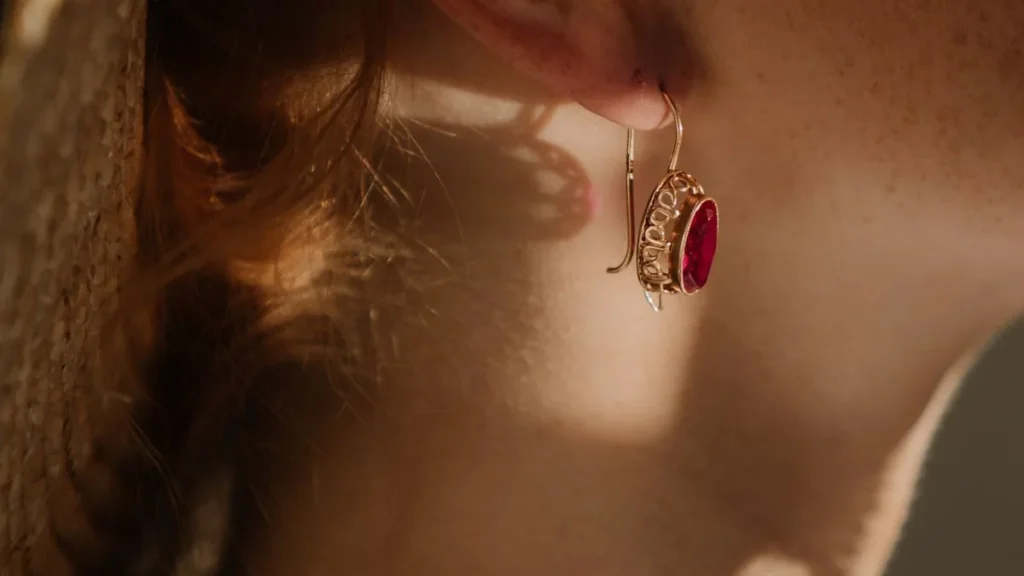
A ruby earring is the most flattering way to wear this stone, and the easiest to buy badly. In a jeweller’s window, every pair looks like the same rich red glow. On your ears, in daylight, the differences appear at once: one pair sits bright against your skin, another turns dark and dull, and a third pulls until you take it off by lunchtime.
Ruby is red corundum, coloured by traces of chromium, and at 9 on the Mohs scale it is one of the hardest gemstones used in jewellery. Yet hardness alone does not make a good pair: colour, treatment, matching, setting and comfort decide whether you wear them for years or leave them in a drawer.
This guide covers colour, matching, clarity, cut, styles, settings, backs, treatments, prices and care, It needs patience, good light, and three questions before you pay: what is the treatment, are the two stones truly matched, and is there a laboratory report?
Key takeaways
- Colour decides value: a vivid, saturated red with a hint of pink, checked in daylight against your own skin.
- Buy a matched pair, not two stones: both earrings must agree in colour, size and cut, or the mismatch shows on your face.
- Comfort is half the purchase: check the weight, the back and the post before you fall for the colour.
- Most rubies are heat treated, which is accepted when disclosed; avoid lead-glass filling in earrings you wear often.
- Above a modest price, ask for a GIA, AGL, Gübelin or SSEF report, and check it matches the stones.
An earring is a pair, not a single stone
A ring is judged as one stone. An earring is judged as two, side by side, on your face, in motion. Two rubies from the same parcel can differ: one slightly pinker, one slightly darker, one a touch larger. On your ears, in daylight, the mismatch is the first thing anyone notices. Ask the jeweller to show the pair together, against your own skin.
Earrings are sold by total carat weight, which is the two stones added together, so a pair described as two carats is two one carat stones. Check each stone separately: a tenth of a carat difference is invisible, but a quarter of a carat will show. A ring takes knocks all day and needs a protective setting for that reason, as our guide to what to look for in a ruby ring explains,.
Colour comes first
With ruby, colour is the most important quality factor, ahead of clarity, cut and size. The finest ruby has a pure, vibrant red to slightly purplish red colour, with vivid saturation, neither too dark nor too light. The old trade name for the best of it is pigeon’s blood: an intense, pure red with a slight blue undertone.
Look at the pair in daylight, not only under the jeweller’s spotlights. Shop lighting is designed to flatter gems, and a ruby that looks fiery under a halogen lamp can turn dark and dull by a window. Watch for brown and orange undertones: a brownish red reads muddy, while an overly orangey stone can be mistaken for a garnet.
Clarity and cut
Rubies are rarely as clean as diamonds, and that is expected. Most contain inclusions, tiny internal features. What matters is whether the inclusions dull the stone or weaken it. Avoid large, dark inclusions near the centre, surface-reaching cracks, or a cloudy patch that kills the transparency in either stone of the pair.
Cut controls how the colour presents face-up. Oval and cushion cuts are the most common for ruby earrings, because they show a large face for their weight and suit both studs and drops. Tilt the pair: a stone with a pale window in the centre will flash colourless every time you turn your head, while a stone cut too deep looks small for its weight and dark in the middle.
Earring styles: studs, drops, hoops and chandeliers
The stud is the simplest choice and often the best: one ruby in each ear, nothing competing with it, worn every day with everything. Studs suit a stone with strong colour, because there is nowhere for a pale stone to hide. Choose a low setting and a back that holds the stud flat.
The drop hangs the stone below a small link, so it moves and catches the light as you walk. A drop flatters a slightly paler stone, because movement creates flashes of colour a still stud cannot. Check that it hangs straight, does not flip, and does not brush your jawline.
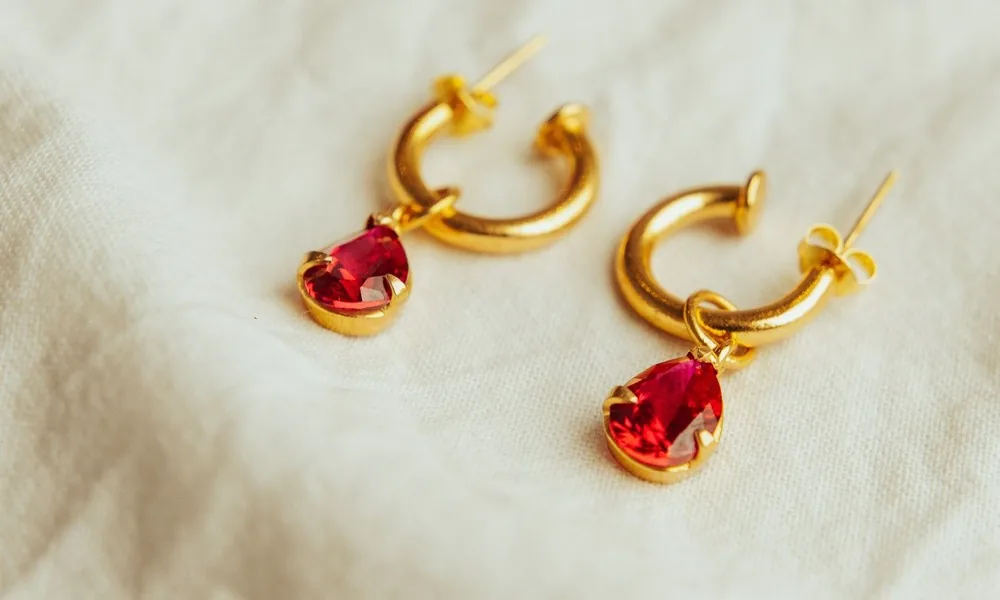
Small hoops set with rubies suit everyday wear and flatter most faces. A hoop with a ruby drop at the bottom is a bolder evening choice, but it is heavier, so the hoop must be light and the closure secure.
The chandelier is the occasion style: several stones arranged in tiers, worn for weddings and evenings. It is the hardest style to match, since four, six or more stones must all agree in colour. Check every stone, not just the largest one, and check the weight first.
Ruby earrings at a glance
| Factor | What to look for |
|---|---|
| Colour | Vivid, saturated red with a hint of pink, even across both stones |
| Matching | Both stones the same colour, size and cut, checked in daylight |
| Clarity | Eye-clean or fine silk only; no cracks or cloudy patches in either stone |
| Cut | Oval, cushion, round or pear; no pale window in the centre when tilted |
| Stone size | 0.5 to 1 carat each for studs; 1 to 2 carats total for most drops |
| Best setting | Bezel or halo in yellow gold; six low prongs for studs |
| Backs and comfort | Secure screw or large disc back; light enough to wear all day |
| Price | $300 to $1,200 for studs; $800 to $4,000+ for drops and halos |
Settings and metals
The setting is half the purchase. A bezel sets the stone inside a rim of metal: the most protective setting, and the neatest against hair and clothing, since there are no prongs to snag. A halo surrounds the centre stone with small diamonds, which protects the ruby’s edges and makes the red look stronger by contrast.
If you prefer prongs, choose six rather than four and keep them low. Tall prongs catch on hair and knitwear, and a snagged prong bends, which is how stones are lost. Yellow gold flatters red best and is the classic partner for ruby, while white gold or platinum suits a cooler, slightly purplish red., as our guide to the best gold jewellery for everyday wear explains. For earrings, 14K gold is the practical choice: lighter and harder than 18K.
Backs, posts and comfort
Backs are the part buyers check last and regret first. A butterfly back is the everyday default, fine for light studs. A screw back is more secure and worth the small extra cost for anything valuable, because it cannot slide off. A large disc back spreads the weight and stops a heavy stud drooping forward, the most common complaint with ruby studs over one carat each.
Weight is the comfort test. Half carat studs weigh very little; two carat drops with halos are a different matter. Try the pair on, wear it for ten minutes in the shop, and walk around. If your lobes ache, the earrings are too heavy for daily wear. Ask what the posts are made of: solid 14K gold, platinum or titanium are safest for sensitive ears, and avoid plated posts, whose plating wears off inside the piercing. The same comfort checks apply to any coloured-stone pair, as our guide to what to look for in a morganite earring shows.
Treatments: the question to ask first
Almost every ruby on the market has been heat treated, and that is accepted in the trade when it is disclosed. Gentle heating improves the colour and clarity, and the result is stable. What changes value dramatically is everything else: lead-glass filling, surface diffusion and dyeing. A lead-glass filled ruby is heavily fractured corundum filled with glass. It looks red and costs a fraction of a true ruby, but it is fragile and must never be sold at a natural ruby price.
Ask in writing what treatment each stone received, and get the answer on the receipt. A seller who cannot answer, or who calls a stone untreated without a laboratory report, is a seller to walk away from. Lab-grown rubies are real rubies in chemistry, but they should be priced as lab-grown, far below natural.
How much should you pay?
Start with the loose stones. Fine ruby of vivid colour, well cut and lightly included, can cost several hundred to several thousand dollars per carat, and fine unheated stones of over a carat command far more. Colour is what you pay for: a strongly red half carat stone can cost more per carat than a dark two carat one.
For finished earrings, simple 14K gold studs with heated rubies typically cost $300 to $1,200, a halo pair in 14K gold $800 to $2,500, and drops or chandeliers $1,000 to $4,000 or more. If a price looks far below them, check the treatment and the metal first: lead-glass filled stones and plated earrings are the usual explanations.
Wearing and caring for it every day
At 9 on the Mohs scale, ruby resists everyday scratching better than almost any coloured gem, which is why it suits earrings so well. But hardness is not toughness: a hard knock can still chip a facet edge, so a bezel or halo earns its keep on earrings that swing. Put the pair on after perfume, hairspray and sunscreen, not before.
Store the pair in a soft pouch of its own, with the backs on, so the two earrings cannot scratch each other. Clean the stones with warm water, mild soap and a soft brush, and dry them before putting them away. Ask the jeweller before using an ultrasonic cleaner, and never use one on a lead-glass filled ruby.
Your ruby earring checklist
- See the pair together in daylight, against your own skin, with your hair worn as usual.
- Check both stones match in colour, size and cut, with no pale window when tilted.
- Choose a vivid, saturated red with no brown or orange undertone.
- Try the pair on for ten minutes: check the weight, the back and whether the stud droops.
- Ask in writing what treatment each stone received, and whether it is natural or lab-grown.
- Check the posts match the setting metal, the backs fit tightly, and drop closures click shut.
Frequently asked questions
What size ruby is best for earrings?
Half a carat to one carat each for studs; one to two carats total for drops.
Are ruby earrings good for everyday wear?
Yes, with normal care. Ruby is 9 on the Mohs scale, and a bezel or halo protects its edges. Choose light studs for daily wear and keep heavier drops and chandeliers for occasions.
Is yellow gold the best metal for ruby earrings?
Usually, yes. Yellow gold warms the red and is the classic partner for ruby. White gold or platinum suits a cooler, slightly purplish red, while rose gold can pull out the orange side.
Do ruby earrings need a certificate?
Above a modest price, yes. Ask for a report from GIA, AGL, Gübelin or SSEF, and check that it matches the stones you are buying, including the treatment and whether the ruby is natural or lab-grown.
What is the best back for ruby studs?
A screw back is the most secure, and a large disc back stops a heavy stud drooping. A butterfly back is fine for light studs, but check it often: it is the back most often lost.
Are ruby earrings a good gift?
They are one of the easiest fine jewellery gifts: no size to guess, and studs suit almost everyone. Choose a vivid red in yellow gold, with secure backs, and keep the receipt and the certificate.
The bottom line
A good pair is bought as a pair, in daylight, against your own skin, with the weight tried on and the treatment in writing. Colour comes first, then a cut with no window, then a protective setting and comfortable backs.
Note: Prices are typical 2027 retail ranges and vary by jeweller, metal, stone quality and treatment. Every stone is different, so compare pairs side by side before you buy.