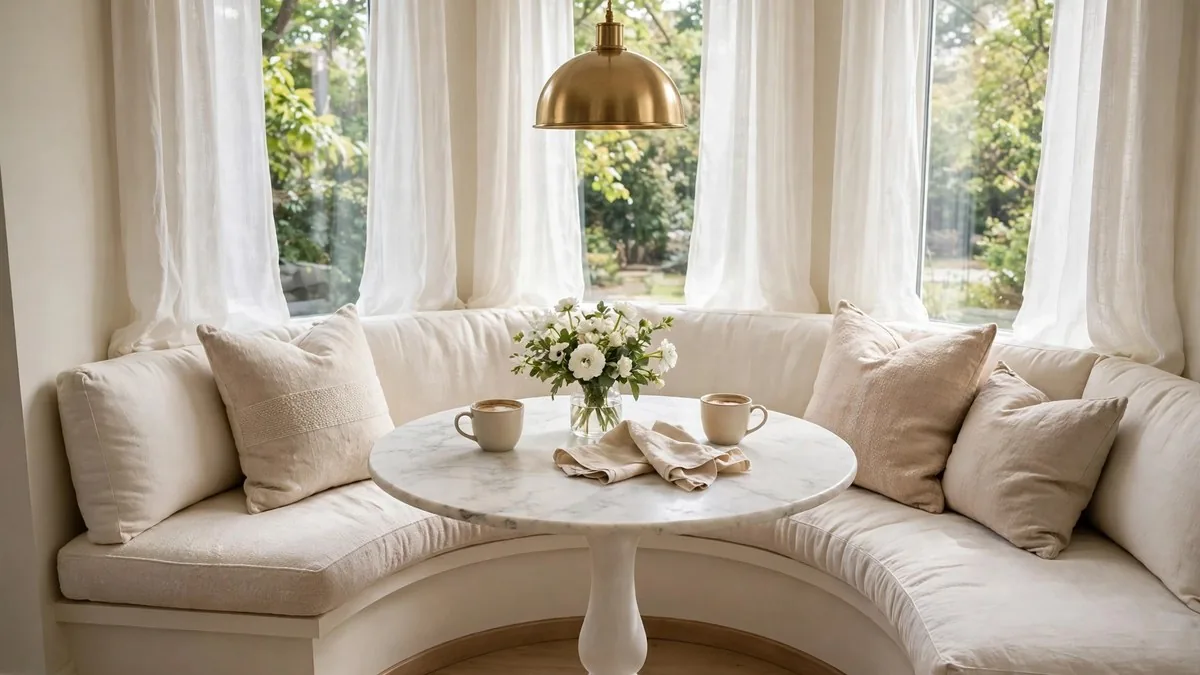

A luxury breakfast nook is not a small dining room. It is a corner with a job: the first coffee of the day, a slow weekend brunch, homework spread across the table while dinner simmers. Done well, it becomes the most-used seat in the house.
What makes one feel luxurious is rarely money spent on a single piece. It is the fit. The bench meets the wall without a gap, the table is exactly the right size for the people who eat at it, the light falls on the table, and everything within reach has a place to go when the meal is over.
This guide works through the decisions in the order that matters: the corner first, then the seating, the table, the light, the materials and the storage. Follow that order and even a modest budget produces a corner that feels considered.
Key takeaways
- Put the nook where the morning light is: a window, a bay or a garden-facing corner beats a dark wall.
- Build the banquette first: 45 cm seat depth and height, 60 cm of table width per person.
- Choose a round or oval pedestal table for tight corners; a rectangle only earns its place in a wide, straight nook.
- Hang one pendant 75 to 85 cm above the tabletop at 2700K, on a dimmer.
- Hide clutter inside the bench: lift-up seats keep linens and school things out of sight.
Start with the corner, not the catalogue
Every good nook begins with a walk around the kitchen at breakfast time. Where does the sun land at eight in the morning? Which corner is out of the cooking traffic but still close enough to the kettle? A nook behind the fridge door will be abandoned no matter how beautiful it is.
The best corners share three things: a window, a wall to lean the bench against, and at least 90 cm of clear floor on the open side so someone can slide out without asking the whole table to move. A bay window is the classic gift, because the bench follows the curve of the wall. Measure first: mark the footprint in painter’s tape and live with it for a week.
Build the banquette first
The banquette is the nook. Chairs can be swapped and tables can be changed, but a built-in bench is architecture, and it sets every other dimension. A straight bench along one wall seats two; an L-shape wrapping two walls seats four; a U-shape around three sides seats five or six in a bay.
Get the numbers right and the bench disappears beneath you. Seat height should be 45 cm, like a dining chair, so feet rest flat on the floor. Seat depth should be 45 to 50 cm, with 60 cm of bench per person and 30 to 38 cm between the bench edge and the table. A slightly angled backrest in washable fabric turns a bench into a sofa you eat at.
Choose the table by arithmetic
Once the bench is sized, the table chooses itself. A round table suits almost every nook: no corners to bruise hips on, and a pedestal base leaves legroom free. A 90 cm round seats two to three; a 105 cm round seats four at a squeeze; a 120 cm round seats four properly but needs a generous corner. An oval table is the elegant compromise, with soft edges and extra places.
A rectangular table only earns its place when the nook is long and straight, with a bench down one side and chairs down the other. For the top, marble and stone read the most luxurious and wipe clean, though they need coasters and respect for citrus and red wine. Solid oak or walnut brings warmth and ages gracefully, and a pedestal base matching your hardware ties the nook to the room.
| Decision | The luxury choice | What it costs you | Avoid |
|---|---|---|---|
| Position | Window or bay, out of cooking traffic | A little planning time | Behind a door swing or the fridge |
| Bench | Built-in, 45 cm high, 45 to 50 cm deep | Joinery, not flat-pack | A backless bench nobody lingers on |
| Table shape | Round or oval on a pedestal base | One fewer seat | Four legs, sharp corners |
| Table size | 90 cm for two, 105 to 120 cm for four | Measuring twice | A table too big for the corner |
| Lighting | One pendant, 75 to 85 cm above the table, dimmable | An electrician’s visit | A bare bulb |
| Upholstery | Performance linen or velvet, washable | A higher fabric price | Silk, or anything that fears jam |
| Storage | Lift-up bench seats, a drawer for linens | Deeper bench construction | Open shelves |
| Styling | One vase, one tray, nothing else | Restraint | A centrepiece you must move |
Layer the lighting so mornings and evenings both work
A nook lives two lives: bright and practical at breakfast, soft and low at dinner. One light cannot do both unless it is dimmable. Start with a single pendant hung dead centre over the table, its base 75 to 85 cm above the tabletop, low enough to pool light on the plates. The shade should be about half to two-thirds the width of the table.
Warmth matters more than brightness. Bulbs at 2700K give the amber glow of a café, while anything above 3000K turns the corner clinical. A brass dome throws a focused pool downwards and reads expensive even switched off; a linen drum shade diffuses the light. Then add a quieter second layer: a small sconce beside the window, a picture light over a print, or a candle at dinner.
Choose materials you want to touch
Luxury in a small space is felt more than seen. The nook is touched constantly: hands on the table edge, backs against the bench, feet on the floor. Spend where contact happens and save where it does not. A solid wood table edge, a linen cushion with a little give, a brass pendant with real weight: these are the details that make a corner feel expensive.
Keep the palette narrow, three materials and two colours, and repeat them. Warm oak with cream linen and brushed brass is the classic nook combination: light and comfortable next to almost any kitchen. Fabric takes the most punishment, so choose well: performance linen resists stains and softens with washing, velvet looks richer than anything else, and leather wipes clean but feels cold on a winter morning.
Plan storage that earns its keep
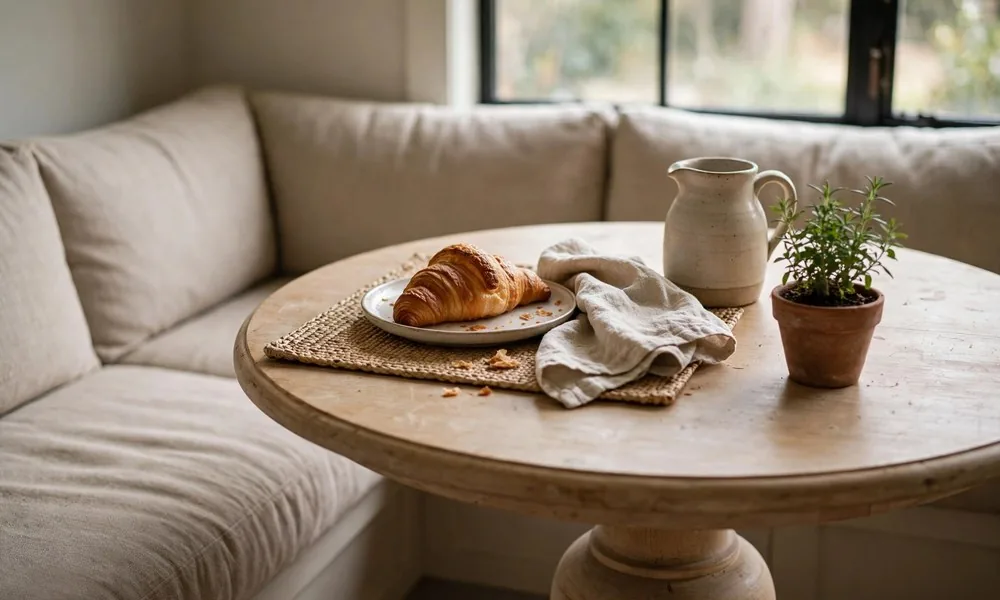
A nook without storage becomes a dumping ground within a month. The bench is the answer, because it hides more than any sideboard of the same footprint. Lift-up seats swallow linens, placemats and board games, and a shallow drawer in the front holds napkins and cutlery, so setting the table takes thirty seconds.
Keep the everyday within arm’s reach. A narrow floating shelf above the bench, no deeper than 15 cm, holds two or three mugs and a small plant, and nothing else. The rule is simple: if something lives in the nook, it should be used there at least once a week, or it belongs in the kitchen proper.
Make a small space feel generous
Small is not the enemy of luxury; clutter is. A nook of two square metres can feel generous if every line is clean and nothing fights for attention. Start by editing: one bench, one table, one pendant, one picture. A round table leaves no dead corners, and a bench pushed against the wall needs no pull-out space behind it, saving nearly a metre of floor.
Colour and reflection do the rest. Pale upholstery and a light tabletop bounce daylight around, while a dark bench can make the walls close in. If the window is small, a mirror opposite the opening doubles the light. Finally, give the nook a second job: a bench with a cushion and a reading light is a luxury reading nook by afternoon, and a table with a laptop is the best homework desk in the house.
Finish the walls and the tabletop
The walls of a nook should do one job: make the corner feel finished without competing with the window. A single framed print above the bench, hung low enough to be seen while seated, is usually enough. Limewash or a soft plaster finish adds texture without pattern, and a narrow picture ledge lets you swap prints with the seasons. Wallpaper can work too, but keep it to the bench wall only.
The tabletop is where restraint pays off. One low vase with fresh stems, a small tray holding salt, oil and a candle, and nothing else. A centrepiece you have to move before you can eat is not decoration, it is an obstacle. The same care that shapes a luxury entryway applies here: one repeated material, one repeated metal finish, and the nook reads as part of the home. If the house also has a formal dining room, keep the two distinct: the dining room is for occasions, as our guide to creating a luxury dining room explains, while the nook is for every day.
Your build checklist
- Mark the bench footprint in tape and live with it for a week before ordering joinery.
- Confirm 45 cm seat height, 45 to 50 cm seat depth, and 60 cm of bench per person.
- Choose a round or oval pedestal table: 90 cm for two, 105 to 120 cm for four.
- Hang one dimmable pendant 75 to 85 cm above the table at 2700K.
- Order fabric swatches, spill coffee on them, and pick the one that survives.
- Build lift-up storage into the bench and add one shallow shelf, then stop adding furniture.
Frequently asked questions
How much space do I need for a luxury breakfast nook?
A comfortable nook starts at about 1.8 by 2.4 metres, enough for a bench, a 90 cm round table and 90 cm of clear floor on the open side. Smaller corners can work with a half-round table.
Is a banquette better than chairs in a breakfast nook?
For a fixed corner, yes. A banquette seats more people in less space, needs no pull-out clearance, and hides storage under the seat. Many nooks mix the two: a bench on the wall side, chairs on the open side.
What is the best table shape for a small breakfast nook?
A round pedestal table, in almost every case. It has no corners to bump into, it lets people slide along the bench easily, and the single central leg leaves legroom free. An oval table suits a longer one.
How low should a pendant hang over a breakfast nook table?
Hang the base of the shade 75 to 85 cm above the tabletop, about 160 to 170 cm above the floor. Choose a shade half to two-thirds the width of the table, and always put it on a dimmer.
What fabric is best for banquette cushions?
A performance linen or a stain-resistant velvet, in a mid-tone that hides crumbs. Both wipe clean and survive daily breakfasts. Avoid silk and anything dry-clean only, and test a swatch with coffee first.
How do I make a breakfast nook feel luxurious on a budget?
Spend on fit and light, not on labels. A well-made bench that meets the wall exactly, a single good pendant on a dimmer, washable linen cushions and a stone or solid wood tabletop will outshine expensive furniture that does not fit.
The bottom line
A luxury breakfast nook is a small room designed with the care of a big one: a corner chosen for its light, a bench built to the centimetre, a table sized by arithmetic, one warm pendant on a dimmer, materials that feel good to touch, and storage hidden inside the seat. Together, they make the kitchen corner the place the household gathers.
Start with the tape on the floor, then the bench, then the table. Buy the pendant once you know the table’s height, and choose the fabric last, after you have spilled coffee on the swatch. The most luxurious nooks fit so well you forget they were ever designed at all.
Note: Sizes and prices here reflect widely reported 2027 interior guidance and typical retail ranges; they vary by maker and market, so treat them as a starting point and measure your own corner before ordering.