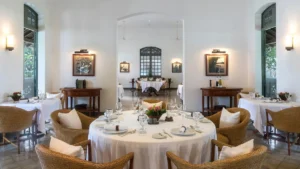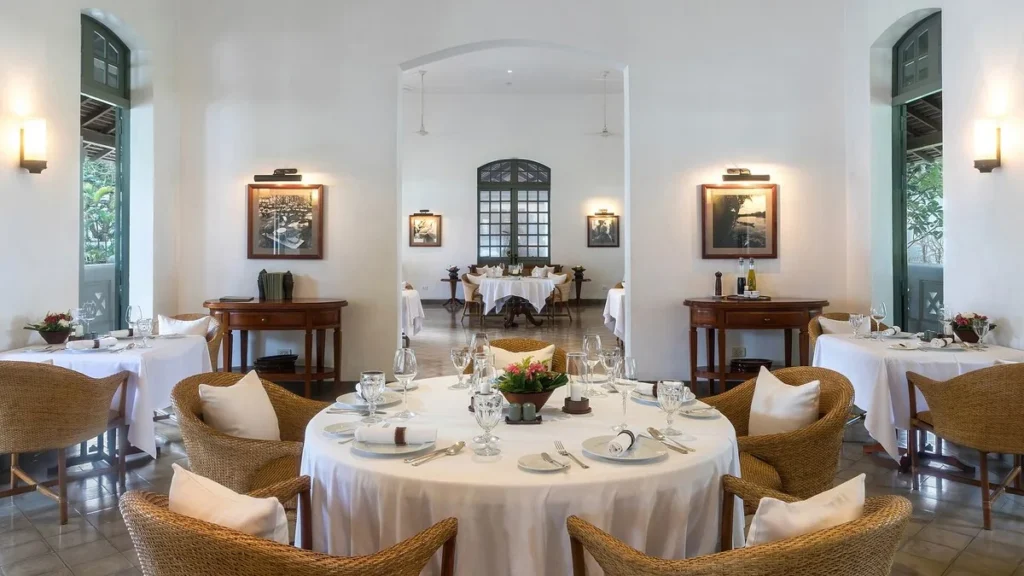
A luxury dining room is not the room with the most expensive table in it. It is the room where every meal feels like an occasion — where the chairs invite you to stay and the light flatters the table. Walk in and you feel it at once: the proportions are right, the surfaces generous, the room quiet enough for conversation.
That feeling is not reserved for grand houses. It comes from decisions made in the right order: layout first, then the table, chairs, light, materials and storage. Get the order wrong and even beautiful pieces look stranded.
This guide works through each layer in turn, drawing on 2027 directions — sculptural tables, upholstered chairs, tactile materials and lighting designed around the table.
Key takeaways
- Start with the layout: 90 centimetres of clearance behind every chair.
- Size the table by arithmetic: 60 cm per person, 30 cm per setting.
- Choose chairs for comfort: a padded seat, a back that meets the shoulders.
- Hang the light over the table, half to two-thirds its width, 75–90 cm above, warm and dimmable.
- Finish with a sideboard, a rug and curtains.
Start With the Layout — the Table Is the Anchor
Every luxury dining room is built around one object: the table. Before you buy anything, measure the room and centre the table under the light, its long axis following the room. A table pushed against a wall is a breakfast nook, not a dining room. Long rooms suit a rectangle; near-square rooms suit a round or oval table, which lets everyone see each other.
Clearance separates a luxurious room from a cramped one. Allow at least 90 centimetres between the table edge and the wall, so a chair can be pulled out and someone can walk behind it; 105 to 120 centimetres feels better in a generous room. The luxury living room in this series follows the same thinking. Think in zones: table at the centre, sideboard nearest the kitchen, one smaller zone to breathe.

Choose the Table Like It Is the Whole Room
The table sets the tone for everything else, so it deserves the largest share of the budget. In 2027 the direction is sculptural: a visible base — a stone pedestal, oak slabs on edge, a curved trestle — and softened shapes, with rounds, ovals and eased rectangles overtaking the sharp-cornered plank.
Size it by arithmetic. Allow 60 centimetres per person and 30 centimetres per place setting: 180 centimetres seats six, 240 seats eight, 300 seats ten; a round table 120 centimetres across seats four, 150 seats six. Standard height is 75 centimetres. Solid oak or walnut is warm and repairable — a scratch can be oiled out. Honed marble is cooler and more formal, but needs sealing and coasters. Buy a finish that tolerates real use: a table that cannot take a hot dish is a display piece.
Choose Chairs for Comfort, Not Just for Looks
Chairs are where luxury is felt rather than seen. A dining chair has one job a photograph cannot show: keeping a person comfortable for an hour after the plates are cleared. Look for a padded seat, a back that curves to meet the shoulders, and a seat depth of around 42 to 45 centimetres. Sit in it properly before you buy — one that looks right and feels wrong is money wasted.
Fabric is a practical decision dressed as a decorative one. Performance velvet and tight-weave wool are the 2027 favourites: rich to the touch and forgiving of wear. Bouclé is soft but traps crumbs; leather in cognac or oxblood ages gracefully and wipes clean. Choose a darker tone for daily use, and buy the full set at once. Do not buy a matching set: side chairs in one frame with different host chairs at the ends, tied by a repeated colour or material, gives the gathered-over-time feeling that defines quiet luxury.
Layer the Lighting Around the Table
Lighting is the difference between a dining room that looks expensive in a photograph and one that feels expensive at nine o’clock at night. A single ceiling light flattens the room and gives you exactly one mood. A luxury dining room needs light centred on the table, layered, warm — around 2700K to 3000K — and dimmable.
Sizing the fixture is simple arithmetic, and it is where most people go wrong. The chandelier should measure one-half to two-thirds the width of the table — a 40-inch-wide table wants a fixture roughly 20 to 27 inches across. Hang its bottom 30 to 36 inches (75 to 90 centimetres) above the tabletop for a standard 8-foot ceiling, adding about 3 inches for every extra foot of height. For a long table use a linear fixture or a row of pendants; for a round table, a ring, orb or drum. Add the second and third layers: wall sconces at eye level, picture lights over art, and a small lamp on the sideboard for a low glow once the table light is dimmed.
Build a Warm, Tactile Palette
Colour is the fastest way to change how a dining room feels, and 2027 is a warm year for it. After years of cool whites and greys, the direction is warmer neutrals and deeper, nature-led colour: mushroom, warm cream, cocoa and clay, with burgundy and deep green as accents. Deep walls suit a dining room well, because it is used mostly in the evening, when a dark wall and warm light feel intimate.
The most useful approach is tonal: pick one colour family and work within it. A deep green wall with olive chairs and warm wood feels rich; a cocoa sideboard with cream walls and brass light feels warm without being dark. Two or three colours, used generously, always beat six used sparingly — the same quiet-luxury thinking behind our guide to quiet luxury home decor. Let texture carry the interest: open-grain wood, honed stone, heavy linen, velvet.
Plan Storage That Works While You Eat
A dining room without storage is a room that is always being tidied. A sideboard is the essential piece: it holds linen, serving dishes and candles — the things that otherwise migrate to the table and stay there. Choose one 150 to 200 centimetres long for an eight-seat table, with drawers for cutlery and cupboards for platters.
Keep the serving logic short: the sideboard belongs on the wall nearest the kitchen, so the journey from kitchen to table to sideboard is a triangle of a few steps. A drinks cabinet earns its place if used weekly; a display cabinet only if its contents are worth looking at daily. Anything stored here should belong to dining — the moment it becomes household overflow, the room stops feeling like a dining room. The luxury home office in this series follows the same rule.
Mind the Acoustics — Quiet Is a Luxury
The most overlooked luxury in a dining room is the sound of it. Hard surfaces — a stone table, a wooden floor, bare walls, glass — bounce voices around until a table of six sounds like a table of twenty. The fix is softness, and it is the same softness that makes the room look luxurious: a rug under the table, upholstered chairs, curtains, linen on the table.
Let the Rug and the Floor Do the Grounding
The rug is the most underestimated piece in a dining room, and the one most often bought too small. It should extend at least 60 centimetres beyond the table on every side, so chairs stay on it even when pulled out. A rug that ends under the chair legs makes the whole room look accidental.
Wool is the classic luxury choice: soft underfoot, durable, and forgiving of spills if treated promptly. A low, tight pile is essential — a deep pile makes chairs hard to move and traps crumbs. A subtle pattern hides the marks of use far better than a plain pale rug.
Finish the Walls, Art and Tabletop
Walls should do one thing well: give the eye somewhere to rest between courses. One large piece of art, roughly two-thirds the width of the sideboard or wall it hangs on, beats a cluster of small frames. Hang its centre at about 145 centimetres — seated eye level — so it reads from the table. Fluted panels or plaster add detail, and a mirror opposite a window doubles the daylight.
The tabletop is the last layer. A centrepiece should be low — under 30 centimetres — so it never blocks a sightline, and it should be one thing done well: a low bowl of flowers, a sculptural object, or three small vases. Leave the top bare if it is beautiful enough to show.
| Element | What works in 2027 | Common mistake |
|---|---|---|
| Table | Sculptural base, softened shape, 60 cm per person | Too big; no clearance behind chairs |
| Chairs | Padded seat, curved back, velvet or wool | Beautiful chairs that hurt after twenty minutes |
| Lighting | Fixture half to two-thirds of table width, 75–90 cm above | One ceiling light at full brightness |
| Palette | Warm neutrals plus burgundy, deep green or cocoa | Six colours used sparingly |
| Storage | Sideboard 150–200 cm near the kitchen wall | No storage; the table becomes a dumping ground |
| Acoustics | Rug, upholstered chairs, curtains, linen | All hard surfaces — stone, glass, bare walls |
| Rug | Extends 60 cm beyond the table, low wool pile | Rug too small, chairs catching on the edge |
| Art | One large piece, centre at 145 cm, low centrepiece | Small pictures hung too high |
Your luxury dining room checklist
- ☐ Table centred under the light, 90 cm clearance behind every chair
- ☐ Table sized by arithmetic: 60 cm per person
- ☐ Chairs sat in before buying: padded seat, supportive back
- ☐ Light half to two-thirds of table width, 75–90 cm above, warm and dimmable
- ☐ Sideboard near the kitchen, rug extending 60 cm beyond the table
- ☐ Soft surfaces for sound, and one low centrepiece
Frequently asked questions
What size dining table do I need?
Allow 60 centimetres per person and 30 centimetres of depth per place setting: 180 centimetres seats six, 240 seats eight and 300 seats ten; a round table 120 centimetres across seats four and 150 seats six.
How big should a chandelier be over a dining table?
One-half to two-thirds the table width — a 40-inch-wide table wants a fixture roughly 20 to 27 inches across. Hang its bottom 30 to 36 inches (75 to 90 centimetres) above the tabletop at an 8-foot ceiling, adding about 3 inches for every extra foot of height.
What is the best material for a luxury dining table?
Solid oak or walnut for warmth and repairability — a scratch can be oiled out. Honed marble for a cooler, more formal look, though it needs sealing and coasters. Choose a finish that tolerates daily use.
How do I make a small dining room feel luxurious?
Choose a round or oval table, add one upholstered element, curtains hung high, a large mirror opposite the window, and warm dimmable light over the table.
Should dining chairs match the table?
No — the 2027 dining room is collected, not matched. Side chairs in one frame with different host chairs at the ends, tied by a repeated colour or material, looks gathered over time. Match the comfort, not the set.
How much should I budget for a luxury dining room?
As a guide: $2,000 to $6,000 for a solid-wood eight-seat table, $300 to $1,200 per chair, $800 to $3,000 for a chandelier, $1,500 to $6,000 for a sideboard and $800 to $4,000 for a wool rug.
The bottom line
A luxury dining room is not a shopping list. It is a sequence of calm, deliberate decisions: a layout built around the table with room to move, a table sized by arithmetic and made to be used, chairs chosen for comfort, light at the right height and warmth, a restrained palette with something to touch, storage that works while you eat, and enough soft surfaces that the room sounds as good as it looks.
Start with the layout, buy the table second, sit in the chairs third. The most luxurious dining rooms are gathered slowly, around the people who eat in them.
Note: Prices and sizing guidance here reflect widely reported 2027 interior directions and typical retail ranges; they vary by maker and market, so treat them as a starting point and measure your own room before buying.