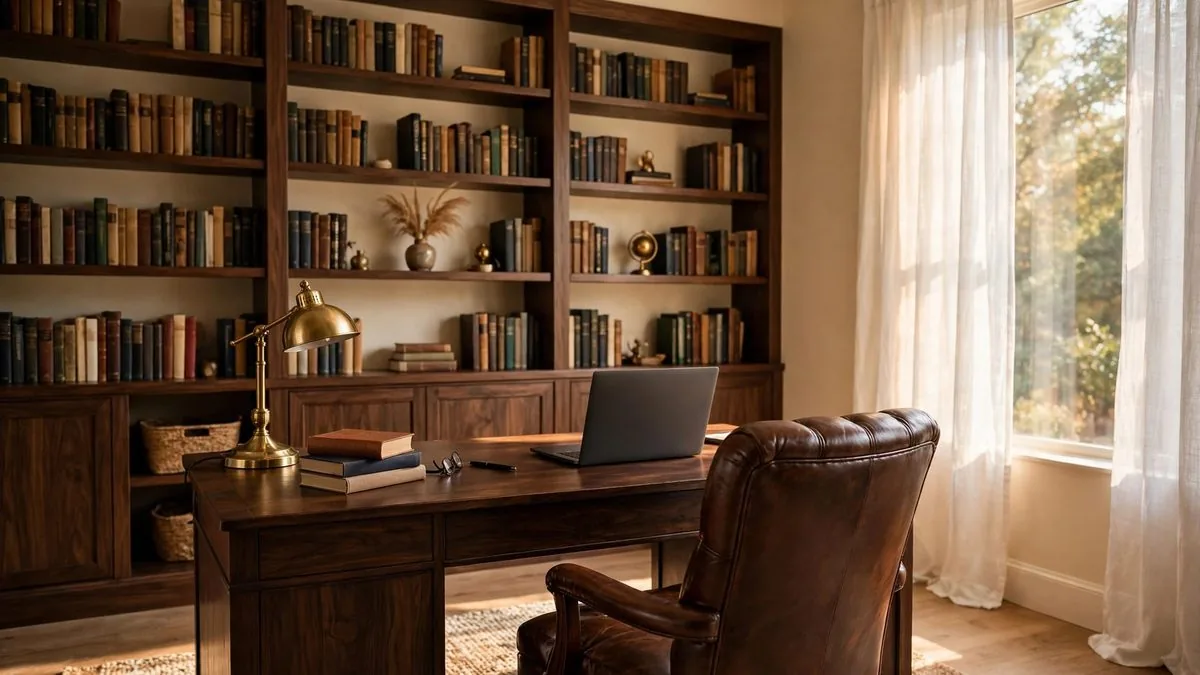

A luxury home office is not the room with the most expensive desk in it. It is the room where the work gets done well — where your back does not ache by four o’clock, the light flatters you on a video call, and nothing on the desk fights for your attention. Walk in and you feel it at once: the proportions are right, the chair invites a long sitting, and the room feels calm rather than cluttered.
That feeling comes from decisions made in the right order: layout first, then the desk, then the chair, then light, storage and sound. Get the order wrong and even beautiful furniture will look stranded — a grand desk facing a blank wall, a chair that hurts after an hour, a room that echoes on every call. This guide works through each layer in turn, drawing on where interiors are heading in 2027: warmer colours, natural materials, and collected furniture rather than matching sets.
Unlike the rest of the house, a home office has a job to do. The bedroom is for rest and the living room is for gathering; the office is for focus, and every choice should be judged by one question: does it help you think clearly for eight hours? When the answer is yes, the luxury follows.
Key takeaways
- Start with the layout: desk near side light, facing the room, calm wall behind you for calls.
- Buy the best desk and chair you can afford — they are the pieces your body meets every day.
- Layer lighting in threes — daylight, a warm task lamp and soft ambient light — all dimmable, none glaring.
- Hide cables and clutter: closed storage and a tidy desk make a small office feel expensive.
- Soften sound with rugs, curtains, books and upholstery, so calls stay clear and the room feels quiet.
Start With the Layout — Where the Desk Goes
Every luxury home office is built around one decision: where the desk sits. Before you buy anything, stand in the empty room and find the light. A desk beside a window, or at right angles to it, gives daylight without glare on the screen. Back to the window, you sit in silhouette on every call; facing it, you squint by mid-morning. Side light is the kindest light there is.
Think in zones, even in a small room. The working zone is the desk and chair, with at least 90 centimetres clear behind the chair so you can push back and stand. The thinking zone is a second seat — an armchair by the window — for calls and reading. Measure first: a desk of 140 to 160 centimetres suits most home offices, 70 to 80 deep for monitor, keyboard and notebook.
Choose the Desk Like It Is the Whole Room
Because, in a sense, it is. The desk sets the tone for everything else, so it deserves the largest share of the budget after the chair. Solid wood — walnut, oak or ash — ages gracefully and forgives the odd coffee ring in a way that gloss and glass never do. A leather desk pad protects the surface while giving your wrists somewhere kind to rest.
Height matters more than looks. A fixed desk should sit at 72 to 75 centimetres, elbows at roughly ninety degrees when you type. A sit-stand desk earns its price on long days: standing twenty minutes in every hour changes the afternoon. Test it in person — a wobble at full height is a deal-breaker. Keep the surface honest: one lamp, one notebook, one pen, one plant, everything else in a drawer.

The Chair: Comfort You Can Sit In for Eight Hours
The chair is the piece your body meets all day, and it is where looks must come second. A luxury office chair is an ergonomic chair first and a beautiful object second. Look for adjustable seat height and lumbar support, armrests that move up and down, and a seat depth that leaves two fingers’ width between the seat edge and the back of your knees. Sit in it for twenty minutes before you buy it — five in a showroom tells you nothing.
Leather is the classic luxury choice, and a well-made leather chair only gets better with age — but a good mesh back breathes in summer, and a wool-upholstered chair softens the room and absorbs sound. Match the chair’s scale to the desk: a grand executive chair behind a small desk looks like a throne at a side table. Protect the floor with a mat or a flat-weave rug, and test the castors on your actual floor.
Layer the Lighting for Work and for Video Calls
Light is where most home offices fail, and it is the cheapest thing to fix. A luxury office has three layers, none of them a bare ceiling bulb. Daylight is the first: sheer curtains soften a bright window without darkening the room. The second is the task lamp — a brass or matte-black adjustable lamp throwing warm light, around 2700 to 3000 kelvin, where you read and write. The third is ambient: a floor lamp in the corner that makes the room glow after dark.
Every layer should be dimmable and warm — cool white flatters nobody and makes a room feel like a clinic. On video calls, the light should fall on your face, not behind you. Watch for glare: a glossy screen facing a bright window is unreadable by noon. Angle the desk, move the lamp, or add a shade. The best-lit office is one you never notice, because your eyes are never tired.
Storage That Disappears — and Cables Too
Clutter is the enemy of luxury, and a home office generates it faster than any room in the house. The answer is closed storage: drawers, cupboards and a filing cabinet that swallow paper, chargers and spare cables whole. Open shelves are for the beautiful things — books, a framed photograph, a single object you love. Everything else belongs behind a door.
Apply the same ruthless editing you would to a wardrobe: if a cable or a stack of old notebooks has not been touched in a year, it does not earn a place in the room. The discipline is the same one that keeps a closet calm, and our guide to how to organize your closet works just as well for a desk drawer as for a rail of clothes. Cables deserve their own plan: a tray under the desk, a short trunking run to the wall, and a power strip hidden in a fabric box. Wireless where you can, labelled where you cannot, nothing across the floor.
Quiet the Room: Acoustics and the Door
A luxury office sounds quiet. Hard floors, bare walls and a glass desk turn every keystroke and every call into an echo, and a room that echoes feels cheap however much the furniture cost. Soft surfaces are the fix: a wool rug under the desk, heavy curtains, upholstered furniture, and books on the shelves. Each absorbs a little sound, and together they change the room completely.
If you take calls all day, go further. A solid door that actually closes beats an open doorway, and a draught excluder cuts the sound leaking through the gaps. Good headphones are the honest solution for a shared house, and a small sign — call in progress — saves more interruptions than willpower. Test the room with a real call: record thirty seconds and listen back. If you hear echo, add softness; if you hear the washing machine, close the door.
Colour, Texture and the View Behind You
Your video-call background is part of your professional image now, so design it on purpose. A calm wall, a bookshelf, or a single framed print reads as considered; a bed, a drying rack or a blank white wall reads as an afterthought. Sit in the chair, open the camera, and look at what the world sees.
For the palette, 2027 leans warm and grounded: deep greens, warm cream, cocoa, clay and soft burgundy, with wood and brass doing the talking. Three colours at most, repeated through rug, chair and shelves, makes a small office feel collected. Texture does the heavy lifting where colour holds back: wool, leather, linen, brass and wood feel expensive in a way matching plastic never will. For inspiration, see the best celebrity home decor ideas. Finish with a plant and a single scent — a candle for the evening, a diffuser for the day — and the best luxury perfumes are a good start.
Where to Spend and Where to Save
Luxury is a set of priorities: spend where your body meets the room every day, save where the eye barely lingers.
| Piece | Spend on this | Save on this |
|---|---|---|
| Desk | Solid wood top, stable frame | Matching desk set, novelty shapes |
| Chair | Adjustable ergonomics, good lumbar support | Designer name over adjustability |
| Lighting | Dimmable warm task lamp | Statement chandelier in a workroom |
| Storage | Closed drawers and cable tray | Open display shelving everywhere |
| Rug | Wool, large enough for desk and chair | Small rug that floats under nothing |
| Monitor setup | Monitor arm, eye-level screen | Second screen before the first is right |
| Decor | One framed print, one good plant | Sets of matching accessories |
| Sound | Heavy curtains, rug, solid door | Acoustic foam panels on show |
Your Luxury Home Office Checklist
- Desk near side light, facing the room, calm wall behind you for calls.
- Chair tested for twenty minutes: height, lumbar support and armrests all adjustable.
- Three layers of warm, dimmable light — daylight, task lamp, ambient — with no glare.
- Closed storage for paper and cables, tray under the desk, nothing on the floor.
- Soft surfaces in place: rug, curtains, books and upholstery to quiet the echo.
- Video-call view checked on camera, one plant and one scent to finish the room.
Frequently Asked Questions
What size desk do I need for a luxury home office?
A desk of 140 to 160 centimetres wide and 70 to 80 deep suits most home offices: room for a monitor, a keyboard and a notebook, with the screen at arm’s length. In a small room, a 120-centimetre desk works if the surface stays clear.
Should the desk face the window or the wall?
Side-on to the window is usually best: daylight without glare on the screen, and no silhouette on calls. Facing the room, window to your left or right, gives the most flattering light for video.
How much should I spend on an office chair?
Spend more on the chair than on almost anything else — it meets your body for eight hours a day. A well-made ergonomic chair is worth it; a beautiful chair that hurts after an hour is the most expensive mistake in the room.
How do I make a small home office feel luxurious?
Keep the palette to three warm colours, use one good rug to ground the desk, hide everything behind closed storage, and light the room in layers. A small room feels luxurious when every surface is intentional, and cramped when it is full of small, unmatched things.
What is the best lighting for a home office?
Three layers: soft daylight from a side window, a warm dimmable task lamp at 2700 to 3000 kelvin, and a low ambient light for evenings. Keep the light in front of you on calls, never behind you, and check for glare at midday.
How do I hide cables in a home office?
Fix a cable tray under the desk, run trunking to the wall socket, and keep the power strip in a fabric or wooden cable box. Go wireless for keyboard and mouse where you can, and route everything behind the desk leg.
The bottom line
A luxury home office is not a shopping list. It is a sequence of calm, deliberate decisions: a layout built around light, a desk with presence, a chair that supports a full working day, lighting that flatters your eyes and your camera, storage that disappears, and sound that stays quiet. None of that needs a large room — only attention.
Start with the layout, buy the desk and chair second, and let the room grow one layer at a time. The most luxurious home offices are gathered slowly, around the person who works in them.
Note: Trends and colour guidance here reflect widely reported 2027 interior directions; choose what suits your room and treat any single trend as inspiration rather than a rule.