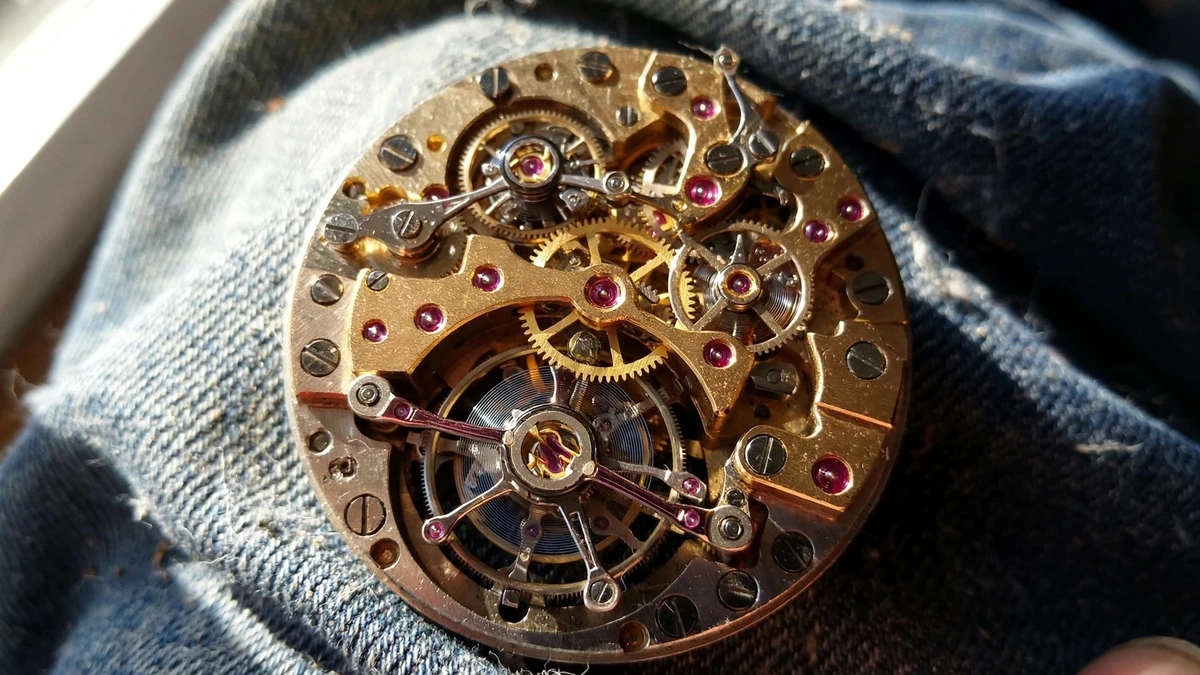

A tourbillon watch is the most famous complication in watchmaking, and the most misunderstood. It is a small rotating cage, usually visible through an opening in the dial, that carries the balance wheel and the escapement around in a slow circle. Invented to fight gravity, it has been for more than two centuries the clearest sign that a watchmaker has mastered the hardest parts of the craft.
The idea is simple to describe and extremely hard to make. Gravity pulls on the balance wheel differently in each position, so a watch runs slightly fast in one and slightly slow in another. A tourbillon averages those errors out by rotating the whole regulating mechanism, so no single position dominates. In a pocket watch, which sat upright in a waistcoat pocket all day, that mattered. On a wrist, which moves constantly, it matters far less.
That does not make the tourbillon pointless. It makes it a craft statement rather than a practical tool, and it explains why tourbillon watches cost so much more than the watches they are based on. Below are nine facts that explain what a tourbillon is, what it does, what it costs to own, and how to judge one honestly before you buy.
Key takeaways
- A tourbillon is a rotating cage that carries the balance wheel and escapement, designed to average out the effect of gravity on timekeeping.
- Abraham-Louis Breguet patented the tourbillon in 1801, originally for pocket watches that spent all day in one upright position.
- Most tourbillon cages rotate once a minute, while multi-axis versions rotate on two or three axes at once.
- On a modern wristwatch, a tourbillon rarely improves everyday accuracy, because the wrist already moves the watch through many positions.
- A tourbillon adds real cost, servicing complexity and fragility, so it is a craft statement to admire, not a practical necessity for keeping time.
What a tourbillon actually does
Gravity is the quiet enemy of every mechanical watch. The balance wheel swings back and forth, and gravity tugs on it slightly differently in each position. A watch that is perfectly adjusted dial-up can run a few seconds fast crown-down, and a few seconds slow in another position. Watchmakers call this positional error, and for most of watchmaking history it was the main limit on accuracy.
The tourbillon attacks the problem by refusing to stay still. The balance wheel, the balance spring and the escapement are mounted inside a small cage, and the cage rotates, usually once a minute, driven by the going train. As it turns, every part of the mechanism spends time in every orientation, so the errors caused by gravity in one position are cancelled by the opposite errors in another. It is an elegant solution, and it is why the tourbillon is still admired more than two hundred years after it was invented.
What a tourbillon does not do is make a watch more accurate in the way most people mean it. A modern, well-adjusted watch without one can already keep time within a few seconds a day. The tourbillon is a beautiful answer to a problem modern watchmaking has mostly solved in other ways, which is why it survives as a mark of skill rather than as a tool.
How to judge a tourbillon and what to look for
Look first at the cage itself. A well-made tourbillon cage is light, balanced and beautifully finished, because every extra gram makes the movement work harder. The cage should rotate smoothly, once a minute in most watches, with no visible wobble and no hesitation. If you can see the cage through the dial, watch it for a full minute. A cage that stutters, or one that is hidden behind a solid dial with no way to see it move, is a warning sign.
Look next at what the tourbillon is paired with. The best tourbillons are part of a movement that is finished to the same standard throughout, with polished bevels, Geneva stripes and a power reserve that makes sense for the watch. A tourbillon fitted into an otherwise plain movement, or one used to justify a price that the rest of the watch cannot support, is a sign that the complication is doing marketing work rather than horological work. Our guide to the most expensive watches in the world shows how often the tourbillon appears at the very top of the market, and why collectors treat it as a test of a brand rather than a feature on a list.
Finally, ask about servicing before you buy. A tourbillon needs a specialist, the service interval is usually shorter than for a simple movement, and the cost is several times higher. That is not a reason to avoid one, but it is a reason to buy from a brand with a real service network, and to budget for the watch as a long-term commitment rather than a one-off purchase.
9 facts about tourbillon watches
The 1801 patent that started it all
What it shows: Abraham-Louis Breguet patented the tourbillon on 26 September 1801, after years of work on the problem of gravity in pocket watches. The word means whirlwind in French, and the name captures what the cage does. What to consider: Breguet invented it for pocket watches, which sat upright in a waistcoat all day, so the original problem was much worse than it is on a wrist. Best for: Anyone who wants the history behind the complication. Movement type: Hand-wound, originally. Price range: Historic Breguet tourbillons are museum pieces. Standout feature: The first patent for a rotating escapement.
Breguet’s patent drawing shows a cage that looks surprisingly modern. The idea was fully formed from the start, and the reason it took so long to become common is that making a cage light and balanced enough to work took another century of toolmaking.
The one-minute rotation
What it shows: Most tourbillon cages complete one rotation per minute, which is why the cage often doubles as the seconds hand. The rotation is driven by the going train, so the cage is part of the movement, not a decoration added on top. What to consider: Some cages rotate faster or slower, and the speed is a design choice, not a measure of quality. Best for: Watching the complication work in real time. Movement type: Hand-wound or automatic. Price range: From a few thousand to several hundred thousand. Standout feature: A living seconds display.
Gravity is not the enemy it once was
What it shows: A wristwatch moves through many positions all day, so gravity’s effect is already averaged out by the wearer’s arm. Modern balance wheels are also smaller, lighter and better made than the ones Breguet worked with. What to consider: This is why a tourbillon rarely improves everyday accuracy on the wrist, even though it genuinely helped pocket watches. Best for: Understanding what you are actually paying for. Movement type: Any modern calibre. Price range: Not applicable. Standout feature: The honest answer to the accuracy question.
Single-axis, double-axis and triple-axis tourbillons
What it shows: A single-axis tourbillon rotates in one plane. A double-axis version adds a second rotation, and a triple-axis version adds a third, so the balance is turned in every direction at once. What to consider: Each extra axis adds parts, weight and fragility, and the accuracy gain on the wrist is small. Best for: Collectors who value mechanical complexity for its own sake. Movement type: Hand-wound, usually. Price range: High to very high. Standout feature: A cage that tumbles in three dimensions.
Multi-axis tourbillons are the most spectacular to watch, and the hardest to service. They are the purest form of the tourbillon as art, and they should be judged as art.
The cage is the hard part
What it shows: A tourbillon cage can contain more than seventy parts, and it must be perfectly balanced. If it is even slightly heavy on one side, it will not rotate evenly, and the watch will run worse, not better. What to consider: The finishing of the cage, polished bevels, rounded arms, a blued balance wheel, is where the maker’s skill is most visible. Best for: Judging a brand’s real capability. Movement type: Hand-wound, usually. Price range: High. Standout feature: Seventy parts that must weigh almost nothing.
A tourbillon is not the same as other complications
What it shows: A tourbillon regulates timekeeping. A minute repeater chimes the time, a perpetual calendar tracks the date, and a chronograph measures elapsed time. They are different jobs, and a watch can have one without the others. What to consider: Some of the most impressive watches combine a tourbillon with a repeater or a calendar, but each added complication multiplies the servicing cost. Best for: Learning the language of high watchmaking. Movement type: Varies. Price range: Very high when combined. Standout feature: A regulator, not a calendar or a chime.
Confusing a tourbillon with a repeater is common, and it is the first thing a dealer will notice. Knowing the difference is the fastest way to sound like someone who has done their homework.
Servicing costs far more than a standard movement
What it shows: A tourbillon service is a specialist job. The movement must be taken apart, the cage checked for balance, and the watch re-regulated, usually by the brand itself rather than an independent watchmaker. What to consider: Service intervals are often three to five years, and the cost can run into thousands, which is a real part of owning the watch. Best for: Budgeting honestly before you buy. Movement type: Hand-wound or automatic. Price range: Servicing often costs several thousand. Standout feature: Ownership that needs a plan, not just a purchase.
Ask the dealer who services the watch, how long it takes, and what it costs, before you pay. A tourbillon with no service network is a beautiful problem waiting to happen.
The affordable tourbillon exists, but finishing differs
What it shows: In the last twenty years, tourbillons have appeared at far lower prices, mostly from makers using industrial production. A tourbillon watch can now cost a few thousand rather than a few hundred thousand. What to consider: The difference is in the finishing, the regulation and the service network. An affordable tourbillon is a real tourbillon, but it is not the same object as a hand-finished one. Best for: Experiencing the complication without a six-figure budget. Movement type: Automatic, usually. Price range: A few thousand and up. Standout feature: The complication, democratised.
How to spot a well-made tourbillon
What it shows: A well-made tourbillon cage rotates smoothly and evenly, the balance wheel swings with a steady beat, and the finishing on the cage and the bridges is clean under a loupe. What to consider: Look for polished bevels, a cage that is light and open rather than heavy and closed, and a brand that will show you the movement rather than hide it. Best for: Buying with confidence. Movement type: Any. Price range: Any. Standout feature: Smooth rotation and honest finishing.
If a dealer will not let you watch the cage turn, or will not answer questions about servicing, walk away. A good tourbillon is proud of being seen.
A short history of the tourbillon
The tourbillon spent most of the nineteenth century as a pocket-watch complication, made in small numbers by Breguet and a handful of followers. When wristwatches took over in the early twentieth century, it almost disappeared, because a wristwatch did not need it and the market would not pay for it.
The revival came in the 1980s and 1990s, when brands such as Audemars Piguet put a tourbillon into a wristwatch and collectors rediscovered it. Breguet itself, revived under new ownership, made the tourbillon central to its identity again. By the 2000s, makers such as Greubel Forsey were building multi-axis tourbillons that pushed the complication further than Breguet ever imagined, and the tourbillon became the defining test of a high-end brand.
Today the tourbillon sits at both ends of the market. At the top are hand-finished pieces that cost as much as a house, and at the other end are industrially made tourbillons that bring the complication within reach of a serious enthusiast. Our guide to the best luxury dress watch brands shows how many of the great names treat the tourbillon as their flagship, and our roundup of the most expensive watches for men is full of tourbillons, because collectors still treat the rotating cage as the clearest proof of mastery.
The caveats that matter
A tourbillon is a wonderful complication, but it is not a free one. It adds cost, fragility and servicing, and it changes what the watch is for. The table below is the honest summary, and it is worth reading before you fall in love with the rotating cage.
| Detail | What is known |
|---|---|
| What it improves | Positional error from gravity, mainly in pocket watches |
| Accuracy on the wrist | Rarely better than a well-adjusted modern movement |
| Service interval | Usually 3 to 5 years, shorter than a simple movement |
| Service cost | Several thousand, and usually only by the brand |
| Water resistance | Often lower, because the cage needs a display opening |
| Shock resistance | Lower than a simple movement; the cage is delicate |
| Resale | Strong for hand-finished pieces from established brands |
| Who should skip it | Anyone who wants a daily watch they never have to think about |
If you are buying your first high-end watch, a tourbillon is a bold place to start. It is better as a second or third serious watch, bought after you already own a daily watch you trust, so the tourbillon can be worn and enjoyed rather than worried over.
Checklist: buying a tourbillon honestly
Use these checks before you buy, and again before you pay for a service.
- Watch the cage turn for a full minute: it should rotate smoothly, with no wobble or hesitation.
- Ask who services the watch, how long it takes, and what it costs, before you buy.
- Check the finishing under a loupe: polished bevels and a light, open cage are good signs.
- Buy from a brand with a real service network, not just a dealer who will sell you the watch.
- Budget for servicing as part of the price, not as a surprise in three years.
- Wear it knowing what it is: a craft statement, not a tool for better timekeeping.
Frequently asked questions
Does a tourbillon make a watch more accurate?
On a pocket watch, yes. On a modern wristwatch, the improvement is usually too small to notice, because the wrist moves the watch through many positions and modern movements are already well adjusted.
How often does a tourbillon need servicing?
Usually every three to five years, and the service is a specialist job. The cage must be checked for balance and the watch re-regulated, which is why most brands insist on servicing it themselves.
Why are tourbillon watches so expensive?
The cage is hard to make and must be perfectly balanced, the finishing is done by hand, and very few watchmakers can build one. You are paying for the skill and the time, not just the parts.
What is the difference between a tourbillon and a carousel?
A carousel looks similar, but the cage is driven differently and rotates more slowly, usually once an hour. A tourbillon cage is driven by the going train and usually rotates once a minute.
Can I wear a tourbillon watch every day?
You can, but it is a delicate complication. It is more vulnerable to shocks than a simple movement, and many owners keep a tourbillon for occasions rather than daily wear.
Are affordable tourbillons worth buying?
They are real tourbillons, and they let you experience the complication at a fraction of the price. The difference is in the finishing, the regulation and the service network, so judge them on their own terms.
The bottom line
A tourbillon watch is neither the most accurate watch you can buy nor the most practical. It is the most honest expression of what watchmaking can do when difficulty is the point. Breguet invented it to solve a real problem, and two centuries later it survives because the solution is beautiful, the making is hard, and the rotating cage is still the clearest sign that a watchmaker has mastered the craft.
If you buy one, buy it for that reason. Choose a brand that will service it, watch the cage turn before you pay, and wear it knowing that its value is in the making, not in the seconds it saves. That is the honest way to own a tourbillon, and it is the way the complication was meant to be appreciated.