
A pearl ring carries more risk than any other piece of pearl jewellery. A necklace hangs safely away from hard surfaces, but a ring lives on your hand. It knocks against door handles and catches on sleeves.
That exposure is what makes choosing well so important. A ring bought on looks alone can lose its shine, loosen in its setting or chip within a year, while a carefully chosen one can be worn every day for decades. The difference is a short list of checks: lustre, nacre, size, shape, setting, metal and fit.
This guide covers pearl type, size, setting, metal, sizing, fakes and budget for 2027.
Key takeaways
- Lustre comes first: sharp, bright reflections beat a larger, duller pearl.
- On a ring, the setting matters as much as the pearl: a bezel or halo protects the edges.
- Freshwater pearls offer the best value for everyday rings, while Akoya pearls give the brightest, most classic lustre.
- Choose a smaller pearl than you would for a necklace: 6 to 9 millimetres suits most hands.
- Check the fit, metal, drill hole and returns policy in writing before you pay.
Start with lustre, the quality that matters most
Gemologists judge pearls on seven factors: size, shape, colour, lustre, surface, nacre and matching. There is no single worldwide grading scale for pearls, so letter grades such as AAA are set by each seller.
Of the seven factors, lustre matters most. It is the sharpness and brightness of the light a pearl returns. A high-lustre pearl shows a crisp, almost mirror-like reflection, while a low-lustre pearl looks milky, flat or chalky. Hold the ring in daylight and tilt it: if your reflection stays clear, the lustre is strong.
Nacre decides how long the beauty lasts. It is the layered material a mollusc deposits around the nucleus, and it is what gives a pearl its glow. Thick nacre keeps a pearl glowing for decades, while thin nacre turns chalky and can chip or peel. Freshwater pearls are nearly solid nacre, which is why they wear so well on a ring.
Know the four main pearl types
Nearly all pearl rings sold today use cultured pearls. Freshwater pearls are grown in mussels, mostly in China, and are the most commonly produced type. Because many pearls can grow in a single mussel, they are also the most affordable.
Akoya pearls are the classic saltwater pearl, farmed mainly in Japan and China. They are usually 6 to 9 millimetres across, white or cream, and prized for the brightest, most mirror-like lustre of any pearl type. An Akoya ring is a classic choice for an engagement ring, but its thinner nacre needs a protective setting. South Sea pearls, from Australia, Indonesia and the Philippines, are the largest cultured pearls, typically 9 to 16 millimetres. Tahitian pearls, from French Polynesia, are naturally dark, usually 8 to 14 millimetres. Both are luxury choices for occasional wear.
| Pearl type | Typical size | Lustre | Colour | Best ring style | Price guide | Daily wear |
|---|---|---|---|---|---|---|
| Freshwater | 5–9 mm | Soft to bright | White, pink, lavender, peach | Solitaire, stacker, modern | $40–$200 | Excellent |
| Akoya | 6–9 mm | Very high, mirror-like | White, cream, rose overtone | Solitaire, halo | $150–$600 | Good, protected |
| South Sea | 9–13 mm | Soft, satiny glow | White, silver, gold | Cocktail ring | $800 and up | Occasions only |
| Tahitian | 8–12 mm | Strong, bright | Grey, green, peacock black | Modern halo | $400 and up | Good, thick nacre |
| Baroque freshwater | 7–11 mm | Good, varied | White, pink, metallic | Artistic, bypass, freeform | $50–$250 | Good, low setting |
| Keshi | Small to medium | High, with orient | Matches host type | Cluster | $80–$400 | Fair, shapes vary |
| Imitation glass or plastic | Any size | Flat, too perfect | Uniform white | Costume only | Under $30 | Coating can peel or chip |
A large South Sea pearl ring at a freshwater price is not a South Sea pearl. Our round-up of the best pearl rings of 2027 shows each type on the hand.
Choose the right size for your hand
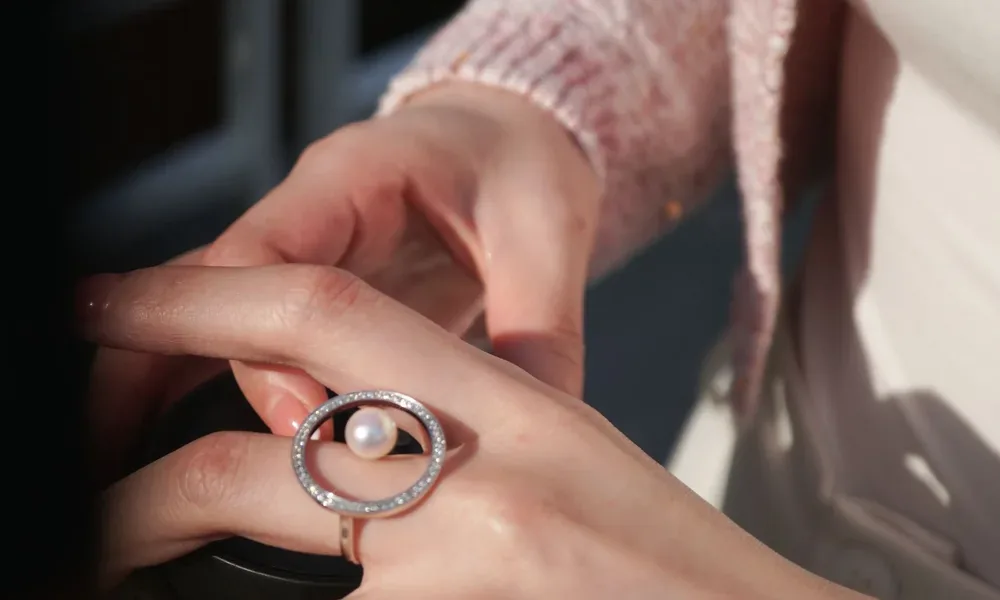
Size is measured in millimetres, and on a ring the right size is smaller than most people expect. For an everyday pearl ring, 6 to 8 millimetres suits most hands: visible and elegant without catching on sleeves, pockets and door handles. A 7 to 8 millimetre pearl is the classic size.
Think about how the ring will be used, not just how it looks in the box. A pearl on a tall prong setting looks dramatic, but it is the first thing to hit a tabletop. A pearl set low, in a bezel or a shallow cup, sits closer to the finger and survives daily life far better. If the pearl snags on a sleeve or a pocket, the size or the setting is wrong for you.
Shape, colour and the single pearl
Round pearls cost the most, because a perfectly round pearl is the hardest to grow. Near-round pearls offer almost the same look for much less. Button pearls, flattened on one side, sit low and comfortably in a ring setting. Drop pearls suit a bypass or halo design, and baroque pearls suit a freeform setting. Colour is a matter of taste: rose overtones suit warm skin, silver overtones suit cool skin.
Because a ring holds one pearl, you can spend your whole budget on that single pearl. That is the pearl ring’s great advantage: a modest budget buys a genuinely fine single pearl. Spend it on lustre first, then on a clean surface, then on shape. Size comes last.
The setting: how the pearl is held, and how safe it is
A pearl ring is only as good as its setting, the metalwork that holds the pearl. A pearl is usually half-drilled and glued onto a small metal peg. The pearl should sit straight and centred, with no wobble, no tilt and no gap where dirt can collect. If you can rock the pearl with a fingertip, the setting is loose and the pearl could come off.
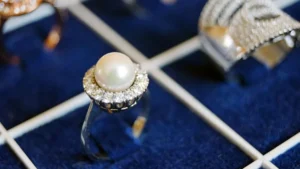
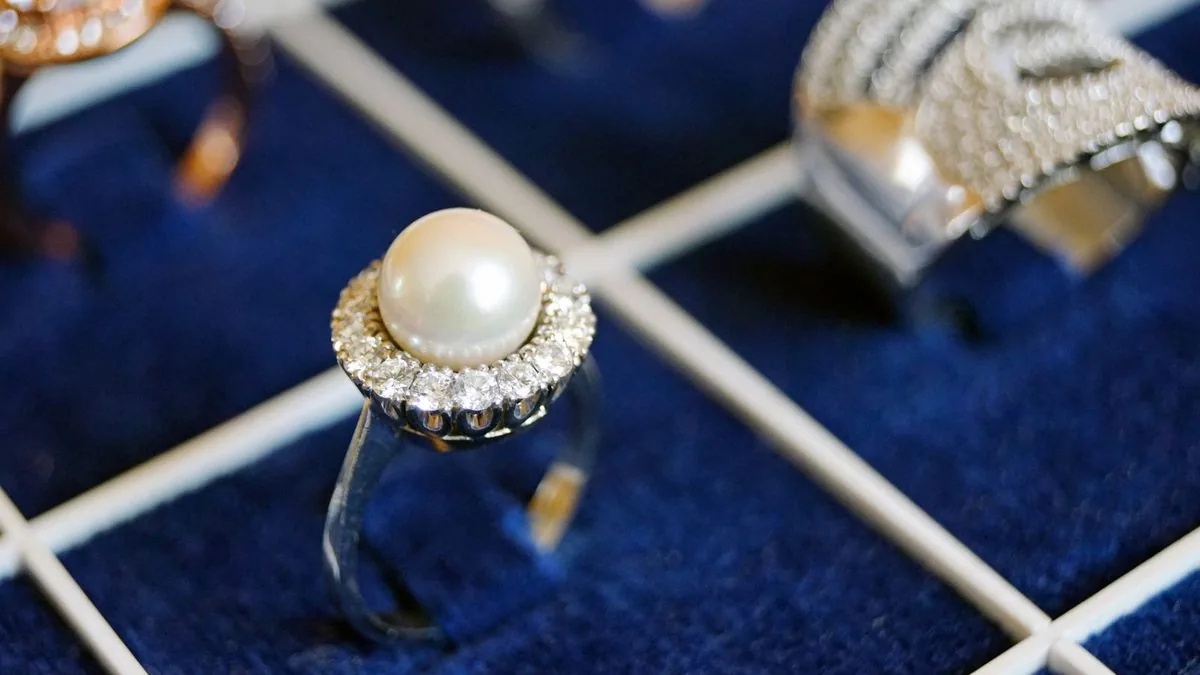
A solitaire setting holds a single pearl on a peg, often with four small prongs around its base. It shows the pearl at its best, but it leaves the pearl exposed, so it suits a careful wearer or an occasion ring. A halo setting surrounds the pearl with small diamonds or crystals, which protects its edge and makes it look larger. A bezel setting wraps a rim of metal around the base of the pearl, giving the best protection of all.
Metal, band and everyday durability
The metal decides how the ring wears, ages and suits your skin. Gold is the classic choice, in yellow, white or rose, and 14 karat gold is strong enough for everyday wear. Eighteen karat gold is softer and richer in colour, but it scratches more easily. Sterling silver is lighter and cheaper, but it tarnishes. Platinum is strong and hypoallergenic, but it costs much more.
Check the band as carefully as the pearl. It should be smooth inside, with no sharp edges, and the right width for the pearl: a band that is too thin will bend under a large pearl, while a band that is too wide can overpower a small one. Pearls are soft, so they scratch easily and should never be stored loose with harder stones.
Sizing, comfort and getting the fit right
Ring size is not a detail to guess. A ring that is too tight will pinch, while one that is too loose will spin and risk slipping off. Get sized by a jeweller, ideally in the afternoon, and try the size in the metal and width you will actually buy, since a wide band fits tighter than a narrow one.
Comfort is the test that matters most after fit. Wear the ring for a few minutes in the shop. The ring should feel light and almost forgettable. If the pearl pulls, the ring twists, or the band digs in, it is the wrong size, weight or design for you.
How to spot fakes, dyed pearls and misleading labels
Imitation pearls are common, and some are convincing at a glance. Glass, plastic and shell imitations can copy the shape and shine of a real pearl, but rarely its feel. Real pearls feel cool to the touch at first and warm up slowly, while plastic imitations feel warm immediately and oddly light. Real pearls also feel slightly gritty when rubbed gently against a tooth, while imitations feel smooth and slippery.
Be wary of labels that lean on letter grades alone. There is no official AAA grade, so a tag that promises AAA is telling you about the seller’s own scale, not an independent standard. Treatments must be disclosed: bleaching is standard, but dyeing or coating should be reflected in the price. Ask for the pearl type, origin and any treatments in writing, and for a costly ring, ask for a gemmological laboratory report. Our guide to buying pearl jewellery explains how to judge a second classic piece with the same checks.
What to pay, and where the money goes
Prices depend on type, size, lustre, surface, setting and metal. A good freshwater pearl ring costs about $40 to $200, an Akoya pearl ring $150 to $600, a Tahitian pearl ring $400 and up, and a South Sea pearl ring $800 and up, rising well past $2,000 for a large, fine pearl in a gold halo setting. A plain silver band with a small freshwater pearl can cost under $60.
Spend your money in the right order. First, pay for lustre, because it is what you see. Second, pay for a good setting and band, because they keep the pearl safe. Third, pay for the metal, because a good band lasts for decades. Size comes last. Be wary of prices that look too good: a ring advertised as a South Sea pearl for $60 is not a South Sea pearl. To compare the wider range, browse our guide to the best pearl jewellery of 2027.
Your before-you-buy checklist
- Check lustre in daylight: look for a sharp, bright reflection.
- Inspect the surface and the drill hole for chips, cracks, deep pits and flaking nacre,
- Test the setting: the pearl should sit straight and firm, with no wobble or sharp edges.
- Check the band: solid gold or platinum, smooth inside, wide enough to balance the pearl.
- Try the ring on: it should feel light, stay upright, and not snag.
- Confirm the pearl type, any treatments, the metal, size and returns policy in writing before you pay.
Frequently asked questions
What size pearl ring should I buy?
For most hands, 7 to 8 millimetres is the most versatile size: noticeable without being heavy, and easy to wear every day.
Are freshwater pearls good for rings?
Yes. Freshwater pearls are real cultured pearls, nearly solid nacre, so they are durable. A freshwater pearl in a bezel or halo setting is the best starting point for an everyday ring.
How can I tell if a pearl ring is real?
Look for slight surface variations, a deep glow, and a clean drill hole. A real pearl feels slightly gritty against a tooth, while an imitation feels smooth.
Can I wear a pearl ring every day?
You can, with the right one. A freshwater or Akoya pearl in 7 to 8 millimetres, set low in a bezel or halo on a solid gold band, handles daily wear well.
What setting is best for a pearl ring?
A bezel gives the best protection, because a rim of metal shields the pearl’s edge. A halo also protects the edge.
How do I care for a pearl ring?
Put your pearl ring on last, after perfume and makeup, because chemicals damage nacre. Wipe it after wearing and store it in a soft pouch.
The bottom line
What to look for in a pearl ring comes down to a short list: bright lustre, thick nacre, a clean surface, a size that suits your hand, and a protective setting. Then check the metal, the band and the fit. Spend your money on lustre and the setting before size.
Take your time, look at the pearl in daylight, try the ring on, and imagine a normal day with it on your hand. The right ring still glows after that day, and after a hundred more like it.
Note: Prices and sizes here are broad 2027 guides, not quotes for a specific seller. Pearl grades such as AAA are set by individual sellers, not by an independent worldwide standard, so confirm the pearl type, treatments and returns policy in writing before buying.