Hair oil is one of the simplest products in hair care, and one of the easiest to get wrong. Used well, it smooths frizz, adds shine, protects the ends, and makes dry hair feel soft again. Used badly, it leaves hair greasy, flat, and heavy, and most people blame the oil when the real problem is the amount, the timing, or where it was applied.
That is why this guide is organised by method, not by product. A pre-wash treatment, a damp-hair seal, a finishing drop, and an overnight treatment are four different jobs, and they need different amounts and different timing. The same oil can do all four, but only if you change how you use it.
Below are nine steps for using hair oil properly in 2027, from measuring the right amount to adjusting for your hair type and the weather. Each step is described by what to do, what to avoid, and how long it takes, so you can build a routine that works for your hair, not just copy someone else’s. Each step takes only a minute or two, and most of them use oil you already own.
Key takeaways
- Start with two to three drops, warmed between your palms, and add more only if your hair absorbs it within an hour.
- Apply oil to the lengths and ends first, and keep it away from the roots unless you are doing a pre-wash treatment you will wash out.
- Oil works best on damp hair, where it seals in moisture, and as a small finishing drop on dry hair to smooth flyaways.
- A pre-wash treatment once a week and a daily drop on the ends is enough for most dry hair; more oil does not mean more moisture.
- No method repairs split ends or reverses chemical damage, and oil left on the scalp without proper washing can cause buildup and itching.
What hair oil actually does
Hair oil works by coating the hair shaft and smoothing the cuticle, the outer layer of overlapping scales that protects the fibre inside. When hair is dry, that cuticle lifts, moisture escapes, and the surface becomes rough, which is why dry hair looks dull and tangles easily. An oil fills the gaps, flattens the cuticle, and slows moisture loss, which is why hair looks shinier and feels softer after oiling.
Some oils, such as coconut oil, can pass into the hair shaft itself, which helps reduce the swelling and shrinking that happens each time hair gets wet and dries. Oil on dry, product-free hair adds shine, but it does not add water, and that distinction matters.
Oil also protects the ends, which are the oldest and driest part of the hair. The ends have been washed, brushed, and heated more times than the roots, and they have the least natural oil reaching them.
How to get the most from a hair oil
Start with the right oil for your hair. Fine hair needs a light, fast-absorbing oil, such as camellia, squalane, or moringa. Thick, coarse, or curly hair can handle richer oils, such as argan, olive, or coconut. If you are not sure, start light. A light oil used well beats a rich oil used badly, and you can always add a second drop.
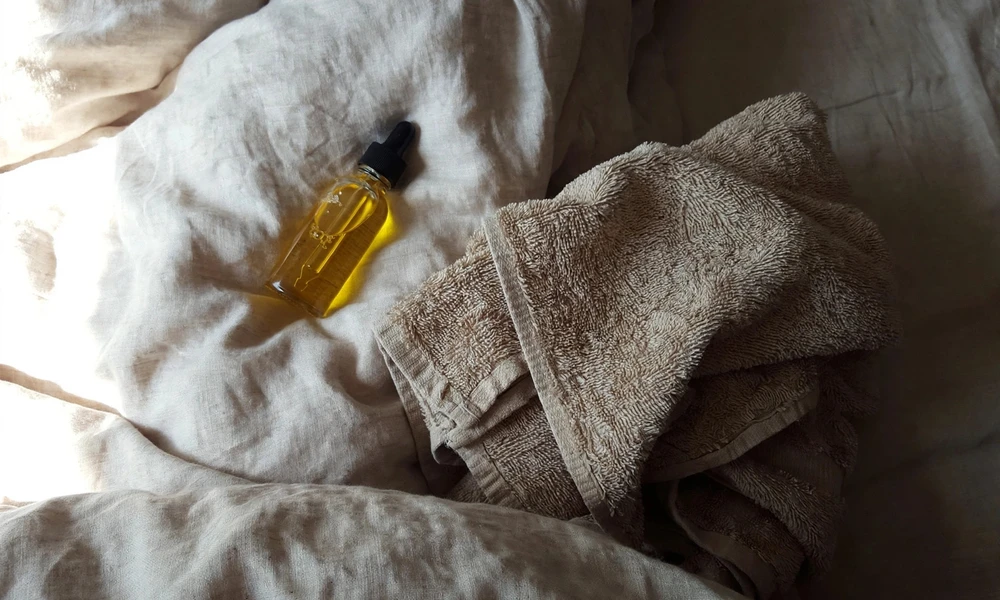
Use the right tools, which are usually just your hands and a wide-tooth comb. Warm the oil between your palms before applying it, because warm oil spreads more evenly and you can feel how much you are using.
Time it well. Oil applied to damp hair after washing seals in moisture. Oil applied at night, before bed, has hours to absorb, and scalp oiling before a wash can help a dry scalp too, as long as you shampoo it out properly in the morning.
How to use hair oil, step by step
Start with the right amount
What to do: Begin with two to three drops for medium-length hair, one drop for short or fine hair, and four to five drops for long, thick hair. Warm the oil between your palms so you can feel the amount before it touches your hair.
What to avoid: Pouring oil straight from the bottle onto your hair, or using a full dropper when a few drops will do. Best For: Everyone, every time you oil. Time Needed: 10 seconds. Standout Tip: You can always add a second drop, but you cannot take oil back without washing, so start small.
Two drops is enough for most hair; add one more next time if it still feels dry.
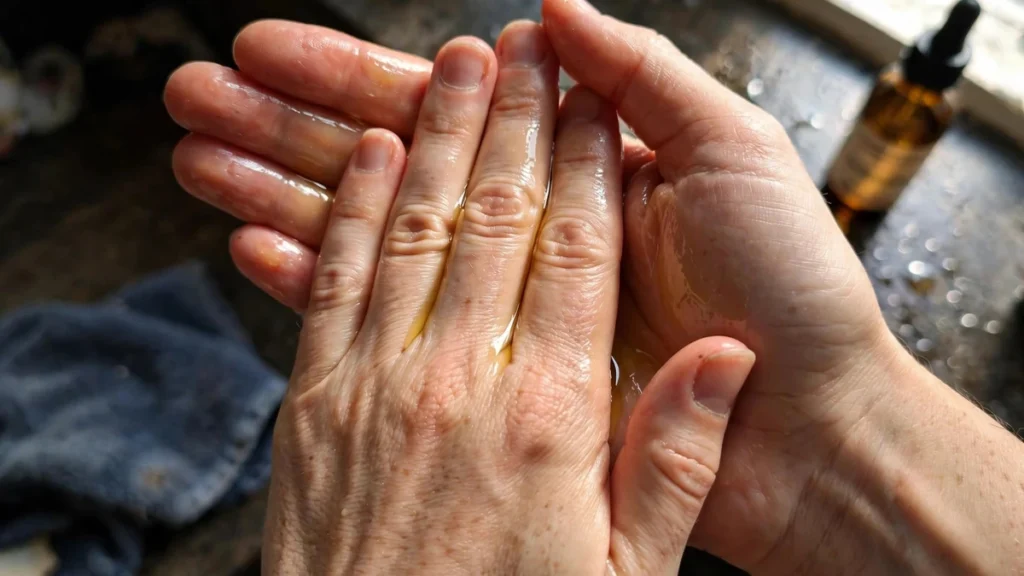
Warm the oil between your palms
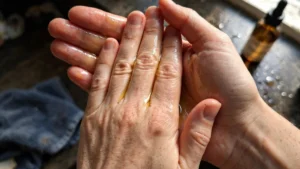
What to do: Rub your palms together for a few seconds until the oil feels warm and thin, then smooth your hands over the hair. The warmth helps the oil spread in a thin, even layer instead of sitting in one spot.
What to avoid: Applying cold, thick oil straight to one section, which leaves a greasy patch that is hard to spread. Best For: Thick oils and solid balms, which need warmth to soften. Time Needed: 10 seconds. Standout Tip: If the oil feels sticky on your hands, you have used too much, so wipe the excess off before touching your hair.
Warming the oil also helps you judge the amount before it reaches your hair.
Apply to the lengths and ends first
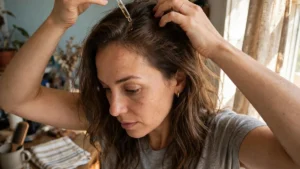
What to do: Smooth the oil over the bottom half of your hair first, where dryness is worst, then work the remaining trace up toward the mid-lengths. The ends need the most oil and the roots need the least.
What to avoid: Starting at the roots, which is the fastest way to make hair look greasy and flat. Best For: Daily use on dry or damp hair. Time Needed: 30 seconds. Standout Tip: Hold the ends in one hand and smooth the oil over them with the other, so every strand gets coated.
The ends need the most help; the roots are already oiled by your scalp.
Work up toward the mid-lengths, not the roots
What to do: After the ends, use whatever oil is left on your palms to smooth the mid-lengths, stopping at least a few centimetres from the scalp. If your hair still feels dry higher up, add one more drop and repeat.
What to avoid: Rubbing oil into the scalp as part of a daily routine, which can cause buildup, itching, and flat roots. Best For: Daily finishing and damp-hair sealing. Time Needed: 30 seconds. Standout Tip: If you can see oil on your scalp, you have gone too far up, so wash your hands and smooth the hair with a dry brush.
The mid-lengths need some oil, but far less than the ends.
Use it as a pre-wash treatment
What to do: Apply a generous amount to dry hair 30 minutes before washing, focusing on the lengths and ends, and comb it through with a wide-tooth comb. Shampoo it out thoroughly, twice if needed.
What to avoid: Leaving a heavy pre-wash oil on the scalp overnight without washing it out well, which can clog follicles and irritate the scalp. Best For: Very dry, coarse, bleached, or damaged hair. Time Needed: 30 minutes, plus wash time. Standout Tip: Do this once a week, not every wash, because daily heavy oiling is unnecessary and hard to wash out.
A scalp massage with a light oil before washing can be part of the same routine, as long as you shampoo thoroughly afterwards.
Use a drop as a finishing step
What to do: After styling, warm a single drop between your palms and smooth it lightly over the surface of the hair to tame flyaways and add shine. Focus on the outer layer, not the underneath.
What to avoid: Using a finishing drop on hair that is already oily, or pressing oil into the roots to smooth them, which flattens the style. Best For: Second-day hair, flyaways, and adding shine after blow-drying. Time Needed: 15 seconds. Standout Tip: A finishing drop works best on hair that is already styled, because it seals the shape rather than changing it.
One drop is enough; two is usually too many for a finishing step.
Try an overnight treatment once a week
What to do: Apply a moderate amount to the lengths and ends before bed, braid the hair loosely, and sleep on a silk or satin pillowcase. Wash it out in the morning with a gentle shampoo.
What to avoid: Applying a heavy overnight oil to the scalp, or sleeping on a cotton pillowcase with oiled hair, which absorbs the oil and stains the fabric. Best For: Very dry, coarse, or curly hair. Time Needed: 5 minutes at night, plus a wash in the morning. Standout Tip: A loose braid keeps oiled hair contained and prevents tangles while you sleep.
Once a week is enough; more often, and the hair can feel coated rather than soft.
Pair it with a gentle wash
What to do: Wash with a mild, sulphate-free shampoo, and rinse thoroughly, especially after a pre-wash or overnight treatment. Follow with conditioner on the lengths, and apply your daily oil to damp hair afterwards.
What to avoid: Using a harsh shampoo to strip oil out, which dries the hair further, or skipping conditioner because you used oil, which leaves the hair unprotected. Best For: Everyone who oils regularly. Time Needed: No extra time, just a better wash. Standout Tip: If the hair still feels oily after one wash, shampoo a second time with a small amount rather than using a strong clarifying shampoo.
If you oil daily but wash poorly, the hair gets coated and dull.
Adjust for your hair type and the weather
What to do: Use less oil in humid weather and more in dry, cold weather. Fine hair needs one drop, thick hair needs three or four, and curly hair often needs oil at two stages, over a leave-in conditioner and again on the ends between washes.
What to avoid: Using the same amount all year round, or copying someone else’s routine without adjusting for your own hair. Best For: Everyone, as a long-term habit. Time Needed: A moment of judgement each time you oil. Standout Tip: In winter, add a drop to your usual amount. In summer, use one drop less, and keep oil off the roots in the heat.
Hair slugging, where oil seals in moisture overnight, is worth trying in dry winter months, as long as you wash it out well in the morning.
Which method suits your hair type
Fine hair does best with the lightest methods: a single drop on damp ends after washing, and a finishing drop on dry hair when needed. Skip the heavy pre-wash treatment unless the ends are very dry, and never apply oil to the roots, because fine hair shows grease faster than any other type. A light oil, used sparingly, adds shine without weight, which is exactly what fine hair needs.
Thick, coarse, or curly hair can use every method. A pre-wash treatment once a week, a daily drop on damp ends, and an overnight treatment in winter will all help, because this hair type absorbs oil readily and rarely looks greasy from it.
Damaged or bleached hair needs the most care, but also the most restraint. A bonding oil or a ceramide-rich oil, used as a pre-wash treatment and a daily finishing drop, helps the hair feel softer and look smoother, but it cannot repair the damage itself.
The caveats that matter
Hair oil is a simple, well-established step, but it is not a cure-all. It will not repair split ends, it will not reverse chemical damage, and it will not make hair grow faster. It can also build up, especially if you use a silicone-heavy oil every day and never clarify, or if you leave oil on the scalp without washing it out properly.
| Detail | What is known |
|---|---|
| Best starting amount | Two to three drops for medium hair, one drop for fine hair, four to five for long, thick hair |
| Best time to apply | On damp hair after washing, or 30 minutes before washing as a pre-wash treatment |
| Where to apply it | Lengths and ends first, mid-lengths with the residue, roots only for a wash-out treatment |
| How often | A daily drop on the ends, a pre-wash treatment once a week, an overnight treatment once a week at most |
| Who should start gently | Fine hair, oily scalps, and anyone prone to buildup; start with one drop on the ends only |
| What to avoid | Applying oil to the roots daily, using heavy oils on fine hair, and skipping a proper wash |
| When to clarify | If hair feels coated, dull, or heavy despite washing, use a clarifying shampoo once |
| What it does not do | It does not repair split ends, reverse chemical damage, or make hair grow faster |
If you have a sensitive or flaky scalp, patch-test a new oil on a small area first, and avoid heavy oils on the scalp unless you are doing a short pre-wash treatment that you wash out properly. If you are using a prescription scalp treatment, check with your clinician before adding a new oil to your routine.
Checklist: using hair oil properly
Use these checks each time you oil, and again after two weeks of regular use.
- Check the amount: two to three drops for most hair, one drop for fine hair, and never a full dropper for daily use.
- Check the placement: lengths and ends first, mid-lengths with the residue, roots only for a wash-out treatment.
- Check the timing: damp hair for sealing in moisture, dry hair for a finishing drop, pre-wash for deep conditioning.
- Warm it first: rub the oil between your palms so it spreads evenly and you can feel the amount.
- Wash it out properly: shampoo thoroughly after a pre-wash or overnight treatment, twice if needed.
- Adjust with the seasons: one drop less in humid summer, one drop more in dry winter.
Frequently asked questions
Can I use hair oil every day?
Yes, a small amount on the ends is fine every day for most dry hair. Use one to three drops, keep it off the roots, and wash thoroughly. If your hair starts to feel coated or heavy, skip a day and clarify once.
Should I use hair oil before or after washing?
Both, for different reasons. Before washing, oil protects the hair from swelling in the shower. After washing, on damp hair, oil seals in moisture.
How much hair oil should I use?
Two to three drops for medium-length hair, one drop for short or fine hair, and four to five drops for long, thick hair. Warm it between your palms first. If your hair looks greasy after an hour, use one drop less next time.
Can I leave hair oil in overnight?
Yes, once a week, on the lengths and ends, with the hair loosely braided. Wash it out in the morning with a gentle shampoo.
Does hair oil help hair grow faster?
No. Oil does not make hair grow faster, but it can help hair look longer over time by reducing breakage.
Can I use hair oil with other hair products?
Yes. Oil works best layered over a leave-in conditioner or a moisturising cream, because it seals in what is already there. Apply the conditioner first, then the oil. Avoid layering oil under a heavy styling product, which can leave the hair feeling coated.
The bottom line
Using hair oil well is a matter of amount, placement, and timing, not brand or price. Two to three drops, warmed between your palms, smoothed through the lengths and ends of damp hair, is the core of the routine. A pre-wash treatment once a week and a finishing drop when needed cover the rest, and adjusting for your hair type and the weather keeps the routine working all year.
Start small, keep oil off the roots, wash it out properly, and judge the result after two weeks of regular use. That is the honest way to get the softness and shine hair oil is known for, without the greasiness that makes people give up on it.