Topaz earrings are one of the easiest ways to wear real colour every day. Blue topaz studs cost a fraction of what sapphire studs would, and the stone is hard enough, at 8 on the Mohs scale, to survive daily wear. That is why topaz suits December birthdays.
Buying earrings is not the same as buying a ring. An earring must sit comfortably for hours and stay secure when you pull a jumper over your head. A flawless stone can still be a bad buy if the setting is heavy or the back is flimsy.
This guide stays strictly on the ear: colour, cuts and sizes, styles, settings and backs, metals, comfort, 2027 prices, and care.
Key takeaways
- Colour comes first: for blue topaz, pick the shade you love; for imperial topaz, a rich orange with a pink or red overtone holds value.
- Almost every blue topaz has been irradiated and heated to create its colour — a permanent treatment that must be disclosed.
- Topaz scores 8 on the Mohs scale but has perfect cleavage, so a sharp knock can split it. Bezel settings protect swinging drops best.
- Weight and backs decide whether you will wear the pair: favour screw or lever backs, and keep each earring under about 5 grams for all-day wear.
- Topaz is usually eye-clean, so a cloudy stone is a poor buy, and a lab report is worth having for expensive imperial topaz.
Start with colour, because it decides almost everything
Pure topaz is colourless; every colour in a jeweller’s window comes from trace elements or treatment. Know which topaz you are buying, because one name covers stones that differ enormously in rarity and price.
Blue topaz comes in three trade shades describing depth, not origin. Sky blue is the palest, an icy blue that suits fair skin and silver. Swiss blue is the vivid medium blue most people picture, and the most common in earrings. London blue is the deep, inky end, with a faint grey or green cast, and the most grown-up of the three. All three are made by irradiating and heating colourless topaz; the treatment is stable and permanent.
Imperial topaz is different: a natural warm orange with a pink or red overtone, mostly from Ouro Preto in Brazil, and genuinely scarce. Judge the stone, not the label: the most valued imperial stones are rich and saturated, and the price gap to a plain brownish-orange stone is very wide. White topaz is a bright, affordable diamond lookalike for studs.
Judge colour in daylight: London blue can look almost black under shop lights, then open into teal-blue by a window. Check both stones match.
Cut and size: how big should the stone be
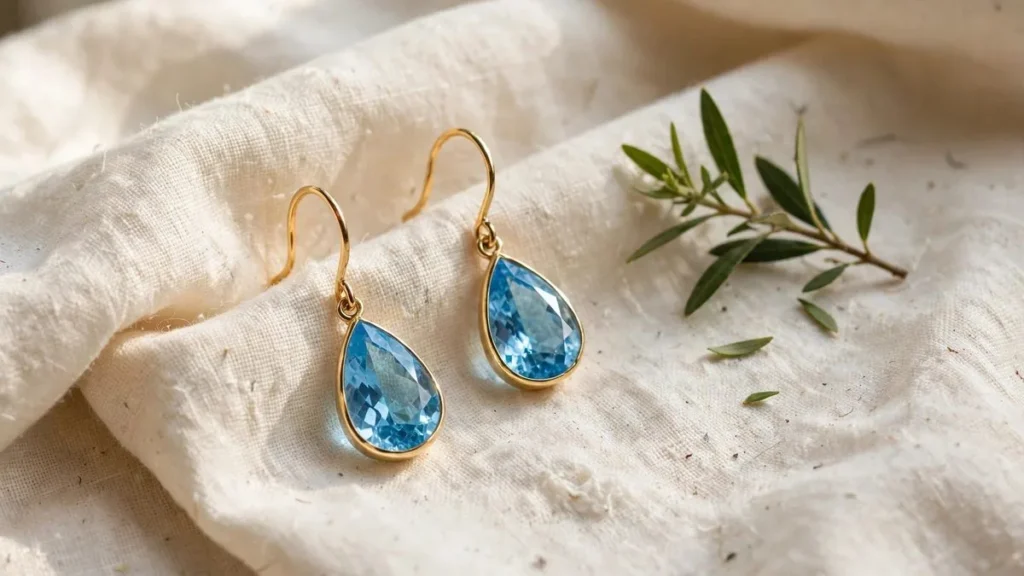
Cut matters on the ear because an earring is seen in motion: a well-cut topaz returns light as it moves, while a poorly cut one goes dark as it turns. Round cuts are safest for studs; oval and cushion cuts suit drops, and pear shapes are the classic drop choice, point facing up.
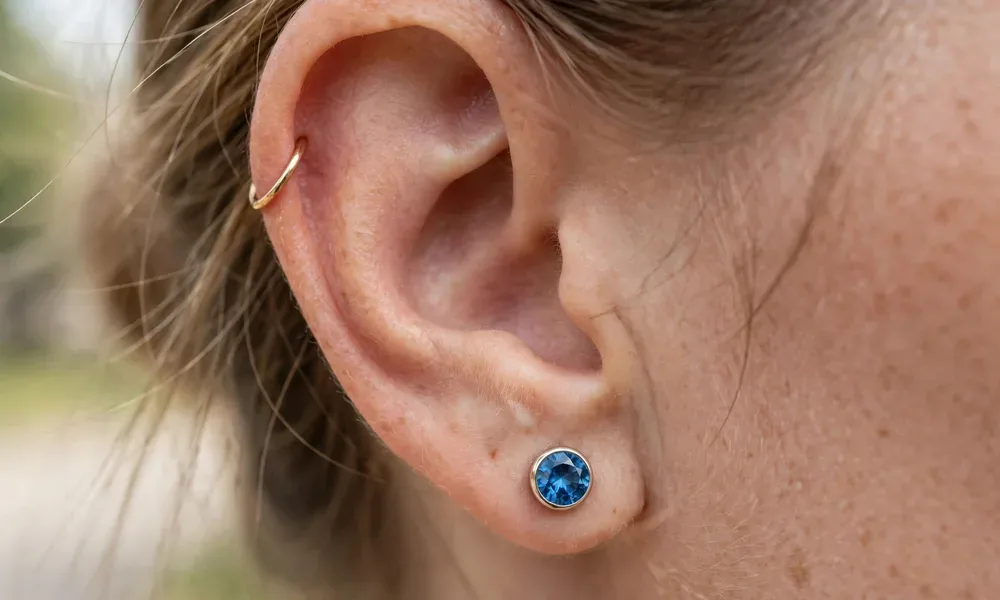
Judge size in millimetres, not carats: 4 mm is about 0.25 carats and reads as delicate, 5 mm is about 0.45 carats and is the sweet spot for everyday studs, 6 mm is about 0.75 carats and makes a clear statement, and 8 mm is close to 2 carats and firmly evening territory. Studs read smaller on the ear than in the box, so the larger size is usually right if the weight is comfortable.
Most topaz is eye-clean, with no inclusions visible to the naked eye. A cloudy stone, a visible crack or a dull centre is a poor buy at any price. Check the girdle, the thin edge, for chips.
Choose the style that suits how you live
Be honest about your days before you fall for a design. Studs are the workhorses: close to the ear, secure, comfortable under headphones and with glasses, and suitable for work and travel. Drops add movement and flatter evening necklines, but catch on scarves and hair. Hoops suit almost every face shape, and a small topaz-set hoop is a useful middle ground. Huggies, the small hoops that hug the lobe, are the current everyday favourite, while chandeliers are occasion pieces.
| Style | Best for | Comfort | Watch out for |
|---|---|---|---|
| Studs | Every day, work, travel | Excellent | Backs that loosen |
| Drops | Evenings, special occasions | Good if light | Snagging on hair and scarves |
| Hoops | Every day to evening | Very good | Weight; clasps that gap |
| Huggies | Every day, layered piercings | Excellent | Diameter must clear the lobe |
| Chandeliers | Occasions, weddings | Moderate | Heavy; best kept for a few hours |
| Threaders | Modern, minimal looks | Good | Can slip; check the chain length |
| Climbers | Statement, no second piercing needed | Good | Must follow the curve of the ear |
| Clip-ons | Unpierced ears | Moderate | Pressure over long wear; screw backs help |
Settings and backs: the parts nobody photographs
The setting holds the stone and protects it, and deserves as much attention as the stone. A bezel, where a rim of metal wraps around the stone, is the most protective choice, and the one to choose for drops. It also makes a stone look slightly larger. A prong setting lets in more light and shows more of the topaz, which suits studs, but prongs must be checked regularly, because a bent prong is how stones are lost.
Backs are the least glamorous part of an earring and the most important for keeping it. Friction backs, the simple push-on butterfly, are fine for light studs but loosen over time. Screw backs are far more secure for daily studs, and la poussette backs, with a spring-loaded notch, are the most secure of all. For drops and hoops, look for lever backs, or latch backs on hoops, which should close with a firm click and no gap. If you have sensitive ears, ask for titanium, surgical steel or solid gold posts: nickel is the usual culprit.
Metal: what flatters topaz and what lasts
White gold and platinum suit blue topaz best, sharpening the cool blue. Sterling silver does the same job at a lower price, though it tarnishes and needs occasional cleaning. Yellow gold warms blue topaz and is the natural partner for imperial topaz, while rose gold flatters pink topaz.
Solid 14k or 18k gold is the best everyday choice: it does not tarnish, and it can be repaired and polished for decades. Platinum is heavier and more expensive. Sterling silver is affordable but softer, so it suits studs better than heavy drops. Gold vermeil looks like solid gold at a lower price, but the coating will eventually wear. Gold plated base metal is the cheapest and least durable option.
Comfort and weight: the test most buyers skip
Weight is the most overlooked factor in earring buying, and it is why so many beautiful pairs end up unworn. A pair that feels fine for five minutes in a shop can ache after three hours, and heavy earrings slowly stretch the piercing. Keep each earring under about 5 grams for all-day wear, and treat anything over 8 grams as an occasion-only piece. If it feels heavy in your palm, it will feel heavier on your ear.
Balance matters as much as weight: a drop whose stone sits too far forward will tilt and pull, while a well-balanced pair hangs straight. Try them on and look down at your phone, because that is when a bad design reveals itself. Our guide to diamond earrings covers the same comfort questions, and the principles are identical: the best earring is the one you forget you are wearing.
What should topaz earrings cost in 2027
Blue topaz is affordable at any size, because the raw material is plentiful and the treatment is cheap, so never pay a premium for a large blue stone on the grounds of rarity. Imperial topaz is the exception: its price rises steeply with colour quality and size, so a certificate matters there.
Sterling silver studs start at around $30 to $80, and gold vermeil studs run from about $60 to $150. Solid 14k gold studs with 5 mm to 6 mm blue topaz typically cost $150 to $400, while the same stones in 18k gold or platinum run $400 to $900. Gold drops with pear or oval topaz generally fall between $250 and $800, and designer pieces can reach $1,500 and beyond. Imperial topaz earrings start higher, often $500 to $1,500, and fine pairs can cost several thousand dollars.
Be suspicious of prices far outside these bands: far below them usually means plated base metal, glass rather than topaz, or a smaller stone than listed, while far above them should come with a certificate or a named maker.
Care: keep the colour and the sparkle
Topaz is hard, but not invincible: its one weakness, perfect cleavage, is the kind of damage that happens when an earring is dropped onto a hard floor or knocked against a door frame. Take drop earrings off before the gym, swimming and bed, and store each pair separately in a soft pouch so the stones do not scratch each other.
Cleaning is simple: warm water, a drop of mild soap, and a soft brush or cloth, followed by a rinse and a pat dry. Avoid ultrasonic and steam cleaners entirely, because the vibrations can split a stone along its cleavage plane, and keep earrings away from household cleaners, hairspray and perfume. Check the prongs and backs every few months, and get a professional clean once a year. Our topaz ring guide explains colour, clarity and treatments in greater depth.
Buying checklist
- Colour first: choose the blue shade you love, or for imperial topaz insist on a rich orange with a pink or red overtone.
- Cut and size: pick a round cut for studs and a pear or oval for drops, and judge size in millimetres.
- Setting: favour a bezel for drops, and check prongs are even and tight before you leave the shop.
- Backs: choose screw or la poussette backs for studs and lever backs for drops.
- Weight: keep each earring under about 5 grams for all-day wear, and try them on before deciding.
- Paperwork: get the treatment, the metal and any lab report in writing.
Frequently asked questions
Is blue topaz a good choice for everyday earrings?
Yes. Blue topaz scores 8 on the Mohs scale, so it resists scratching well, it is usually eye-clean, and it is affordable enough to wear daily. Studs or huggies in a bezel setting are the most practical everyday pair.
Are topaz earrings real gemstones or are they treated?
Topaz is a real, natural gemstone, but almost all blue topaz has been irradiated and heated to create its colour, because natural blue topaz is very rare and usually very pale. The treatment is permanent and should be disclosed.
What is the difference between Sky, Swiss and London blue topaz?
Three depths of the same treated blue, not three origins. Sky blue is the palest, Swiss blue is a vivid medium blue and the most common, and London blue is the deepest. The price difference is small.
How heavy can topaz earrings be before they hurt?
Most people are comfortable with up to about 5 grams per earring for all-day wear, and anything over 8 grams is best kept for occasions. A well-balanced drop feels lighter than a front-heavy one.
Can you wear topaz earrings in the shower or while swimming?
Best not to. Soap, shampoo and chlorine can dull the metal and leave a film on the stone, and water makes earrings easier to lose.
What metal is best for topaz earrings?
White gold or platinum suits blue topaz best, sterling silver is the best-value option for studs, and yellow or rose gold flatters imperial and pink topaz. Solid 14k or 18k gold is the most durable everyday choice.
The bottom line
The best topaz earrings are not the biggest or the most expensive. They are the pair whose colour you love in daylight, whose stones match, whose backs you trust, and whose weight you forget by lunchtime. Start with colour, choose the style that fits your actual days, and spend the extra attention on the backs, the posts and the prongs. If you are still deciding, our history of hoop earrings is a useful place to start.
Note: Prices are indicative for 2027 and vary by maker, metal and retailer. Topaz treatments should always be disclosed, and any fine imperial or natural pink topaz purchase should come with a lab report.