A sapphire ring is one of the most rewarding pieces of jewellery you can buy, and one of the easiest to get wrong. Two rings can look almost identical yet differ enormously in colour and price.
Sapphire is the blue variety of corundum, the same mineral family as ruby, and it scores 9 on the Mohs hardness scale. Only diamond is harder, which makes a well-chosen sapphire genuinely suitable for everyday wear.
This guide covers what matters most before you buy: colour, sapphire types, clarity and cut, treatments, natural versus lab-created stones, settings, prices, and the paperwork that protects you.
Key takeaways
- Colour matters most: rich, even blue with strong saturation and a medium to medium-dark tone, checked in daylight.
- Most sapphires are heat-treated, which is standard and permanent, but it must be disclosed and priced accordingly.
- Untreated sapphires with fine colour cost far more, so ask for a lab report on any expensive stone.
- Sapphire scores 9 on the Mohs scale, so it suits daily wear, but the setting still matters.
- Natural, lab-created and fancy-colour sapphires can all be good buys, if you know which one you are paying for.
Start with colour, because it decides almost everything
With a diamond, cut usually comes first. With a sapphire, colour comes first and drives both beauty and price. Jewellers describe it in three parts: hue, the colour family; tone, how light or dark it looks; and saturation, how strong it is.
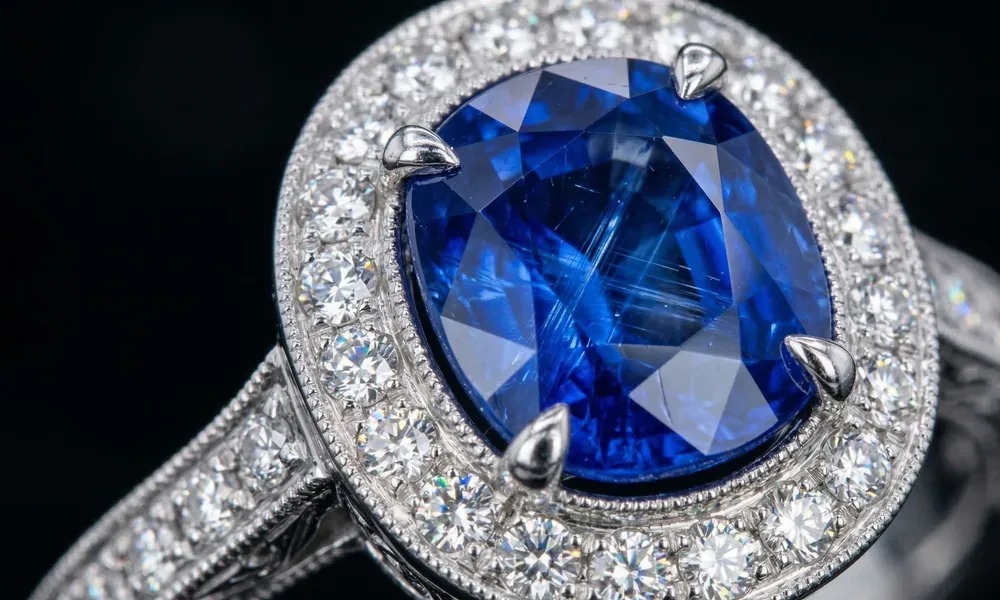
The most prized blue is pure to slightly violetish, strongly saturated, and medium to medium-dark in tone, often called royal blue or, when slightly lighter and velvety, cornflower blue. Avoid stones that are too dark, which look inky indoors, or too pale, which look washed out. Greenish or greyish casts lower the value.
Check the colour in more than one light. Shop lighting flatters every stone, so ask to see the ring in daylight. A good sapphire holds its colour in dimmer conditions rather than going flat. Turn the stone and look across the top, the table, to check the colour is even. Some sapphires show colour zoning, bands or patches of colour, but obvious unevenness hurts beauty and value.
The types of sapphire, and which one suits you
Blue is the classic, but sapphire comes in almost every colour except red, since red corundum is ruby. Other colours are called fancy sapphires and often offer better value. Pink ranges from pale pink to vivid fuchsia and suits rose gold; yellow runs from pale lemon to golden honey. White sapphire is sometimes chosen as a diamond alternative.
The rarest fancy sapphire is padparadscha, a soft pink-orange named after the lotus flower, found mainly in Sri Lanka and Madagascar. Fine padparadscha commands very high prices and is as much a collector’s stone as a ring stone. Star sapphires show a six-rayed star across a domed surface and are usually cut as cabochons, while colour-change sapphires shift from blue in daylight to violet in lamplight. For everyday wear, blue remains the safest choice.
Clarity and cut: what to look for
Almost every natural sapphire contains inclusions, tiny internal features formed as the crystal grew. Fine silk, a soft scattering of needle-like inclusions, can give a velvety look, but too much makes a stone hazy. Look for a stone that is eye-clean, with no flaws visible to the naked eye. Surface-reaching cracks can weaken the stone and must be disclosed.
Cut is how the stone has been shaped and faceted. A well-cut sapphire looks lively, balanced and symmetrical, with colour spread evenly across its face. Oval is the most common shape, followed by cushion, round and emerald. Watch for windowing, a washed-out patch in the centre of a shallow stone where light leaks through, and for dark areas in stones cut too deep. There is no official cut grade for sapphires, so your eyes are the final judge: the stone should look bright and alive, not sleepy or glassy.
Treatments: the question that changes the price
Roughly nine in ten natural sapphires have been heat-treated. Heating, usually to around 1,600 to 1,800 degrees Celsius, improves colour and dissolves some inclusions. It is permanent, stable and accepted by every major gemmological laboratory. A heated sapphire is a real, natural sapphire, and there is nothing wrong with buying one, as long as you know it is heated.
Untreated sapphires are a different category. A fine unheated stone carries a premium of often 20 to 50 percent over a comparable heated stone, growing with size and colour quality. Always ask whether the stone has been heated, and ask for the answer in writing. Other treatments must also be disclosed: diffusion, which uses beryllium or titanium to create colour, can halve a stone’s value. If a seller cannot explain a stone’s treatment, shop elsewhere.
Natural versus lab-created sapphire
A lab-created sapphire, also called lab-grown or synthetic sapphire, is real corundum: the same composition, crystal structure and hardness of 9 as a mined stone. It is grown in a laboratory, a process dating back to the flame-fusion method of the early 1900s. To the naked eye, a lab-created and a natural sapphire of the same colour are impossible to tell apart.
The difference is price. Lab-created sapphires typically cost a small fraction of a comparable natural stone, so you can have a bigger, cleaner, more vivid ring for the same money. The trade-off is resale value: a lab-created stone will not hold its value the way a fine natural stone can. If you are weighing a sapphire against other centre stones, our guide to the best non-diamond engagement rings of 2027 compares sapphire with emerald, ruby, morganite and moissanite.
Origin: beautiful, but not the first thing to pay for
Sapphires are mined in Sri Lanka, Madagascar, Myanmar, Thailand, Australia and elsewhere. Kashmir sapphires, mined mainly in the late 1800s, are legendary for their velvety cornflower blue, with the finest examples reaching six figures per carat at auction. Origin is the laboratory’s opinion, based on inclusions and chemistry. For most buyers it should come after colour, cut, clarity and treatment, and it is only worth paying for when stated on a lab report.
Settings and metals that suit a sapphire
A classic four-prong solitaire shows off the stone and lets in the most light. A bezel setting, where metal wraps around the stone’s edge, protects the corners and suits anyone who works with their hands or never takes a ring off. A halo of small diamonds adds sparkle and makes the sapphire look larger.
Platinum is the most durable and secure metal for a valuable stone, and its cool white tone suits blue sapphires. White gold gives a similar look for less, though it needs replating every few years. Yellow gold warms a blue sapphire, while rose gold flatters pink and padparadscha sapphires. Have the prongs checked once a year, since a worn prong is the most common reason a stone is lost. If you are still deciding on style, our roundup of the best engagement rings of 2027 covers solitaires, halos and three-stone designs.
Size, carat and what a sapphire ring should cost
Carat is weight, not size, and sapphire is denser than diamond, so a one-carat sapphire looks slightly smaller than a one-carat diamond of the same shape. Price per carat climbs steeply with size, especially above one, three and five carats. A smaller stone with better colour is usually a better buy than a larger stone with poor colour.
Prices vary widely, so treat these as a rough guide to 2027. A commercial-grade heated blue sapphire of around one carat costs roughly $200 to $800 per carat; good-quality heated $800 to $2,500; fine heated with vivid colour $2,500 to $6,000; premium unheated $6,000 to $10,000 or more, with collector-grade Kashmir or Burmese stones above $12,000 to $40,000. Pink runs $600 to $6,000 per carat, yellow $600 to $3,500, padparadscha $3,500 to $36,000, and lab-created tens to a few hundred dollars.
For a complete ring, a lab-created sapphire ring can start under $1,000, a natural heated sapphire ring typically runs from around $5,000 to $20,000, and a luxury ring with a rare unheated stone can exceed $20,000. Set your budget first and decide what matters most: size, colour, or an untreated stone. If you are comparing sapphire with a diamond or moissanite centre stone, our diamond versus moissanite engagement ring guide explains how the alternatives compare.
Sapphire types at a glance
| Type | Colour | Typical price per carat | Best for |
|---|---|---|---|
| Blue sapphire | Rich blue | $200 to $6,000+ heated; $6,000+ unheated | Everyday wear and engagement rings |
| Pink sapphire | Pale pink to vivid fuchsia | $600 to $6,000 | Romantic rings, especially in rose gold |
| Yellow sapphire | Pale lemon to golden honey | $600 to $3,500 | Warm colour on a moderate budget |
| Padparadscha | Soft pink-orange | $3,500 to $36,000 | Collectors and one-of-a-kind rings |
| Star sapphire | Blue with a six-rayed star | Varies widely by star quality | Statement and traditional rings |
| Colour-change sapphire | Blue in daylight, violet in lamplight | Premium over blue | Buyers who want something unusual |
| White sapphire | Colourless | Most affordable | A diamond look on a small budget |
| Lab-created sapphire | Any colour, usually blue | Tens to a few hundred dollars | Large, vivid stones for less money |
Certificates, sellers and the paperwork that protects you
For any sapphire ring that costs serious money, insist on an independent lab report from GIA, GRS or SSEF, confirming the stone is natural corundum, its colour, and its treatment. Check the report number with the laboratory itself. Buy from a seller who welcomes questions and puts the facts in writing, and be cautious of anyone who rushes you or offers a very fine stone at a suspiciously low price.
Checklist: what to look for in a sapphire ring
- Check the colour in daylight: rich, even, medium to medium-dark blue, no inky darkness and no grey or greenish cast.
- Check for zoning and windowing: turn the stone and make sure the colour is even and the centre is not washed out.
- Ask about treatment: heated is standard and permanent, unheated costs much more, and diffusion or filling must be disclosed.
- Ask for a lab report: an independent GIA, GRS or SSEF report for any expensive stone, verified with the lab.
- Confirm natural or lab-created: know which one you are paying for, since lab-created costs a fraction of natural.
- Check the setting and metal: a secure setting that suits your life, sound prongs, and a metal that flatters the stone.
Frequently asked questions
What is the most important thing to look for in a sapphire ring?
Colour. Look for a rich, even blue with strong saturation and a medium to medium-dark tone, checked in daylight.
Are heated sapphires bad?
No. Heat treatment is standard, permanent and accepted by every major gemmological laboratory, and roughly nine in ten natural sapphires have been heated.
How can you tell a real sapphire from a fake one?
A lab-created sapphire is a real sapphire, just grown in a laboratory, and it cannot be told from a natural stone by eye alone. Glass imitations may look too perfect or show bubbles under a loupe.
Is a sapphire ring durable enough for everyday wear?
Yes. Sapphire scores 9 on the Mohs hardness scale, second only to diamond, and it does not fade or cloud with wear.
How much should a sapphire ring cost?
A lab-created sapphire ring can start under $1,000, a natural heated sapphire ring typically runs from around $5,000 to $20,000, and a luxury ring with a rare unheated stone can exceed $20,000.
Which sapphire colour is best for a ring?
Classic blue is the most versatile and the easiest to judge, and it suits almost every skin tone and metal. Pink is romantic and flatters rose gold, yellow is warm and sunny, and padparadscha is the rarest choice. Choose the colour you love, neither too dark nor too pale.
The bottom line
A good sapphire ring is bought in a clear order: colour first, then cut and clarity, then treatment, then origin, then setting. Fall in love with the colour in daylight, ask the treatment question before you ask the price, and insist on a lab report for any expensive stone. Do that, and you will end up with a ring that is beautiful, honestly priced, and hard enough to wear every day.
Note: Prices here are indicative 2027 market ranges, not quotes, and vary with colour, size, origin, treatment and seller. Always confirm the treatment, identity and price of the exact stone in writing before you pay.