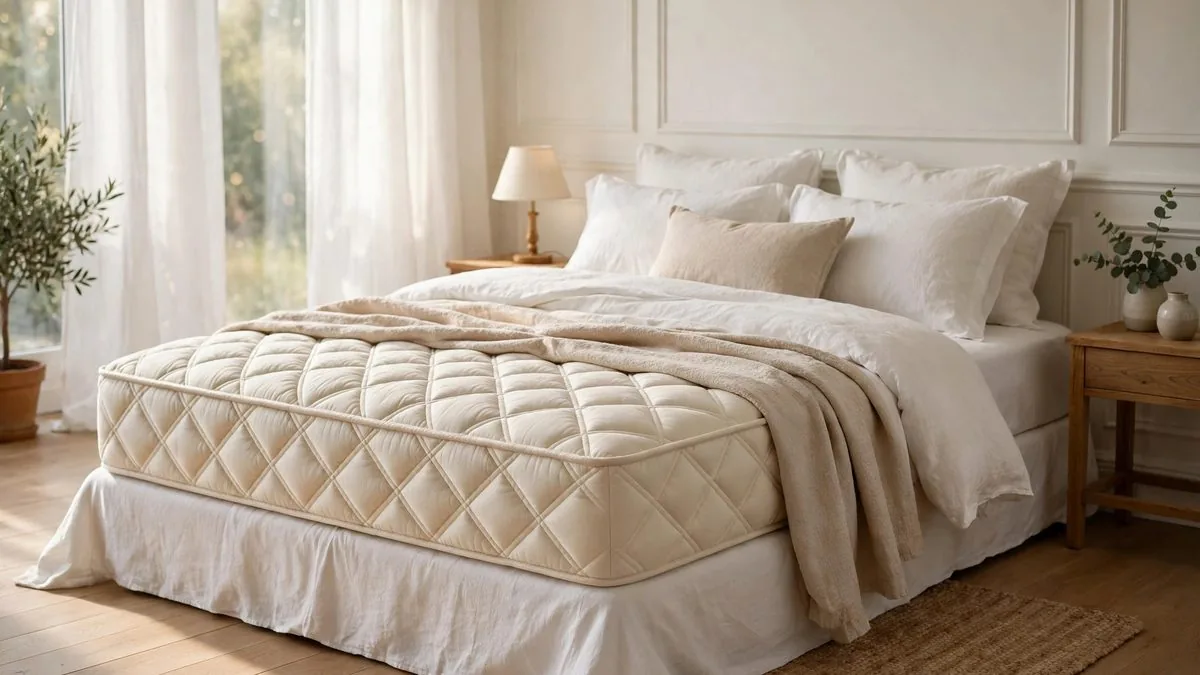

A luxury mattress is one of the few purchases you will use every single night for years, yet most people choose one in a showroom in under fifteen minutes. In 2027 every brand promises premium materials, better sleep and hotel-level comfort — but the word luxury, on its own, tells you almost nothing.
What separates a genuinely luxurious mattress from one that is simply priced like one comes down to construction you can verify: the materials inside each layer, the support system underneath them, how well the mattress manages temperature, and the trial and warranty behind it. A good mattress keeps your spine in a neutral position, relieves pressure at your shoulders and hips, and still feels supportive in year five as it did on night one.
This guide covers what to check before you buy — materials, firmness, edge support, certifications, delivery and returns. Use it as a checklist, and you will be able to tell real engineering from a handsome label.
Key takeaways
- Luxury is construction, not price: layered materials with a purpose, a real support core and reinforced edges justify the cost.
- Match firmness to your sleep position and weight — most sleepers do best on medium to medium-firm.
- Ask for specifics: foam density, coil count and gauge, latex type, and certifications such as CertiPUR-US and OEKO-TEX.
- Temperature regulation should be built into the materials, not sprayed on as a surface treatment.
- Never buy without a trial of at least 100 nights and a ten-year warranty.
What Actually Makes a Mattress Luxury
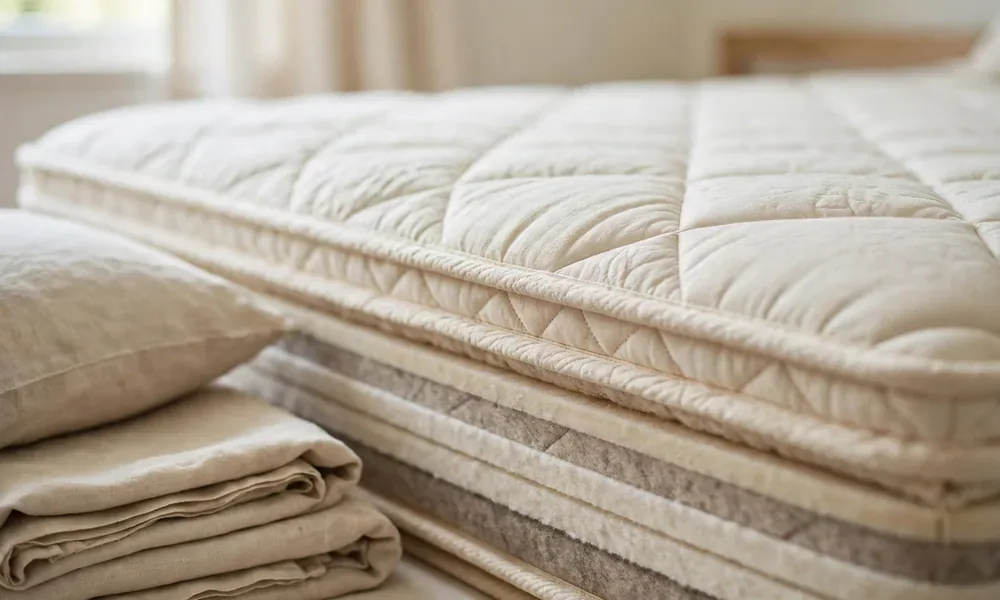
A luxury mattress is a multi-layer system, and each layer should have a distinct job: the cover touches your skin, the comfort layers relieve pressure, a transition layer stops you sinking too far, and the support core holds your spine in alignment. Most genuine luxury mattresses sit between thirteen and seventeen inches tall, because the layers needed for pressure relief, zoned support and edge reinforcement take physical space. The finish matters too — organic cotton, wool, silk, cashmere blends or Tencel rather than plain synthetic polyester — and so does the service: white-glove delivery, old mattress removal, a generous trial and a clear warranty.
The Materials Inside: Latex, Memory Foam and Hybrids
The comfort layer is where pressure relief happens, and two materials define the premium tier. Natural latex is responsive, breathable and hypoallergenic, and a well-made latex layer can serve for fifteen to twenty-five years; it pushes back gently rather than letting you sink in. High-density memory foam contours closely to the body and isolates motion exceptionally well, which is why couples often prefer it. The number that matters is foam density: premium comfort layers should be in the region of four to six pounds per cubic foot, while budget foam is often two to three pounds per cubic foot and can soften within a few years.
Below the comfort layers sits the support core, usually individually pocketed coils in the luxury tier. Each coil sits in its own fabric pocket, so it responds independently to pressure, improving contouring and limiting motion transfer. Premium queen-size mattresses commonly feature eight hundred to more than thirteen hundred coils, made from lower-gauge steel for greater resilience. A hybrid combines a pocketed-coil core with foam or latex comfort layers, pairing pressure relief with support and airflow, and hybrids now dominate the luxury segment.
Firmness and Sleep Position: Getting the Match Right
Firmness is the most personal part of mattress shopping, and the right choice depends on how you sleep and how much you weigh. Medium to medium-firm suits most adults best, supporting the spine while cushioning the shoulders and hips. Side sleepers generally need the softest surface, since their weight concentrates on the shoulder and hip. Back sleepers need balance — enough contouring to fill the curve of the lower back, but enough support to stop the hips sinking — so medium-firm is the usual recommendation, while stomach sleepers need the firmest surface, because a soft mattress lets the hips sink and arches the lower back. Lighter sleepers often find a mattress feels firmer, heavier sleepers sink further in, and couples with different needs should look for zoned support.
Support, Zoning and Edge Support
Zoned support is one of the clearest signs of a thoughtfully built luxury mattress. The body does not press evenly: the hips and lower back are heavier than the shoulders and legs, so a single uniform firmness is always a compromise. Zoned designs use firmer coils or foam through the middle third and softer zones at the head and foot, keeping the spine level while cushioning pressure points, Some add micro-coils above the main core for a springy feel and better airflow. Edge support is the detail most buyers forget to test: sit on the edge as if putting on shoes, and a well-built mattress should hold its shape, not collapse. Reinforced perimeters also increase the usable sleeping surface, which matters for couples.
Temperature: How to Avoid Sleeping Hot
Sleeping hot is one of the most common mattress complaints, and it is mostly a materials problem. Dense memory foam restricts airflow and responds to body heat, so it has a well-earned reputation for trapping warmth — check how the mattress deals with heat. Genuine temperature regulation is built into the materials: breathable natural latex, gel, graphite or copper infusions that draw heat away, and covers in organic cotton, wool or Tencel that wick moisture. Be cautious of cooling claims that rely on a surface treatment alone, since a thin coating can fade with use. Ask whether the cooling is structural — in the foam, the coils and the airflow of the whole mattress — or only on the surface.
Size, Height and Fitting Your Bedroom
Before falling in love with a mattress, measure twice. A luxury mattress is often thicker than a standard one, so check the total height on your bed frame and make sure your sheets fit — deep-pocket fitted sheets exist for a reason. A queen is the most popular choice for couples, while a king gives noticeably more personal space and suits larger bedrooms; in a small room a king can dominate the space, so think about the proportions of the room as well as the bed, as you would with the best celebrity home decor of 2027. Weight matters too: luxury hybrids can be very heavy, so check the delivery route and whether white-glove setup is offered.
Trial Periods, Warranties and Delivery
The home trial is the most important protection when buying a luxury mattress, because no showroom visit can tell you how a mattress feels after eight hours a night for several weeks. Your body needs time to adjust — a mattress that feels firm on day one may feel right by week three — so look for a trial of at least one hundred nights with free returns, including collection. The warranty is the second half of that protection: a luxury mattress should carry a warranty of at least ten years, covering sagging beyond a stated depth — usually around an inch to an inch and a half — as well as stitching, zips and cover defects. White-glove delivery usually includes placement in your bedroom and old mattress removal.
What Justifies the Price — and What Does Not
The price should track the materials and the construction: natural latex, high-density foam, individually pocketed coils, certified textiles and hand-finishing all cost more to produce than budget equivalents, and they last longer. A mattress built from them should hold its shape for eight to ten years or more, while a cheap one may sag within a few. What does not justify the price is branding alone — a famous name or a lavish advertising campaign adds nothing to how you sleep. Certifications are one of the few reliable shortcuts: look for CertiPUR-US for foams, OEKO-TEX Standard 100 for textiles, GOLS or GOTS where organic latex or cotton is claimed, and Greenguard Gold for low chemical emissions.
Red Flags to Watch For
A few warning signs should make you pause. The first is secrecy about what is inside: if a brand will not disclose foam density, coil count, latex type or layer thicknesses, you are being asked to pay for a mystery, while transparent brands publish full specifications. The second is a trial or warranty shorter than the price deserves — a thirty-night trial on a mattress costing several thousand suggests the seller is not confident you will keep it, and the same applies to returns with heavy restocking fees hidden in the small print. The third is pressure to buy immediately: limited-time discounts that never end are a sign the sale matters more than the fit. Finally, watch for claims no mattress can honestly make, such as a medical cure or guaranteed back-pain relief.
| Mattress type | Best for | Feel | Temperature | Durability |
|---|---|---|---|---|
| Natural latex | Hot sleepers, allergy-prone sleepers | Responsive, buoyant | Cool, breathable | Very long, often 15–25 years |
| Memory foam | Couples, pressure-point relief | Close contouring | Can sleep warm unless infused | Good if high density |
| Hybrid (coils + foam/latex) | Most sleepers, all positions | Balanced support and cushioning | Cooler, thanks to airflow | Long, 8–10 years or more |
| Pocket spring | Traditional feel, couples | Springy, supportive | Cool, good airflow | Long with quality coils |
| All-foam | Budget-conscious buyers | Uniform, contouring | Varies with foam type | Shorter, depends on density |
| Adjustable air | Couples with different needs | Adjustable firmness | Varies by construction | Long, but more parts to fail |
| Organic / certified | Chemical-sensitive sleepers | Varies by build | Usually breathable | Long with quality materials |
| Smart mattress | Tech enthusiasts | Varies by base model | Often active cooling | Depends on electronics |
Your Pre-Purchase Checklist
- Confirm the full layer-by-layer construction, including foam density, coil count and latex type, before you pay.
- Match firmness to your sleep position and body weight, and test the mattress lying down in your usual position for at least ten minutes.
- Check for independent certifications such as CertiPUR-US, OEKO-TEX and GOTS or GOLS on any organic claims.
- Test the edge support by sitting on the side of the bed, and check motion isolation if you share the bed.
- Make sure the trial lasts at least 100 nights with free returns, and that the warranty covers sagging for ten years or more.
- Measure your bedroom, bed frame and delivery route, and confirm white-glove delivery and old mattress removal in advance.
Frequently Asked Questions
How much should a luxury mattress cost in 2027?
There is no single price that defines luxury, because the cost depends on size, materials and construction. Judge the mattress by its specifications and its trial and warranty, not by the size of the discount.
How long should a luxury mattress last?
A well-built luxury mattress should hold its shape and support for eight to ten years at minimum, and natural latex models can last considerably longer. The main signs it is time to replace one are visible sagging, waking with aches that fade during the day, or a surface that no longer feels supportive.
Is a hybrid or an all-latex mattress better?
Neither is universally better — it depends on how you sleep. Hybrids suit most people because they combine the pressure relief of foam or latex with the support and airflow of pocketed coils, and they tend to sleep cooler. All-latex mattresses are more responsive and breathable and usually last longer, but they are heavier and can feel firmer.
Do I need a new pillow with a new mattress?
Often, yes. A pillow and a mattress work together to keep your head, neck and spine aligned, so a new mattress changes the height and support your pillow needs to provide. Side sleepers generally need a higher-loft pillow, back sleepers a medium loft, and stomach sleepers a low, soft pillow.
How long should I try a mattress before deciding?
Give it at least three to four weeks of nightly use before making a final decision. Your body needs time to adjust to a new support surface, especially if your old mattress was sagging. A trial of one hundred nights or more is the standard to look for.
What should I do with my old mattress?
Ask the retailer first, because many luxury brands include old mattress removal with white-glove delivery. If not, local recycling services can often collect and break down a mattress for its metal, foam and fabric. A good night routine helps too — a considered winter skincare routine for 2027 or a little luxury body butter for 2027 can turn the last hour before bed into something genuinely restorative.
The Bottom Line
A luxury mattress in 2027 is worth buying when the construction, the materials and the service behind it are all genuinely premium — layered materials with a clear purpose, a pocketed-coil or high-quality latex core, honest certifications, a trial of at least one hundred nights and a warranty of ten years or more. None of that shows up in a photograph or a price tag, so choosing well is mostly about asking good questions and reading the specifications before you pay.
Take your time, test mattresses in your usual sleep position, and remember that the best mattress is not the most expensive one or the most famous one — it is the one that keeps your spine aligned, keeps you cool and still feels supportive years after the delivery van has gone. Choose that mattress, and the luxury is not in the label. It is in every night of sleep that follows.
Note: Mattress preferences are personal, and the right choice depends on your sleep position, body weight and any health conditions you may have. If you have ongoing back pain or a diagnosed sleep disorder, speak to a clinician before choosing a mattress, and treat any product claim of a medical benefit with healthy scepticism.