You bring home a beautiful cashmere sweater, wear it a handful of times, and then you notice them: tiny balls of fibre gathering under the arms, along the sides, and wherever a bag strap has sat. The sweater still feels soft, but up close it looks tired before its time.
Pilling is the most common complaint about cashmere, and the most misunderstood. It is not dirt, not a stain, and not always a sign that you bought a bad sweater. The very qualities that make cashmere so soft and warm are the same qualities that make it prone to pilling, and understanding that trade-off changes how you shop for, wear, and care for the fibre.
This guide explains why cashmere pills, where pills appear first, how to remove them safely, and the habits that keep a good sweater smooth. Most pilling can be fixed at home in a few minutes, and once the loose surface fibres have settled, a well-made piece usually pills far less.
Key takeaways
- Pilling is caused by friction loosening short surface fibres, which then tangle into small balls — a mechanical process, not dirt or damage.
- Cashmere pills more easily than coarser wool because its fibres are exceptionally fine and short, so they work loose more readily.
- Most pilling happens in the first few wears and then settles, as loose surface fibres are shed and the longer, well-anchored fibres remain.
- A cashmere comb is the gentlest removal tool for fine knits; an electric shaver is faster but belongs on its lowest setting.
- Prevention matters more than removal: rest the garment between wears, cut friction from bags and seatbelts, wash gently inside out, and fold rather than hang.
What pilling actually is
A pill is a small, tangled ball of fibre on the surface of a fabric. It forms in three stages: loose fibre ends work their way out of the yarn, repeated rubbing tangles them together, and the cluster anchors itself to the fabric, growing slightly each time the area is rubbed again.
Every natural fibre pills, and any fabric rubbed often enough will show some. Cashmere simply shows it more clearly, because its smooth, even surface makes even small pills stand out. Pilling does not mean the fabric has broken: the yarn underneath is intact, and the sweater can look new again once the pills are gently removed.
Why cashmere pills more than other knits
The answer lies in the fibre itself. Cashmere comes from the soft undercoat of cashmere goats, and the finest fibres measure around 15 to 16 microns across, finer than a human hair. That fineness is what makes cashmere feel so soft, but fine fibres are also short fibres, and short fibres do not grip each other as securely inside a twisted yarn as longer, coarser fibres do.
Yarn is made by twisting fibres together. Longer fibres wrap around each other many times, creating plenty of friction points that hold them in place. Short, fine fibres have fewer wrap points, so under stress they are more likely to slip free, migrate to the surface, and tangle into pills. The softness and the pilling are two expressions of the same property.
Construction matters just as much as the raw fibre. A two-ply yarn, made from two strands twisted around each other, holds its fibres far more securely than a single-ply yarn of the same weight. A tightly knitted fabric gives loose fibres less room to move than a loose, open knit, and long-staple fibre pills more slowly than short-staple fibre. When choosing your next piece, our guide to the best cashmere sweaters is a useful place to compare styles and construction before you buy.
The friction zones: where pills appear first
Pilling is not random. It maps onto the places where fabric meets something else, over and over, for hours at a time. The underarms are the highest-friction point on any sweater, because the arm moves against the body with every step, so this area almost always pills first. Elbows come next, resting against desks and armrests all day, then the sides where the arms swing against the torso, and the front where a bag strap or seatbelt crosses it.
Layers create friction too. A rough wool coat worn directly over cashmere rubs the two fabrics together, and a coat lining can abrade the sides and back of a sweater. Even a snug fit adds friction, because a tight garment is under constant tension. Pairing a smoother outer layer with your knit helps, and checking the season’s best sweater trends for winter can help you plan outfits that do not grind the fabrics against each other.
Does pilling mean your cashmere is poor quality?
Not necessarily. Even the finest cashmere produces some pills in the first few wears, because no spinning process captures every fibre end. The shortest surface fibres, never fully locked into the yarn, work their way free during the first three to six wears. This is a settling process, not a defect, and once those loose fibres are removed, the remaining fibres are long enough and securely twisted to stay in place.
What should make you pause is persistent, aggressive pilling that continues well beyond the first few wears and spreads across the whole garment after minimal, gentle use, a pattern more often connected to short-staple fibre, single-ply construction, or a loosely knitted fabric. The honest test is time: a little pilling in week one is normal, while heavy pilling in month six, after gentle wear and careful washing, points to the construction.
How to remove pills without damaging the knit
Removing pills is simple, but the wrong tool can do real harm. Aggressive scraping, a bare razor blade, or pulling pills off with your fingers can cut fibres, stretch the knit, and leave thin patches. The goal is to lift or trim only the pills, leaving the base fabric untouched.
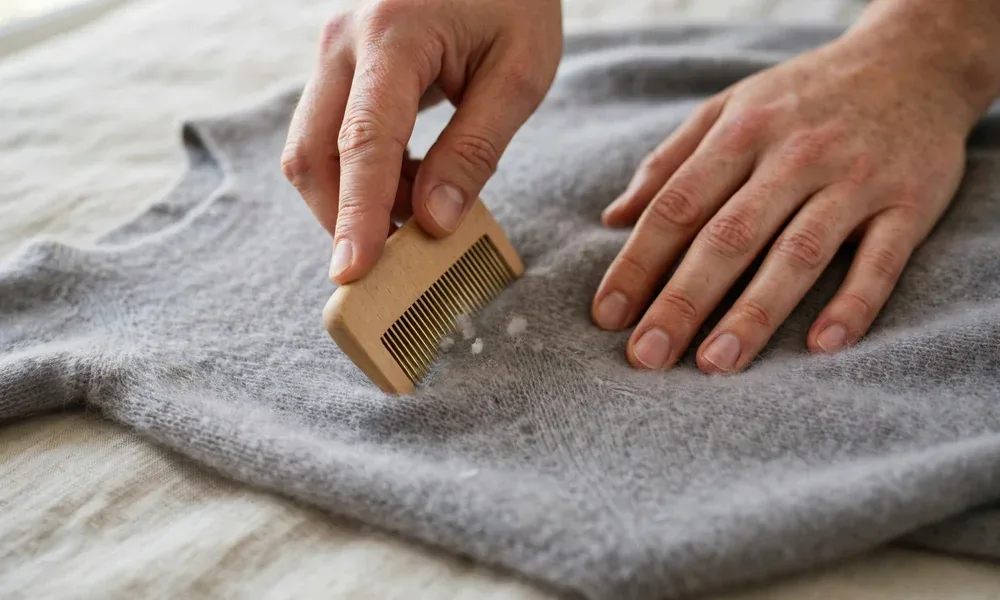
Lay the sweater flat on a clean, dry surface. Work on a dry garment, because damp cashmere stretches more easily and is more vulnerable while handled. Hold the fabric taut with one hand so it cannot bunch up under the tool, and always test any tool first on a hidden area, such as an inside seam, before using it on a visible part of the sweater.
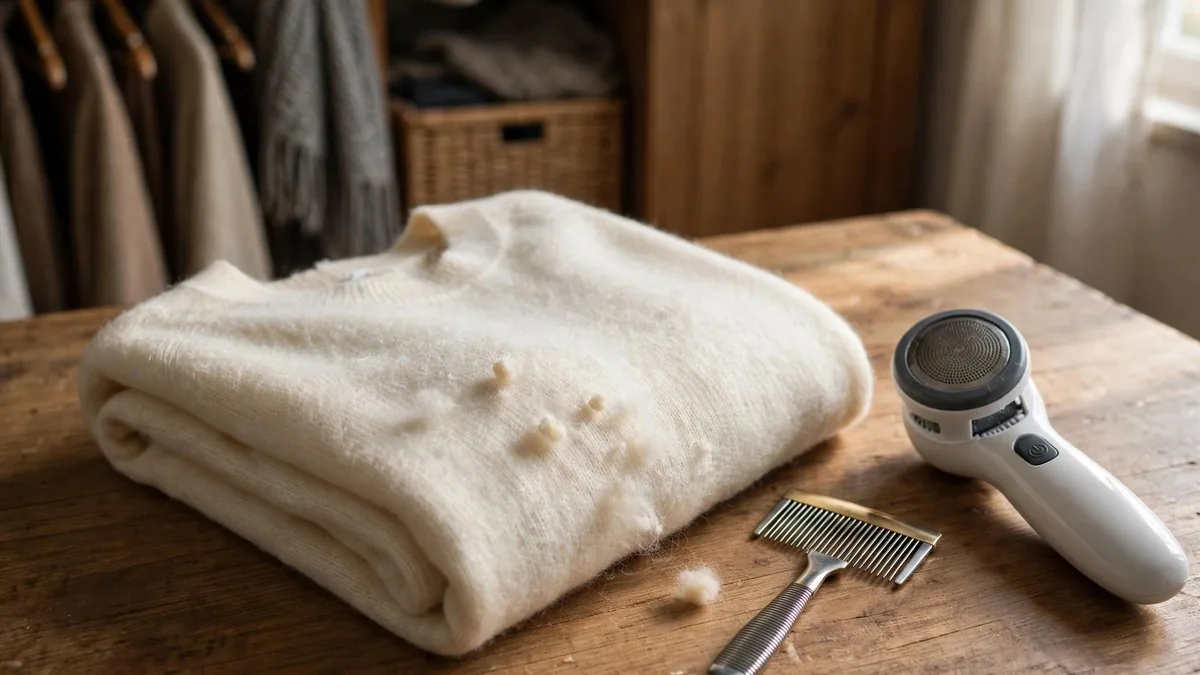
A cashmere comb is the gentlest choice for fine knits. Glide it over the surface in light, one-direction strokes, following the grain of the knit, clearing collected fibres from the teeth every few passes. Stop as soon as the pills are gone: over-combing stresses the fibres. An electric fabric shaver is faster on heavier pilling, but use its lowest setting, keep it moving in short passes, and never let it hover in one spot. Afterwards, shake the sweater gently and run a lint roller over the surface to pick up loosened debris.
| Tool | Best for | Risk level | Speed |
|---|---|---|---|
| Cashmere comb | Light to moderate pilling | Very low | Slow |
| Electric fabric shaver | Heavy pilling | Moderate on lowest setting | Fast |
| Sweater stone | Widespread light pilling | Moderate | Medium |
| Small scissors | Isolated large pills only | Moderate | Very slow |
| Lint roller | Loose debris after de-pilling | Very low | Fast |
| Disposable razor | Emergency use only | High | Medium |
| Fingers | Not recommended | High | Slow |
| Boar-bristle brush | Smoothing after de-pilling | Very low | Medium |
How to prevent pilling in the first place
Prevention is far more effective than correction, and most of it comes down to friction control. Rotate your cashmere rather than wearing the same sweater every day: a day or two of rest between wears lets the fibres relax and resettle. Wear a thin base layer underneath, such as a cotton camisole or a fine T-shirt, to reduce direct friction between skin and fibre, particularly under the arms.
Be mindful of bag straps and seatbelts. A crossbody bag worn on the same shoulder every day will pill that exact patch faster than anything else, so switch shoulders or carry the bag in your hand sometimes. A smooth coat lining causes less abrasion than a rough wool coat worn directly against the knit, and our guide to the best faux fur coats looks at cosy outer layers that pair well with fine knits. At home, keep cashmere away from Velcro, zips, and rough upholstery.
Washing and storing cashmere to keep it smooth
Washing is where many sweaters are quietly damaged: aggressive washing, rubbing, wringing, and tumble drying push loose fibres to the surface and accelerate pilling. Hand washing in cool water with a gentle wool detergent is safest, and if you use a machine, choose a cold, gentle cycle, turn the garment inside out, and place it in a mesh laundry bag. Never overload the drum, and never tumble dry cashmere. Reshape the sweater while damp and dry it flat on a towel, away from direct heat and sunlight.
Storage matters too. Hanging cashmere stretches the shoulders and lets the fabric rub against whatever hangs beside it, so fold your sweaters instead and stack them loosely. Keep moths away with cedar or lavender, and store clean garments only: body oils and dirt left in the fibres make the surface more likely to pill. Give new cashmere a little patience as well: that first round of light pilling is the garment shedding its loose surface fibres, and the second season is usually far smoother than the first.
Your anti-pilling checklist
- Rest each cashmere piece for a day or two between wears, and rotate through several.
- Wear a thin base layer under cashmere to cut friction under the arms.
- Switch bag shoulders, and keep seatbelts and rough coat linings off the same spot.
- De-pill with a cashmere comb on a flat, dry surface, testing on a hidden seam first.
- Wash inside out in cool water on a gentle cycle in a mesh bag, and dry flat, never tumble dry.
- Fold cashmere for storage, stack it loosely, and keep it clean, dry, and moth-free.
Frequently asked questions
Why does my cashmere pill after only one wear?
Early pilling is normal and usually comes from the shortest surface fibres working loose. They were never fully locked into the yarn during spinning, and the first few wears shake them free. Remove them gently with a cashmere comb and the pilling should slow down.
Does pilling mean my cashmere is fake or cheap?
No. Even high-quality cashmere pills, because its fine, short fibres are what make it soft. What matters is the pattern: light pilling in the first few wears that then settles is normal, while heavy pilling all over the garment after gentle use points to short-staple fibre or loose construction.
What is the safest tool for removing pills from cashmere?
A cashmere comb is the gentlest and safest choice for fine knits. Use light, one-direction strokes on a flat, dry surface, hold the fabric taut, and stop once the pills are gone. An electric shaver is faster but should only be used on its lowest setting.
Can I stop cashmere from pilling completely?
Not entirely, because some pilling is inherent to the fibre. But you can reduce it a lot by resting garments between wears, wearing a base layer, avoiding repeated friction from bags and seatbelts, washing gently inside out, and folding rather than hanging.
Should I pull pills off with my fingers?
It is best not to. Pulling a pill can tug the fibres it is anchored to, stretching the knit and weakening the fabric. A comb or a shaver lifts the pill without pulling on the base yarn.
Will my cashmere stop pilling on its own?
In most cases, yes. Once the loose surface fibres have been shed, usually within the first ten to fifteen wears, the remaining fibres are longer and more securely twisted, so they stay in place. Gentle de-pilling during that period helps the sweater settle sooner.
The bottom line
Cashmere pills because it is cashmere. The ultra-fine, short fibres that give it that cloud-like softness are the same ones that work loose under friction and tangle into little balls. That is not a flaw in your sweater or a verdict on its quality. It is the trade-off at the heart of the fibre, and one you can manage with a comb, a little patience, and a few kinder habits.
Buy well-made, two-ply, tightly knitted pieces, de-pill them gently when needed, and protect them from the friction that causes the problem. Do that, and your favourite sweater will stay smooth, soft, and worth reaching for for many winters to come.
Note: This is general guidance for everyday cashmere knitwear. Always check the care label on your own garment first, and follow the maker’s instructions if they differ.