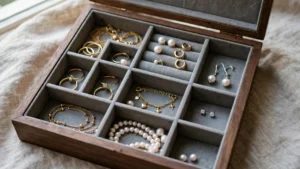
Gold jewellery has been in style for roughly five thousand years. Empires have risen and fallen, hemlines have gone up and down, and whole categories of jewellery have come and gone, yet a simple gold chain, a pair of gold hoops, or a plain gold band still looks right. That is not an accident: gold has qualities that no other jewellery material quite matches.
The short answer is that gold is rare enough to feel precious, durable enough to wear every day, and warm enough in colour to suit almost everyone. It does not tarnish the way silver does, it does not irritate most skin, and it can be reshaped, repaired, and passed on in a way that plated or costume jewellery cannot. It also carries meaning: a gold ring is still the default symbol of commitment in most of the world.
Below are nine reasons gold jewellery never goes out of style, from its physical properties to its cultural weight. Each one is described by what it offers, what to watch for, and who it suits best, so you can choose pieces that will still look right in ten years, not just this season.
Key takeaways
- Gold endures because it is rare, durable, and warm in colour, and because it suits almost every skin tone.
- It does not tarnish, it rarely irritates skin, and it can be repaired, resized, and reshaped, which makes it a practical everyday material.
- Gold carries cultural meaning across the world, from wedding rings to milestone gifts, which keeps demand steady across generations.
- It holds value better than most jewellery materials, though it should be bought for wearing, not as a financial investment.
- No gold is indestructible, and gold-plated pieces are not the same as solid gold, so knowing what you are buying matters more than the colour alone.
What makes gold different from other jewellery metals
Gold is a chemical element, and its properties are unusual. It does not rust, it does not tarnish, and it does not react with air or water the way silver does. A gold ring left in a drawer for twenty years will look much the same when you take it out; a silver ring left in the same drawer will have darkened. That stability is the foundation of gold’s reputation.
Gold is also soft, which sounds like a weakness but is actually a strength. Pure gold is too soft to hold its shape in a ring, so it is mixed with other metals: 18-karat gold is 75 percent pure gold, 14-karat is about 58 percent. The alloy is hard enough to wear daily, yet still workable enough for a jeweller to resize, repair, or reshape. A ring that no longer fits can be made to fit again, a broken chain can be soldered, and a scratched bangle can be polished.
Finally, gold is warm. Its colour, a soft yellow that ranges from pale champagne to deep amber, flatters warm, cool, and neutral skin tones, and it sits comfortably next to most gemstones, from diamonds to emeralds to pearls. That versatility is why gold is the default setting for so much fine jewellery.
How we chose these reasons and what to look for
Look first at what gold actually is. The karat tells you how much pure gold is in the alloy: 24-karat is pure gold, 18-karat is 75 percent, 14-karat is about 58 percent, and 9-karat is about 37 percent. Higher karat means a richer colour and a softer metal; lower karat means a paler colour and a harder metal. For everyday jewellery, 14-karat and 18-karat are the usual choices, because they balance colour, strength, and price.

Look next at the difference between solid gold, gold-filled, and gold-plated. Solid gold is gold all the way through, and it is the only form that will last a lifetime with normal care. Gold-filled has a thick layer of gold bonded to a base metal, and it is durable, but it is not solid gold. Gold-plated has a very thin layer over a base metal, and it will wear through with regular use, often within a year or two. The price reflects that difference, and so does the lifespan.
Finally, look at how gold is actually worn. The pieces that last are simple, well-made, and worn often: a plain band, a fine chain, a pair of small hoops, a simple pendant. Elaborate, trend-led designs date quickly, but a simple gold piece does not, because there is nothing in it to date. Our guide to the best gold jewellery for everyday wear covers the practical side of choosing pieces you will actually reach for, which is the real test of whether gold belongs in your jewellery box.
The 9 reasons gold jewellery never goes out of style
It does not tarnish
What we like: Gold does not react with air or water, so it keeps its colour and shine for decades with almost no maintenance. What to consider: It can still scratch and pick up dirt, so it needs an occasional gentle clean. Best for: Anyone who wants jewellery that looks after itself. Cost: Higher than silver or plated jewellery, but the lifespan is far longer. Time needed: A few minutes of cleaning every few months.
It suits almost every skin tone
What we like: Gold’s warm colour flatters warm, cool, and neutral skin, and it works with most hair colours and eye colours. What to consider: Very pale yellow gold can look washed out on very fair skin, where a richer yellow or rose gold works better. Best for: Anyone choosing a first piece of fine jewellery. Cost: No extra cost, it is a property of the metal itself. Time needed: None, it is immediate.
Silver suits some people beautifully and washes others out. Gold is more forgiving. Its warmth gives the skin a healthy glow, which is why it is so often the first metal people reach for when they buy a piece they intend to wear every day.
It is gentle on skin
What we like: Pure gold is hypoallergenic, and high-karat gold rarely causes irritation, even for people with sensitive skin. What to consider: Lower-karat gold contains more alloy metals, including nickel in some white gold, which can irritate sensitive skin. Best for: People with sensitive or reactive skin. Cost: Higher-karat gold costs more, but it is kinder to skin. Time needed: None, though a patch test is sensible for new wearers.
It can be repaired and reshaped
What we like: A gold ring can be resized, a broken chain can be soldered, and a scratched surface can be polished back to new. What to consider: Repairs cost money, and a piece that has been resized many times may eventually need more work. Best for: Heirloom pieces and jewellery meant to be kept for decades. Cost: Repairs are usually modest compared with replacing the piece. Time needed: A few days at a jeweller, typically.
It carries meaning across cultures
What we like: Gold is the traditional wedding metal in most of the world, and it marks milestones, from christenings to anniversaries, in almost every culture. What to consider: The meaning varies, so a gold gift should suit the occasion and the recipient’s own traditions. Best for: Gifts, engagements, weddings, and anniversaries. Cost: Varies widely, from a simple band to an elaborate set. Time needed: None, the meaning is already there.
Gold’s cultural weight is enormous. It is the metal of commitment, of celebration, and of family, in South Asia, the Middle East, Europe, Africa, and the Americas. No fashion cycle can undo that, because the meaning is not a trend, it is a tradition.
It holds its value
What we like: Gold has intrinsic value, and a well-made gold piece retains a meaningful share of its material worth, unlike costume or plated jewellery. What to consider: Jewellery is not a financial investment: the retail price includes design, labour, and markup, so resale value is always lower than the purchase price. Best for: People who want a purchase that is not disposable. Cost: High up front, lower over a lifetime of wear. Time needed: None, though resale takes research.
It works with every gemstone
What we like: Gold sets diamonds, emeralds, rubies, sapphires, and pearls beautifully, and it suits both colourless and coloured stones. What to consider: The gold colour should complement the stone: yellow gold warms a diamond, white gold suits a cool stone, rose gold suits pink and Morganite tones. Best for: Engagement rings, statement necklaces, and heirloom pieces. Cost: The setting adds to the cost of the stone. Time needed: None, it is a design choice.
It layers and mixes easily
What we like: Gold chains, bracelets, and rings layer well together, and gold mixes comfortably with silver, leather, and beads for a modern look. What to consider: Mixing metals works best when one metal dominates, and too many competing pieces can look cluttered. Best for: Everyday styling and building a personal jewellery wardrobe. Cost: No extra cost, it is a styling choice. Time needed: A few minutes to arrange layers.
Gold is easy to wear because it is easy to combine. A fine gold chain works alone or layered with two more. A gold band stacks with other rings. A pair of gold hoops goes with almost anything. That flexibility is why gold is the backbone of most jewellery collections, and why it adapts to new trends without being replaced by them.
It is timeless by design
What we like: Simple gold designs, a plain band, a fine chain, small hoops, have no trend to date them, so they look as current in 2027 as they did in 1987. What to consider: Very elaborate or heavily branded designs do date, so simplicity is the safest choice for longevity. Best for: Anyone buying a piece to keep for decades. Cost: Simple designs are often better value than elaborate ones. Time needed: None, it is a design choice.
Which gold is right for you
Start with karat. For everyday wear, 14-karat gold is a strong choice: durable, good in colour, and more affordable than 18-karat. For special pieces, or if you have sensitive skin, 18-karat gold is richer in colour and gentler, though softer and needing a little more care. For an heirloom or an engagement ring, 18-karat is often worth the extra cost.
Then choose the colour. Yellow gold is the classic and suits warm skin tones best, though it flatters most people. White gold is cooler and more modern and suits cool skin tones, but it is usually rhodium-plated and needs replating every few years. Rose gold is warm and romantic and suits fair and medium skin tones well. Our guide to buying a diamond is useful here, because the gold you choose for a ring or a necklace should complement the stone it holds, not compete with it.
Finally, think about how you will wear it. For every day, choose something simple, solid, and comfortable: a plain band, a fine chain, small hoops. For special occasions you can be bolder, but keep the design simple enough that it will still look right in ten years.
The caveats that matter
Gold is durable, but it is not indestructible. It scratches, it can dent, and it can be damaged by harsh chemicals, including chlorine and bleach. Take it off before swimming, cleaning, or heavy manual work, and store it separately from other jewellery. Those small habits are the difference between a piece that looks new for decades and one that looks tired in five years.
| Detail | What is known |
|---|---|
| Best karat for everyday wear | 14-karat for durability and value; 18-karat for richer colour and sensitive skin |
| Does it tarnish? | No, solid gold does not tarnish, though it can scratch and pick up dirt |
| Skin sensitivity | High-karat gold rarely irritates; lower-karat and some white gold can, due to alloy metals |
| Gold-plated vs solid gold | Plated gold wears through, often within a year or two; solid gold lasts a lifetime |
| Care | Warm soapy water and a soft cloth; avoid chlorine, bleach, and harsh chemicals |
| Storage | Store pieces separately in soft pouches to prevent scratching |
| Resale value | Gold retains material value, but jewellery resale is always below retail price |
| What it does not do | It does not guarantee an investment return, and it cannot be worn carelessly without damage |
The other caveat is the label. Gold-plated, gold-filled, and solid gold are very different things, and the price should reflect that. If a piece is described as gold but the price seems too low for solid gold, check the hallmark: 585 means 14-karat, 750 means 18-karat. If there is no hallmark and no clear description, ask the seller before you buy.
Checklist: choosing gold jewellery honestly
Use these checks before you buy, and again when you are deciding whether a piece is worth keeping.
- Check the karat: 14-karat for everyday durability, 18-karat for richer colour and sensitive skin.
- Check the label: solid gold, gold-filled, and gold-plated are different things, with very different lifespans.
- Check the hallmark: look for a karat stamp, 585 for 14-karat, 750 for 18-karat, before you pay.
- Check the fit: a ring should slide on comfortably and resist coming off; a chain should sit flat and not kink.
- Check the design: simple, well-made pieces last longer in style than elaborate or heavily branded ones.
- Check the care: warm soapy water and a soft cloth, no chlorine or bleach, and separate storage to prevent scratching.
Frequently asked questions
Is gold jewellery a good investment?
As jewellery, no. You buy gold jewellery to wear it, and the retail price includes design, labour, and markup, so resale value is always lower than what you paid. Gold does retain material value, which is more than most jewellery materials offer, but it should not be bought as an investment.
What is the difference between 14-karat and 18-karat gold?
14-karat gold is about 58 percent pure gold, and 18-karat is 75 percent. 18-karat has a richer colour and is gentler on sensitive skin, but it is softer and more expensive. 14-karat is harder, more durable, and more affordable, which makes it a good choice for everyday wear.
Does gold jewellery tarnish?
Solid gold does not tarnish. It can scratch, and it can pick up dirt and oils from the skin, which dulls its shine, but a gentle clean with warm soapy water restores it. Gold-plated jewellery does wear through, which is a different problem: the thin gold layer disappears and the base metal shows through.
Can I wear gold jewellery every day?
Yes. Gold is one of the best everyday jewellery materials because it does not tarnish and rarely irritates skin. Take it off before swimming, cleaning with harsh chemicals, or heavy manual work, and store it separately to prevent scratching.
Is rose gold still in style?
Yes. Rose gold has been popular for over a decade and remains a current choice, especially for fair and medium skin tones. Like yellow and white gold, it is a classic colour rather than a passing trend. Our guide to the best luxury jewellery brands covers the houses that work in all three gold colours, which is useful if you are choosing between them.
How should I clean gold jewellery at home?
Soak it in warm water with a drop of mild dish soap for a few minutes, then brush gently with a soft toothbrush and rinse. Dry it with a soft cloth. Avoid ultrasonic cleaners for pieces with soft stones such as pearls or opals, and never use bleach or chlorine-based cleaners on gold.
The bottom line
Gold jewellery never goes out of style because it is built on qualities that do not change: it does not tarnish, it suits almost everyone, it can be repaired and reshaped, and it carries meaning no trend can replace. It is rare enough to feel precious and durable enough to wear every day.
Choose solid gold, in a karat and colour that suits you, in a simple design you will still like in ten years, and look after it with basic care. That is the honest way to buy gold: not as an investment, and not as a trend, but as a piece of jewellery that will still be in style long after the fashion around it has changed.