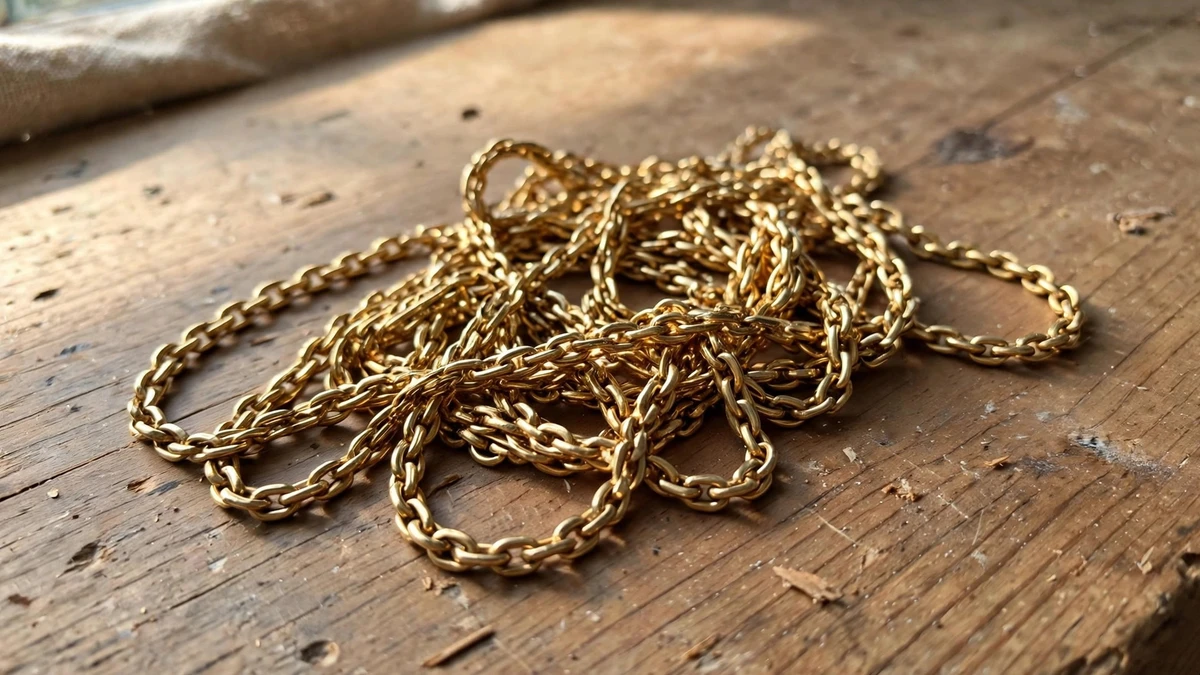
A tangled necklace is a small problem with an outsized power to ruin a morning. You reach for a chain you love, and instead of a clean line of gold or silver you find a tight knot, a pendant twisted into the links, and a clasp buried somewhere in the middle. Pulling at it only makes it worse. The knot tightens, the chain kinks, and a necklace that was worth keeping becomes a necklace you are afraid to touch.
The good news is that most tangles are fixable at home, with patience and the right order of steps. A knot is not a single problem. It is a chain that has folded over itself, and each fold can be eased apart if you work from the outside in, keep the chain flat, and never force a link through a loop it does not fit through. The tools are ordinary: a flat surface, good light, two pins, and a drop of oil.
Below are nine steps that untangle a necklace properly in 2027, from laying it flat to storing it so it does not tangle again. Each step explains what to do, what to avoid, who it suits best, and how long it takes, so you can rescue a favourite piece without damaging the chain, the clasp, or the pendant.
Key takeaways
- Work on a flat surface in good light, undo the clasp, and loosen the knot from the outside in — never pull both ends of the chain.
- A drop of baby oil or olive oil on the knot reduces friction and lets the links slide apart without forcing them.
- Two pins or needles are the best tools for a tight knot: they lift one loop at a time without scratching the metal.
- Warm soapy water helps a fine chain, but it is not safe for pearls, opals, or glued settings, which should stay dry.
- No method saves a chain that is already kinked or stretched, and a valuable or gem-set necklace belongs with a jeweller, not on a kitchen table.
What untangling a necklace actually means
A tangle is a chain that has folded through its own loops. When a necklace is stored loose in a drawer or a travel bag, the chain moves, the pendant swings, and the links pass through one another. The result looks like a single hard knot, but it is usually several loose loops stacked on top of each other, and each one can be lifted free if you can see it clearly.
That is why pulling is the worst first move. When you pull both ends of a tangled chain, the loops tighten against each other and the knot locks. The links also stretch, and a fine chain that has been pulled hard will keep a kink even after the knot is gone. A kinked link is weaker than a straight one, and it is the place where a chain will eventually snap.
The honest way to think about untangling is as slow, close work, not a tug. You lay the chain flat, you find the outer edge of the knot, and you ease one loop at a time. It takes ten to twenty minutes for a bad tangle, and most of that time is looking, not pulling. If you cannot see the knot clearly, you need better light or a magnifying glass, not more force.
What you need and what to look for
You need very little: a clean, flat surface in a pale colour so the chain stands out, a bright lamp or daylight, two straight pins or sewing needles, and a small bottle of baby oil or plain olive oil. A soft cloth is useful for wiping the chain clean afterwards, and a shallow dish keeps the pendant safe while you work on the chain.
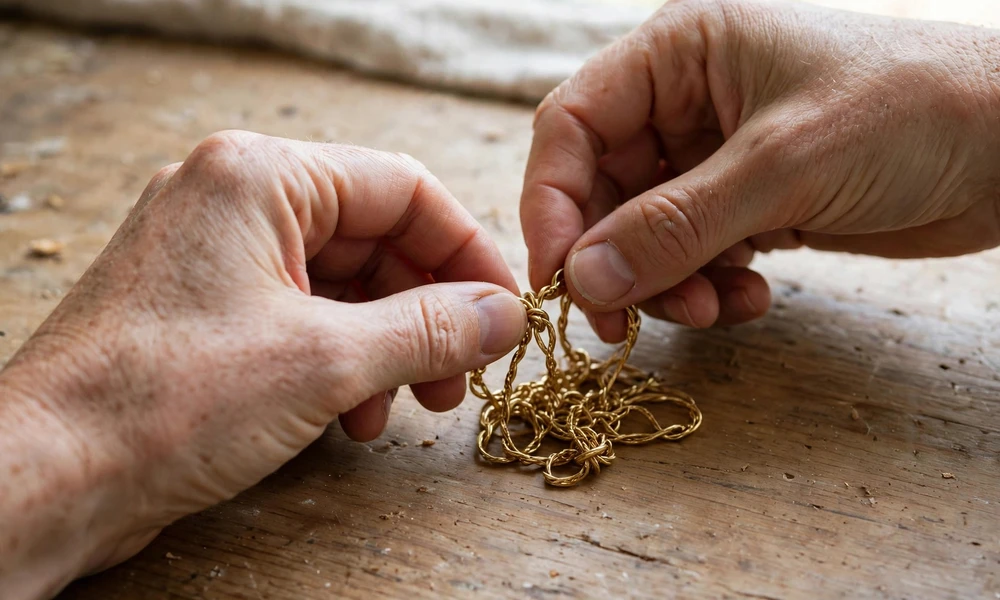
Look first at the chain itself. A fine cable or curb chain is the easiest to untangle, because the links are small and regular. A snake chain is harder, because the links are tight and the chain resists bending. A herringbone chain should not be untangled at home at all, because its flat links kink permanently if they are bent. A pendant necklace needs extra care, because the pendant adds weight that pulls the chain through the knot while you work, so take the pendant off the chain first if the bail allows it.
Finally, check the clasp and the ends. Undo the clasp before you start, because a fastened chain is a closed loop and a closed loop cannot be untangled. Check whether the chain is already kinked or whether a link is stretched open. If a link is open, the chain needs a jeweller to close it properly, and no amount of untangling will make it safe to wear.
The 9 steps to untangle a necklace properly
1. Lay the necklace flat and find the knot
What to do: Place the necklace on a flat, pale surface and spread it out gently with your fingers, so the chain lies in one layer. What to avoid: Do not hold it up in the air, where gravity pulls the knot tighter. Best for: Every tangle, and the step that makes all the others possible. Time needed: Two minutes. Standout tip: A white plate or a sheet of paper makes a fine gold chain easy to see.
2. Undo the clasp and spread the chain
What to do: Open the clasp and lay both ends of the chain out straight, away from the knot, so you have two free ends to work with. What to avoid: Do not leave the clasp fastened, and do not let the pendant dangle over the edge of the table. Best for: Chains with a spring-ring or lobster clasp. Time needed: One minute. Standout tip: Put the pendant in a small dish so its weight does not pull the chain while you work.
3. Add a drop of baby oil or olive oil
What to do: Put a single drop of baby oil or plain olive oil directly on the knot and let it sit for a minute, so it seeps between the links. What to avoid: Do not pour oil over the whole necklace, and do not use cooking spray, which leaves a sticky film. Best for: Gold, silver, and plated chains with a tight knot. Time needed: Two minutes, including waiting. Standout tip: One drop is enough; more oil only makes the chain slippery and hard to hold.
4. Work the knot with two pins
What to do: Slide the point of one pin under the outermost loop and lift it gently, while the second pin holds the rest of the knot steady. What to avoid: Do not stab at the knot, and do not use a pin to lever a link open. Best for: Tight knots in fine chains. Time needed: Five to ten minutes. Standout tip: Work in short sessions and rest your eyes; a tired hand pulls harder than a fresh one.
5. Use a needle for a very tight knot
What to do: Thread a fine sewing needle through the centre of a tight knot and wiggle it gently to create a small gap, then work the gap wider with a pin. What to avoid: Do not push the needle through a link, and do not use a knife or a craft blade. Best for: Knots that will not open with pins alone. Time needed: Five minutes. Standout tip: A needle with a blunt tip is safer for the chain than a sharp one.
6. Loosen a fine chain with warm soapy water
What to do: Soak a fine gold or silver chain in a small bowl of warm water with a drop of washing-up liquid for five minutes, then lift it out and work the knot with pins. What to avoid: Do not use hot water, and never soak pearls, opals, turquoise, or any stone that is glued into its setting. Best for: Fine chains with a knot that oil alone has not loosened. Time needed: Ten minutes including soaking. Standout tip: Dry the chain on a soft cloth straight away, and never leave it wet in a closed box.
7. Untangle the pendant from the chain
What to do: Once the chain is free, hold the pendant still and slide the chain through the bail slowly, checking that the bail is not bent. What to avoid: Do not pull the pendant through a knot, and do not force a chain through a bail that is too small for it. Best for: Pendant necklaces where the pendant twisted into the tangle. Time needed: Two minutes. Standout tip: If the bail is bent, leave it to a jeweller; a bent bail is easy to snap.
8. Straighten the chain and check for kinks
What to do: Lay the chain out straight and run it slowly between your thumb and forefinger, feeling for kinks, stiff links, or stretched loops. What to avoid: Do not pull a kink straight by force, which weakens the link further. Best for: Every necklace, as the final check before it goes back on. Time needed: Two minutes. Standout tip: Hold the chain up to the light and look along its length; a kink shows as a small bend in an otherwise straight line.
9. Fasten the clasp and store it flat
What to do: Fasten the clasp, lay the necklace flat in a pouch or a jewellery box with a separate compartment, and keep it away from other chains. What to avoid: Do not throw it loose into a drawer or a travel bag, which is how the next tangle starts. Best for: Every necklace, and the step that prevents a repeat. Time needed: One minute. Standout tip: Threading the chain through a drinking straw keeps it straight in a suitcase.
Which untangling method is right for your necklace
Start with the chain. A fine cable or curb chain in gold or silver responds well to oil and pins, and it is the easiest kind of tangle to fix at home. A snake chain is harder, because its links are tight and the chain is stiff, so it needs more oil, more patience, and a lighter touch. A herringbone chain should go to a jeweller, because its flat links kink permanently if they are bent even slightly.
Then think about the pendant and the stones. A solid gold or silver pendant can be taken off the chain and set aside while you work, which makes everything easier. A pearl, opal, or turquoise piece should stay dry and away from oil, so skip the oil and the soapy water and work dry with pins only, or take it to a jeweller. A chain necklace with no pendant at all is the simplest case, because there is nothing heavy pulling the knot tighter while you work.
Finally, be honest about the value. A costume chain from a high-street shop is a good candidate for home untangling, because the worst outcome is a chain you replace. A fine gold chain, a family piece, or anything with a stone you cannot replace is worth a jeweller’s fee, which is usually small for a simple untangle, and which buys you a chain that comes back cleaned, checked, and safe to wear.
The caveats that matter
Untangling is gentle work, but it is not risk-free. The main risks are kinking a fine chain, scratching a soft metal with a pin, and getting oil or water onto a stone that should stay dry.
| Detail | What is known |
|---|---|
| Best first step | Lay the chain flat, undo the clasp, and find the outermost loop of the knot |
| Best lubricant | One drop of baby oil or plain olive oil on the knot, wiped off afterwards |
| Best tools | Two straight pins or sewing needles, used to lift one loop at a time |
| What to never do | Pull both ends of the chain, which tightens the knot and kinks the links |
| What to keep dry | Pearls, opals, turquoise, and any stone glued into its setting |
| What to check at the end | Kinks, stretched links, and a bent clasp or bail before wearing it again |
| When to see a jeweller | A herringbone chain, a valuable or gem-set piece, or a chain that is already kinked |
| What it does not fix | A stretched link, a broken clasp, or a chain that has already snapped |
If a necklace is valuable, sentimental, or set with stones you cannot replace, take it to a jeweller rather than working on it at home. A professional untangle is quick and inexpensive, and it comes with a check of the clasp, the links, and the setting, which is worth having once a year in any case.
Checklist: untangling a necklace honestly
Use these checks before you start, and again before you wear the necklace.
- Check the materials: gold and silver can take oil and soapy water, pearls and opals cannot.
- Check the chain: undo the clasp, lay it flat, and look for kinks or stretched links before you touch the knot.
- Check the light: work in daylight or under a bright lamp, and use a magnifying glass for a fine chain.
- Check your tools: two pins, one drop of oil, and a soft cloth are enough; leave the knives and pliers in the drawer.
- Check your patience: work one loop at a time from the outside in, and stop if you find yourself pulling hard.
- Check the storage: fasten the clasp, lay it flat in its own compartment, and keep it separate from other chains.
Frequently asked questions
How long does it take to untangle a necklace?
Most tangles take ten to twenty minutes, and a bad one can take half an hour. The time goes mostly to looking and to working one loop at a time. If you are pulling hard after five minutes, stop, add another drop of oil, and try a different loop on the edge of the knot.
Can I use baby oil on a gold necklace?
Yes. A single drop of baby oil or plain olive oil on the knot is safe for solid gold and sterling silver, and it makes the links slide apart instead of catching. Wipe the chain with a soft cloth afterwards, and wash it gently with warm soapy water if it still feels greasy.
What is the best tool for untangling a necklace?
Two straight pins or fine sewing needles. They are thin enough to lift one loop at a time and strong enough to hold the knot steady, and they do not scratch the metal if you use them gently. Avoid knives, craft blades, and pliers, which damage links.
How do I stop my necklaces from tangling?
Store each one separately, with the clasp fastened, either hanging or lying flat in its own compartment. Our guide to layering necklaces without tangling covers the same habits for wearing them, because the rules are the same: keep chains apart, keep them straight, and never throw them loose into a drawer or a bag.
Can I untangle a necklace with a pendant still on it?
You can, but it is harder, because the pendant’s weight pulls the chain through the knot while you work. If the bail allows it, take the pendant off first and set it aside in a small dish. If the pendant is fixed to the chain, hold it still while you work on the knot, and deal with it last.
When should I take a tangled necklace to a jeweller?
When the chain is herringbone, when the piece is valuable or set with stones you cannot replace, or when the chain is already kinked or a link is stretched open. A jeweller can untangle it, check the clasp and the setting, and straighten or replace a damaged link, usually for a small fee.
The bottom line
The best way to untangle a necklace in 2027 is the slow way: lay it flat, undo the clasp, add a drop of oil, and work the knot apart one loop at a time with two pins. It takes ten to twenty minutes and a little patience, but it saves the chain, the clasp, and the pendant, and it leaves you with a necklace that is safe to wear again.
Choose the method that suits your chain, keep pearls and soft stones dry, and know when to stop and hand it to a jeweller. A necklace that is stored flat, fastened, and on its own will not tangle again, and that is the real fix — not a cleverer knot, but a better habit.