

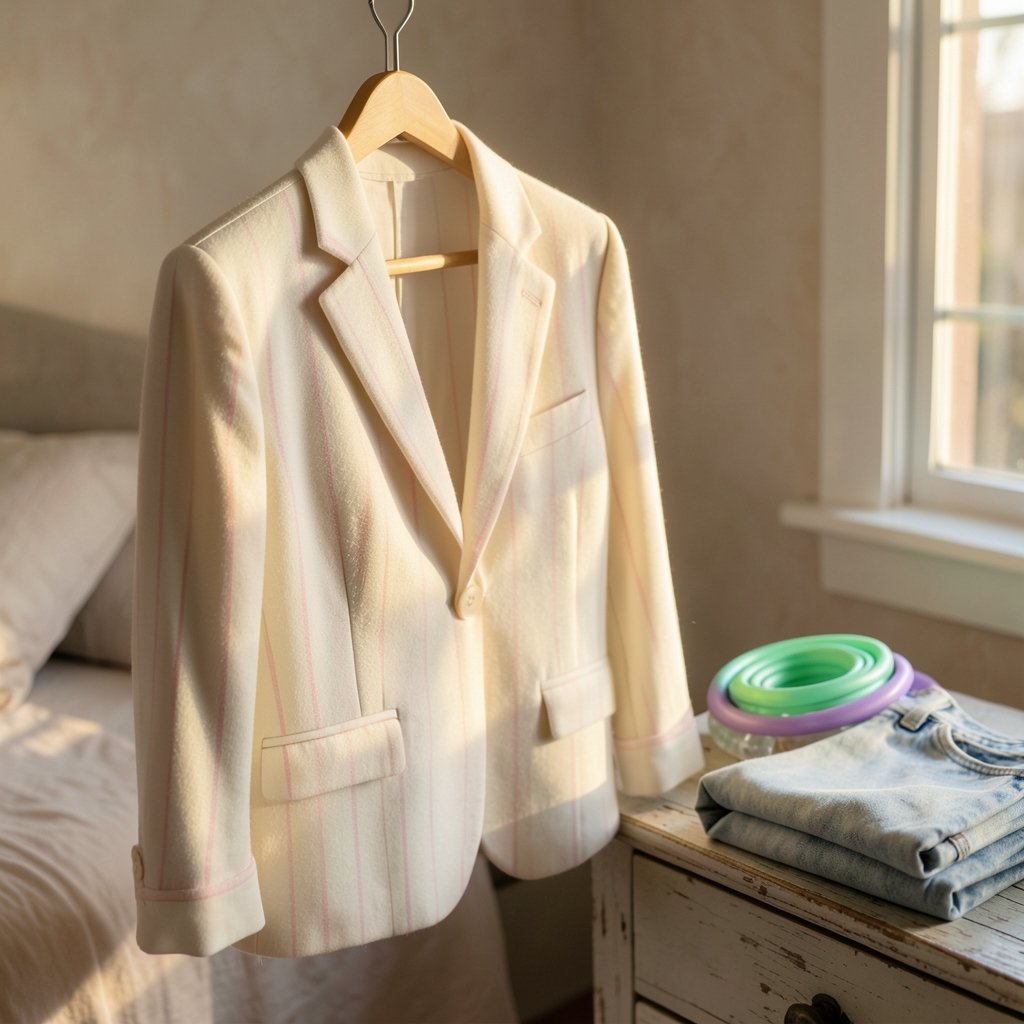
What do you picture when someone says “80s fashion”? A woman in a boxy blazer with shoulders wide enough to land a plane on? Leg warmers over neon tights? Maybe a denim jacket with acid-wash streaks and a perm that could survive a wind tunnel? All three are correct, and that is exactly why the decade is so hard to sum up in one sentence.
The 1980s were loud, contradictory and oddly practical all at once. Office wear got armored, gym wear escaped the gym, and music television turned clothing into a nightly broadcast. This guide walks through what people actually wore, why it happened, and how to borrow the good parts today without looking like a costume rental.
The Shoulder Was the Story
If you remember one thing about 1980s style, make it the silhouette. Women’s workwear in the early-to-mid 1980s went wide and structured: padded shoulders, broad lapels, tapered trousers and skirts that hit just below the knee. Designers such as Giorgio Armani became associated with this softened-but-strong tailoring, and the look spread fast through television shows like Dynasty, which premiered in 1981.
The logic behind it was social as much as aesthetic. More women were entering professional roles, and the clothes borrowed the visual language of male authority while reshaping it. A padded blazer was not subtle. It was a statement that said “I am in the room, and I take up space.”
Practical note: the mistake most people make when recreating this look is going too big everywhere. Real 1980s tailoring was wide at the shoulder and narrow at the hip. If your blazer is oversized and your trousers are wide, you get a shapeless block instead of a power silhouette. Pick one half to exaggerate.
MTV, Music Video and the Speed of Trend

MTV launched on 1 August 1981, and music video is widely credited with speeding up how fashion trends traveled. Stylized pop performers became visual brands, and Madonna’s rise from 1983 to 1984 is the clearest example of a singer whose look was as discussed as her songs.
It is tempting to say MTV caused 1980s fashion. That is an oversimplification, but it is not nothing. Before cable, most people saw new styles in magazines or at the mall. After cable, they saw them in their living room, repeatedly, with a soundtrack. That repetition changed how quickly a look moved from niche to mainstream.
For a deeper look at how runway moments get translated into everyday style, Angelica Hicks’ fashion illustration work shows how a single image can carry a whole mood into popular culture.
Aerobics, Dance and Clothes That Left the Gym
The fitness boom pushed athletic clothing into daily life. Leotards worn over tights, leg warmers, headbands and high-cut athletic wear spread through exercise culture and films such as Flashdance (1983). The exact credit split between the film and the broader fitness trend is still debated, but the result is not: gym clothes stopped staying in the gym.
This is the ancestor of modern athleisure. If you want the full lineage, the story of how 2010s athleisure and streetwear rewrote the rules picks up exactly where the 1980s left off.
What actually works in practice: modern recreations of this look succeed when they keep the color story and drop the volume. Neon accents on a clean base read as a nod. Full neon from head to toe reads as a theme party.
Subcultures Went Mainstream Fast
The 1980s were not one look. They were several running at the same time, and the commercial machine absorbed them quickly.
| Subculture | Signature pieces | Where it showed up |
|---|---|---|
| New Romantic / New Wave | Ruffled shirts, tailored jackets, dramatic makeup | UK club scene, early 1980s |
| Punk (later forms) | Leather, studs, torn denim, band graphics | Street and club wear |
| Hip-hop | Tracksuits, sneakers, gold chains | Urban street style, then mass retail |
| Preppy / yuppie | Polo shirts, loafers, blazers, visible logos | Affluent professional identity |
| Power dressing | Padded blazers, broad lapels, tapered trousers | Offices and television |
The pattern worth noticing is the speed of absorption. Styles that began as markers of belonging to a small group were being sold to mainstream shoppers within a few seasons. That is a familiar cycle now, but in the 1980s it was still new enough to feel jarring.
Denim, Logos and the Status Game
Denim had a huge decade. Stone-washed and acid-washed finishes became mass-market in the mid-to-late 1980s, and designer jeans with visible branding turned a workwear fabric into a status marker. The exact first-adoption dates for acid wash are contested, so treat any precise origin story with suspicion.
The bigger shift was the logo itself. Wearing a brand name across your chest or hip became a way of signaling taste and spending power. That instinct never really left. It just changed fonts.
If you are mapping this onto current shopping habits, the 2026 fashion trends guide is a useful comparison point for how branding cycles repeat.
Hair, Makeup and the Big Finish
Big hair was not a side detail. It was the frame around everything else. Perms, mousse and hairspray created volume, and makeup leaned on bold blush and bright eyeshadow. This is a retrospective generalization, and there was enormous variation by region and income level, but the caricature exists for a reason.
Here is the honest version: the exaggerated hair and makeup are the hardest part to wear today without irony. The clothing translates. The hairspray helmet does not.
How to Wear 80s Style Today Without Looking Costumed
The trick is subtraction. Most failed 1980s outfits fail because they stack every reference at once.
- Choose one anchor piece. A single structured blazer or a pair of high-waisted tapered trousers. Not both plus a graphic tee plus a belt.
- Keep the color palette to two or three tones. Neon works as an accent, not a base.
- Match the proportion rule. Wide shoulder, narrow leg. Or loose top, fitted bottom. Never wide on wide.
- Use modern fabrics. The silhouette is the point. Stiff 1980s synthetic blends are not.
- Skip the irony. Wearing it straight reads as style. Wearing it as a joke reads as a costume.
Common mistake: buying vintage pieces that fit badly because the label is exciting. A padded blazer that does not sit on your actual shoulder line will look wrong no matter how authentic it is. Tailoring matters more than provenance.
For a wider view of where these ideas are heading, the 2026 fashion trends female roundup shows how much of the current cycle is quietly recycling 1980s structure.
Why the Decade Still Gets Recycled
Fashion keeps returning to the 1980s because the decade solved a problem designers still face: how to make clothes read as confident from a distance. A strong shoulder, a bold color block, a clear logo. These are visual shortcuts, and shortcuts never go out of demand.
There is also the media factor. The 1980s were increasingly globalized and media-driven, with cable TV, magazines and mall retail spreading trends faster than in earlier decades. That acceleration is now the default state, which makes the decade feel oddly contemporary. The mechanism that made 1980s style move so fast is the same mechanism running your feed today.
The current fashion trends 2026 coverage keeps circling back to volume and tailoring, which is essentially the 1980s argument restated in new fabric. And the broader conversation around Italian luxury fashion shows how the tailoring-first approach that defined power dressing never really lost its commercial footing.
If you want to follow how these cycles get analyzed in real time, knowing how to find the best fashion substacks without wasting your inbox is a genuinely useful skill. And for anyone curious how a single film can lock a decade’s aesthetic into public memory, the story of the Barbie world tour book and the fashion movie it hinted at is a good parallel case.
What the 1980s Got Right
Strip away the hairspray and the decade made three durable contributions.
First, it normalized the idea that workwear could be deliberately powerful rather than merely appropriate. Second, it moved athletic clothing into everyday life permanently. Third, it proved that subcultural style could scale into mass retail without losing its visual punch, even if it lost its meaning along the way.
The parts that aged badly are mostly the parts built on excess for its own sake. The parts that aged well are structural: proportion, contrast and confidence. Those are not decade-specific. They are just good design.
Conclusion
The 1980s were never one style. They were a negotiation between boardroom ambition, gym culture, music television and street-level subculture, all happening at once and all selling fast. That is why the decade resists a tidy summary and why it keeps coming back.
The useful lesson for anyone dressing today is not to copy the surface. It is to copy the logic. Pick a strong silhouette. Commit to one bold element. Let everything else stay quiet. Do that, and you get the energy of 80s fashion without the costume.
Frequently Asked Questions
What defined 80s fashion?
The decade is best defined by volume and contrast. Padded shoulders, broad lapels and tapered trousers shaped workwear, while bright athletic clothing, bold logos and exaggerated hair and makeup filled everything else. The unifying thread was confidence you could see from across a room.
Who popularized power dressing in the 1980s?
Designers such as Giorgio Armani are closely associated with the softened, structured tailoring that became power dressing, and television shows like Dynasty helped push the look into mainstream awareness after its 1981 premiere. The exact timeline of its spread is debated, so treat “early-to-mid 1980s” as approximate.
Did MTV cause 80s fashion trends?
MTV, which launched on 1 August 1981, is widely credited with speeding up how trends spread, and music video clearly boosted the visibility of stylized performers. But calling it the single cause oversimplifies things. Cable television was one accelerant among several, alongside magazines and mall retail.
Why were leg warmers so popular in the 80s?
Leg warmers came out of the fitness boom and dance culture, where they kept muscles warm during and after class. Films such as Flashdance in 1983 helped push them into everyday wear. How much credit the film deserves versus the wider fitness trend is still argued over.
What is acid-washed denim?
Acid wash is a denim finishing treatment that creates a mottled, faded look. It became mass-market in the mid-to-late 1980s alongside stone washing. The precise origin story is contested, so be careful with any claim about exactly who did it first.
How can you wear 80s fashion today without looking like a costume?
Choose one anchor piece, keep the palette to two or three tones, and follow the proportion rule of wide shoulder with narrow leg. Use modern fabrics and wear it straight rather than ironically. The most common mistake is stacking too many references at once, which turns a strong look into a theme party.
The throughline is simpler than it looks: the 1980s turned clothing into a broadcast. Shoulders, logos and neon all existed to be read at a distance, by a room, a camera or a crowd. That instinct is now ambient, and it explains why the decade’s vocabulary keeps resurfacing whenever visibility is the goal. Wear it with restraint and the broadcast stays legible; wear all of it and the signal turns to noise.














