


Is a robot vacuum actually worth it, or does it just push dust into corners and get stuck under the sofa? That question is fair. The category has grown from a novelty gadget into a serious appliance, and the gap between a great robot and a mediocre one is enormous. The best robot vacuum for one home can be a frustrating waste of money in another. A carpeted house with two dogs has very different needs from a small apartment with hard floors and a cat.
This guide breaks down what actually matters, what the spec sheet hides, and how to match a robot to your floors, your pets, and your patience level. No hype, no brand cheerleading.
The Best Robot Vacuum Depends on Four Things
There is no single winner. Anyone who tells you otherwise is either selling something or only tested in one house. The right pick comes down to four variables:
- Floor type. Carpet demands suction and a good brush roll. Hard floors reward a robot that can also mop.
- Pets. Hair wraps around brushes, and pet waste is the classic robot-vacuum disaster.
- Home size and layout. Big, multi-room homes need mapping and long battery life. Small flats can get by with less.
- How much you want to babysit it. Self-emptying docks and mopping combos cost more but cut daily fuss.
Get those four right and almost any well-reviewed model in the matching tier will serve you well. Get them wrong and even a flagship will disappoint.
Navigation: The Spec That Matters Most
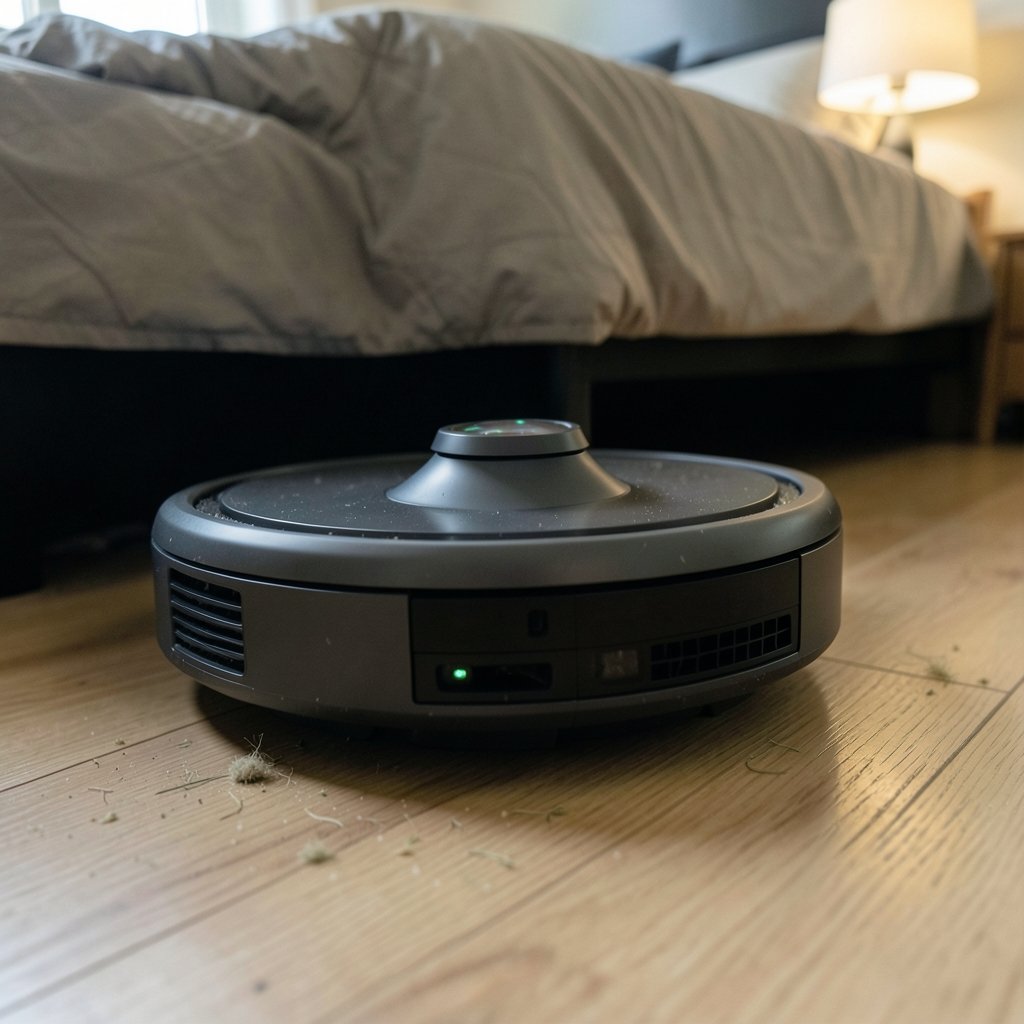
Navigation is the single biggest differentiator, and it is the one shoppers understand least. Robot vacuums generally fall into four camps:
| Navigation type | What it does | Best for |
|---|---|---|
| Random bounce | Changes direction on contact, no map | Tiny, single-room spaces on a budget |
| Gyroscope / inertial | Tracks distance and turns, rough coverage | Simple open-plan rooms |
| Camera-based vSLAM | Builds a visual map of your home | Multi-room homes, no-go zones |
| LiDAR (laser) | Maps with laser ranging, works in the dark | Larger homes, complex layouts |
LiDAR and camera mapping both let a robot build a persistent map. That map supports room-by-room cleaning, scheduled zones, and no-go areas. Random-bounce models cannot do any of that. If you want to tell the robot “clean the kitchen but never enter the bathroom,” you need mapping. That single feature is worth more than a few hundred pascals of extra suction.
One practical note: camera-based robots need light to see, so they can struggle in dark rooms or under beds. LiDAR does not care about lighting. If you schedule cleans at night or have a dark ground floor, lean toward laser mapping.
Suction Ratings Are Not Comparable Across Brands
Every box shouts a pascal number. Pascals (Pa) measure pressure, and manufacturers use them as a marketing weapon. The problem is that there is no universal standard for how that figure is measured. One brand’s 5,000 Pa may not clean better than another’s 3,000 Pa, because airflow, brush design, and sealing all matter just as much.
Treat Pa figures as a rough tier indicator, not a ranking. A robot with strong airflow and a well-designed brush roll will out-clean a higher-Pa model with a leaky chassis. Independent, side-by-side testing is the only reliable comparison, and even that varies with the floor type used in the test.
The practical takeaway: do not pay a premium for a bigger number on the box. Pay for better navigation, a reliable brush, and a dock that empties itself.
Carpet, Hard Floors, and the Brush Roll Question
Floor type changes everything, and it is where a lot of buyers get burned.
On carpet, deep cleaning depends on agitation as much as suction. A brush roll with stiff bristles digs into pile and lifts embedded dirt. On hard floors, that same brush can scatter debris and scratch delicate surfaces, which is why many robots now detect floor type and lift or stop the brush automatically.
For homes with a mix of surfaces, look for:
- Auto carpet boost, which raises suction when it detects carpet.
- A brush that can be lifted or swapped, so hard floors get a gentler pass.
- Rubber or hybrid brush rolls if hair is a problem. Bristle brushes wrap hair tightly; rubber fins shed it more easily.
If your home is mostly hard floor with a few rugs, a robot with a retractable brush and a mop pad is a smarter buy than a carpet specialist. If you have wall-to-wall carpet and pets, prioritize agitation and a tangle-resistant brush over mopping features you will never use.
Hair, Pets, and the Tangle Problem
Pet hair and long human hair are the number one maintenance headache. Hair wraps around the brush, clogs the intake, and slowly strangles performance until the robot is basically sweeping.
What actually works:
- Rubber brush rolls over bristle brushes for heavy shedding.
- Anti-tangle designs with comb teeth or counter-rotating rollers.
- Regular brush cleaning, ideally weekly, even on “self-cleaning” models.
- A robot that avoids cords and pet waste, which brings us to obstacle avoidance.
Obstacle avoidance is a known weak point across the category. Camera-plus-AI systems generally outperform simple bump sensors, but failures are still commonly reported, especially with charging cables, socks, and pet accidents. No robot is fully reliable here. If you have a puppy or an elderly pet, run a quick floor check before a scheduled clean. That thirty-second habit prevents the worst-case scenario that ruins a robot’s reputation forever.
HEPA Filters and Allergies: Read the Fine Print
Allergy sufferers are drawn to HEPA claims, and rightly so. But the word is used loosely. The relevant benchmark is typically HEPA H13 or H14 under the EN 1822 standard, which classifies filter efficiency at the microscopic level.
Here is the catch: a HEPA-grade filter only helps if the whole unit is sealed. If air leaks around the filter housing, dust bypasses the filter entirely. Many robots advertise a HEPA filter but do not seal the chassis. Look for language about a sealed system rather than a filter grade alone.
Also remember that the dock matters. A self-emptying base that sucks debris into a bag keeps dust contained. A robot that dumps its bin into an open container sends fine particles back into the air. For allergy households, a sealed bag in the dock is a genuine upgrade.
Self-Emptying Docks and Mopping: Worth the Extra?
Self-emptying docks and mopping combos went mainstream in the early 2020s, and they have reshaped what people expect. The question is whether you need them.
Self-emptying docks hold weeks of debris, so you stop emptying a tiny bin every day. For large homes and heavy shedders, this is the feature that turns a robot from a chore into a background appliance. The trade-off is size, price, and the cost of replacement bags.
Mopping combos range from a simple drag pad to rotating pads that scrub and self-clean. A drag pad is fine for light dust on hard floors. Rotating pads handle sticky marks better but add maintenance. Neither replaces a proper mop for tough stains, and neither should be used on carpet.
A sensible rule: buy the dock if you have pets or a big home. Buy the mop only if most of your floor is hard surface. Otherwise you are paying for a feature that sits idle.
Battery Life: The Advertised Number Is a Lie
Advertised runtime is usually measured at low power. Real-world runtime on max suction is often much shorter, sometimes less than half the quoted figure. A robot that claims 180 minutes may manage 60 to 80 minutes when actually working hard on carpet.
For most homes, this matters less than you think, because good mapping lets a robot return to its dock, recharge, and resume where it left off. That resume feature is more valuable than a big battery. If you have a large single floor and no resume function, though, a short runtime means the far rooms never get cleaned.
Check for recharge-and-resume in the specs. It is the quiet hero feature that makes big-home cleaning work.
Firmware and App Support: The Long Game
A robot vacuum is a small computer on wheels, and like any computer it depends on software. Some brands have dropped app and cloud support for older models, which can disable scheduling and maps. That turns a working robot into a dumb one overnight.
Before buying, check how long the brand has supported its older models and whether core functions work without the cloud. Local scheduling that runs on the robot itself is more durable than a feature that needs a server. It is a boring consideration that pays off in year four.
Matching the Robot to Your Home
Here is a practical way to translate all of this into a buying decision.
| Your situation | What to prioritize | What to skip |
|---|---|---|
| Small flat, hard floors, no pets | Mapping, mop pad, compact dock | Carpet boost, huge battery |
| Carpeted home, one dog | Strong agitation, rubber brush, self-empty dock | Fancy mopping |
| Large multi-room house | LiDAR mapping, recharge-and-resume, big dock | Random-bounce budget models |
| Allergy household | Sealed HEPA system, bagged dock | Open-bin docks |
| Long hair in the house | Anti-tangle brush, easy brush access | Bristle-only rollers |
If your hair type or your family’s hair sheds heavily, tangle resistance moves to the top of the list. The same logic applies whether you are dealing with coarse, tightly coiled strands or fine waves that slip into every crevice. Readers researching curl patterns often land on guides to 4c hair and 2b hair for care routines, and the shedding reality is similar: more hair on the floor means more brush maintenance, whichever pattern you have.
For homes with a long hallway or a row of rooms, mapping accuracy matters more than raw power. A robot that cleans the row of rooms in sequence without missing the far end is worth more than one with a bigger suction number. Coverage beats brute force every time.
Common Mistakes Buyers Make
A few traps show up again and again.
- Buying on suction alone. Navigation and brush design matter more.
- Skipping the floor check. Cords and pet waste remain the top cause of robot failures.
- Expecting a mop to replace mopping. It maintains; it does not deep clean.
- Ignoring dock size. A self-empty base needs clearance and a power outlet.
- Forgetting maintenance. Filters, brushes, and sensors need regular cleaning or performance drops fast.
- Assuming the app will last forever. Check support history before you commit.
None of these are dealbreakers. They are just the details that separate a happy owner from a frustrated one.
Conclusion
The best robot vacuum is not the one with the biggest number on the box. It is the one whose navigation matches your layout, whose brush suits your floors and hair, whose filtration is genuinely sealed, and whose dock you can live with. Get those basics right and the robot fades into the background, quietly doing its job. Get them wrong and you will spend more time rescuing it than you ever saved. Start with your floors, your pets, and your home size, then let the specs follow.
Frequently Asked Questions
How much should I spend on a robot vacuum?
Budget models handle small, simple spaces. Mid-range models add mapping and better brushes, which is the sweet spot for most homes. Flagship models add self-emptying docks and mopping. Spend more only if pets, carpet, or a large home justify it.
Do robot vacuums work on carpet?
Yes, but carpet rewards agitation as much as suction. Look for a stiff brush roll, auto carpet boost, and a tangle-resistant design. Deep pile is harder for any robot, so expect it to maintain rather than deep clean.
Are HEPA filters in robot vacuums effective?
Only if the unit is sealed. A HEPA H13 or H14 filter helps, but air that bypasses the filter carries dust straight back out. Check for sealed-system claims and a bagged, self-emptying dock for the best containment.
Why does my robot vacuum keep getting stuck?
Cords, socks, rug tassels, and pet waste are the usual culprits. Camera-plus-AI avoidance helps but is not perfect. A quick floor check before scheduled cleans prevents most stuck-robot incidents.
Can a robot vacuum replace a regular vacuum?
It replaces daily upkeep, not deep cleaning. Most homes still need a full-size vacuum for stairs, upholstery, and periodic deep cleans. Think of a robot as maintenance, not a substitute.
How often should I clean the robot’s brush and filter?
Clean the brush weekly in pet or long-hair homes, and rinse or replace the filter every one to three months depending on use. Clogged brushes and dirty filters are the fastest way to make a good robot perform badly.











