


What good is a beautiful TV if it’s perched on a wobbly hand-me-down table or leaning against a stack of coffee table books? Anyone who has stared at a giant black rectangle propped against a wall at 9 PM knows the feeling. The right stand turns a screen into a piece of furniture. The wrong one turns movie night into a game of structural integrity roulette.
Below is a shortlist of specific stands worth considering, grouped by the job they do best. Each entry covers who it suits, what it does well, one honest limitation, and its price when a listed price is available. A comparison table comes first, then the picks, then a short guide to choosing. Note that prices and availability move around constantly, so verify the latest numbers on the retailer’s own page before buying.
| Stand | Best for | TV size support | Standout feature | Listed price |
|---|---|---|---|---|
| Salamander Designs Chameleon Oslo 247 | Most versatile | Varies by configuration | Aluminum C-frame chassis | Not listed |
| BDI Corridor 8175 | Corner placement | Not listed | Angled corner design | Not listed |
| Salamander Designs Synergy Quad 245 | Full home theater systems | Not listed | Modular quad configuration | Not listed |
| Sanus VSTV2 | Swivel viewing | Not listed | Swivel base | Not listed |
| Goobay TV stand Basic Fix | Budget buyers | 32″ to 55″ | 35° swivel arm, three height settings | EUR45.25 |
| One for All Full Metal Tripod WM7461 | Design-forward rooms | 32″ to 65″ | 360° swivel, no drilling | EUR196.93 |
| InLine TV-Standfuss | Slim, no-drill setups | 37″ to 70″ | Three-way height adjustment | EUR138.03 |
| Sorbus TV Stand Dresser | Dorms and small bedrooms | Not listed | Two storage drawers | $74.99 |
Salamander Designs Chameleon Collection Oslo 247: The Most Versatile Pick
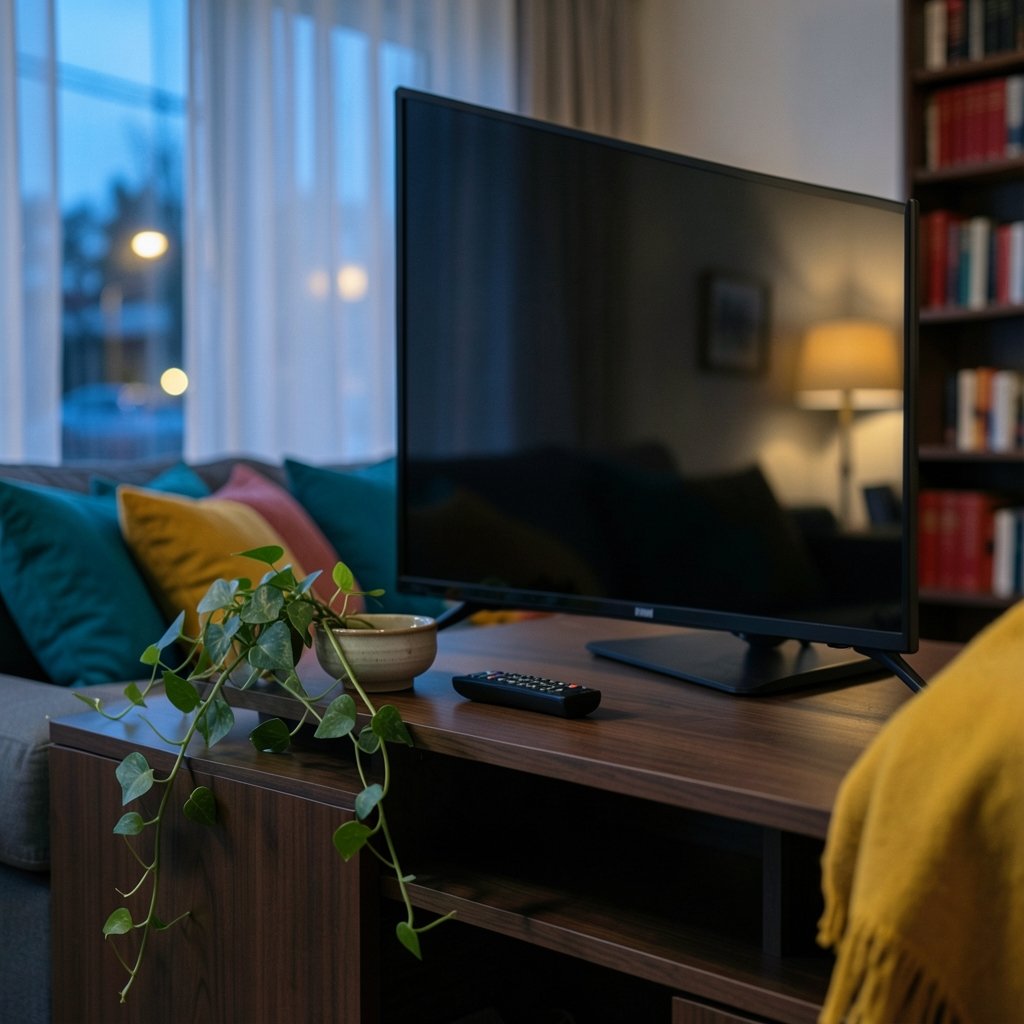
If a single stand had to cover the widest range of needs, this is the one most often named for the job. Every model in the Chameleon series sits on the brand’s C-frame, a sturdy aluminum chassis that gives the piece a rigid skeleton rather than relying on particle board alone. That structure is why it earns the “most versatile” label: it can be configured to suit different room layouts and equipment loads instead of forcing the room to suit it.
It suits people who plan to keep a stand for a decade and want it to adapt as their gear changes. The limitation is the flip side of that flexibility. Configurable furniture usually costs more than a fixed design and takes longer to assemble, so bargain hunters and anyone who wants a same-day solution should look elsewhere. No price is listed in the source material, so check the retailer directly.
BDI Corridor 8175: The Corner Specialist


Corner placement is where most TV stands fail. A standard rectangle shoved into a 90-degree corner leaves dead space behind it and pushes the screen awkwardly forward. The BDI Corridor 8175 is designed around that problem, which is why it takes the corner category.
It suits living rooms where the only sensible spot for a screen is a corner, especially open-plan spaces where a flat wall is already claimed by windows or a fireplace. The design keeps the screen angled toward the seating area instead of parallel to a wall nobody sits against. The limitation is that corner-specific furniture rarely works well anywhere else. Buy this for a corner and expect it to stay in that corner. Pricing is not listed in the source, so confirm it with the seller.
Salamander Designs Synergy System Quad 245: Built for Home Theater Gear
A TV is only part of a home theater. There is a receiver, a streaming box, maybe a game console, a center channel speaker, and a tangle of cables that needs somewhere to hide. The Synergy System Quad 245 is built for exactly that pile of equipment.
It suits people assembling a proper multi-component system who need ventilation, shelf depth, and cable routing rather than a single narrow shelf. Modular systems let you add or rearrange bays as the collection of boxes grows, which is a real advantage when a receiver gets swapped for a bigger one. The limitation is scale. This is a substantial piece of furniture, and it will dominate a small room. It also costs more than a basic stand because you are paying for modularity. Check current pricing with the retailer.
Sanus VSTV2: The Swivel Base Option
Sometimes the problem is not storage or style. It is the angle. A screen mounted flat against a wall can leave one end of a long sofa staring at a reflection instead of a picture. The Sanus VSTV2 solves that with a swivel base.
It suits rooms with seating spread across a wide arc, or households where one person watches from a kitchen island and another from a couch. Swiveling the screen a few degrees is far cheaper than rearranging a room or adding a second TV. The limitation is that a swivel base is a stand, not a cabinet. If you need closed storage for consoles, cables, and remotes, this will not provide it. Pricing is not listed in the source material.
Goobay TV Stand Basic Fix: The Budget Workhorse
At EUR45.25, this is the pick for anyone who needs a stable base and nothing more. It holds televisions and monitors up to 40 kg across a 32″ to 55″ range and mounts on a discreet black glass plate that blends into most room designs.
The 35° swivel arm and three height adjustments make it easy to position the screen for comfortable viewing, and buyers consistently report that it keeps the TV stable, assembles simply, and delivers good quality for the price. The limitation is precision. Customer feedback notes that fitting the vertical section to the glass plate lacks some mechanical finesse, and there is a fair amount of assembly involved. One reviewer also flagged that it only accommodated their 46-inch Samsung. Check your TV’s VESA pattern and weight before ordering.
One for All Full Metal Tripod WM7461: Design That Doubles as Decor
Some rooms cannot absorb another boxy cabinet. The Full Metal Tripod WM7461 takes the opposite approach, turning the stand itself into a design object. It holds a 32″ to 65″ television up to 30 kg without drilling a single hole, which makes it a natural fit for renters.
The design descends from the brand’s Red Dot award-winning tripod line, and it adds a 360° swivel function plus integrated cable management so the back of the setup stays tidy. Buyers describe it as slim, stable, and very easy to install, and the look earns consistent praise. The limitation is price. At EUR196.93, it costs more than four times the Goobay, and you are paying for form as much as function. It also offers no closed storage.
InLine TV-Standfuss: The Slim No-Drill Solution
The InLine TV-Standfuss is the pick for anyone who wants a minimalist footprint. It supports a TV up to 40 kg in the 37″ to 70″ range, and assembly involves no drilling and no wall holes, which keeps a rental deposit intact.
Three-way height adjustment on the brackets adapts to different screen sizes, and a cable management column built into the stand keeps cords organized. Buyers call it quite stable and appreciate the horizontal swiveling. The limitation is the footprint itself. Reviewers note the stand base is quite small compared to the competition, which is great for tight spaces but means you should keep an eye on stability if kids or pets bump the furniture. At EUR138.03, it sits in the middle of the pack.
Sorbus TV Stand Dresser: For Dorms and Small Bedrooms
Small spaces need furniture that multitasks. The Sorbus TV Stand Dresser measures 38 inches long and less than a foot wide, so it slips into dorm rooms and tight bedrooms where a full media console simply will not fit.
It suits students and renters who need the TV raised to viewing height and want two drawers for clothes, cables, or controllers at the same time. At $74.99 with a listed 6% discount from $79.99, it is the cheapest option on this list. The limitation is capacity. A dresser-style stand is built for light loads, so a heavy 65-inch panel is not the right match. Measure the depth of your TV’s feet before you commit.
How to Choose a TV Stand That Actually Works
The specs that matter are fewer than the marketing suggests. Work through these in order.
- Check the VESA pattern and weight. The mounting holes on the back of your TV follow a standard pattern, and the stand’s box will list which patterns it supports. A stand rated for 40 kg will not safely hold a heavier panel no matter how sturdy the shelf looks.
- Match stand width to screen width. As a practical target, leave roughly 6 to 12 inches of visual breathing room on each side so the screen does not sit edge to edge. For a 55-inch TV, a stand in the high 40s to mid-60s inches wide tends to work. A 65-inch set pairs well with roughly 60 to 78 inches. A 75-inch set usually wants 72 to 90 inches.
- Decide whether you need closed storage. Open shelves collect dust and visible clutter. Doors hide it but add cost and alignment issues over time.
- Inspect the weak points. Thin back panels, doors that drift out of alignment, and shelves that sag under a game console or a stack of books are the classic failure modes on cheap stands. Poor edge finish on corners shows up fast once a vacuum bumps it.
- Plan for cables before you buy. Cable access should be standard, not a bonus. If there is no route from the shelf to the wall, you will be looking at a hanging cord forever.
- Think about the swivel. If seating wraps around the room, a swivel base earns its keep. If everyone faces one wall, skip it and spend the money on storage.
One more practical note: if you are shopping around a big sale event, it pays to know which discounts are real. The same discipline applies whether you are hunting a stand or checking whether a Best Buy discount code actually saves you money on accessories, and it is worth reviewing how to spot real savings in Best Buy Black Friday deals before the rush. If you are weighing a bigger-ticket purchase alongside the stand, the same logic applies to whether the best stock to buy right now is probably not a single stock at all, which is a useful reminder that urgency is a sales tactic, not a spec.
Common Mistakes People Make
The most frequent error is buying for the TV you have instead of the TV you will have in three years. A stand rated for a 55-inch screen becomes a problem the moment a 65-inch set arrives. The second is ignoring depth. A deep cabinet in a narrow room eats the walking path. The third is skipping the VESA check entirely and discovering the mismatch after the box is open. The fourth is buying the cheapest option for a heavy panel. Universal stands are usually heavier and more stable than the flimsy plastic legs that ship in the TV box, but “heavier than the included legs” is a low bar.
Conclusion
The best TV stand is the one that matches your room, your gear, and your tolerance for assembly. For sheer adaptability, the Salamander Chameleon Oslo 247 covers the most ground. For a corner, the BDI Corridor 8175 is purpose-built. For a full home theater stack, the Synergy Quad 245 has the room. For tight budgets, the Goobay Basic Fix at EUR45.25 is hard to beat, and the Sorbus dresser at $74.99 handles dorm life. Measure your TV, check the VESA pattern, and buy for the next screen, not just this one.
Frequently Asked Questions
What size TV stand do I need for a 65-inch TV?
A stand roughly 60 to 78 inches wide tends to land well in a spacious family room. Aim for 6 to 12 inches of clearance on each side so the screen does not hang edge to edge, and always confirm the stand’s listed weight capacity against your TV’s actual weight.
Do TV stands include a mount, or do I buy one separately?
It varies. Some stands, like certain corner models, ship with a VESA-compatible mount in the box. Others are pure furniture with a flat top, and you simply rest the TV’s own feet on it. Check the product listing for the words “mount included” before you order.
Can a universal TV stand hold a heavy OLED?
Often yes, but the weight rating is the deciding factor. Universal stands are generally heavier and more stable than the basic legs that come in the TV box. Verify the stand’s maximum load and its supported VESA pattern against your specific model.
Is a swivel base worth the extra cost?
It is worth it if seating wraps around the room or you watch from more than one spot, such as a couch and a kitchen island. If everyone faces the same wall, put the money toward storage or a sturdier build instead.
How much assembly is normal for a TV stand?
Most flat-pack stands require a real session with a screwdriver, and some buyers report that certain models involve quite a lot of assembly. Stands with glass plates can be fiddly to align precisely. Budget an evening and read the instructions fully before starting.
Are cheap TV stands safe for a large TV?
They can be, as long as you stay within the stated weight limit and check the weak points. Thin back panels, sagging shelves, and doors that go out of alignment are the usual failure signs on budget stands. If your TV is near the top of the stand’s weight range, spend more.











