

What if the car looks perfect, drives fine, and still costs you $4,000 in repairs six months later? It happens every day, and almost always because the buyer skipped a handful of questions that take ten minutes to ask. The used market rewards patience. Roughly two-thirds of car shoppers now prefer used over new, which means competition for clean cars is real, and sellers know it. Your best defense is a short, sharp list of questions that exposes history, condition, paperwork, and hidden risk before money changes hands.
Start With the Questions You Can Ask Before You Leave Home
Most buyers waste their first hour driving across town to look at a car they could have eliminated with two phone calls. Screen the seller first. Ask why the car is for sale, how long they have owned it, and whether the title is in their name and ready to transfer. Sellers who dodge the title question usually have a reason: an outstanding loan, a co-signer who is not available, or a rebuilt title they would rather discuss in person.
Ask for the VIN before you visit and request a vehicle history report. A history report is not a guarantee, but it flags accidents, salvage or flood branding, and odometer inconsistencies. Then confirm the VIN on the report matches the VIN on the dashboard and door jamb when you arrive. A mismatch is a walk-away moment, not a negotiating point.
Also ask for the mileage when the car was last serviced, in addition to the current mileage. A car with 90,000 miles and a fresh timing belt is a different purchase from one with the same mileage and no records. If you are shopping a specific model, know which versions age well before you start calling sellers. Our guide to the used Toyota Corolla’s best generations and engines to avoid is a good example of narrowing the field before the first phone call.
What Should You Ask About Service Records and Maintenance?
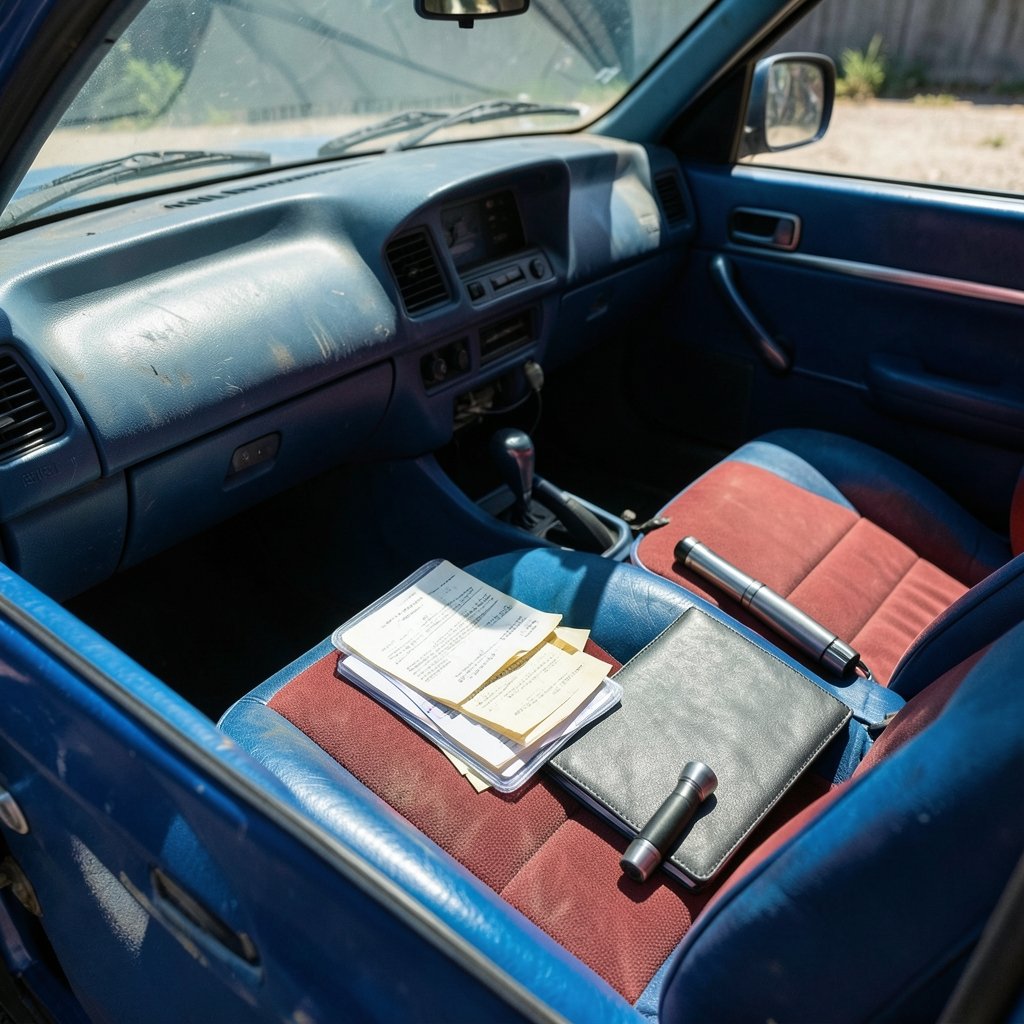
Ask to see the maintenance file rather than only hearing about it. A stack of receipts with dates and mileage tells a story. So does an empty glovebox.
The practical questions:
- Where was the car serviced, and can I see invoices?
- When was the last oil change, and what interval was used?
- Has the transmission fluid, coolant, or brake fluid ever been changed?
- Are there any known leaks, warning lights, or recurring problems?
- Has the car ever failed an inspection, and why?
Sellers who maintain cars keep records because they are proud of them. Sellers who do not will say “it’s all been done” without evidence. Treat verbal assurances as a starting point, never as proof. According to AAA’s buying checklist, a history report and an independent mechanic inspection belong at the top of any used-car to-do list, and that ordering matters: records first, inspection second.
What Should You Ask About Accidents, Damage, and Title Status?
This is where money hides. Ask directly whether the car has been in an accident, whether any panels have been repainted, and whether the title is clean, salvage, rebuilt, or flood-branded. Then ask a follow-up: “Was the airbag deployed?” A deployed airbag means a serious impact, and repaired airbag systems are a common source of trouble.
Ask whether the car has ever been submerged or lived near salt water. Flood cars can look immaculate and fail electrically months later. Check for musty smells, fogged headlights, and silt under the spare tire.
The title question deserves special attention. A clean title in the seller’s name, with no lien, is the only version that lets you register the car without drama. If there is a loan, ask how the lien will be paid off and whether the lender will release the title at the sale. Never accept “we’ll sort it out after.”
What Should You Ask About the Test Drive and Mechanical Condition?
Ask whether you can take the car on a mixed test drive: cold start, city streets, highway speeds, and a parking lot. A cold start reveals noises that vanish once the engine warms. Highway time exposes alignment, transmission shudder, and wind noise.
Ask whether you can have an independent mechanic inspect it, and whether the seller will allow it on a lift. Anyone selling a sound car says yes. Anyone who refuses is telling you something useful.
For trucks and SUVs, the questions get more specific. You want to know about towing history, frame condition, and whether the four-wheel-drive system has been exercised. Our breakdown of buying used trucks without landing in a money pit covers the frame and drivetrain checks that separate a keeper from a project. The same logic applies to SUVs: a used Toyota 4Runner generation guide helps you ask smarter questions about rust, mileage, and known weak points before you even see the truck.
What Should You Ask About Features, Comfort, and the Small Stuff?
Ask about the things you will notice every day: does the air conditioning blow cold, do all the windows and locks work, does the infotainment connect reliably, and are there two keys? A missing second key can cost real money to replace on modern cars.
Ask about tires by checking the date codes yourself, and ask when the brakes were last done. These are wear items, not deal-breakers, but they are excellent negotiating leverage. If the A/C is weak, ask whether it has been serviced recently and whether the system holds a charge. A weak system is often a small fix, but it can also be a compressor. Our guide on what to do when your car’s air conditioning isn’t cold explains why “it just needs a recharge” is sometimes true and sometimes a warning sign.
What Should You Ask About Paperwork, Fees, and Payment?
Ask for the out-the-door price in writing, especially at a dealer. That number should include taxes, title, registration, and any documentation fee. Ask what the fee covers and whether it is negotiable. Ask whether the advertised price assumes financing you do not want.
Ask about warranty coverage in plain terms: what is covered, for how long, what voids it, and who honors it. A dealer “warranty” that requires servicing at that dealership is a different product than a manufacturer-backed plan.
Ask how payment will work and get a receipt that includes the VIN, sale price, date, and both signatures. If you are financing, get pre-approved before you shop. Walking in with a rate in hand keeps the conversation about the car instead of the loan.
How Do You Read the Answers You Get?
Listen for specificity. “It’s been a great car” is noise. “I bought it in 2021 at 42,000 miles, the water pump was replaced at 68,000, and here are the receipts” is signal. Vague answers to precise questions are the single most reliable red flag in private sales.
Watch for pressure tactics. A seller who insists the car will be gone tomorrow, refuses an inspection, or will not provide the VIN is not offering a bargain. There are always other cars.
Write the answers down as you go. After three viewings, memory blurs, and small details like “the seller mentioned a small leak” disappear. A one-page comparison sheet with price, mileage, records, title status, and inspection results will keep you honest when emotion kicks in.
What Should You Ask Yourself Before You Sign?
The last set of questions is internal. Can you afford the maintenance as well as the payment? Does the car fit your actual driving rather than your imagined driving? Have you priced insurance for this specific model? Do you have a budget for the first round of repairs, because every used car needs something?
Be honest about the “needs nothing” trap. A used car with no immediate issues is rare, and a seller claiming perfection is either uninformed or overselling. Budget for tires, fluids, and a baseline service, then decide whether the price still makes sense.
Conclusion
The best used-car buyers are not the ones who know the most about engines. They are the ones who ask the same short list of questions every time and refuse to skip the boring ones. Screen the seller before you drive over, demand records and a history report, confirm the title, insist on an independent inspection, and get the out-the-door price in writing. None of that requires mechanical expertise. It requires a little discipline and a willingness to walk away. Do that, and the car you buy will be the one you keep, not the one you regret.
Frequently Asked Questions
What is the single most important question to ask a used car seller?
Ask whether you can have the car inspected by an independent mechanic, and whether the seller will provide the VIN and a vehicle history report. A seller who agrees to all three is offering transparency. A seller who refuses any of them is signaling a problem you would rather find now than after you pay.
Should I ask a private seller for service records?
Yes, and ask to see the actual invoices rather than a summary. Records with dates and mileage confirm that maintenance happened and give you a baseline for what is due next. If records are missing, factor a full fluid and belt service into your offer.
How do I ask about accidents without sounding accusatory?
Keep it factual and direct: “Has the car been in any accidents or had any paintwork?” Then follow up with “Was the airbag deployed?” Most honest sellers answer without offense. If the answer changes between the phone call and the in-person visit, that inconsistency matters more than the accident itself.
What questions should I ask about the title?
Ask whether the title is clean, in the seller’s name, and free of liens. If a loan exists, ask how and when the lien will be released and whether you will receive the title at the sale. Ask whether the car has ever been branded salvage, rebuilt, or flood-damaged. Get the answers before you discuss price.
Is a vehicle history report enough on its own?
No. A history report shows what was reported, and plenty of damage never gets reported. Use it to screen out branded titles and odometer problems, then verify with a physical inspection and a mechanic’s review. The report is a filter, not a guarantee.
What should I ask a dealer that I would not ask a private seller?
Ask for the out-the-door price in writing, an itemized list of fees, and the exact terms of any warranty, including what voids it. Also ask whether the advertised price depends on financing. Dealers offer more consumer protection than private sellers, but the paperwork is where the real cost lives.
Ask for a written statement of the vehicle’s condition, and compare it against what you find. If the seller will not put claims in writing, assume the claims are soft. ## What Should You Do Immediately After Buying? The questions do not stop at the sale. Before you hand over money, ask for the title, a signed bill of sale, and all keys and remotes. After the sale, transfer the title and register the car promptly, and confirm insurance is active before you drive away. Then book a baseline service: oil, fluids, filters, belts, and a brake inspection. Ask your mechanic to check anything the pre-purchase inspection flagged. Keep every receipt in one folder; when you sell the car, that folder becomes your best negotiating tool. A used car bought with discipline is not a gamble. It is a documented decision, and the paperwork you collect on day one is what makes it one.











