

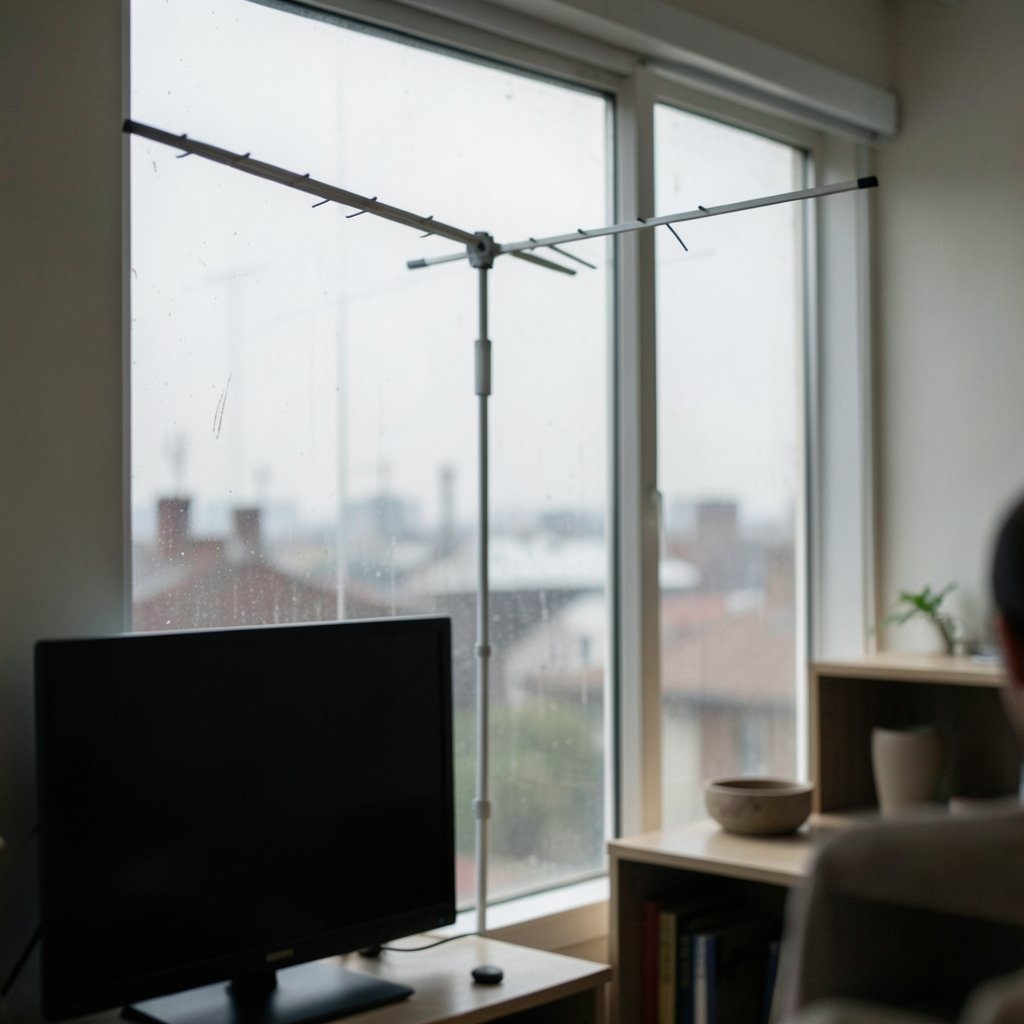
Can you really get dozens of free HD channels with a piece of plastic stuck to your window? Yes, and that is exactly why indoor TV antennas have become one of the cheapest upgrades in home entertainment. The catch is that the market is flooded with flat panels that all look identical and promise wildly different results. Some pull in 60 channels from 40 miles away. Others pull in nothing but static and regret.
This roundup cuts through the noise. It covers the specific models that reviewers keep recommending, what each one does well, where each one stumbles, and who each one is actually for. No vague advice about “choosing the right antenna for your needs” before the products show up. The options come first. The buying logic comes after.
Quick Comparison of the Top TV Antenna Options
| Antenna | Best For | Style | Standout Strength | Main Limitation |
|---|---|---|---|---|
| Antennas Direct ClearStream Eclipse | Most people in cities and suburbs | Flat, stick-on, reversible black/white | Strong range up to 50-plus miles with included amplifier | Must be affixed to a flat surface; cable may be short for some setups |
| Channel Master FLATenna | Budget buyers who want simplicity | Flat, reversible black/white | Solid performance at a low price, widely praised | Basic design with no frills |
| Winegard FlatWave FL5500A | Apartment dwellers near a window | Flat, reversible black/white | Easy to hide, good for 50-mile indoor use | Amplifier can overload strong local signals |
| Winegard FlatWave FL-5000 | Simple setups with clear line of sight | Ultra-thin flat panel | Lightweight and easy to mount | Works best only with no obstacles, roughly 35 to 40 miles |
| Antennas Direct ClearStream 4MAX | Rural homes and weak-signal areas | Indoor/outdoor, rugged | Omnidirectional pickup within about 70 miles | Pricey and not exactly pretty on a wall |
Antennas Direct ClearStream Eclipse: The Safe Pick for Most Homes

If there is a consensus favorite in the antenna world, this is it. TechRadar named the ClearStream Eclipse the best indoor TV antenna for most people, praising it as a “simple, yet powerful indoor antenna with an unobtrusive design.” That verdict has been echoed across multiple review cycles, which is rare in a category where opinions usually split.
Who it suits: Renters and homeowners in cities or suburbs who want one antenna that just works without a trip to the roof.
What it does well: The Eclipse is a flexible single-loop design about 8 inches across. It sticks to a window or wall with the included mounting kit, and its reversible black-and-white finish means it can blend into either a dark or light room. Reviewers report strong signal pulling at distances up to 50-plus miles, and it ships with a signal amplifier. There is also a free companion app for pointing advice, which saves a lot of trial and error.
The real limitation: It has to be affixed to a flat surface, so you cannot perch it on a shelf and move it around freely. The supplied cabling may also be too short for some room layouts, which means budgeting for a coax extension.
Price: Check the current listing before buying. Prices on this model move around, and the research reviewed here does not lock in a figure.
One practical note from testing culture around this antenna: mount it as high as you reasonably can and facing the tower cluster, not just wherever the wall looks emptiest. Aesthetics-first placement is the single most common reason people return a perfectly good antenna.
Channel Master FLATenna: The Budget Workhorse
The FLATenna has a confusing history. You may find it sold as the FLATenna 35, where 35 refers to the range in miles, or as the FLATenna Duo, which has one white side and one black side. Channel Master now sells only the Duo and has rebranded it simply as the FLATenna. Same product, different labels, so do not pay extra for what looks like a newer version.
Who it suits: Anyone who wants dependable basic reception without spending much.
What it does well: Reviews are solid across the board, from professional testers to buyer feedback, and it works to its stated specifications without drama. The double-sided finish gives you mounting flexibility. In a comparison table of indoor antennas, it holds its own against models costing more.
The real limitation: It is a no-frills panel. There is no clever design, no app, and no premium feel. If your signal situation is genuinely difficult, this is not the antenna that solves it.
Price: It typically sits at the low end of the indoor antenna market, which makes it a low-risk first purchase.
Winegard FlatWave FL5500A: Best for Window-Mounted City Living
Winegard’s amped flat panel is the other name that shows up on nearly every serious list. It supports both VHF and UHF signals, comes with 6 feet of coax cable, and is rated for indoor use at up to 50 miles.
Who it suits: Apartment and condo dwellers with a window that faces the broadcast towers.
What it does well: Like the FLATenna, it is white on one side and black on the other, so it disappears against most walls and window frames. It is heavily recommended by reviewers and users alike, and the 6-foot cable gives a bit more placement freedom than some rivals.
The real limitation: The amplifier. Testers have found that nine times out of 10, a gain amplifier does not offer an overall benefit. It can boost weak stations, but it can also overload stations you already receive well, and the net result is fewer channels, not more. The fix is simple: try the FL5500A with the amplifier connected and again without it, then keep whichever version gives you more stable channels.
Winegard FlatWave FL-5000: The Minimalist Option
The FL-5000 is the simpler sibling of the FL5500A. It is an ultra-thin digital indoor antenna that picks up signals well when positioned correctly.
Who it suits: People with a clear line of sight to the towers who want the least visually intrusive option possible.
What it does well: With no obstacles in the way, it can pull HD signals from roughly 35 to 40 miles out. It is lightweight, easy to mount on a wall or window, and comes with a long coax cable.
The real limitation: Positioning matters more here than on the amped models. Get it wrong and performance drops fast. If your window faces a wall, a hill, or a neighboring building, look elsewhere.
Antennas Direct ClearStream 4MAX: For Rural and Weak-Signal Homes
Sometimes an indoor panel is not enough. If you live far from the towers or deal with dense foliage, the 4MAX is the step up.
Who it suits: Rural households, or anyone who has already tried an indoor antenna and come up short.
What it does well: Its omnidirectional design picks up signals within a 70-mile range, it is weatherproof, and it installs with the included mounting kit. It is optimized for 4K UHD and 1080p channels.
The real limitation: Two of them. It is somewhat pricey, and it is not the most aesthetically pleasing thing to bolt to a wall or roof. This is a function-over-form purchase.
How to Choose Without Wasting Money
The options above are good, but the wrong antenna in the wrong spot beats nothing. A few rules separate a smooth setup from a frustrating one.
- Check what is actually broadcast near you first. Enter your address into a reception mapping tool before you buy anything. It shows which stations are close and which direction they sit in. Ten minutes here saves a return shipping label later.
- Start cheap and unamplified. The best advice from experienced testers is to buy the cheapest non-amplified model you can find first. If you get too few channels or none at all, adding an amplifier probably will not change that.
- Take range claims as estimates, not promises. Real-world range varies wildly with terrain, buildings, and even trees. Testers have pulled in channels from farther than a stated maximum and failed to get channels that should have been easy.
- Go high and go outside the wall. An antenna behind a brick wall or a metal-backed wall loses signal fast. A window facing the towers is almost always better than a cozy spot behind the sofa.
- Rescan after every move. Televisions do not automatically find new channels when you reposition an antenna. Run a fresh channel scan each time you move it, or you will be judging the old lineup.
- Consider the next broadcast standard. If your TV supports ATSC 3.0, you can expect modern features to arrive over time, from HDR to 4K UHD and beyond. It is worth knowing before you spend on a premium model.
A note on hair, of all things: people obsess over curl patterns the way they obsess over antenna specs, and the lesson transfers. A product tuned for 4c hair is not automatically right for someone with 2b hair, and an antenna tuned for one signal environment will not automatically suit yours. Match the product to the situation, not to the marketing.
Common Mistakes That Kill Reception
The most frequent error is buying an amplified antenna because “more power sounds better.” In practice, amplifiers muddy reception and add expense, and they can overload strong local stations. Try the amp, then try without it, and trust the channel count.
The second mistake is placement by aesthetics. An antenna hidden behind a cabinet looks tidy and performs terribly. Third is skipping the rescan, which makes a good antenna look broken. Fourth is assuming an indoor antenna will fix a rural signal problem. If you are far from the towers, an outdoor model is the next best option, and no flat panel will change that.
There is also a quiet trap in the reviews themselves: many roundups earn affiliate commissions on the links they recommend. That does not make the picks wrong, but it is a reason to cross-check a model across several sources before committing, the same way you would check the row of reviews before trusting a single verdict.
Conclusion
The best antenna for TV is not the most expensive one or the one with the biggest range number on the box. For most households in a city or suburb, the Antennas Direct ClearStream Eclipse is the safest bet, with strong range, a clean look, and a design that reviewers keep endorsing. Budget-minded buyers can happily start with the Channel Master FLATenna. Window-facing apartment dwellers should look at the Winegard FlatWave FL5500A, and rural homes with weak signals should skip the flat panels entirely and go for the ClearStream 4MAX.
Whatever you pick, buy from a seller with an easy return policy, test it in two or three spots, and rescan each time. The antenna that works is the one that is pointed the right way, not the one with the longest spec sheet.
Frequently Asked Questions
Do TV antennas still work in a streaming world?
Yes. Digital antennas receive free over-the-air broadcasts in high definition, including local and national news, sports, movies, and plenty of shows. An antenna is a one-time purchase that complements streaming rather than replacing it, and it is the cheapest way to keep local programming without a cable or satellite subscription.
How far can an indoor TV antenna really reach?
Stated ranges are best estimates, not guarantees. The ClearStream Eclipse is rated for 50-plus miles, the Winegard FL5500A for 50 miles, the FL-5000 for roughly 35 to 40 miles, and the ClearStream 4MAX for about 70 miles. Real results depend on terrain, buildings, trees, and how high you mount the antenna. Testers have exceeded some ratings and fallen short of others.
Should I buy an amplified antenna?
Usually not first. Experienced testers have found that in most cases an amplifier does not offer an overall benefit and can actually reduce your channel count by overloading stations you already receive well. Buy a cheap non-amplified model first. If you already own an amplified antenna, test it both with and without the amplifier connected and keep the better result.
Where should I put my indoor antenna?
High up, near a window, and facing the direction of the broadcast towers. Avoid brick walls, metal-backed walls, and spots behind furniture or appliances. Use a reception mapping tool to find your nearest towers before you start moving things around, and run a fresh channel scan after every repositioning.
Is an outdoor antenna worth it?
If you live in the country or have already struggled to get a clear signal indoors, yes. An outdoor antenna is the next best option after indoor models fail, and a rugged indoor/outdoor model like the ClearStream 4MAX covers both use cases. For city and suburban homes with nearby towers, an indoor panel is usually enough.
How much should I spend on a TV antenna?
The sweet spot for an indoor antenna sits in the budget-to-mid range, and paying much more usually buys features you do not need. If you are considering spending well beyond that, put the money toward an external antenna instead. Check current prices before buying, since they shift, and prioritize a seller with easy returns.











