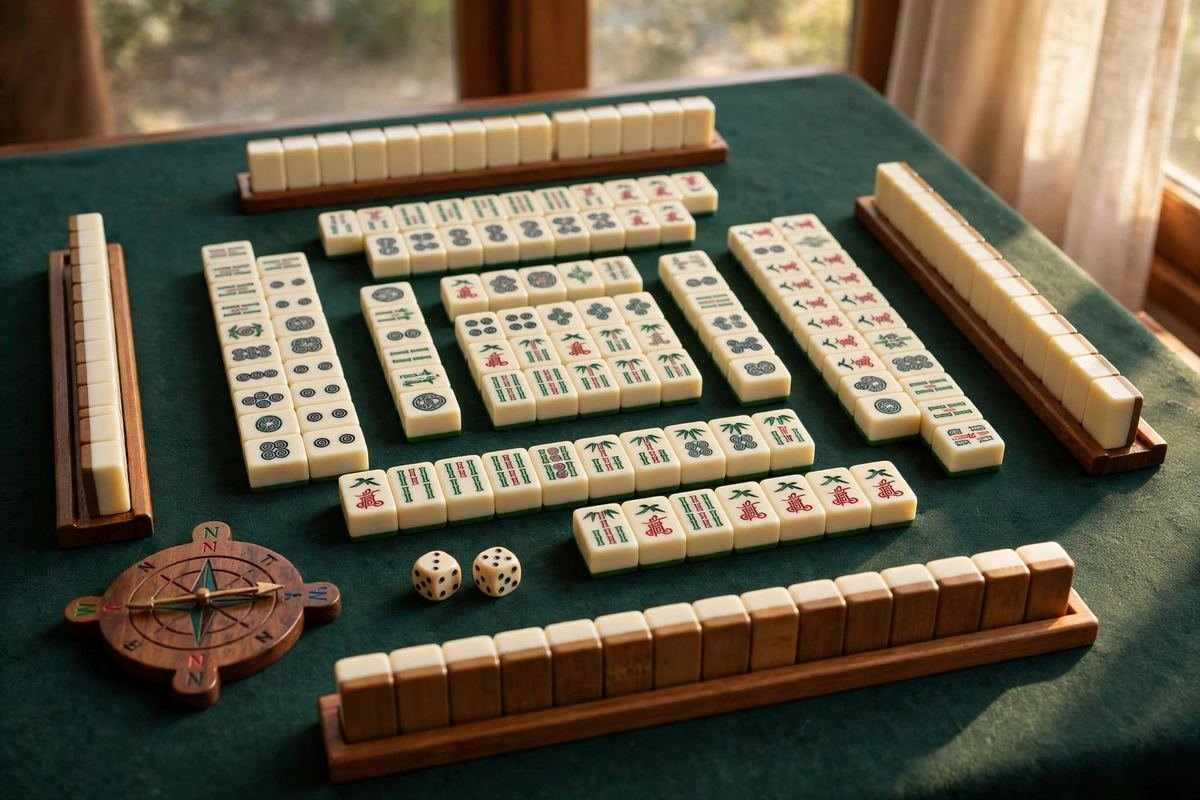
A mahjong set is the box of engraved tiles at the heart of one of the world’s most loved table games, and choosing the right one makes the difference between a game that feels wonderful and one that frustrates everyone at the table. A standard set contains 144 tiles, plus racks, dice and a few extras. Players draw and discard in turn until one completes a winning hand, a little like rummy with engraved bricks instead of cards.
So which mahjong set should you buy? For most people, a standard 144-tile set in melamine or resin, with four racks and a sturdy case, is the right choice. It covers the Chinese and Japanese styles of play and costs far less than a bamboo set. This guide explains what is inside a set, how the tile types differ, and how to look after it.
Key takeaways:
- A standard set has 144 tiles: three suits of 36, plus 16 winds and 12 dragons.
- Extra flower, season and joker tiles take the total to 152 or 160.
- Melamine and resin tiles suit most players; bamboo and bone are beautiful but dearer and need more care.
- Check the tile count, racks, dice and case before you buy, and match the set to your style of play.
What is a mahjong set?
A mahjong set is everything you need to play, packed into a case: the tiles, the racks that hold them, the dice that decide who starts, and usually a wind indicator and scoring chips. Each tile is a small, weighty rectangle, roughly the size of a domino, with a suit symbol engraved on its face. Players build a hand on their rack, hidden from the others, drawing and discarding in turn.
Mahjong began in China in the nineteenth century and spread around the world, picking up local variations. The Chinese game, Japanese riichi mahjong and American mahjong all use the same basic tiles, but the number of tiles and some rules differ. So the first question before buying is which style you will actually play.
The tiles in a mahjong set
Every standard set is built from the same families of tiles. The three suits make up most of the set. Each suit runs from one to nine, with four copies of every tile: 36 per suit, 108 in total.
Dots, or circles
The dots suit shows rings, from a single large circle on the one of dots up to nine small circles on the nine. The one of dots is often the most decorative tile in the set. Dots are the easiest suit for a beginner to read, because the number is simply the number of circles.
Bamboo, or sticks
The bamboo suit shows sticks, again from one to nine. The one of bamboo is usually a single bird, often a sparrow, rather than a stick. Bamboo tiles can be harder to count quickly than dots. On a well-made set the engraving is deep and the inlay is crisp, which makes counting much easier.
Characters, or cracks
The characters suit shows Chinese characters rather than pictures, with the character for ten thousand on every tile. This suit trips up most beginners, because the tiles look similar until you learn the number characters. Many modern sets print a small Western number in the corner of each character tile, which helps new players enormously.
Winds and dragons
Alongside the suits are the honour tiles: 16 wind tiles, four each of east, south, west and north, and 12 dragon tiles, four each of red, green and white. The winds are marked with their Chinese character, and the dragons are usually a red or green character, or a blank tile for the white dragon. These tiles have no numbers. They form sets of their own.
Flowers, seasons and jokers
Many sets include eight extra tiles: four flowers and four seasons, each one unique rather than repeated four times. These are bonus tiles in Chinese and some other styles, but they are not used in Japanese riichi mahjong. American sets add eight joker tiles, which can stand in for any tile.
Mahjong set sizes compared
Mahjong sets are not one-size-fits-all. The tile count decides which versions of the game you can play, while the tile size decides how the set feels in the hand. Standard tiles are about 30 millimetres tall. Larger tiles are easier to read and to pick up. Smaller travel tiles pack into a smaller case, but they can feel fiddly during a long game.
| Set type | Tiles | Used for | Best for |
|---|---|---|---|
| Standard 144-tile set | 144 | Chinese and Japanese riichi mahjong | Most players and first-time buyers |
| 152-tile set | 144 plus 8 flower tiles | Chinese mahjong | Players who want the full set |
| American 160-tile set | 152 plus 8 jokers | American mahjong | American players only |
| Travel or mini set | 144, smaller tiles | Casual play on the move | Holidays and small tables |
| Large-tile set | 144 or 152, larger tiles | Chinese and Japanese mahjong | Easier reading and handling |
What are mahjong tiles made of?
The material decides how the tiles feel, how they sound when shuffled, how long they last and how much they cost. Modern sets are mostly melamine or resin, while traditional sets use bamboo, bone or wood.
Melamine is the most common material for a set bought today. It is a hard, dense plastic that takes deep engraving and shrugs off knocks and spills. A melamine set is the practical choice for regular play: tough, easy to clean and modestly priced. Its one drawback is that it can feel a little light compared with natural materials.
Resin tiles are similar to melamine and are often used for sets with detailed painted designs. Bamboo is the traditional material for the tile body, often backed with bone on the face. Bamboo tiles are light, warm to the touch and quietly beautiful, but they are more delicate: bamboo can split if it dries out, and the bone face can chip if dropped.
Bone and ivory were the classic materials for fine sets, but genuine ivory is no longer used in new sets. Wooden tiles, often in a pale boxwood, are sometimes made for travel sets, because wood is light, though it wears faster than melamine. Whatever the material, check the finish: the engraving should be clean and deep enough to feel with a fingertip.
How to choose a mahjong set
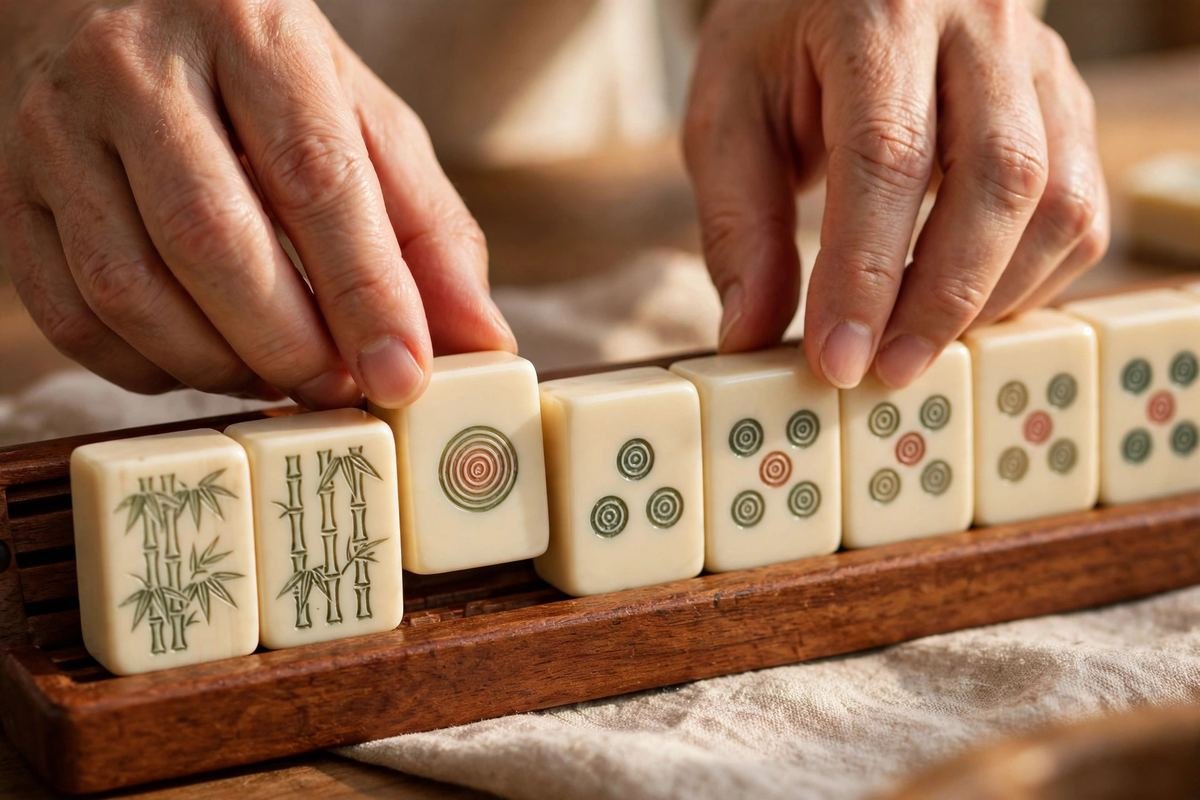
Choosing a mahjong set is simpler than the catalogues make it look, once you know which style you play. Start with the tile count: 144 tiles for Chinese or Japanese play, 152 with flowers and seasons, and 160 with jokers for the American game. Buying a set with the wrong count means buying twice.
Next, look at the racks. A good set includes four, one per player, long enough to hold a full hand without crowding. Wooden racks feel better and last longer than thin plastic ones. Some sets include racks with pushers, which help build the walls of tiles and suit beginners.
The case matters more than most buyers expect. A set that lives in a flimsy box will lose tiles. Look for a case with a separate compartment for each part of the set, and a handle if the set travels to friends’ houses or a club night.
Check the dice and the extras. Most sets include two or three dice, a wind indicator and scoring chips. A set that arrives without them is not really complete. Finally, think about who will read the tiles: if beginners will play, choose a set with Western numbers in the corners of the character and wind tiles.
A mahjong set sits happily alongside other tabletop classics, and many households keep a puzzle on the same shelf. If you enjoy number games as a warm-up, sudoku practises the pattern-spotting mahjong rewards. And since a game can run long, keep a favourite mug of tea or coffee close by.
Your mahjong set buying checklist
Work through this list before you buy, and you will avoid the common mistakes.
- Confirm the tile count: 144 for Chinese or Japanese play, 152 with flowers and seasons, 160 with jokers for American play.
- Check the set includes four racks, long enough for a full hand, ideally with pushers.
- Look for Western numbers in the corners of character and wind tiles if beginners will play.
- Inspect the tile finish: deep clean engraving, neat inlay, and tiles uniform in size and weight.
- Make sure the dice, wind indicator and scoring sticks are included.
- Choose a hard case with separate compartments for tiles and racks.
- Pick a tile size that suits the players: standard for most, larger for easier reading.
- Check the material: melamine or resin for regular play, bamboo or bone for a treasured set.
- Count the tiles when the set arrives, and check for duplicates, missing tiles or chips.
How to look after a mahjong set
Mahjong tiles are tougher than they look, but a little care keeps them beautiful for decades. Store them in their case, flat and out of direct sunlight, because heat and sunlight can fade the inlay and warp wooden racks. Keep them dry: moisture is the enemy of bamboo and bone. Clean the tiles with a soft, dry cloth after play, and use a barely damp cloth for stubborn marks. Never soak the tiles, and shuffle them on a soft surface such as a tablecloth, rather than on bare stone or glass.
Frequently asked questions
How many tiles are in a mahjong set?
A standard mahjong set has 144 tiles. Many sets add eight flower and season tiles for a total of 152, and American sets add eight jokers for a total of 160. Always check the count on the box.
What is the difference between Chinese and American mahjong sets?
The tiles are largely the same, but American mahjong uses jokers and racks with pushers, and it follows a standardised card of hands that changes each year. A Chinese set without jokers cannot be used for the American game.
Are bamboo mahjong sets better than melamine ones?
Neither is better in every way. Bamboo sets are lighter, warmer to the touch and closer to the traditional game, but they are dearer and need careful storage. Melamine sets are tougher, easier to clean and better suited to regular play, especially with children.
Do I need racks to play mahjong?
You can play without racks by standing the tiles on the table, but it is awkward and slow. Racks keep a hand of thirteen or fourteen tiles upright and hidden, so a set with four good racks is worth having.
Can children play with a mahjong set?
Yes, children can learn mahjong from around eight or nine, and the game is a good workout for memory and pattern spotting. Choose a set with Western numbers in the corners, and keep it away from very young children, because the small tiles and dice are a choking hazard.
How do I know if a mahjong set is good quality?
Look for tiles that are uniform in size and weight, with deep clean engraving and neat colour inlay. The tiles should feel solid rather than hollow, the case should close properly, and the racks should be sturdy. If the tiles look uneven, walk away.
A set worth playing with
A mahjong set is a small investment in many evenings of good company. The right one is not the most expensive or the most ornate, but the one that matches the game you play and survives being used week after week. A standard 144-tile melamine set, with four sturdy racks and a proper case, will serve most players for years. So count the tiles, check the racks, and pick the set that suits your table.