Amethyst is the purple stone most people picture when they think of a coloured gemstone ring. It is the February birthstone, it has been set into rings for centuries, and it is one of the few genuinely beautiful stones that stays within reach of an ordinary budget. The problem is not finding an amethyst ring. It is finding one where the colour is real and even, the stone is well cut, and the setting protects it instead of hiding its flaws.
That is why this guide is organised by what actually matters in a ring: colour depth, cut, clarity, and setting. A deep, evenly coloured stone in a simple bezel can look far more expensive than a pale, uneven stone in an elaborate mount. Price is a poor guide on its own. Some of the most wearable amethyst rings are mid-priced, and some of the most expensive are the hardest to wear every day.
Below are nine amethyst rings worth considering in 2027, from a classic solitaire to a bold cocktail ring, each one described by what it is good at, what to watch for, and who it suits best, so you can choose with your eye and your budget in mind, not just a bestseller list.
Key takeaways
- Amethyst is a purple variety of quartz, hard enough for everyday wear at Mohs 7, but colour quality varies enormously.
- Look for a medium to deep purple with even colour and no obvious pale or brown patches, and a cut that returns light rather than going dark in the centre.
- Most amethyst on the market is heat-treated to improve its colour, which is standard practice, but it should be disclosed.
- Bezel and halo settings protect the stone best for daily wear, while high prongs suit occasional wear and show off the colour.
- No amethyst ring is an investment stone, and amethyst has no proven healing properties, whatever a seller may claim.
What amethyst actually is
Amethyst is quartz, silicon dioxide, coloured purple by trace amounts of iron and by natural irradiation in the earth. It sits at 7 on the Mohs hardness scale, which makes it hard enough for a ring you wear most days, though it is not as tough as sapphire or diamond and it can chip if it takes a sharp knock on a hard surface. The best stones come from Brazil, Uruguay and Zambia, and the most prized colour is a deep, reddish purple often called Siberian colour, though very few stones sold under that name actually come from Siberia.
What matters most in an amethyst is colour. A good stone is a saturated medium to dark purple that looks the same from every angle, with no pale centre and no brown or grey patches. Pale stones can look washed out in daylight, while very dark stones can look almost black indoors. Colour zoning, where one part of the stone is darker than another, is common and is the first thing to check when you hold a ring up to the light. A well-cut stone should look lively, not flat, and should not go dark and lifeless in the middle.
Almost all amethyst sold today has been heat-treated to deepen or even out its colour, and that is normal, accepted practice in the trade. It becomes a problem only when a seller hides it, or when a stone is sold as untreated at an untreated price. Synthetic amethyst, grown in a laboratory by the hydrothermal method, is also common, and glass imitations are everywhere at the cheap end. A reputable jeweller will tell you what you are buying, and a certificate from a recognised gem laboratory is worth asking for on any ring over a few hundred pounds.
How we chose these rings and what to look for
Look first at the colour and the cut. Hold the ring in daylight, not just under shop lights, and check that the purple is even across the whole stone. A good cut returns light evenly and keeps the stone bright from edge to edge. A poor cut leaves a dark window in the centre or a pale, washed-out rim. Our guide to amethyst bracelets uses the same colour test, because the stone behaves the same way whatever the setting.
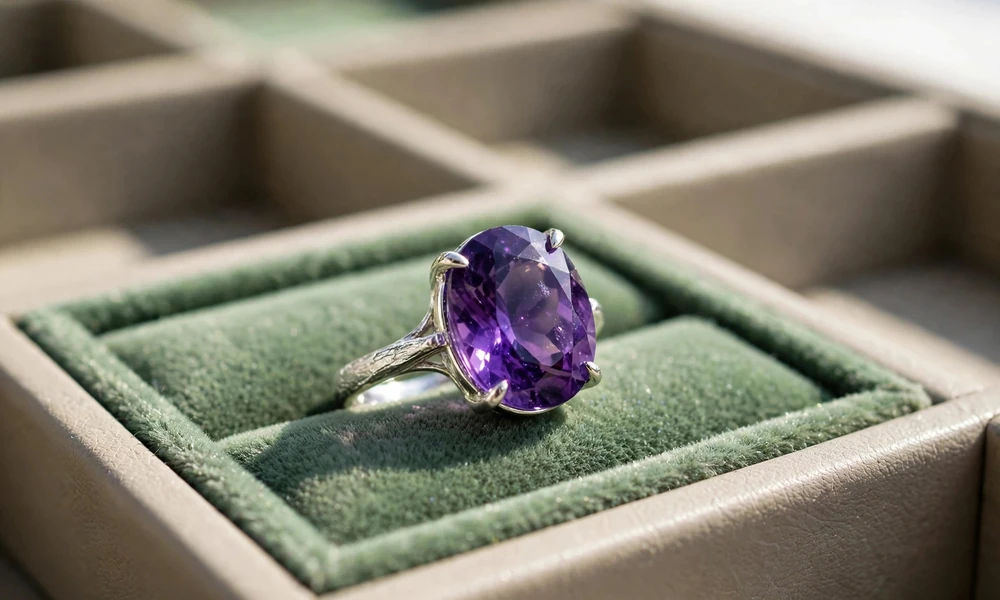
Look next at the setting and the metal. A bezel setting, where a rim of metal surrounds the stone, protects the edges best and suits everyday wear. A halo of small diamonds or white sapphires makes the centre stone look larger and brighter, but it adds cost and more places for dirt to collect. High prongs show off the stone beautifully but leave the corners exposed, so they suit a ring worn for evenings and occasions rather than every day. Yellow gold warms a purple stone, white gold and platinum cool it, and rose gold sits somewhere in between.
Finally, look at the practical details. Check the ring size can be adjusted, because amethyst rings are often bought as gifts, and check that the stone is securely set by giving it a gentle push with a fingernail. Ask whether the stone is natural or synthetic and whether it has been heat-treated, and get the answer in writing on the receipt. A good jeweller will also tell you how to clean it: warm soapy water and a soft brush, never an ultrasonic cleaner if the stone has visible fractures, and never harsh chemicals.
The 9 best amethyst rings of 2027
Tiffany & Co. Amethyst Solitaire Ring
What we like: A classic oval amethyst in a clean six-prong platinum setting, with a deep, even purple and a polished finish that lets the stone do the talking.
What to consider: Premium price, and the high setting means it catches on knitwear. Stone: Oval amethyst, around 3 carats. Setting: Six-prong solitaire in platinum. Best For: A timeless statement ring or a February birthday. Price Range: Luxury.
Cartier Amethyst Cocktail Ring
What we like: A large cushion-cut amethyst in a sculpted gold band, bold and unmistakably Cartier in its proportions, with a warm, saturated purple.
What to consider: A big stone that suits evenings better than the office, and sizing is limited. Stone: Cushion-cut amethyst, around 6 carats. Setting: Sculpted yellow gold band. Best For: Evening wear and special occasions. Price Range: Luxury.
David Yurman Amethyst Cable Ring
What we like: A round amethyst set into the signature twisted cable band, with a deep purple that suits the brand’s sculptural style and a comfortable, everyday weight.
What to consider: The cable detail collects dirt and needs regular cleaning. Stone: Round amethyst, around 2.5 carats. Setting: Cable band in sterling silver with 14-karat gold accents. Best For: Everyday wear with a designer signature. Price Range: Premium.
Mejuri Amethyst Dome Ring
What we like: A smooth dome of polished amethyst in 14-karat gold vermeil, modern and minimal, with a rich colour at a price that makes it easy to wear every day.
What to consider: Vermeil wears over time and will need re-plating eventually. Stone: Polished amethyst cabochon. Setting: Dome setting in gold vermeil over sterling silver. Best For: A modern everyday ring. Price Range: Mid-range.
Monica Vinader Amethyst Signet Ring
What we like: A faceted amethyst set into a clean signet shape in 18-karat gold vermeil, with a deep purple that looks far more expensive than the price suggests.
What to consider: The signet shape is a bold look that does not suit everyone, and vermeil needs care. Stone: Faceted amethyst, around 1.5 carats. Setting: Signet setting in gold vermeil over sterling silver. Best For: A bold everyday statement. Price Range: Mid-range.
Missoma Amethyst Stacking Ring
What we like: A small, bright amethyst on a fine gold vermeil band, designed to stack with other rings, with a clean purple and a comfortable, slim profile.
What to consider: A small stone, so it works best as part of a stack rather than on its own. Stone: Small round amethyst, around 0.5 carats. Setting: Fine band in gold vermeil over sterling silver. Best For: Stacking and layering. Price Range: Affordable.
Maria Black Amethyst Sculptural Ring
What we like: An irregular, sculptural amethyst set into a chunky silver band, with a raw, modern feel and a deep purple that stands out against the cool metal.
What to consider: An unusual shape that suits a modern wardrobe better than a classic one, and the silver will tarnish without care. Stone: Freeform amethyst, around 2 carats. Setting: Sculptural band in sterling silver. Best For: A modern, artistic look. Price Range: Mid-range.
Astrid & Miyu Amethyst Halo Ring
What we like: A round amethyst surrounded by a halo of small cubic zirconia stones in gold vermeil, which makes the centre stone look larger and brighter than it is.
What to consider: The halo adds sparkle but also more small stones to keep clean, and vermeil needs gentle care. Stone: Round amethyst, around 1 carat. Setting: Halo setting in gold vermeil over sterling silver. Best For: A bright, sparkling everyday ring. Price Range: Affordable.
Thomas Sabo Amethyst Charm Ring
What we like: A deep purple amethyst in a detailed sterling silver setting with the brand’s signature charm styling, bold, characterful and easy to wear.
What to consider: A detailed setting that needs regular cleaning, and the silver will darken in the recesses over time. Stone: Oval amethyst, around 2 carats. Setting: Detailed sterling silver setting. Best For: A characterful everyday ring. Price Range: Mid-range.
A good, honest ring for people who like their jewellery to have personality. The stone is a proper deep purple, the silverwork is detailed without being fussy, and it sits comfortably enough for daily wear.
Which amethyst ring is right for you
Everyday wear calls for a bezel or low-profile setting, a stone of medium depth, and a metal you do not have to think about. Sterling silver and 14-karat gold are both practical, and a cabochon or low dome stone will survive daily knocks better than a high, pointed cut. If you work with your hands, keep the stone small and the setting flush, and take the ring off for heavy work.
Occasion wear is where a large cocktail ring or a high solitaire earns its place. Here the colour can be deeper and the stone bigger, because the ring is not taking daily knocks, and a halo or high prongs will show the stone off properly. Our guide to amethyst necklaces follows the same logic, because a matching set should share the same colour depth rather than mixing a pale ring with a deep necklace.
As a gift, a February birthstone ring is an obvious choice, and amethyst is also a traditional gift for a sixth wedding anniversary. Choose a classic shape, a medium purple that suits most skin tones, and a size that can be adjusted, and keep the receipt and any certificate with the ring so the recipient knows what they have.
The caveats that matter
Amethyst is durable, but it is not indestructible. At Mohs 7 it will scratch against harder stones such as diamond and sapphire, so store it separately from other jewellery, ideally in a soft pouch. It can also fade with long exposure to strong sunlight or heat, so do not leave it on a sunny windowsill or in a hot car, and take it off before a sauna or a sunbed.
Heat treatment is standard and should be disclosed, but it is not the only treatment to watch for. Irradiation is used to deepen pale amethyst, and some stones sold as amethyst are in fact synthetic quartz or glass. A price that looks far too low for the size and colour is a warning sign, not a bargain, and a seller who cannot tell you whether the stone is natural, synthetic or treated is a seller to walk away from.
| Detail | What is known |
|---|---|
| What it is | Purple quartz, silicon dioxide, coloured by iron and natural irradiation |
| Hardness | 7 on the Mohs scale, hard enough for everyday wear with care |
| Best colour | Medium to deep purple, even across the stone, no brown or grey patches |
| Common treatments | Heat treatment to improve colour, standard practice, should be disclosed |
| Common imitations | Synthetic hydrothermal amethyst and glass, both common at the cheap end |
| Best setting for daily wear | Bezel or low-profile setting, which protects the stone edges |
| Cleaning | Warm soapy water and a soft brush, never harsh chemicals |
| What it does not do | It has no proven healing properties and is not an investment stone |
If you are buying a ring for an engagement or a milestone, it is worth having the stone checked by an independent gemmologist before the return window closes. That is not a formality. A certificate confirms the stone is what you were told it is, and it protects you if the ring ever needs to be insured or repaired.
Checklist: choosing an amethyst ring honestly
- Check the colour in daylight: it should be an even medium to deep purple, with no pale centre or brown patches.
- Check the cut: the stone should return light evenly and not go dark in the middle.
- Check the setting: the stone should not move when pushed gently, and the prongs or bezel should be smooth.
- Ask about treatment: natural or synthetic, heat-treated or not, and get the answer in writing.
- Check the size and the return policy: can the ring be resized, and how long do you have to return it?
- Store it separately: keep it in a soft pouch away from diamond and sapphire jewellery that could scratch it.
Frequently asked questions
Is amethyst hard enough for an everyday ring?
Yes, at Mohs 7 it is hard enough for daily wear with reasonable care. Avoid sharp knocks, take it off for heavy manual work, and store it away from harder stones that could scratch it.
How can I tell if an amethyst is real?
Real amethyst is cool to the touch, has a hardness of 7, and usually shows slight colour zoning or tiny inclusions. Glass imitations often contain round bubbles and feel warmer. For any expensive ring, ask for a certificate from a recognised gem laboratory.
Is heat-treated amethyst worth less?
Heat treatment is standard practice and is reflected in the price of most amethyst on the market. An untreated stone of the same colour is rarer and more expensive, but a treated stone is not a fake. What matters is that the treatment is disclosed.
Can amethyst fade in sunlight?
Yes, prolonged exposure to strong sunlight or heat can fade amethyst over time. Store it away from sunny windowsills, take it off before sunbathing or a sauna, and keep it in a jewellery box when you are not wearing it.
What metal suits amethyst best?
Yellow gold warms a purple stone and suits warm skin tones, while white gold and platinum cool it and suit cool skin tones. Sterling silver is a good everyday choice and keeps the price down. There is no wrong answer, it is a matter of taste and budget.
Is an amethyst ring a good engagement ring?
It can be, if the wearer loves purple and understands the stone is softer than diamond or sapphire. Choose a bezel setting for protection, a medium to deep colour, and a size that can be adjusted. Our guide to engagement rings covers the practical questions to ask before you commit, whatever stone you choose.
The bottom line
The best amethyst ring in 2027 is not the biggest or the most expensive. It is the one with an even, medium to deep purple, a cut that keeps it bright, and a setting that protects it for the way you actually wear it. For daily wear, a bezel-set cabochon or low dome in gold or silver is the honest choice. For evenings, a large cocktail ring or a high solitaire shows the stone off properly.
Choose one ring, check the colour in daylight, ask whether the stone is natural and whether it has been treated, and buy from a jeweller who answers those questions plainly. That is the honest way to get the beauty amethyst is known for, without paying a luxury price for a pale stone in a fancy setting.