Best Nose Bars for Women 2027
A nose bar is the quietest way to wear nose jewellery, and that is exactly why it works so well. Unlike a hoop, which draws the eye in a loop, or a stud, which sits as a single point of light, a nose bar runs in a clean straight or gently curved line across the piercing. It reads as deliberate and understated, a piece of jewellery that finishes an outfit without ever shouting about itself.
The problem is that nose bars are easy to buy badly. A bar that is too long slides and catches, a bar that is too short pinches, and a bar in the wrong metal can irritate a piercing that has been calm for years. Gauge, length, thread type and metal all matter more here than they do with a stud, because a bar has two ends and twice as many places for something to go wrong.
Below are nine nose bars worth considering in 2027, from a plain titanium bar for everyday wear to diamond-set gold for evenings. Each one is described by what it is good at, what to watch for, and who it suits best, so you can choose a bar that fits your piercing, your skin, and your life.
Key takeaways
- A nose bar is a straight or gently curved bar through a nose piercing, and it suits women who want a clean, minimal line rather than a loop or a single stud.
- Gauge and length matter more than brand: a bar that is too long catches on clothing, and a bar that is too short puts pressure on the piercing.
- Implant-grade titanium, 14-carat gold and niobium are the safest everyday metals for sensitive skin, while plated and nickel-heavy bars are the most common cause of irritation.
- Threadless and internally threaded bars are easier on a piercing than externally threaded ones, which can scrape the channel on the way in.
- No nose bar suits a piercing that has not fully healed, and a bar that hurts, swells or weeps after a change should come out and be replaced with the original jewellery.
What a nose bar actually is
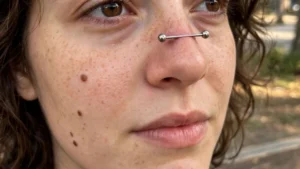
A nose bar is a short length of metal, usually straight or gently curved, with a decorative end on each side of the piercing. It passes through the piercing channel in the same way a stud does, but instead of a flat back or a single gem, it has two visible ends. The result is a clean horizontal line across the nose, which is why bars are often chosen by women who like the look of a piercing but want something more subtle than a hoop.
Most nose bars are made for a nostril piercing, though some are designed for a septum piercing, where the bar sits horizontally across the nose. The two are not interchangeable. A nostril bar is shorter, usually between 6 and 8 millimetres, while a septum bar is longer and often curved to follow the shape of the nose. Buying the wrong one is the most common mistake, so check the piercing it is made for before you check anything else.
Bars are also described by their gauge, which is the thickness of the metal. For nostril piercings, 18 gauge and 20 gauge are the most common, with 18 gauge being slightly thicker and more stable. A bar in a thinner gauge than your piercing will move too much and can irritate the channel, while a bar in a thicker gauge simply will not fit. If you are unsure of your gauge, ask the piercer who did your piercing, or take your current jewellery to a reputable studio and have it measured.
How we chose these nose bars and what to look for
Look first at the metal. Implant-grade titanium is the safest starting point for most skin, because it is nickel-free, light, and very unlikely to cause a reaction. Fourteen-carat gold is a good choice for evenings and for women who want a warmer finish, provided it is solid gold rather than plated, since plating wears away and exposes the base metal underneath. Niobium is another safe option, though it comes in fewer designs.
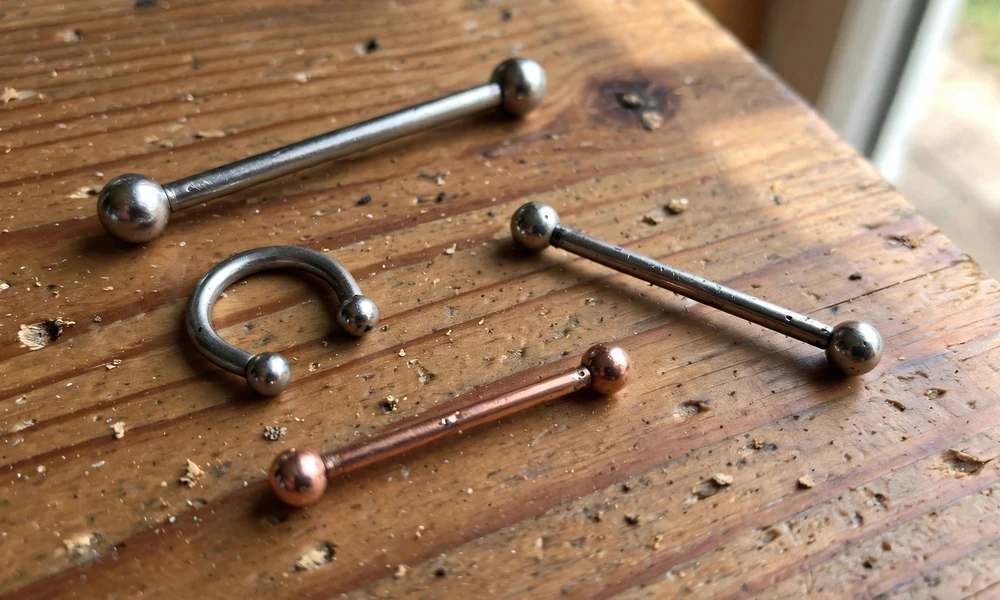
Look next at the ends. A bar with threadless ends pushes together and holds by tension, which makes it easy to change and gentle on the piercing. A bar with internally threaded ends screws together from the inside, which is secure and smooth. A bar with externally threaded ends has a visible screw thread on the outside of the bar, and that thread can scrape the piercing channel every time it goes in or out. If you change your jewellery often, threadless or internally threaded is the better choice. Our guide to gold jewellery for everyday wear explains why solid gold holds up better than plated pieces over time, and the same rule applies to nose bars.
Finally, look at the length. A nostril bar should sit with a small amount of room on either side, enough for the piercing to breathe but not so much that the bar slides back and forth. A bar that is too long catches on scarves, towels and pillowcases, and a bar that is too short presses on the skin and can cause swelling. Most women find 6 or 7 millimetres right for a nostril, but a piercing that is still settling may need a little more room.
The 9 best nose bars for women in 2027
The Classic Straight Titanium Bar
What we like: Implant-grade titanium, smooth polished ends, light enough to forget, and available in 18 and 20 gauge. What to consider: Plain by design, so it will not suit women who want sparkle. Best for: Everyday wear and sensitive skin. Material: Implant-grade titanium. Price range: £8 to £20. Standout feature: Nickel-free and hypoallergenic.
This is the bar to buy first if you are new to nose bars or if your piercing is easily irritated. It does nothing fancy, and that is the point. It sits quietly, it does not catch, and it gives a fresh piercing a calm, stable piece of jewellery to heal around.
The Gold Seamless Bar
What we like: Solid 14-carat gold with smooth, rounded ends and a warm finish that suits most skin tones. What to consider: Costs more than titanium, and gold is softer, so it can scratch if handled roughly. Best for: Evenings and special occasions. Material: 14-carat solid gold. Price range: £60 to £150. Standout feature: A warm, polished finish that never tarnishes.
The Diamond-Set Gold Bar
What we like: A small pavé diamond at each end, set in solid gold, with a sparkle that catches the light without looking loud. What to consider: The most expensive bar on this list, and the settings need an occasional check. Best for: Weddings, formal dinners and milestone occasions. Material: 14-carat gold with diamonds. Price range: £180 to £450. Standout feature: Two small diamonds that catch the light from both ends.
This is the bar for a day when the jewellery matters as much as the outfit. The diamonds are small enough to stay elegant and large enough to be noticed, and the gold keeps the whole piece feeling warm rather than cold.
The Silver Curved Bar
What we like: A gentle curve that follows the shape of the nostril, in polished sterling silver with a cool, bright finish. What to consider: Silver tarnishes and needs a regular polish, and it is not ideal for very sensitive skin. Best for: Women who prefer cool-toned jewellery. Material: 925 sterling silver. Price range: £20 to £55. Standout feature: A curved shape that sits naturally against the nose.
The Rose Gold Thin Bar
What we like: A slim 20-gauge bar in rose gold with a soft pink warmth that flatters fair and medium skin. What to consider: The thin gauge means it moves more, so it suits a fully healed piercing only. Best for: Minimal looks and delicate styling. Material: 14-carat rose gold. Price range: £55 to £130. Standout feature: A slim profile that looks almost like a fine line of jewellery.
Rose gold has a warmth that sits between gold and silver, which makes it easy to wear with both. This bar is for women who want their nose jewellery to be noticed only by people who are looking closely.
The Hinged Clicker Bar
What we like: A hinged closure that clicks open and shut, making it the easiest bar on this list to change without help. What to consider: The hinge is a moving part, so it needs an occasional check to make sure it still closes firmly. Best for: Women who change their jewellery often. Material: Implant-grade titanium with a gold finish. Price range: £15 to £40. Standout feature: A clicker hinge that opens and closes with one hand.
The Captive Bead Bar
What we like: A small bead held between the two ends of the bar, which adds a point of interest without adding weight. What to consider: The bead can loosen over time, so check it before you wear it. Best for: Casual days and festival styling. Material: Surgical steel with a titanium bead. Price range: £10 to £30. Standout feature: A bead that can be swapped for a different colour.
The captive bead is a classic piercing design, and it works on a nose bar because it gives the eye something to rest on. Swap the bead for a crystal or a coloured stone and the same bar looks completely different.
The Pearl Accent Bar
What we like: A small freshwater pearl at one end and a smooth metal ball at the other, in a design that feels soft and romantic. What to consider: Pearls are delicate and should not be worn in the shower or while swimming. Best for: Bridal looks and soft, romantic styling. Material: 14-carat gold with a freshwater pearl. Price range: £70 to £160. Standout feature: A single pearl that softens the whole look of the bar.
The Blackened Steel Bar
What we like: A matte black finish on surgical steel, with a modern, understated look that suits bold styling. What to consider: The black coating can wear with heavy use, and it is not the best choice for sensitive skin. Best for: Evening looks and edgy styling. Material: Blackened surgical steel. Price range: £12 to £35. Standout feature: A matte black finish that stands out without sparkle.
Which nose bar is right for you
Start with your piercing. If it is a nostril piercing, you need a short bar, usually 6 or 7 millimetres, in 18 or 20 gauge. If it is a septum piercing, you need a longer, often curved bar, and you should measure the distance across your septum before buying. A bar made for one piercing will not fit the other, and forcing it will only cause pain and swelling.
Then think about your skin. If your piercing is easily irritated, or if you have reacted to jewellery before, choose implant-grade titanium or solid 14-carat gold and avoid plated or nickel-heavy metals. If your skin is calm and your piercing is fully healed, silver and steel are fine for everyday wear, though silver needs a polish now and then. A good roundup of nose rings for women covers the same metal choices in more detail, and the advice holds for bars too.
Finally, think about how often you change your jewellery. If you change it weekly, a threadless or hinged clicker bar will save you time and irritation. If you wear one piece for months at a time, a classic straight or curved bar in a metal you love is the better investment, because it will not need changing and it will not wear out.
The caveats that matter
A nose bar is a simple piece of jewellery, but it still sits in a piercing, and piercings need care. A bar should never be forced through a piercing that is swollen, sore or still healing, and it should never be worn if the ends are loose, because a loose end can come off and the bar can fall out. Clean the bar and the piercing with a saline solution after a change, and wash your hands before you touch it.
| Detail | What is known |
|---|---|
| Best metal for sensitive skin | Implant-grade titanium, 14-carat solid gold, or niobium |
| Common nostril gauge | 18 or 20 gauge; check your current jewellery if unsure |
| Common nostril length | 6 to 7 millimetres, with a little room on either side |
| Easiest closure to change | Threadless ends or a hinged clicker, both gentle on the piercing |
| Closure to avoid if you change often | Externally threaded ends, which can scrape the channel |
| Who should wait before switching | Anyone whose piercing is not fully healed, usually 2 to 4 months for a nostril |
| When to remove a bar | If it hurts, swells, weeps, or the ends feel loose |
| What a bar does not do | It does not suit every piercing type, and it will not stay put if the gauge is wrong |
If you are pregnant, breastfeeding, or using medication that affects healing, speak to your piercer before changing jewellery. That is not a formality. A piercing that is slow to heal needs a stable, well-fitting piece of jewellery, and a change made at the wrong time can set it back by weeks.
Checklist: buying a nose bar honestly
Use these checks before you buy, and again after a week of wear.
- Check the piercing type: a nostril bar and a septum bar are different lengths and are not interchangeable.
- Check the gauge and length: match your current jewellery, or have your piercing measured at a studio.
- Check the metal: implant-grade titanium or solid gold for sensitive skin, and avoid plated or nickel-heavy bars.
- Check the ends: threadless or internally threaded is gentler than externally threaded.
- Check the fit after a week: the bar should sit still, not slide, pinch, or catch on clothing.
- Check the ends regularly: a loose ball or bead should be tightened or replaced before the bar can fall out.
Frequently asked questions
How do I know what size nose bar I need?
Measure your current jewellery, or ask a piercer to measure your piercing. For most nostrils, 18 or 20 gauge and 6 to 7 millimetres is right. If your current bar slides back and forth, it is too long. If it presses on the skin, it is too short.
Can I wear a nose bar in a new piercing?
Not until it has fully healed, which usually takes two to four months for a nostril. A new piercing needs the jewellery your piercer fitted, because it is the right size for a healing piercing. Changing it early can cause irritation, swelling and a longer healing time.
Is titanium or gold better for a nose bar?
Titanium is the safest choice for sensitive skin and for everyday wear, because it is light, nickel-free and very unlikely to cause a reaction. Gold is better for evenings and for women who want a warmer finish, provided it is solid gold rather than plated.
Why does my nose bar keep catching on things?
It is probably too long. A bar with too much room slides back and forth and catches on scarves, towels and pillowcases. Try a bar 1 millimetre shorter, and check that the ends are not larger than they need to be.
Can I sleep in a nose bar?
Yes, if it fits well and the ends are secure. A short, smooth bar is comfortable to sleep in. A long bar, or one with large decorative ends, can press on the skin overnight and cause soreness, so check the fit before bed.
How do I clean a nose bar?
Remove it, wash it with warm water and a mild soap, rinse it well, and dry it before putting it back. Clean the piercing with a saline solution after a change. Our guide to pearl necklaces for women covers the same gentle cleaning principles, and they apply to delicate nose jewellery too.
The bottom line
The best nose bar in 2027 is not the most expensive or the most decorative. It is the one that fits your piercing, suits your skin, and stays comfortable all day. For most women, that means a short bar in implant-grade titanium or solid gold, with threadless or internally threaded ends, in a length that sits still without pinching.
Choose one bar, wear it for a few weeks, and judge it on how your piercing feels, not on how it looks in the box. A bar that fits well will be forgotten within a day, and that is the best sign you chose the right one.