

Emerald Septum Rings 2027: 9 Picks Worth Wearing
An emerald septum ring is a small piece of jewellery with an outsized effect. The rich green of an emerald sits right at the centre of the face, so even a tiny stone changes how a whole look reads. It can feel classic and quietly expensive, or fresh and modern, depending on the setting, the metal, and the shade of the stone. That range is exactly why emerald septum rings have become a favourite for people who want colour in a piercing without the flash of a diamond.
The difficulty is choosing well. Emeralds vary enormously in colour, from a pale, almost yellow green to a deep, velvety green, and a stone that looks vivid in a photograph can look flat in daylight. Emeralds are also softer and more included than sapphires, which means the setting and the cut matter more. Then there is the metal, the gauge, and the question of whether the stone is natural or lab-grown.
Below are nine emerald septum rings worth considering in 2027, from a classic green clicker to a tiny everyday ring and a lab-grown option that keeps the price sensible. Each one is described by what it does well, what to watch for, and who it suits best, so you can choose with your piercing in mind, not just a photograph.
Key takeaways
- Emerald is softer than sapphire and usually contains natural inclusions, so a protective setting matters more than it does for harder stones.
- Colour matters more than size: a small, vivid green stone reads better than a large, pale one.
- Clickers are the easiest to open and close; horseshoes suit a bolder look; seamless rings are the most discreet.
- Check the gauge, the diameter, and the metal before buying — a ring that does not fit your piercing will not sit comfortably.
- No septum ring suits a fresh or irritated piercing, and an emerald that is heavily oiled or cracked should be avoided.
What emerald septum rings actually are
A septum ring sits through the thin tissue at the base of the nose, between the nostrils. In an emerald septum ring, the stone is set into the visible part of the piece, usually at the front centre of a clicker, along the curve of a horseshoe, or as a single stone on a seamless ring. The stone is the point of the design. Everything else — the metal, the closure, the size — exists to show it off and to keep it comfortable.
Emerald is the green variety of the mineral beryl, coloured by chromium or vanadium. Its green ranges from a light, almost mint shade to a deep, saturated green, and the most valued stones are a vivid, slightly bluish green. Emerald scores 7.5 to 8 on the Mohs hardness scale, which makes it durable enough for daily wear, but softer than sapphire or diamond, and almost all emeralds contain tiny internal features called inclusions, often described as the stone’s garden.
People choose emerald septum rings for three reasons: colour, character, and versatility. Green is unusual in nose jewellery, so an emerald stands out without shouting. The inclusions and depth of colour give each stone a personality, and the same green can look understated in a tiny seamless ring or striking in a larger clicker.
How we chose these emerald septum rings and what to look for
Look first at the stone. A good emerald is vivid and even in colour, without yellow or grey undertones and without a dull, cloudy centre. A small stone with strong colour beats a larger washed-out one, and a vivid lab-grown emerald beats a pale natural one.
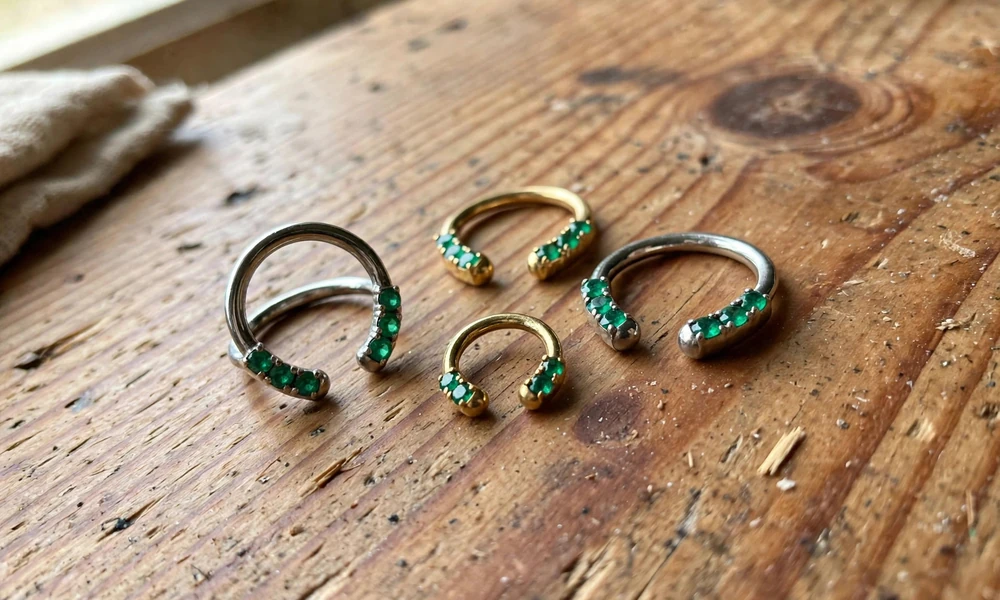
Look next at the setting and the metal. The stone should be held by prongs or a bezel, not glued in place, because glue loosens with heat, water, and daily handling, and a bezel also protects the softer emerald from knocks. Solid gold, implant-grade titanium, and solid sterling silver are the usual safe choices for a healed piercing. Our guide to gold jewellery for everyday wear explains why solid gold holds up better than plated pieces, and the same logic applies here: a septum ring is worn every day, so the metal needs to survive that.
Finally, check the fit. Most septum piercings are done at 16 gauge, with some at 14 gauge, and the ring diameter is usually 8 to 10 millimetres. A ring that is too small will press against the nose, and a ring that is too large will hang low and catch on things. If you do not know your gauge or diameter, measure your current ring or ask your piercer before ordering, because a beautiful ring in the wrong size is unwearable.
The 9 best emerald septum rings of 2027
The Classic Green Emerald Clicker
What we like: A vivid oval green emerald in a hinged clicker that opens and closes with a soft snap, easy to put in and take out without tools. What to consider: The hinge needs a firm click to stay shut, so check it after the first few wears. Best for: Everyday wear and first-time emerald buyers. Material: 14k solid gold with a natural green emerald. Price range: $190 to $340. Standout feature: The colour — a strong, slightly bluish green that reads clearly even in a small stone.
This is the ring the rest of the list is measured against: not the cheapest, but the one most people will reach for every morning.
The Bezel-Set Emerald Horseshoe
What we like: A round green emerald held in a smooth bezel at the base of a horseshoe, with ball ends that keep the shape balanced. What to consider: A horseshoe sits lower than a clicker, so it reads as a bolder look. Best for: People who want their septum ring to be noticed. Material: Implant-grade titanium with a natural green emerald. Price range: $100 to $170. Standout feature: The bezel setting, which protects the softer emerald edges from knocks.
A horseshoe is the classic septum shape, and the bezel keeps the stone safe in a clean, finished outline.
The Zambian Emerald Clicker
What we like: A Zambian emerald with a deep, slightly bluish green, set in a slim gold clicker that lets the stone do the talking. What to consider: Zambian emeralds are often a touch darker than Colombian ones, so check the stone in daylight before buying. Best for: People who want a rich, saturated green. Material: 14k yellow gold with a natural Zambian emerald. Price range: $220 to $380. Standout feature: The depth of colour, which is the most intense green on this list.
Zambian emeralds are known for a deep, cool green that wears even better than it photographs.
The Light Green Emerald Seamless Ring
What we like: A single light green emerald set into a thin seamless ring, with a fresh, spring-like colour that reads as understated rather than showy. What to consider: Light green emeralds can look pale in dim light, so a stone with a clear green tone is worth seeking out. Best for: Minimal looks and fair skin tones that suit softer colours. Material: Solid sterling silver with a natural light green emerald. Price range: $70 to $130. Standout feature: The seamless closure, which has no hinge or gap to catch on clothing.
This is the most discreet ring on the list: the stone catches the light quietly, and there is nothing to snag.
The Lab-Grown Emerald Hinged Hoop
What we like: A lab-grown emerald with strong, even colour at a fraction of the price of a comparable natural stone. What to consider: Lab-grown stones do not hold resale value the way fine natural emeralds can, but that rarely matters in a septum ring. Best for: Anyone who wants vivid colour on a sensible budget. Material: 14k solid gold with a lab-grown green emerald. Price range: $120 to $210. Standout feature: The colour consistency — lab-grown stones are reliably vivid, without the cloudy patches common in cheaper natural stones.
A lab-grown emerald is chemically the same stone as a natural one. In a small septum ring, the difference is invisible and the saving is real.
The Emerald and Diamond Halo Clicker
What we like: A central green emerald ringed by tiny diamonds, adding sparkle without taking attention from the emerald. What to consider: The diamonds are small, so they add light rather than size, and the price reflects that. Best for: Special occasions and people who want one dressier septum ring. Material: 14k white gold with a green emerald and a halo of small diamonds. Price range: $280 to $480. Standout feature: The halo layout, which makes the emerald look larger and the ring look considered rather than plain.
This is the most formal ring in the roundup, earning its place when you want the piercing to look deliberate and finished.
The Emerald Seamless Ring
What we like: A single emerald set into a smooth seamless band, with no hinge, no gap, and nothing to catch. What to consider: A seamless ring needs a small tool or a piercer to open and close, so it suits people who rarely change their jewellery. Best for: Long-term everyday wear and sensitive piercings. Material: Implant-grade titanium with a natural green emerald. Price range: $80 to $150. Standout feature: The smooth, uninterrupted circle, which is the most comfortable shape here.
Seamless rings are the quiet achievers of septum jewellery: no visible mechanism, and the least likely to snag.
The Oval Emerald Clicker
What we like: An oval emerald set lengthwise in a slim clicker, giving the stone a longer, more elegant outline than a round cut. What to consider: An oval stone shows inclusions more easily than a round one, so look for a clean stone. Best for: People who like a slightly dressier, more elongated look. Material: 14k rose gold with a natural green emerald. Price range: $200 to $350. Standout feature: The oval shape, which makes the stone look larger than a round stone of the same weight.
An oval cut suits a septum ring well, because the longer shape follows the curve of the nose.
The Tiny Emerald Horseshoe
What we like: A 2-millimetre green emerald set at the base of a slim horseshoe, small enough to read as a dot of colour rather than a statement. What to consider: The stone is tiny, so its colour needs to be strong to show up at all — avoid pale stones at this size. Best for: First septum rings, subtle styles, and stacking with other nose jewellery. Material: Implant-grade titanium with a natural green emerald. Price range: $75 to $140. Standout feature: The size — it is the smallest ring here, and the easiest to wear every day without thinking about it.
Small does not mean forgettable: a vivid 2-millimetre emerald is visible from conversation distance.
Which emerald septum ring is right for you
Start with the closure. If you change your jewellery often, a clicker is the easiest option — it opens and closes with your fingers and needs no tools. If you rarely change it, a seamless ring is smoother and less likely to catch, and a horseshoe gives the boldest look of the three.
Then think about colour and metal together. Green emerald with yellow gold is the classic pairing, warm and rich. Emerald with white gold or silver is cooler and more modern, and the green reads as fresher against a cool metal. Rose gold softens the green and suits warmer skin. A roundup of the best nose rings for women shows the same principle across styles: the metal sets the tone, and the stone follows it.
Finally, be honest about how much attention you want. A tiny horseshoe is a private pleasure, visible only up close. A halo clicker with diamonds is a public one, visible across a room. Neither is better, but they suit different days and different moods, and many people end up owning one of each.
The caveats that matter
Emerald is softer and more included than sapphire or diamond, and a septum ring is worn through a piercing, so both facts matter. A new piercing needs time to heal before any stone-set ring goes in, and a ring that is too heavy, too tight, or made from a metal your skin dislikes will irritate it. The stone itself is rarely the problem — the fit and the metal are.
| Detail | What is known |
|---|---|
| Hardness | Emerald scores 7.5 to 8 on the Mohs scale, softer than sapphire |
| Best colour for most people | Vivid, even green without yellow or grey undertones |
| Most common gauge | 16 gauge, with some piercings at 14 gauge |
| Usual diameter | 8 to 10 millimetres for most septum piercings |
| Safest metals | Solid gold, implant-grade titanium, and solid sterling silver |
| What to avoid | Glued-in stones, heavily oiled or cracked emeralds, and plated metals |
| When to wait | Until a new piercing is fully healed, usually several months |
| What it does not do | A septum ring does not suit an unhealed piercing, whatever the stone |
Most emeralds are lightly oiled to improve their appearance, which is standard practice. Heavily oiled stones, or stones with visible surface cracks, are worth avoiding. A bezel setting protects the stone from knocks, which matters more for emerald than for harder stones.
Checklist: buying an emerald septum ring honestly
Use these checks before you buy, and again when the ring arrives.
- Check the stone: vivid, even colour in daylight, with no yellow patches or cloudy centre.
- Check the setting: prongs or a bezel holding the stone, not glue, and a bezel is better for emerald.
- Check the metal: solid gold, implant-grade titanium, or solid sterling silver, not plated.
- Check the fit: confirm your gauge and diameter before ordering, and measure your current ring if unsure.
- Check the closure: a clicker should snap shut firmly, and a seamless ring should close without a visible gap.
- Check the return policy: a reputable seller accepts returns if the size or colour is wrong.
Frequently asked questions
Can I wear an emerald septum ring every day?
Yes, if your piercing is fully healed. Emerald is hard enough to handle daily wear, especially in a bezel setting, which protects the stone. Clean the ring gently with warm water and mild soap, and check the setting now and then for looseness.
Is a lab-grown emerald as good as a natural one?
For a septum ring, yes. A lab-grown emerald has the same hardness and chemistry as a natural stone, and its colour is often more even. It costs less, and at the small sizes used in septum rings, the difference is not visible.
What gauge is a septum ring?
Most septum piercings are 16 gauge, with some done at 14 gauge. Check your current jewellery or ask your piercer before buying, because a ring in the wrong gauge will not fit comfortably.
Will an emerald septum ring irritate my piercing?
The stone itself should not. Irritation usually comes from the metal, the fit, or a piercing that has not finished healing. If your piercing is sore, switch to a simple implant-grade titanium ring and let it settle before wearing a stone-set piece.
How do I clean an emerald septum ring?
Remove it, wash it in warm water with a drop of mild soap, and dry it with a soft cloth. Avoid ultrasonic cleaners and steam cleaners, which can damage emerald, and avoid harsh chemicals, which can dull the metal over time.
Can I wear an emerald septum ring with other nose jewellery?
Yes. A small emerald clicker pairs well with a nostril stud, and the same colour logic applies: match the metals, and keep one piece as the focus. Our roundup of the best emerald nose rings is a useful place to find a matching stud in the same stone and metal.
The bottom line
The best emerald septum ring in 2027 is the one that fits your piercing, suits your colouring, and feels comfortable enough to forget you are wearing it. For most people, that is a small green emerald in a gold or titanium clicker. Lab-grown emerald is a sensible way to get that colour for less, and a Zambian or oval-cut stone is worth considering if you want a deeper or more elegant green.
Choose one ring, check the gauge and diameter before you order, and wear it for a few weeks before deciding. A septum ring is a small thing, but you see it every time you look in a mirror, so it is worth choosing slowly and well.