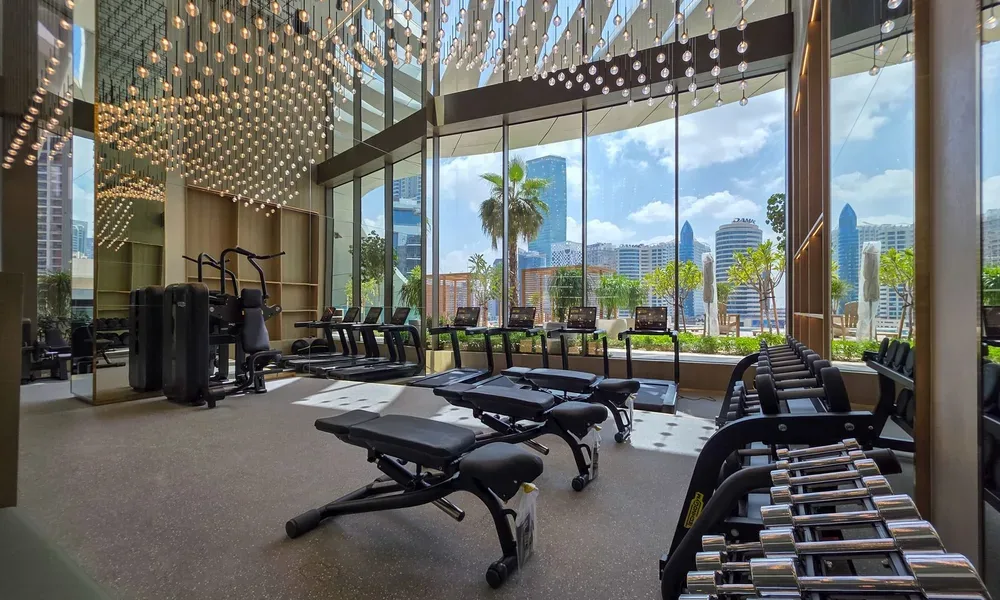
A luxury home gym is not a spare room with a treadmill pushed against the wall. It is a room designed like a good hotel spa: the light is planned, the floor suits the work, the equipment looks at home in the house, and everything is within reach without clutter. The best luxury home gyms of 2027 pair serious training with interiors you would happily show a guest.
The market has changed fast. Smart strength systems replace a rack of plates with digital resistance that adjusts between repetitions. Connected treadmills and rowers bring live coaching into a private room. Italian makers such as Technogym build cardio machines in wood, leather and glass that read as furniture. Yet the fundamentals have not changed: a luxury gym needs space, a protective floor, good air and light, and a recovery corner.
This guide covers the best luxury home gyms for 2027 as complete rooms and systems, not as isolated products. It compares the leading machines and explains how much space and money each approach needs. Prices are approximate starting figures from late 2026, and they move with sales and new models, so treat them as a planning guide rather than a quotation.
Key takeaways
- A luxury home gym is a designed room, not a collection of machines: planning, flooring, light and storage matter as much as the equipment.
- Technogym leads on design and build, Tonal 2 leads on smart strength in a small footprint, and Peloton leads on connected classes.
- Plan for at least 120 square feet for a single-purpose room, and 180 to 300 square feet for separate strength and cardio zones.
- A full multi-zone luxury gym typically runs from about $10,000 to $30,000 in equipment, and a designer-led build can reach $75,000 or more.
- Count the ongoing cost first: most connected systems need roughly $40 to $60 a month, while a Concept2 rower needs no membership at all.
The Best Luxury Home Gyms at a Glance
The table below compares the leading luxury home gym systems on what each is best for, what it costs to start, and how much space it needs.
| System or machine | Best for | Approx. starting price | Space and notes |
|---|---|---|---|
| Technogym Artis and Personal lines | Design-led, commercial-grade rooms | From about $14,000 per machine | Full-size; dedicated room, professional installation |
| Tonal 2 | Smart strength, small footprint | From $4,295, plus $59.95 a month | Wall-mounted; about 7 feet of wall |
| Peloton Bike+ and Tread | Connected classes and community | Bike+ from $2,695; Tread from $3,495 | Bike 4 by 2 feet |
| Woodway 4Front | Serious runners | From about $13,995 | Large; slat belt, very high mileage |
| Hydrow Arc and Origin | Immersive, low-impact rowing | Arc from $2,295; Origin from $2,195 | Rower footprint, stores upright; $50 a month |
| NordicTrack Commercial X22i | Steep incline walking and running | From $3,499 | Large treadmill; 40 percent incline, 6 percent decline |
| Concept2 RowErg | Reliable rowing, no subscription | About $990 | Compact, splits for storage |
| Bespoke designer-built gym | A room designed as part of the home | From about $15,000 to $75,000-plus | Any size; joinery and hidden storage |
What Makes a Home Gym Luxurious in 2027
Luxury comes from five things working together, and equipment is only one of them. First, space planning: zones for strength, cardio and stretching that do not fight each other, with clear walkways and ceiling height for overhead work. Second, premium materials, from rubber or wood flooring to joinery that hides plates behind closed doors. Third, technology that switches on without cables everywhere. Fourth, a recovery corner, even a quiet one with a mat. Fifth, design that matches the house, as our guide to quiet luxury home decor explains.
Technogym: The Design Benchmark
Technogym, founded in Cesena, Italy, in 1983, is the brand most often called the Ferrari of fitness equipment, and the comparison is about design as much as performance. Its Artis line is the commercial-grade range found in high-end hotels and clubs, while its Personal line is made for homes, with machines finished in wood, leather and glass. A premium treadmill such as the Skillrun is listed from about $23,090, and Artis cardio machines generally start in five figures.
Tonal 2: Smart Strength for Smaller Rooms
Tonal 2 is the best answer when a luxury home gym must fit a real house rather than a purpose-built wing. This wall-mounted system uses electromagnetic digital resistance instead of metal plates, offering up to 250 pounds of resistance. Built-in sensors track form, count repetitions and adjust the load automatically, giving a solo trainer some of the guidance a coach would offer. It starts from $4,295, and requires a membership of $59.95 a month on a 12-month commitment.
Peloton: The Connected Class Leader
Peloton remains the strongest choice for people who train best with a class, an instructor and a community. The Cross Training Bike+ starts from $2,695 and adds a rotating screen and automatic resistance, which makes off-bike strength, yoga and stretching classes practical. The Tread Vision starts from $3,495, while the top Tread+ Vision, built on a slat belt of rubberised slats, is listed from $6,695. All-Access membership costs $49.99 a month.
Woodway 4Front and NordicTrack X22i: Two Very Different Treadmills
Runners face a real choice, and the two best treadmills could hardly be more different. The Woodway 4Front is a commercial slat-belt treadmill, built around dozens of individual rubber slats instead of a conventional belt, with a running surface of about 22 by 68 inches and a design rated to last well over 100,000 miles. It is listed from about $13,995. The NordicTrack Commercial X22i takes the opposite approach, from $3,499: up to 40 percent incline and 6 percent decline, paired with iFit guided runs and a Pro subscription at $39 a month.
Hydrow and Concept2: The Rowing Choice
Rowing is the most space-efficient full-body cardio a luxury gym can offer, and the choice comes down to experience versus simplicity. Hydrow builds connected rowers that film real athletes rowing on real water, with live leaderboards and structured programmes. The Arc is listed from $2,295 with a 24-inch screen and quiet magnetic resistance, while the Origin is listed from $2,195 and the compact Wave from $1,995, all with a $50-a-month household membership. The Concept2 RowErg, at about $990, is the opposite: no screen, no classes, no subscription, and fan-based resistance that has been the club standard for decades.
Planning the Room: Space, Flooring and Light
Space planning comes before shopping, because the room decides what fits and what will actually be used. A functional minimum is about 10 by 12 feet, or 120 square feet, enough for a rack or a smart strength system, a bench and a barbell. A room of 12 by 15 feet or 15 by 20 feet, roughly 180 to 300 square feet, allows separate strength and cardio zones without constant rearranging.
Flooring is the most important design decision in the room, and the one people most often redo. Rubber tile or roll, in 3/8-inch to 3/4-inch thickness, is the standard for strength training: it absorbs dropped weights, protects the subfloor and cleans easily, at roughly $2 to $5 per square foot installed. Thicker tiles belong under racks and platforms, while wood or luxury vinyl can work in cardio and stretching zones if protected by mats. Install flooring and mirrors first, before any equipment arrives.
Design, Storage and Recovery
The details are where a luxury home gym earns its name. Built-in joinery hides plates, bands and towels behind doors that match the house, and a calm palette of warm neutrals, dark wood and black metal ages better than bright accent walls. A gym that sits comfortably beside well-chosen furniture and art, like the rooms in our round-up of the best celebrity home decor, will be used far more than one that feels like a storage unit with a treadmill in it. Recovery deserves its own zone too: a stretching corner with a mat and a foam roller at minimum, or a sauna or cold plunge in a full suite costing from about $2,000 to $25,000. The same idea runs through a luxury lifestyle, where the experience after the main event matters as much as the event itself, whether that is a drive in one of the best luxury cars or a slow evening at home after training.
How Much a Luxury Home Gym Really Costs
Honest budgeting counts the build, the equipment and the running costs together. A polished single-system room, built around a Tonal 2 or a Peloton bike with good flooring, mirrors and storage, can start at a few thousand dollars plus the monthly membership. A full multi-zone luxury gym, with a premium treadmill or rower, a strength system, free weights and a recovery corner, typically runs from about $10,000 to $30,000 in equipment alone. A designer-led build is usually quoted from $15,000 to $75,000 or more. Then add running costs: memberships run roughly $40 to $60 a month per system, so two subscriptions can cost more than $1,200 a year. Compare the five-year total, not the headline figure, before you commit.
Before You Buy Checklist
Work through this checklist before ordering anything, and in this order, because each step protects the next one.
- Measure the room, the ceiling height, the doorways and the route in, and mark out each zone on the floor with tape.
- Choose your training style first, whether strength, running, rowing, classes or a mix, and let that decide the equipment.
- Price the five-year total, including hardware, delivery, installation, memberships and maintenance.
- Order flooring and mirrors before equipment, and confirm power, ventilation and Wi-Fi in every corner of the room.
- Check weight limits, floor loading and noise, especially in flats and rooms above living spaces, and confirm installation in writing.
- Plan storage and recovery from the start, with closed joinery and a dedicated stretching and cool-down zone.
Frequently Asked Questions
How much does a luxury home gym cost in 2027?
A polished single-system room starts at a few thousand dollars, a full multi-zone luxury gym typically costs about $10,000 to $30,000 in equipment, and a designer-led build usually runs from $15,000 to $75,000 or more.
How much space do I need for a luxury home gym?
A minimum of about 10 by 12 feet, or 120 square feet, works for a single-purpose room with a strength system, a bench and a barbell. For separate strength and cardio zones, aim for 180 to 300 square feet, with at least eight feet of ceiling height.
Which luxury home gym system is best overall?
There is no single winner, because the best system depends on how you train. Technogym leads on design and build quality, Tonal 2 leads on smart strength in a small space, Peloton leads on classes and community, Woodway leads for serious runners, and Hydrow leads for immersive rowing.
Do I need a monthly subscription for a luxury home gym?
Not always, but most connected systems need one. Tonal 2 requires a $59.95-a-month membership, Peloton charges $49.99 a month for All-Access, Hydrow charges $50 a month, and NordicTrack’s iFit Pro costs $39 a month.
What flooring is best for a luxury home gym?
Rubber tile or roll in 3/8-inch to 3/4-inch thickness is the standard for strength areas, because it absorbs dropped weights and protects the floor underneath, at roughly $2 to $5 per square foot installed. Use thicker tiles under racks and platforms, and protect wood or vinyl floors in cardio and stretching zones with mats.
Is a luxury home gym worth it compared with a gym membership?
It can be, if you train regularly and value privacy, time and design. A premium club membership costs hundreds of dollars a month and still requires travel, while a home gym is available at any hour and can be shared by the household.
The Bottom Line
The best luxury home gyms of 2027 are rooms first and collections of machines second. Start with the training you will actually do, the space you honestly have, and the five-year cost including every subscription. Then choose the system that fits that plan: Technogym for a design-led permanent room, Tonal 2 for smart strength in a small footprint, Peloton for classes and community, Woodway for serious running, Hydrow or Concept2 for rowing, and a bespoke build when the room itself matters as much as the workout.
Note: Prices and specifications change with sales, new models and regional pricing, so confirm the current figure with the maker before ordering. For heavy equipment upstairs, or a sauna or plunge needing plumbing, speak to a qualified builder first.