Argan oil has been called liquid gold for so long that the nickname sounds like marketing. For centuries, Moroccan women have pressed the kernels of the argan tree, Argania spinosa, into a golden oil for skin, hair and food.
The question is why this oil behaves the way it does. The answer is chemical, and it differs from jojoba oil. Jojoba works because it is a liquid wax that copies a fraction of your own sebum. Argan works because it is a triglyceride oil with an unusual fatty-acid balance, plus a small fraction of vitamin E, sterols and polyphenols.
This article stays on that mechanism: what is in the bottle, what does each part do to your barrier or cuticle, what have small human studies measured, and where does the evidence stop?
Key takeaways
- A triglyceride oil, roughly 80% unsaturated fat: oleic acid 43 to 49%, linoleic acid 29 to 36%.
- Its key skin mechanism is linoleic acid feeding ceramide 1 linoleate, the ceramide that holds the barrier together, plus a mild occlusive film that slows water loss.
- Most of its vitamin E is gamma-tocopherol (600 to 900 mg/kg), with ferulic acid, squalene and the rare sterols schottenol and spinasterol in the remaining 1%.
- Best human evidence: 60 postmenopausal women, better hydration, lower water loss and better elasticity after 60 days.
- On hair it coats the cuticle, explaining shine and frizz control, but no trial shows it makes hair grow.
What argan oil actually is
Argan oil is pressed from the kernels of the argan tree, which grows in south-western Morocco and almost nowhere else. Most cosmetic oil comes from women’s cooperatives there. On an ingredient list it appears as Argania Spinosa Kernel Oil.
There are two kinds: culinary oil from roasted kernels, cosmetic oil from unroasted ones. Like olive and rosehip oils, it is built from triglycerides, which already separates it from jojoba, which is almost entirely wax esters.
The fatty-acid balance is the whole story
About 80% of its fatty acids are unsaturated: oleic acid, an omega-9 fat, at 43 to 49%, and linoleic acid, an omega-6 fat the body cannot make, at 29 to 36%. The rest is mostly palmitic (11 to 15%) and stearic acid (4 to 7%).
Linoleic acid does the barrier work: it builds ceramide 1 linoleate, the ceramide that holds the skin’s lipid sheets together. When skin is dry, that ceramide is often depleted, and topical linoleic acid can raise it again.
Oleic acid is the complicated half. It gives argan oil its rich, cushioning feel, but it is also a penetration enhancer: it disturbs the lipid packing of the stratum corneum, loosening the sheets so other molecules pass through. On a damaged or eczema-prone barrier, used neat and often, that is a reason for caution.
The 1% that makes argan different
If argan oil were only oleic and linoleic acid, it would be unremarkable. What sets it apart is the unsaponifiable fraction, the roughly 1% that is not triglycerides.
The headline compound is vitamin E, at roughly 600 to 900 mg of total tocopherols per kilogram, more than double olive oil’s level. Most of it is gamma-tocopherol, at roughly 69 to 92% of the total, which traps certain nitrogen-based free radicals better, stabilised by ferulic acid. If vitamin E is what you are chasing, our guide to the best vitamin E oils for skin in 2027 compares formulas built around it.
Then come the sterols. Where olive and sunflower oils are dominated by beta-sitosterol, argan oil’s major sterols are schottenol (44 to 49%) and spinasterol (34 to 44%), both rare delta-7 sterols. The same fraction carries squalene, around 313 mg per 100 g, plus polyphenols such as caffeic acid and oleuropein.
How it behaves once it touches skin
The stratum corneum, the outermost skin layer, is often described as a brick wall: dead cells are the bricks, and the lipid matrix between them is the mortar. When the sheets are intact, water stays in and irritants stay out. When they are disrupted, water escapes faster and skin feels tight.
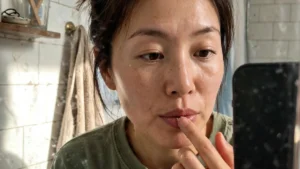
Argan oil works on that wall two ways. As an emollient, its fatty acids fill the gaps between surface cells, which is why skin feels softer within minutes. As a mild occlusive, it lays a thin film that slows water loss. It does not hydrate on its own: with no water and no humectant, it seals in moisture already there, so use it over damp skin or a serum.
In 2014, Boucetta and colleagues applied cosmetic argan oil to one forearm of 60 postmenopausal women for 60 days: water loss fell and skin water content rose, both significantly. It is a small study, in one age group, with no blinding and no comparison oil, so it proves argan oil moisturises.
How argan compares with other familiar oils
| Oil | Lipid type | Oleic / linoleic | Feel on skin | Comedogenic rating | Best fit | Main weakness |
|---|---|---|---|---|---|---|
| Argan | Triglyceride | 43–49% / 29–36% | Rich, cushiony | 0, low | Dry, mature skin | High oleic disturbs barriers |
| Jojoba | Wax ester | 5–15% / almost none | Dry, silky | 2, low | Barrier support | No hydration alone |
| Rosehip | Triglyceride | 14% / 44% | Light, fast-absorbing | 1, low | Texture and tone | Oxidises quickly |
| Squalane | Hydrocarbon | None | Weightless, dry | 0 to 1, very low | Light barrier support | Less occlusive |
| Sweet almond | Triglyceride | 65% / 25% | Smooth, medium | 2, low | Body and massage | Heavy on oily faces |
| Olive | Triglyceride | 74% / 11% | Rich, slow | 2, low | Body care | Very high oleic disrupts barriers |
| Coconut | Triglyceride | 6% / 2% | Heavy, greasy | 4, high | Body, hair lengths | Clogs facial pores |
Argan oil sits in the middle: richer than rosehip, lighter than olive, and far less likely to clog pores than coconut, rated 0 for comedogenicity. Our round-up of the best face oils for 2027 calls it the best all-rounder for dry to normal skin, while jojoba suits oilier skin.
What the evidence actually shows, and what it does not
The elasticity evidence is the most quoted. In 2015, the same group followed 60 postmenopausal women for 60 days, half applying argan oil and half consuming it, against an olive oil control. The topical group improved skin elasticity significantly, and the dietary group improved further, with firmness up 9% and biological elasticity up 15%. A 12-week study in 67 women reported roughly 8% better elasticity and 20% better hydration against placebo. But they are small, short, and confined to postmenopausal women, so they do not prove argan oil erases wrinkles or boosts collagen.
The sebum claim is weaker. A 2007 study by Dobrev tested a cream combining argan oil with saw palmetto and sesame seed extract, applied twice daily for four weeks to 20 volunteers, and reported a sebum-regulating effect in 95% of them. But there were 20 people, no control group, and argan oil was one of three actives. Treat sebum regulation as a hypothesis.
The acne, eczema and wound claims are weaker still. Lab work shows argan oil reducing inflammatory markers in cells and mouse skin, but no good human trial shows it treats acne, eczema or psoriasis.
How it works on hair and scalp
On hair, the mechanism is mostly physics. The cuticle, the shingle layer on each shaft, lifts when hair is dry, damaged or colour-treated, and lifted cuticles scatter light and catch on each other: that is frizz. Argan oil coats the shaft and flattens the cuticle, so light reflects evenly and strands slide past each other.
So the strongest hair evidence is about shine and frizz, not growth. A 2013 study found argan oil improved intensely coloured or dyed hair, and a hair-mask study reported better shine and less frizz in 34 women with damaged hair. Our guide to the best hair oils for 2027 places it among the wider field.
What it does not do is grow hair. No published trial shows argan oil stimulating growth, thickening hair or repairing split ends: coating a dead shaft cannot wake up a follicle. On the scalp, it can soften dry skin, but its high oleic share makes it a poor choice for a flaky scalp: the yeast behind dandruff feeds on oleic acid. If your scalp is flaky, jojoba is kinder.
Who benefits most, and who should be cautious
Dry and mature skin is the classic argan oil success story. Sebum production falls with age, ceramide synthesis slows, and antioxidant reserves run thin. Argan oil replaces the first two losses directly, supplying linoleic acid and a squalene and tocopherol top-up.
Normal and combination skin benefits more quietly: two to three drops as a final seal over serum or moisturiser add comfort and a soft glow. Oily skin is the grey area, so try it on one cheek for two weeks first.
Acne-prone skin should treat argan oil as barrier support, not acne care: no trial shows it clearing breakouts. Tree-nut allergy sufferers should patch test carefully, and eczema sufferers should be cautious about oleic acid on a damaged barrier.
How to use it so the mechanism works for you
Application order matters. Argan oil is an occlusive, so a film laid down first can reduce how well water-based products on top are absorbed. The order is water first, oil last: cleanse, apply serum while skin is still slightly damp, follow with moisturiser, then press two to four drops over the top.
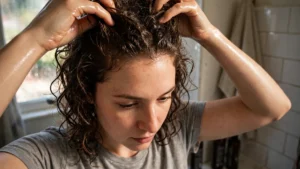
On hair, the oil works on the shaft, not the root, so keep it off the scalp unless the scalp is dry, and concentrate on the mid-lengths and ends. Smooth two to three drops over damp hair before styling, or over dry hair to tame frizz.
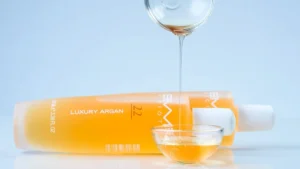
Choose 100% pure, cold-pressed, unroasted argan oil, with Argania Spinosa Kernel Oil as the only ingredient, in a dark glass bottle. Pale gold with a faint nutty smell is right; dark amber or a rancid note means the oil is old.
Your argan oil checklist
- Buy 100% pure, cold-pressed, unroasted argan oil.
- Patch test on your inner forearm first.
- Apply last, after serums and moisturiser.
- Use two to four drops for the face.
- For hair, use it on mid-lengths and ends.
- Store away from heat and light.
Frequently asked questions
Why does argan oil work on dry skin?
Its linoleic acid (29 to 36%) feeds ceramide 1 linoleate, the ceramide that holds the barrier together, while its triglyceride film slows water loss.
Is argan oil better than jojoba oil?
Neither is better in general. Jojoba copies part of your own sebum, so it feels dry and silky and suits oily skin. Argan is a triglyceride oil, so it feels richer and suits dry skin.
Does argan oil clog pores?
It rarely does: argan oil is usually rated 0 on the 0 to 5 comedogenic scale. That rating is a rough guide, so patch test first.
Can argan oil reduce oily skin or sebum?
Possibly, but the evidence is weak. A small 2007 study of 20 people using a cream combining argan oil with saw palmetto and sesame seed extract reported lower sebum after four weeks, but there was no control group.
Does argan oil help hair grow?
There is no published evidence that it does. Argan oil helps hair by coating the cuticle, adding shine and reducing frizz; a 2013 study confirmed the benefit for dyed hair.
How is argan oil different from other face oils?
The difference is the combination. Its oleic-linoleic balance is close to even, its vitamin E is mostly gamma-tocopherol, and its sterols are the rare schottenol and spinasterol.
The bottom line
Argan oil works because it matches what dry, ageing skin is missing: linoleic acid feeds the ceramide that holds the barrier together, oleic acid softens and seals, and gamma-tocopherol, ferulic acid, squalene and rare sterols give it an antioxidant fraction most oils lack.
It is not a miracle. It does not hydrate on its own, it has not been proven to reduce oil production, clear acne, treat eczema or grow hair, and its high oleic share makes it the wrong oil for a flaky scalp or a damaged barrier. Used correctly, in small amounts over damp skin, it is one of the most rational oils in skincare.
Note: This article explains how argan oil works and is for general information only; it is not medical advice. If you have a skin condition, are pregnant, or use prescription treatments, speak to a dermatologist before changing your routine, and stop using any product that causes persistent redness, itching or breakouts.