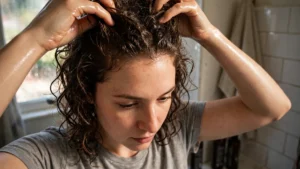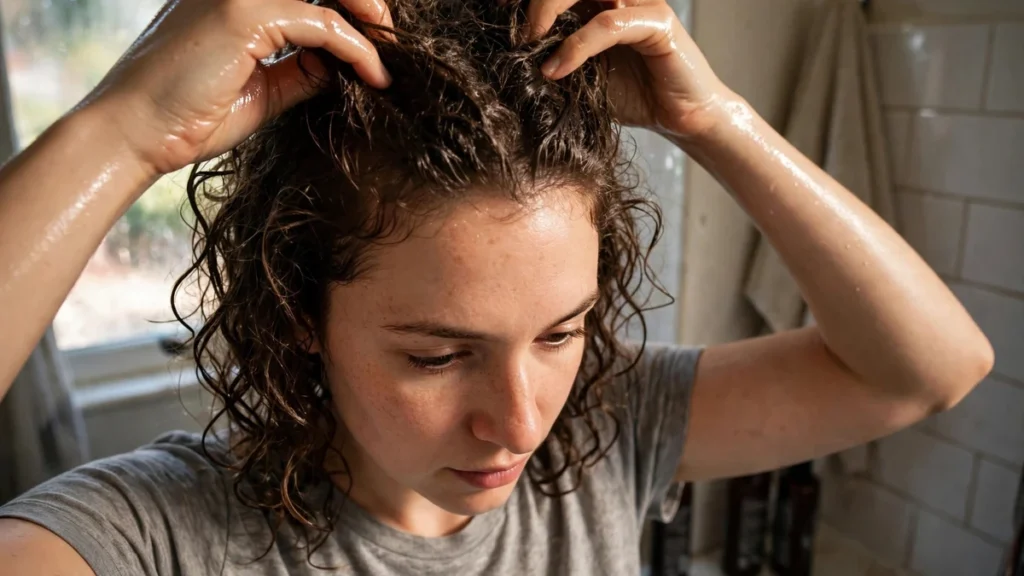
Oiling curly hair is not the same as oiling straight hair. The spiral shape means oil does not spread evenly on its own, the ends are usually much drier than the roots, and the wrong amount in the wrong place can turn defined curls into limp, greasy strands within an hour.
The most common mistake is treating oil as a moisturiser and applying it to dry hair in the hope of fixing dryness. Oil does not add water to hair. It seals in the water that is already there, so it works best on damp hair, after washing or after a leave-in conditioner.
This guide walks through the method step by step, from washing to the final drop on dry curls, with the amounts, the timing and the mistakes to avoid for each curl type. Follow it for three to four weeks and you will know whether oiling suits your hair, and exactly how much your curls need.
Key takeaways
- Oil seals moisture in; apply it to damp hair, not dry hair, for the main benefit.
- Section curls and use a few drops per section, because oil does not spread evenly through a spiral on its own.
- Warm the oil between your palms first, so it spreads thinly instead of sitting in one heavy patch.
- A pre-wash oiling protects curls from shampoo stripping, and 20 to 30 minutes is long enough.
- No method works for every curl type, and itching or flaking after oiling means the product or the amount is wrong for your scalp.
Why curly hair needs oil differently
The spiral is the whole story. On straight hair, the oil produced by the scalp travels down the strand by gravity and by brushing, coating the length fairly evenly. On curly hair, every bend slows that journey, so the roots can be oily while the ends are dry and frizzy.
Porosity adds a second layer. Curls often have a slightly lifted cuticle at the bends, which lets moisture escape quickly and lets humidity in just as fast. The oil smooths the cuticle, reduces friction between strands, and slows down the moisture loss that makes curls look dull by the afternoon.
Density matters too. Fine curls have less hair to absorb oil, so even a small amount can weigh them down, while thick, dense curls can drink up several drops per section and still look dry. The method below is written for the middle of that range, with notes on how to adjust it up or down, because the right amount for your hair is something you find by testing, not by following a single number.
What you need before you start
You need very little equipment, but what you have matters. A lightweight oil is the safest starting point, because it is forgiving if you use slightly too much, while a heavy oil punishes every extra drop. Choose an oil that suits your curl type rather than the most popular bottle, and check the label for silicones if you want to avoid build-up. A wide-tooth comb or your fingers are enough for detangling, and a soft microfibre towel or an old cotton T-shirt is better than a rough bath towel, which roughs up the cuticle and creates frizz before the oil has a chance to work.

Wash your hair first, or at least dampen it thoroughly. Oil on dirty, product-heavy hair seals in the build-up as well as the moisture, and the result is dull, coated curls. For the daily method, start with clean, damp hair, and apply a leave-in conditioner first if your curls need one. Our guide to the best hair oils for dry hair covers the richer oils that suit a pre-wash treatment, while the steps below use a lighter finishing oil for everyday sealing.
How to use hair oil for curly hair, step by step
Start with clean, damp hair
What to do: Wash with a gentle shampoo, condition, and squeeze out excess water with a microfibre towel or T-shirt until the hair is damp, not dripping. What to avoid: Do not apply oil to soaking wet hair, because it slides off, and do not apply it to dirty hair, because it seals in build-up. Best For: All curl types, every wash day. Time Needed: 2 minutes. Standout Tip: Damp hair should feel cool and slightly heavy, not wet enough to drip.
Oil on properly damp hair traps the water inside the strand. If your hair dries before you finish, mist it lightly with water rather than starting over.
Warm two to three drops between your palms
What to do: Put two to three drops in one palm, rub your hands together for a few seconds, and spread the oil thinly across both palms and fingers. What to avoid: Do not pour oil directly onto your hair, because it lands in one heavy patch and is almost impossible to spread evenly. Best For: All curl types, especially fine curls. Time Needed: 10 seconds. Standout Tip: Warm oil spreads further, so you use less of it.
Warming is a small step that makes a real difference. Cold oil is thicker and sits on the surface, while warmed oil thins out and coats the strands evenly. It also stops you from accidentally using five drops when two would have been enough.
Section your curls into four parts
What to do: Part your hair down the middle, then from ear to ear, to make four sections, and clip three of them up while you work on the first. What to avoid: Do not try to oil all your hair at once, because the outer layer gets everything and the underneath stays dry. Best For: Medium to thick curls, and anyone with dense hair. Time Needed: 1 minute. Standout Tip: Four sections is enough for most hair; use six if your hair is very thick.
It is the single most useful habit for curly hair, because it is the only way to get an even result, and it stops the common problem of greasy top layers and dry underneath layers.
Smooth oil over the mid-lengths and ends first
What to do: Take one section down, smooth your oiled palms over the mid-lengths and ends, then run your fingers through gently to spread it. What to avoid: Do not start at the roots, because the roots are already the oiliest part and do not need more. Best For: All curl types, especially dry ends. Time Needed: 1 minute per section. Standout Tip: The ends are the oldest and driest part of the hair, so they deserve the oil first.
The palms carry most of the oil on the first pass, so the ends get the most, which is exactly what they need. Repeat with a fresh drop or two for each section.
Keep oil away from the roots
What to do: Stop smoothing about 5 cm from the scalp, and use only the residue left on your hands if the roots look dry. What to avoid: Do not massage finishing oil into the scalp, because it weighs the roots down, flattens the curl at the top, and makes hair look greasy within hours. Best For: Fine and wavy curls, and anyone whose roots get greasy quickly. Time Needed: No extra time. Standout Tip: Flat roots are almost always caused by oil applied too high.
A finishing oil belongs on the lengths. If your scalp is dry, treat it separately with a dedicated scalp oil and wash it out.
Scrunch to encourage the curl pattern
What to do: After oiling each section, cup the ends in your palm and scrunch gently upwards towards the scalp, holding for a second before releasing. What to avoid: Do not rake your fingers through the curls after scrunching, because it breaks the clumps apart and creates frizz. Best For: Wavy and curly hair that needs definition. Time Needed: 1 minute. Standout Tip: Scrunching pushes the oil into the curl clumps instead of coating the outside only.
The scrunching motion encourages the strands to group into their natural clumps, and the oil helps those clumps hold their shape as they dry.
Use a pre-wash treatment once a week
What to do: Once a week, apply a richer oil to dry hair from the mid-lengths to the ends, leave it for 20 to 30 minutes, then shampoo twice to remove it. What to avoid: Do not leave a pre-wash oil on overnight unless the product is made for it, because it can transfer to your pillow and irritate your skin. Best For: Dry, damaged or colour-treated curls. Time Needed: 20 to 30 minutes. Standout Tip: A pre-wash treatment protects the hair from shampoo stripping, so it is worth the extra time.
A pre-wash oil gives the shampoo something to remove first, so the hair underneath stays softer. Use a heavier oil for this step than you would for daily finishing.
Refresh second-day curls with a single drop
What to do: On the morning after wash day, warm a single drop between your palms and smooth it very lightly over the frizziest sections only. What to avoid: Do not re-oil all your hair, because second-day hair already holds oil from the day before and will go limp. Best For: Second and third-day curls, frizz control. Time Needed: 30 seconds. Standout Tip: One drop is genuinely enough; if it does not work, mist with water first and then add the drop.
A light mist of water followed by a single drop of oil revives the curl pattern without the heavy, coated feeling of a full reapplication.
Wash out properly and reset
What to do: On your next wash day, shampoo twice if you used a heavy oil, and use a clarifying shampoo every few weeks to remove build-up. What to avoid: Do not keep layering oil on top of old oil for days, because it builds up, dulls the curls and can irritate the scalp. Best For: All curl types, especially heavy-oil users. Time Needed: 5 minutes. Standout Tip: Clean hair absorbs the next oiling far better than coated hair.
Oil that has done its job needs to be washed away so the next application can work on clean hair. If your curls start looking dull or feeling coated, the answer is usually a good wash, not more oil.
How much oil your curl type needs
Wavy hair, types 2A to 2C, needs the least. Two drops for the whole head is usually enough, applied only to the mid-lengths and ends, and many wavy-haired people do better oiling every other wash day rather than every time.
Curly hair, types 3A to 3C, sits in the middle. Two to three drops per section, four sections, is a good starting point, which works out to roughly eight to twelve drops for the whole head. That sounds like a lot, but spread across all the hair it is a thin layer, and most of it goes to the ends.
Coily hair, types 4A to 4C, usually needs the most, and often benefits from a heavier oil. Three to four drops per section is a reasonable start, and many people with coily hair also oil the scalp separately, which is a different step with a different product. Our guide to what scalp oiling is explains the difference, because the two habits need different amounts, oils and timing.
The mistakes that matter
Most oiling problems come from three mistakes: too much oil, oil in the wrong place, and oil on dirty hair. Too much oil is the most common, and it shows up as limp curls, a greasy look by midday, and hair that needs washing the next morning.
| Detail | What is known |
|---|---|
| When to apply | On clean, damp hair after washing, or as a pre-wash treatment on dry hair |
| How much to use | Two to three drops per section; one drop per section for fine hair |
| Where to apply | Mid-lengths and ends first; keep finishing oil away from the roots |
| How to spread it | Warm between palms, section the hair, smooth and scrunch |
| Pre-wash treatment | Once a week, 20 to 30 minutes, then shampoo twice |
| Second-day refresh | Mist with water first, then one drop on the frizziest sections only |
| What to avoid | Oil on dirty hair, oil on the roots, and layering oil on old oil |
| When to reset | Shampoo twice after heavy oil, and clarify every few weeks |
Oil on the roots is the second mistake, and it is the one that flattens curls at the top while the ends stay dry. The third mistake is skipping the wash: oil layered on top of old oil, sweat and styling product builds up, dulls the curls and can irritate the scalp. Night care makes the same difference, and our guide to how to protect hair while sleeping covers the pineapple method and silk pillowcases that keep an oiled style intact overnight.
Checklist: before every oiling session
Run through these checks each wash day until the routine is automatic.
- Start with clean, damp hair, not dirty or soaking wet hair.
- Warm two to three drops between your palms before you touch your hair.
- Section curls into four parts and work one section at a time.
- Apply to the mid-lengths and ends first, and keep oil away from the roots.
- Scrunch gently to encourage the curl pattern, and do not rake through afterwards.
- Reset on wash day: shampoo twice after heavy oil and clarify every few weeks.
Frequently asked questions
How often should I oil my curly hair?
Most curls do well with oil on every wash day, plus a single drop to refresh second-day frizz. A pre-wash treatment once a week is enough for most people, and daily heavy oiling usually causes build-up.
Can I use hair oil on dry curly hair?
Yes, but only for shine and frizz control, not for hydration. Oil on dry hair sits on the surface and smooths the cuticle, which tames flyaways and adds shine. For the main benefit, apply it to damp hair, where it seals in water.
Why does hair oil make my curls look greasy?
Usually because you used too much, or applied it too close to the roots. Curls need oil on the mid-lengths and ends, where they are driest, and the roots already have natural oil.
Should I oil my scalp too?
Scalp oiling is a separate habit. Use a dedicated scalp oil, massage it in, leave it for 20 to 30 minutes, and wash it out. Do not use your finishing oil on the scalp as a leave-in, because it weighs the roots down and can clog follicles.
Can I sleep with hair oil in my curly hair?
A light finishing oil is fine overnight, especially if you protect the curls with a silk pillowcase or a loose pineapple. A heavy pre-wash oil should be washed out after 20 to 30 minutes, not left overnight, because it can transfer to your pillow, irritate your skin, and leave the hair coated. If you do sleep with oil in, use a small amount and protect your pillowcase.
How do I wash hair oil out of curly hair?
Shampoo twice with a gentle shampoo, focusing the first wash on the scalp and the second on the lengths. If the hair still feels coated, use a clarifying shampoo once, then follow with conditioner.
The bottom line
Using hair oil on curly hair is a method, not just a product. Damp hair, warmed oil, sections, ends first, roots left alone, and a proper wash to reset: that sequence is what makes the difference between shiny, defined curls and limp, greasy hair. A bottle that suits your curl type, used in the right amount, is worth more than a shelf of oils that do not.
Start with two drops per section, follow the steps above for three to four weeks, and adjust only one thing at a time if the result is not right. That is the honest way to find the amount and the routine that suits your curls, without buying a shelf of oils and blaming the wrong one.