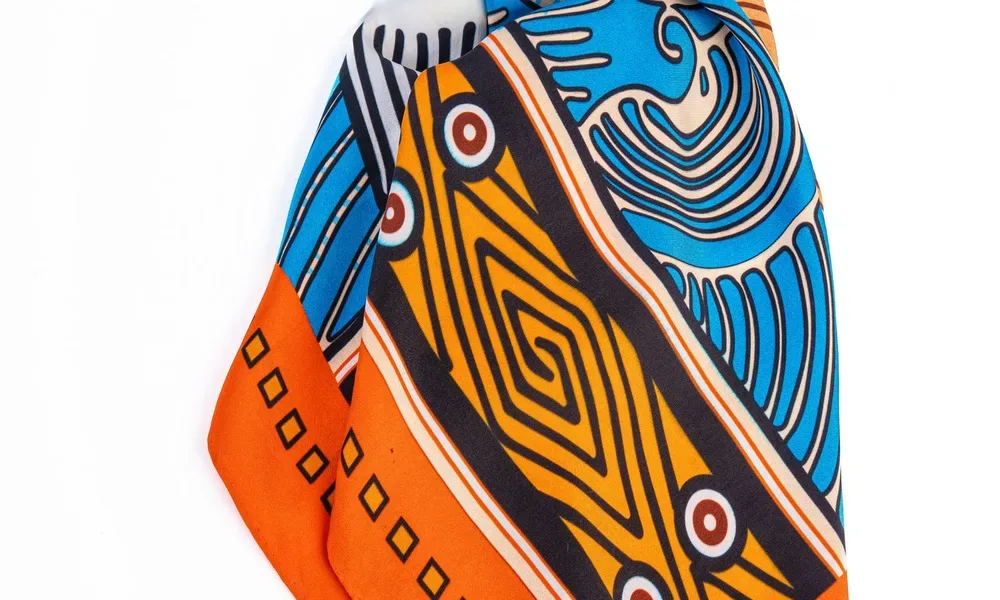
A silk scarf is one of the smallest luxuries you can buy, and one of the easiest to get wrong. Folded on a counter, two scarves can look almost identical: the same size, the same bright print. Six months later, one still looks new and the other has faded and lost its shape. The difference was never in the pattern. It was in the fibre, the weight, the weave, and the finishing.
Silk has been prized for thousands of years: strong for its weight, cool against the skin, and able to hold colour with a depth cotton and polyester rarely match. But “silk” on a label covers a wide range, from long mulberry filaments to coarse wild silk and outright polyester imitations.
This guide is about buying, not styling. Our work styling guide covers knots and necklines; this one covers what is in your hands before you tie it.
Key takeaways
- Choose 100 percent mulberry silk: the smoothest, strongest silk for scarves.
- Momme weight matters most after fibre type: 14 to 19 momme suits most scarves, 16 to 19 the sweet spot.
- Twill holds knots; charmeuse drapes but slips; crepe de chine resists wrinkles.
- A 90 cm square is the most versatile size; 50 to 70 cm suits a neckerchief, 110 to 140 cm a shawl drape.
- Hand-rolled hems, even printing, and a label stating fibre content are the signs of a well-made scarf; vague wording and a very low price are warnings.
What silk actually is
Silk is a natural protein fibre, produced by silkworms as they spin their cocoons. A single cocoon can yield a filament 1,200 to 1,600 metres long, and that length is what gives good silk its smooth surface and strength.
Most scarf silk is mulberry silk, from the domesticated Bombyx mori silkworm, fed only on mulberry leaves. It accounts for around 90 percent of world silk production, and it is the gold standard: long, uniform filaments, a bright lustre, and excellent dye affinity, so colours stay rich. Wild silks such as tussar, eri, and muga are coarser, more matte, and less suited to a fine printed square. Raw silk is graded from 6A down; aim for Grade 6A or 5A.
Momme weight: the number that decides drape
Unlike cotton, silk is not rated by thread count. Its density is measured in momme, written as “mm”: one momme equals about 4.34 grams per square metre. A higher momme means more silk per square metre — more body, more opacity, and usually more durability. It is the most useful number for comparing scarves.
Scarves usually fall between 8 and 19 momme: 8 to 12 is light and sheer, lovely for summer but prone to snagging; 14 to 16 gains body and holds a knot; 16 to 19 feels substantial, with deeper colour. For everyday wear, choose 16 to 19 momme.
Weave types: twill, charmeuse, crepe, and habotai
The same mulberry fibre can be woven into very different fabrics, and the weave decides the sheen, the drape, and how the scarf behaves when tied. Silk twill is the classic luxury scarf weave, used for the famous 90 cm squares of the great Paris houses. Its diagonal rib gives it texture, a soft matte-to-satin sheen, and real structure: it holds knots better than any other silk weave and takes prints with exceptional sharpness.
Charmeuse uses a satin weave, with a glossy front, a dull back, and a fluid drape. It looks stunning worn loose, but it is slippery, so knots work loose, and it snags easily. Crepe de chine has a matte, pebbled surface and excellent wrinkle recovery, making it best for a scarf folded into a bag. Habotai, also called China silk, is light and smooth, suiting prints and warm weather, but it is the most delicate of the four. Remember: shine signals the weave, not the quality — a thin, cheap charmeuse can outshine a fine twill and still be the weaker cloth.
Silk scarf types compared
Size, weave, and weight together decide what a scarf can do.
| Scarf type | Typical size | Best weave | Momme | Best for | Knot hold | Care | Watch out for |
|---|---|---|---|---|---|---|---|
| Classic square | 90 x 90 cm | Twill | 14–16 | Neck wear, everyday | Excellent | Dry clean / hand wash | Thin copies |
| Small square / neckerchief | 50–70 cm | Twill or habotai | 12–16 | Neck, wrist, bag accent | Good | Hand wash gently | Too small to tie |
| Large square / shawl | 110–140 cm | Twill or crepe | 16–19 | Shoulder drape, head wrap | Good | Dry clean preferred | Bulky under a coat |
| Slim necktie scarf | 100 x 8 cm | Twill | 14–16 | Neat work looks | Excellent | Hand wash gently | Too narrow otherwise |
| Charmeuse drape scarf | 90 x 90 cm | Charmeuse | 16–19 | Evenings, loose draping | Fair, slips | Dry clean preferred | Snags, sliding knots |
| Crepe travel scarf | 90 x 90 cm | Crepe de chine | 14–16 | Travel, packing flat | Good | Hand wash, dries quickly | Muted colours |
| Lightweight habotai scarf | 70–90 cm | Habotai | 8–12 | Summer, printed scarves | Fair | Hand wash gently | Sheer, snags easily |
| Silk-blend scarf | 90 x 90 cm | Twill or crepe | 12–16 | Everyday wear, lower price | Good | Follow the label | Hidden blend % |
Size and shape: measure before you fall in love
Silk has very little stretch, so a square that feels generous in your hand can feel tight around a collar. Think about the circumference you need: your neck, plus enough overlap for a knot. A 90 cm square is the most versatile size for neck wear: it folds into a neat band and ties comfortably without bulk.
Smaller squares of 50 to 70 cm work as neckerchiefs, wrist wraps, and bag accents, but they are too small for a full neck knot. Large squares of 110 to 140 cm drape beautifully over the shoulders, but they are hard to keep tidy under a blazer. For a first good scarf, start with the 90 cm square: it does the most jobs.
Print, colour, and hems
A scarf is often bought for its print, and the print is where cheap work shows. Look closely, in good light: on a well-made scarf the colours are saturated and even, and the print reaches cleanly to the border. On a poor one, colours look washed out, lines bleed, and the pattern stops short of the edge.
The edge tells you more about how a scarf was made than almost anything else. A hand-rolled hem is the hallmark of a premium scarf: rolled by hand and stitched with tiny, even stitches, it is soft, flexible, and slightly rounded, and it folds and knots without a stiff ridge. Run your finger along the edge: it should be even all round, with no puckering or loose threads, and the corners should turn cleanly.
The feel test: five checks before you pay
Start with your hands. Real silk feels cool at first, then warms quickly against the skin. It is smooth without being slippery like polyester satin, and it has a soft, dry rustle when scrunched, sometimes called a scroop. If it feels plasticky, waxy, or unnaturally slick, it is probably synthetic, whatever the label says. Hold it up to the light: good silk has a soft, even lustre, not a hard shine, and large gaps between the threads mean a loose weave that will snag.
Stretch a small section gently and let it go: silk should recover its shape. Read the label properly. It should state the fibre content in percentages, the country of origin, and the care instructions. Aim for “100 percent silk” or “100 percent mulberry silk”; a “silk blend” should come with numbers, while “silk-like” or “silk feel” usually means no silk at all. One last test, on a loose thread only: real silk smells like burnt hair and leaves a soft ash, while polyester melts into a hard bead.
Price signals and care
Price is a poor guide on its own, but a useful warning sign. A well-made 90 cm square in 100 percent mulberry silk twill, with a hand-rolled hem, usually costs around $80 to $150 from a specialist maker, and $200 to $400 or more from a luxury house. Far below $50, be suspicious: the silk alone costs more than that to produce well. A very high price, though, does not guarantee better silk: a $400 scarf from a famous name may match a $120 scarf from a specialist maker.
Silk asks for gentle care, but it is not as fragile as its reputation suggests. Hand wash it in cool water with a mild detergent made for silk, and never wring it out: press the water out, roll it in a clean towel, then reshape it and dry it flat, away from direct sun. Iron on a low setting, on the reverse side, and store it folded, away from perfume and rough jewellery, which cause most stains and snags.
Checklist: choosing the perfect silk scarf
- Label says 100 percent mulberry silk, or states blend percentages and care.
- Momme weight 14 to 19, ideally 16 to 19.
- Weave suits your use: twill for knots, charmeuse for draping, crepe de chine for travel.
- Size suits your use: 90 cm for neck wear, 50-70 cm for a neckerchief, 110-140 cm for a shawl.
- Hand-rolled hem, neat corners, no loose threads or puckering.
- Passes the feel test: cool then warm, smooth not plasticky, springs back when stretched.
Frequently asked questions
How can I tell if a silk scarf is real silk?
Check the label: it should say 100 percent silk, ideally 100 percent mulberry silk, with percentages if it is a blend. Then feel it: real silk is cool at first, then warms, with a soft rustle when scrunched. A very low price, a vague label, and a plasticky feel together are strong signs it is not pure silk.
What momme weight is best for a silk scarf?
For a scarf you will wear often, 16 to 19 momme is the practical choice: enough weight to hold a knot and survive repeated wear. Lightweight 8 to 12 momme suits summer but snags easily, while 14 to 16 momme is a good middle ground.
Is silk twill better than charmeuse for a scarf?
For most buyers, yes. Twill holds knots, keeps its shape, and takes prints with exceptional sharpness, which is why the classic luxury squares are made from it. Charmeuse is more beautiful draped loosely, but it slips and snags more easily.
What size silk scarf should I buy first?
A 90 cm square is the most versatile first buy: it folds into a neat band, ties comfortably, and works as a neck scarf, head covering, or shoulder wrap. Smaller squares suit a neckerchief, larger ones a shawl drape, but neither does as many jobs.
Can I machine wash a silk scarf?
It is safer not to. Hand washing in cool water with a mild detergent, then drying flat away from direct sun, keeps silk soft and bright for longest. If the label says dry clean only, follow it.
How much should a good silk scarf cost in 2027?
A well-made 90 cm square in 100 percent mulberry silk twill usually costs around $80 to $150 from a specialist maker, and $200 to $400 or more from a luxury house. Below $50, be cautious: it is likely a blend or synthetic. Above $400, you may be paying for the brand as much as for better silk.
The bottom line
The perfect silk scarf is not the most expensive one, nor the shiniest on the counter. It is the one whose fibre, weight, and weave match how you will wear it, and whose price is justified by the label, not the name on it. Choose 100 percent mulberry silk, 16 to 19 momme, in twill if you want one scarf that does everything, and check the hem and print first.
For a first good silk scarf, a classic 90 cm twill square in a colour you already wear is the safest buy. Our guide to the best silk blouses covers the matching silk to wear it with, and the best satin dresses guide covers evening looks a silk scarf can finish. Our best luxury fashion brands guide helps if you are comparing makers.
Buy once, buy well, and look after it. A silk scarf chosen this way will still be the one you reach for in ten seasons’ time.
Note: prices vary by maker and season; check the label and the current price before you buy.