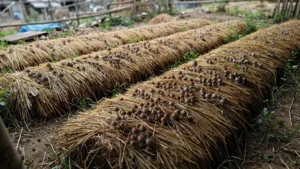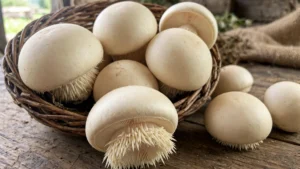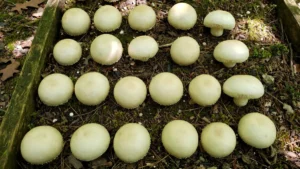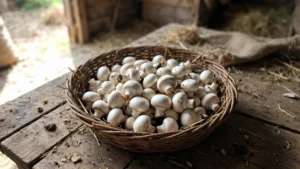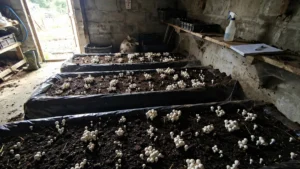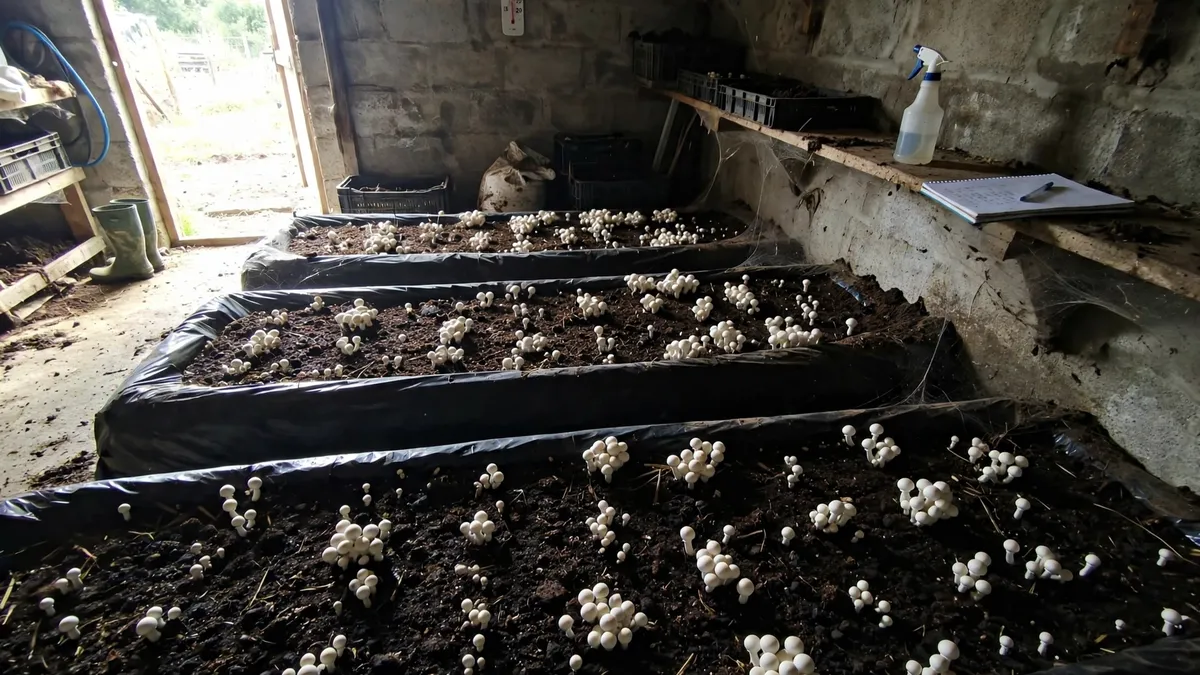

The white button mushroom is the one most people have already eaten, probably without ever thinking about it. It is the small, pale cap sliced into salads, scattered over pizzas and stirred into pasta, and it grows in the dark, in long compost beds, in rooms that smell faintly of earth and straw. There is nothing showy about it. It does not hang from a log like a pom-pom or fan out in a golden funnel. It pushes up in neat white rows, a few centimetres across, and it is picked by hand, tray after tray, all year round.
The farms in this guide grow white buttons as their main crop, and they open their doors to guests who want to see how the everyday mushroom is made. These are working farms, not resorts. The grow rooms are dim and cool, the compost beds run in long rows, and the morning job is picking: twist, snap, trim, and fill the basket. Most stays have fewer than ten rooms, a kitchen that cooks the morning pick the same day, and a grower who walks you through the room.
Below are nine white button farm retreats worth considering in 2027, from a compost farm an hour from Paris to a hillside farm outside Edinburgh. Each stay is judged on what it offers, what to keep in mind before you book, and the kind of traveller it fits, so you can choose on the strength of the farm, not on a bestseller list.
Key takeaways
- White button is Agaricus bisporus, a small white mushroom grown in dark rooms on compost beds, and the most widely eaten mushroom in the world.
- Farms grow it in flushes on pasteurised compost, and because the rooms are indoors, the season runs all year rather than in one short window.
- The best stays let guests walk the grow rooms, pick with the grower, and eat the morning harvest the same day.
- Book two nights, because one night rarely lines up with a picking session and a cooking session.
- White button mushrooms contain no gluten on their own, but farm kitchens also serve bread, pasta and sauces, so ask about gluten before you book.
What white button mushrooms actually are
White button is Agaricus bisporus, a mushroom with a smooth white cap, a short stem and pink-brown gills tucked underneath. It is picked young, while the cap is still closed around the stem, which is what keeps it pale and firm. Left to grow, the same mushroom opens into a large brown cap, which is sold under a different name. The flavour is mild and clean, almost nutty when cooked, and it takes on the taste of whatever it is cooked with, which is why it turns up in so many dishes.
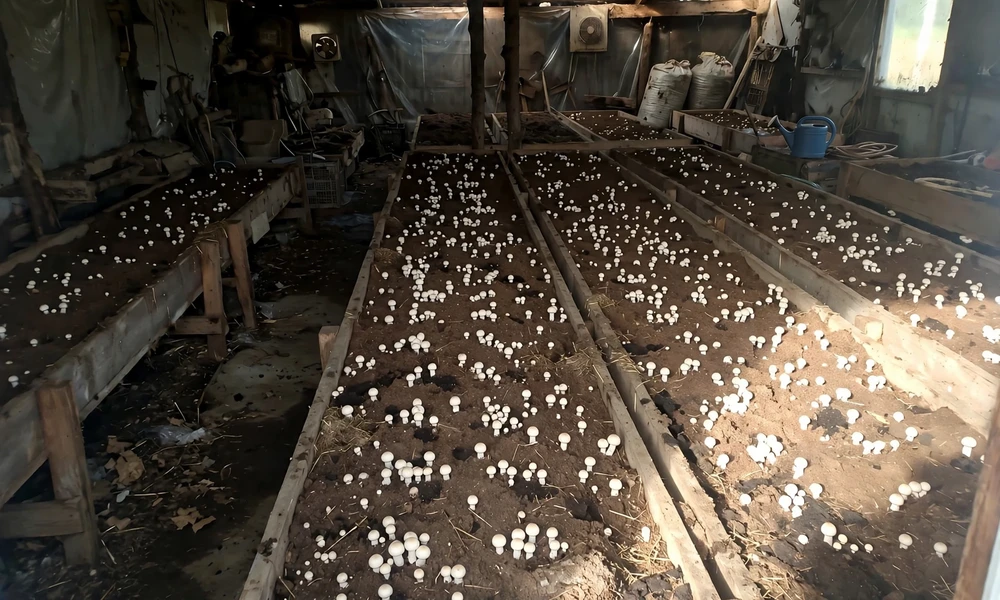
On a farm, white buttons grow in dark rooms on beds of pasteurised compost, usually straw and manure. A casing layer of damp peat or chalky soil goes on top, and the mushroom pushes through it in flushes, a wave of caps every week or so. The rooms stay cool and damp, and the beds are watered by hand or by mist. A picker walks the rows with a basket and a small knife, twisting each cap free and trimming the stem.
What sets white button apart from the mushrooms in the rest of this series is how ordinary it is, and how much work hides behind that ordinariness. It is not foraged in a wood or cut from a log. It is farmed in a building, on a bed, in the dark, and the skill is in the compost, the temperature and the timing of the flush. Our guide to reishi farm retreats covers a mushroom grown on logs for tea, while white button is grown on compost for the table, and the two farms feel nothing alike.
How we picked these nine farm stays
We looked for farms where white button is the main crop, not a side line. Every stay on this list grows the mushroom on site, in compost beds, and lets guests walk through the grow rooms with the person who tends them. A farm that buys its mushrooms in and only serves them did not make the list. Neither did a hotel that puts a mushroom dish on the menu but has no grow room at all.
We also looked for kitchens that cook the harvest the day it is picked. White button is at its best within a day of picking, when the caps are still closed and firm. A kitchen that serves only canned or frozen mushrooms is missing the point of the trip. The stays below all cook fresh, most of them in a pan with butter and garlic, and several run a short cooking session where guests slice and fry their own pick. Our cordyceps farm retreats guide uses the same test, and it is the one that separates a real mushroom farm from a country hotel with a nice menu.
Lastly, we weighed the rooms and the setting. These are working farms, so expect plain rooms and narrow lanes. What counts is a clean bed, a hot shower, and a short walk from your door to the grow room. Prices below cover one night with breakfast included, for 2027.
The 9 best white button farm retreats of 2027
Seine Valley White Button Compost Farm, Paris
What we like: A small compost farm an hour from Paris, with five guest rooms, long dark grow rooms and a kitchen that fries the morning pick in butter. The picking session is unhurried, and the grower explains the compost in plain language. What to consider: The rooms are simple, the grow rooms are cool and dim, and there is no swimming pool. Best For: A first mushroom farm trip from Paris. Style: Working compost farm. Price Range: $64–$101 a night, breakfast included. Standout Feature: The compost beds run in long rows you can walk between.
Beaujolais White Button Farm Stay, Lyon
What we like: A valley farm above the river, with a stone farmhouse, a bright kitchen and a terrace for lunch. The evening light across the valley outshines every other stay on this list. What to consider: The lane down to the farm is steep, and the evenings are very still. Best For: Couples after hills and a harvest in one trip. Style: Valley farmhouse. Price Range: $82–$118 a night, breakfast included. Standout Feature: Lunch on the terrace above the river.
Flemish White Button Garden Farm, Brussels
What we like: A walled garden farm outside Brussels, with a long grow room, a vegetable patch and a kitchen that serves white buttons with garden greens. The days move slowly and the welcome is genuine. What to consider: The grow room runs cool and damp, so pack a layer, and the village shops shut early. Best For: Travellers after a slow, gentle first stay. Style: Walled garden farm. Price Range: $74–$110 a night, breakfast included. Standout Feature: The garden fills the plate next to the mushroom.
Dutch Polder White Button Farm Stay, Amsterdam
What we like: A flat polder farm an hour from Amsterdam, with wide skies, a bright grow room and bicycles for the lanes. The casing session is thorough and the farm shop is well stocked. What to consider: The polder wind is strong, and the nearest town is a bike ride away. Best For: Cyclists and families who love wide open land. Style: Open polder farm. Price Range: $67–$103 a night, breakfast included. Standout Feature: Bikes for riding the polder lanes.
Brandenburg White Button Forest Farm, Berlin
What we like: Pine and beech forest east of Berlin, with a large grow room, a wood-fired kitchen and a compost shed you can visit. The growers take the craft seriously and give guests plenty of time. What to consider: The forest tracks turn muddy after rain, and the station is a bus ride off. Best For: Travellers who want to learn the growing as well as the eating. Style: Woodland farm with a wood-fired kitchen. Price Range: $80–$118 a night, breakfast included. Standout Feature: The wood-fired kitchen and compost shed.
Styrian White Button Country Farm, Vienna
What we like: Rolling farmland south of Vienna, with a stone farmhouse, a cool cellar grow room and a kitchen that cooks white buttons with dumplings. The hills roll gently and the walks are short. What to consider: The cellar stairs are steep, and the nearest town is a drive away. Best For: Food lovers chasing a hearty farm table. Style: Stone farmhouse in rolling farmland. Price Range: $87–$125 a night, breakfast included. Standout Feature: White buttons served with farm dumplings.
Bohemian White Button Woodland Farm, Prague
What we like: Deep beech forest outside Prague, with a timber farmhouse, a misty yard and a sauna for cold evenings. The forest walks run long and the air smells clean. What to consider: The mist lifts late in the morning, and the sauna must be booked ahead. Best For: Walkers who love cool forest air. Style: Timber farmhouse among beech trees. Price Range: $68–$106 a night, breakfast included. Standout Feature: A sauna waiting after cold forest evenings.
Take the forest track before breakfast, while the mist still sits in the trees. The grow room feels warm and damp after the cold track, and that contrast is part of the pleasure.
Cotswold White Button Barn Farm, London
What we like: A stone barn conversion in the Cotswolds, with a neat grow room, a walled garden and a kitchen that fries white buttons with sage. The lanes are lovely and the village pub is a short walk away. What to consider: The barn rooms run small, and the pub is packed on Friday nights. Best For: A quick London break with good food. Style: Stone barn conversion. Price Range: $95–$139 a night, breakfast included. Standout Feature: White buttons fried with garden sage.
Lothian White Button Hillside Farm, Edinburgh
What we like: A garden farm in the Lothian hills, with a bright grow room, a wood stove and a kitchen that serves white buttons with oats and greens. When the sky clears, the view stretches to the Firth. What to consider: The weather changes fast, and the hill road narrows in rain. Best For: Travellers who enjoy a Scottish farm table. Style: Hillside garden farm. Price Range: $77–$113 a night, breakfast included. Standout Feature: White buttons with oats and garden greens.
Which region suits which traveller
Paris and Lyon are the best places to start. The farms sit near cities with fast trains, the stays are short, and the menus are familiar. With only two nights to spare and no wish for a long journey, France is the place to start. The Seine Valley farm is the simplest of the nine to get to.
Brussels, Amsterdam and Berlin suit travellers who like flat ground, bicycles and long walks. The polder farm is the most open and the most family-friendly, while the Brandenburg farm is the best for anyone who wants the growing explained in full. Vienna and Prague suit food lovers and walkers, with heartier kitchens and cooler woods. London and Edinburgh fit a short break, with stone barns, garden farms and a pub down the lane. Our guide to nameko farm retreats uses the same regional logic: pick the region that matches your pace, and the mushroom will follow.
The caveats that matter
White button is a mild, well-known edible mushroom, but it is still a mushroom, and a few cautions apply. Never eat a wild mushroom you have not had checked by an expert, and never eat white buttons raw in large amounts. Farm-grown caps are safe to eat once cooked, but raw white button is hard to digest, and the farm will cook it for you. If you have a mushroom allergy, warn the farm before you book, and ask what goes into the kitchen sauces. Some farms grow other fungi in the same rooms, so ask about cross-contact before you eat.
| Detail | What is known |
|---|---|
| What it is | Agaricus bisporus, a small white mushroom with a closed cap, a short stem and pink-brown gills |
| Where it grows | In dark rooms on pasteurised compost beds, under a casing layer of damp peat or chalky soil |
| Can it be eaten raw | Not in large amounts, white button must be cooked through, and only after a guide has checked the pick |
| Best-known dishes | White button fried in butter and garlic, white button pizza, white button pasta, white button soup |
| Who should ask first | Anyone with a mushroom allergy, and anyone avoiding gluten |
| What to pack | A warm layer for the cool grow room, closed shoes for damp floors, a basket or bag |
| How far ahead to book | Two to four weeks, since small farms have few rooms and weekends fill early |
| What it is not | Not shiitake, not oyster mushroom, not the large brown cap sold as a portobello |
One more practical note: farm stays in this series are small, and weekends fill first. If your dates cannot move, book early and ask the farm which weeks the flushes are strongest, not just which weeks rooms are free.
Checklist: before you book a white button farm stay
Use these checks before you book, and again the week before you travel.
- Check the farm grows white buttons on site, in compost beds, and lets guests walk the grow room.
- Check the kitchen cooks the harvest the day it is picked, not from frozen stock.
- Check the flush weeks, not just room availability, before you set your dates.
- Ask about gluten and allergies, and what the kitchen serves on the side.
- Pack a warm layer for the grow room, closed shoes for wet floors, and a basket for your pick.
- Book two nights, so picking and cooking both fit the trip.
Frequently asked questions
Is white button the same thing as a portobello?
They are the same species, Agaricus bisporus, picked at different ages. White button is picked young, while the cap is still closed and pale. A portobello is the same mushroom left to grow into a large, open brown cap. They are cooked differently: white button is sliced into salads, pasta and pizza, while portobello is grilled whole.
How is white button different from shiitake?
Shiitake carries a brown cap, a stem and gills, with a deep, savoury flavour. White button is pale, mild and much softer in flavour. Shiitake is usually grown on logs, while white button on a farm is grown on compost beds in dark rooms.
Can I eat white button raw?
A few thin slices in a salad are common, but large amounts of raw white button are hard to digest. Farm stays cook it, usually sliced and fried in butter and garlic, and that is how it should be eaten on a farm visit.
When is the best month to visit a white button farm?
Every month works, because the grow rooms sit indoors and the flushes keep coming all year. Spring and autumn make the nicest walk between farmhouse and grow room, so ask the farm which weeks run strongest before you book.
Do white button farm stays suit children?
Most do, provided children can walk the grow room quietly and keep clear of damp floors and equipment. The picking session is usually the part children enjoy most, because the white caps are easy to spot and fun to twist free.
Is white button gluten-free?
The mushroom itself contains no gluten. The risk sits in the kitchen: bread, pasta, dumplings and sauces can hold gluten, so ask the farm what a gluten-free guest can eat before you book.
The bottom line
The best white button farm retreat in 2027 is not the grandest or the most expensive. It is the one where the mushroom is grown on site, picked in the morning and cooked the same day, with a clean room and a short walk between the two. For a first trip, the Seine Valley farm is the simplest to reach. For food lovers, the Styrian farmhouse lays the most generous table. For walkers, the Bohemian woodland farm is the most beautiful.
Choose one farm, book two nights, pack a warm layer, and judge the trip on the morning you pick your own white buttons and the lunch you eat them at. That is the honest way to meet the most ordinary mushroom there is, without turning the trip into a hotel stay with a mushroom on the menu.