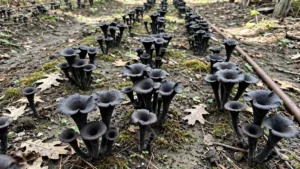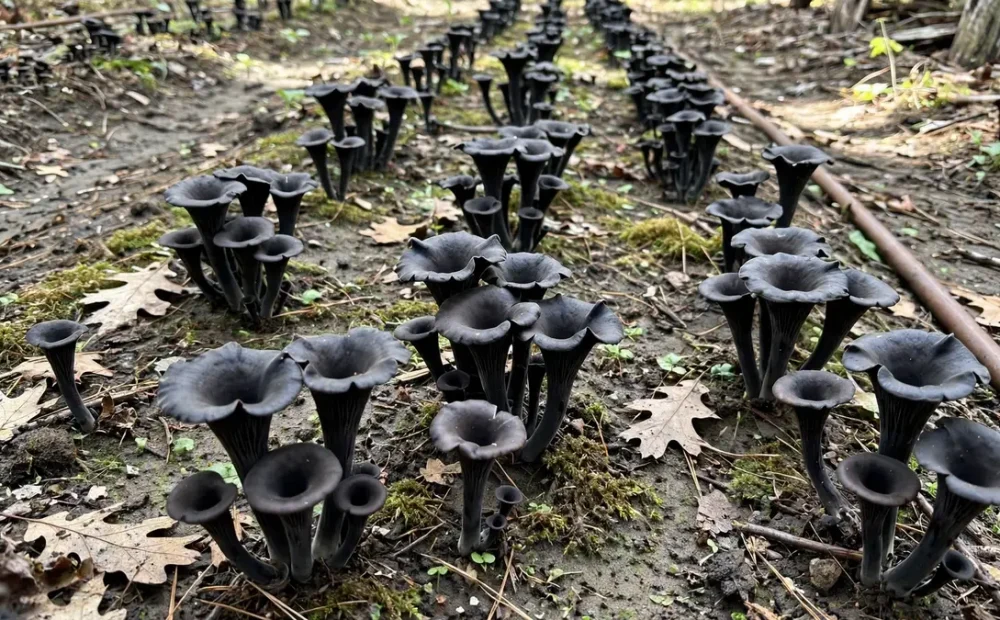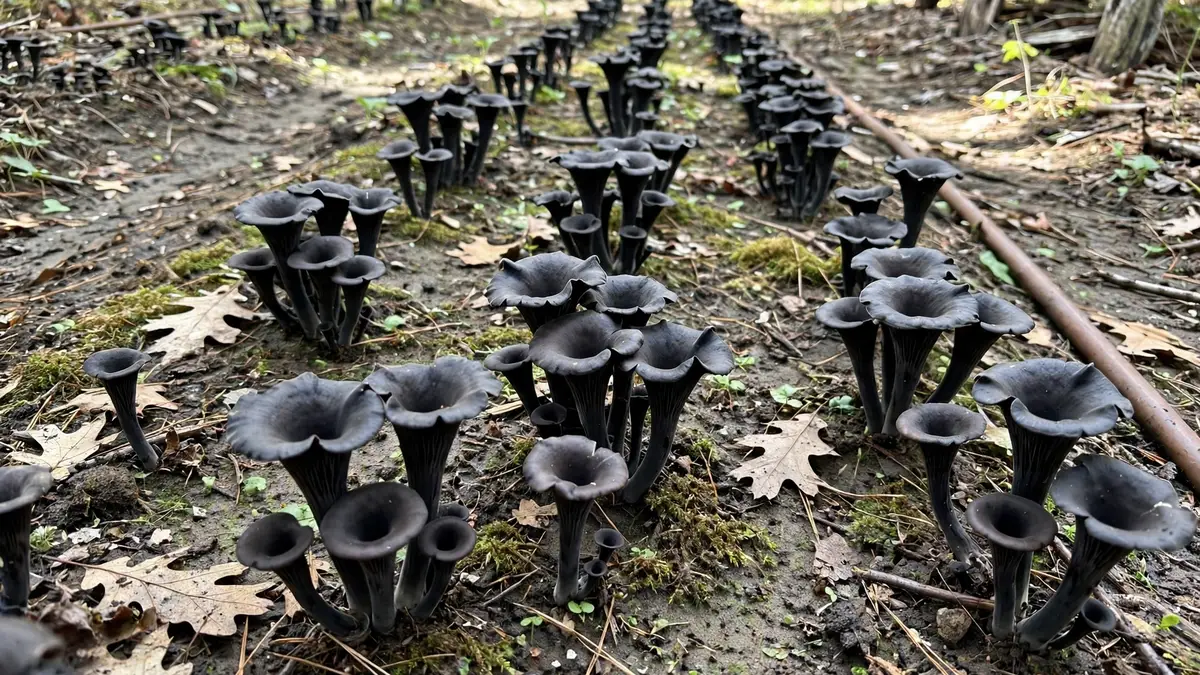

Black trumpet is the mushroom you walk straight past before you see it. It grows in loose clusters on the autumn woodland floor, dark grey-black and funnel-shaped, the colour of wet leaf litter, so it hides in plain sight until you learn to look down. The French call it trompette de la mort, the trumpet of the dead, a name that sounds grim until you taste it: dried and ground, or simmered into a sauce, it has a deep, smoky richness that chefs prize above almost any other wild mushroom.
The stays here are small woodland farms, not hotels with a mushroom garnish. Each one keeps its own stretch of beech and oak woodland, walks it with a guide who knows where the trumpets fruit, and dries the harvest on site for the kitchen. Black trumpet cannot be grown in rows like shiitake, so the trip is a guided hunt in managed woods rather than a walk past grow bags, and the drying room is where the day’s pick turns into something you can cook with all winter.
The nine stays below run from a woodland farm outside Paris to a farm in the hills above Zagreb. Each one is judged on its woods, its drying room and its table, so you can match the farm to the trip you want.
Key takeaways
- Black trumpet is Craterellus cornucopioides, a dark grey-black, funnel-shaped mushroom with a smooth underside and no gills, growing wild in autumn beech and oak woods.
- It cannot be grown in rows like shiitake, so farms host guided walks in their own managed woodland and dry the harvest for sauces and soups.
- The best stays keep their own woods, walk them with a guide who knows the fruiting spots, and dry and grind the trumpets on site.
- Give the trip two or three nights, since a woodland walk, a drying session and a cooking afternoon seldom fit into a single day.
- Black trumpet itself contains no gluten, but farm kitchens also serve bread, pasta and sauces, so ask about gluten before you book.
What black trumpet actually is
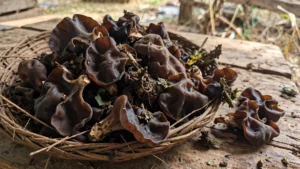
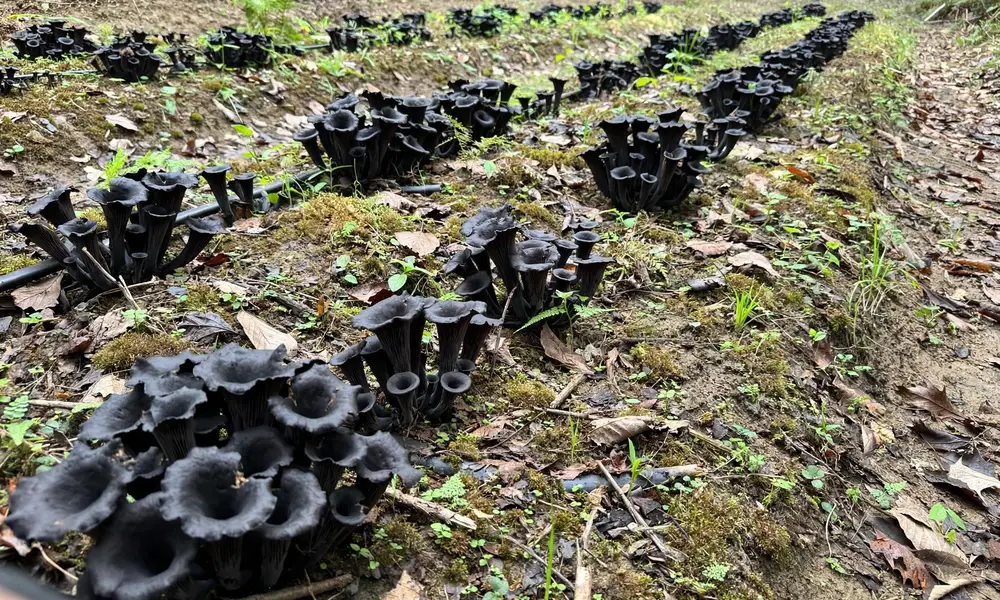
Black trumpet is Craterellus cornucopioides, a wild mushroom of the autumn woods. It grows in clusters on the ground beneath beech, oak and hornbeam, its cap a hollow, flared funnel in shades of charcoal, grey and sooty black, with a pale grey underside that is smooth rather than gilled. The stem is hollow, the flesh thin and dark, and the whole mushroom is small, often no taller than a thumb, which is why a basket takes a morning to fill.
What sets it apart from the mushrooms most people cook with is the flavour it gains from drying. Fresh black trumpet is mild and a little earthy, but dried and simmered it turns dark and fragrant, with a smoky depth that suits cream sauces, risotto and roast chicken. Farms dry it slowly on racks or in a low drying room, then grind some of it into a dark powder for the kitchen and keep the rest whole for soups. It is a mushroom you buy dried as often as fresh, and the drying is half the point of the stay.
Farms value it because it fruits in the same woods year after year, in the damp weeks of autumn, and a good stretch of beech woodland can be walked for a decade without losing its crop. You will not find it in grow bags or on logs, and you will not pick it without a guide: it hides in the leaf litter, and its dark colour makes it easy to miss and easy to confuse with inedible fungi. Our guide to cordyceps farm retreats follows a very different rhythm, built around orange fingers grown on grain trays indoors, but black trumpet farms are slower, muddier places, and the walk through the woods is the heart of the visit.
How we picked these nine farm stays
We looked for farms where black trumpet is the main autumn crop, not a curiosity found once on a walk. Every stay on this list keeps its own managed woodland, walks it with a guide who knows the fruiting spots, and dries the harvest on site. A farm that buys dried trumpet in and only cooks with it did not make the list, and neither did a country hotel that lists a mushroom sauce but has no woods of its own.
We also looked for farms that dry and grind on site, the same week the trumpets are picked. Dried black trumpet keeps its smoky flavour for months, but only if it is dried slowly and stored dry, and a farm that buys its dried stock in is missing the point of the trip. The stays below all dry their own harvest, most of them on open racks or in a low drying room, and several run a short cooking session where guests simmer their own pick into a sauce. Our turkey tail farm retreats guide applies the same test, and it is the check that tells a real mushroom farm apart from a country hotel with a pleasant menu.
Finally, we looked at the rooms and the setting. These are working farms, so the rooms are plain and some lanes are single-track. What matters is a clean bed, a hot shower, and a short walk to the woods. All prices are per night with breakfast included, for 2027.
The 9 best black trumpet farm retreats of 2027
Île-de-France Black Trumpet Woodland Stay, Paris
What we like: A small woodland farm an hour from Paris, with six guest rooms, a beech wood the farm has managed for a decade, and a drying room you can visit after the walk. The morning hunt is unhurried, and the evening sauce tasting is generous. What to consider: The rooms are plain, the lane in is single-track, and there is no swimming pool. Best For: A first black trumpet trip from Paris. Style: Working woodland farm. Price Range: $72–$111 a night, breakfast included. Standout Feature: The trumpets are dried the same day they are picked.
Rhône Hills Black Trumpet Forest Retreat, Lyon
What we like: Oak woods above the river, a small terrace, and a kitchen that serves the farm’s own vegetables with a black trumpet cream sauce. The evening light across the hills is the best on this list. What to consider: The walk from the road is steep, and the nights are deeply quiet. Best For: Couples who want a hill walk and a harvest in the same day. Style: Hillside woodland farm. Price Range: $85–$123 nightly, breakfast included. Standout Feature: Oak woods above the river with a terrace for the evening meal.
Piedmont Black Trumpet Woodland Stay, Turin
What we like: Chestnut and beech woods outside Turin, with a stone farmhouse, a long drying room and a kitchen that grinds black trumpet into a dark powder for risotto. The autumn fog over the woods is part of the charm. What to consider: The fog hangs late in the morning, and the farm needs a drive to the nearest town. Best For: Travellers who want to cook what they pick. Style: Stone farmhouse among chestnut woods. Price Range: $65–$103 a night, breakfast included. Standout Feature: Black trumpet ground into powder for risotto.
Ask to see the grinding room if the farm offers it. The smell of warm, dried trumpet stays with you long after the visit.
Tuscan Hills Black Trumpet Forest Retreat, Florence
What we like: Rolling oak woods south of Florence, with a converted barn, a shaded drying loft and a kitchen that serves black trumpet sauce with fresh pasta. The hills are gentle and the walking is easy. What to consider: The barn rooms are small, and the nearest village is a drive away. Best For: Travellers who arrive hungry and like a long farm table. Style: Converted barn among rolling oak woods. Price Range: $91–$135 a night, breakfast included. Standout Feature: Black trumpet sauce served with farm pasta.
Styrian Black Trumpet Woodland Stay, Vienna
What we like: Beech woodland south of Vienna, with a timber farmhouse, a cool cellar drying room and a kitchen that serves black trumpet soup with dark bread. The walks are gentle and the table is generous. What to consider: The cellar steps are steep, and the farm is quiet on weekdays. Best For: Travellers who fancy a slow Austrian weekend. Style: Timber farmhouse in beech woodland. Price Range: $78–$117 nightly, breakfast included. Standout Feature: Black trumpet soup served with dark farm bread.
Bohemian Black Trumpet Forest Retreat, Prague
What we like: Deep beech forest outside Prague, with a timber farmhouse, a misty woodland floor and a sauna for cold evenings. The forest walks are long and the air is cold and clear. What to consider: Mist hangs late in the morning, and the sauna needs booking ahead. Best For: Walkers who like cold, clear air under beech trees. Style: Timber farmhouse set inside beech forest. Price Range: $64–$102 a night, breakfast included. Standout Feature: A wood-fired sauna waiting after cold forest walks.
Buda Hills Black Trumpet Woodland Stay, Budapest
What we like: Oak and hornbeam woods in the Buda hills, with a white farmhouse, a bright drying room and a kitchen that serves black trumpet sauce with dumplings. The city is close enough for a day trip. What to consider: The hill road is slick in rain, and the farm is busy on autumn weekends. Best For: Travellers who want woods and a city in one trip. Style: White farmhouse in the Buda hills. Price Range: $82–$121 a night, breakfast included. Standout Feature: Black trumpet sauce served with farm dumplings.
Julian Alps Black Trumpet Forest Stay, Ljubljana
What we like: Mixed beech forest at the edge of the Julian Alps, with a wooden lodge, a wood stove and a kitchen that simmers black trumpet into a dark, smoky soup. On a clear day the peaks show over the trees. What to consider: The weather turns fast, and the lodge road is narrow. Best For: Travellers who want mountains behind their mushroom walk. Style: Wooden lodge at the forest edge. Price Range: $74–$113 a night, breakfast included. Standout Feature: A smoky black trumpet soup by the wood stove.
Medvednica Black Trumpet Woodland Retreat, Zagreb
What we like: Beech and oak woods on the slopes of Medvednica, with a stone house, a long drying room and a kitchen that serves black trumpet risotto with local cheese. The village market is a short walk. What to consider: The farm is quiet in winter, and the market only runs on Saturdays. Best For: Travellers who want a slow Croatian weekend. Style: Stone house in hillside woods. Price Range: $89–$131 a night, breakfast included. Standout Feature: Black trumpet risotto with local cheese.
Which region suits which traveller
Start with Paris or Lyon. The farms sit close to cities with good rail links, the stays are short, and the food is familiar. With only two nights, start in France, where the Île-de-France stay is the simplest of the nine to reach and the woods are the easiest to walk.
Turin and Florence suit travellers who like to cook, with chestnut woods, pasta and risotto on the table. Vienna, Prague and Budapest suit travellers who like deep forest, long walks and hearty kitchens, while Ljubljana and Zagreb suit a longer trip, with mountains, Saturday markets and a slower pace. Our guide to wood ear farm retreats uses the same regional logic: pick the region that matches your pace, and the mushroom will follow.
The caveats that matter
Black trumpet is a wild mushroom that hides in leaf litter, and a few cautions apply. Never eat a wild mushroom you have not had checked by an expert, and never eat black trumpet raw. Farm stays pick with a guide, dry the harvest, and cook it properly, so let the farm handle the identification and the cooking. If you have a mushroom allergy, tell the farm before you book and ask what goes into the sauces it serves. Some farms also keep other fungi in the same woods, so ask about cross-contact before you book.
| Detail | What is known |
|---|---|
| What it is | Craterellus cornucopioides, a dark grey-black funnel-shaped mushroom with a smooth underside and no gills |
| Where it grows | Wild in autumn beech, oak and hornbeam woods, in managed woodland walked with a guide |
| Can it be grown in rows | No, black trumpet is mycorrhizal and cannot be cultivated commercially |
| Best-known uses | Dried black trumpet sauce, black trumpet risotto, black trumpet ground into powder for soups |
| Who should ask first | Anyone with a mushroom allergy, and anyone avoiding gluten |
| What to pack | A warm layer for the cool woods, closed shoes for damp ground, a basket or bag |
| How far ahead to book | Three to five weeks for the autumn season, two weeks outside it |
| What it is not | Not chanterelle, not porcini, not a farmed mushroom of any kind |
One more practical note: farm stays in this series are small, and autumn weekends fill first. If your dates cannot move, book early and ask which weeks the woods are fruiting, not just when rooms are free.
Checklist: before you book a black trumpet farm stay
Use these checks before you book, and again the week before you travel.
- Check the farm keeps its own managed woodland and walks it with a guide who knows the fruiting spots.
- Check the farm dries its own harvest on site, rather than buying dried stock in.
- Ask which weeks the woods are fruiting before you settle on dates.
- Ask whether the kitchen can cook gluten-free, and what it serves with the sauce.
- Pack a warm layer for the woods, closed shoes for the damp ground, and a basket for what you pick.
- Book two or three nights, so a woodland walk, a drying session and a cooking afternoon all fit the trip.
Frequently asked questions
Is black trumpet the same thing as chanterelle?
No. Chanterelle is golden, with blunt forked ridges under the cap and an apricot scent, while black trumpet is dark grey-black, funnel-shaped, and smooth underneath with no gills at all. Chanterelle is eaten fresh; black trumpet is at its best dried and simmered into a sauce.
How is black trumpet different from porcini?
Porcini is a thick-stemmed mushroom with a brown cap and a spongy pore layer, and it is cooked fresh in risotto and pasta. Black trumpet is thin, dark and hollow, with a smooth underside, and its flavour comes out when it is dried. Both are prized, but they are different fungi from different woods.
Can I eat black trumpet raw?
No. Raw black trumpet is thin and tough, and wild mushrooms should always be cooked. Farm stays dry the harvest and simmer it into sauces, and that is how it should be used. Never eat a wild mushroom without expert identification.
When is the best month to visit a black trumpet farm?
Autumn is the strongest season, roughly September to November, when the woods are damp and the trumpets are fruiting well. The woods fruit in waves, though, so ask which weeks are strongest before you book, and be ready to move your dates by a week.
Do black trumpet farm stays suit children?
Most do, if children can walk the woods quietly and keep close to the guide. The hunt is usually what children enjoy most, because spotting a dark trumpet in the leaf litter feels like finding something hidden.
Is black trumpet gluten-free?
The mushroom itself contains no gluten. The risk is in the kitchen: bread, pasta, dumplings and sauces may contain gluten, so ask what the farm can serve a gluten-free guest before you book.
The bottom line
The best black trumpet farm retreat in 2027 is not the grandest or the most expensive. It is the one where the woods are managed on site, walked with a guide, and the day’s pick is dried the same week, with a clean room nearby. For a first trip, the Île-de-France stay is the simplest to get to; for cooks, the Piedmont farmhouse is the most rewarding; for walkers, the Bohemian forest stay is the prettiest of the nine.
Choose one farm, book two or three nights, pack a warm layer, and judge the trip on the morning you spot your first trumpet in the leaf litter and the evening you taste the sauce. That is the honest way to meet a mushroom that hides in plain sight, without turning the trip into a hotel stay with a mushroom sauce on the menu.