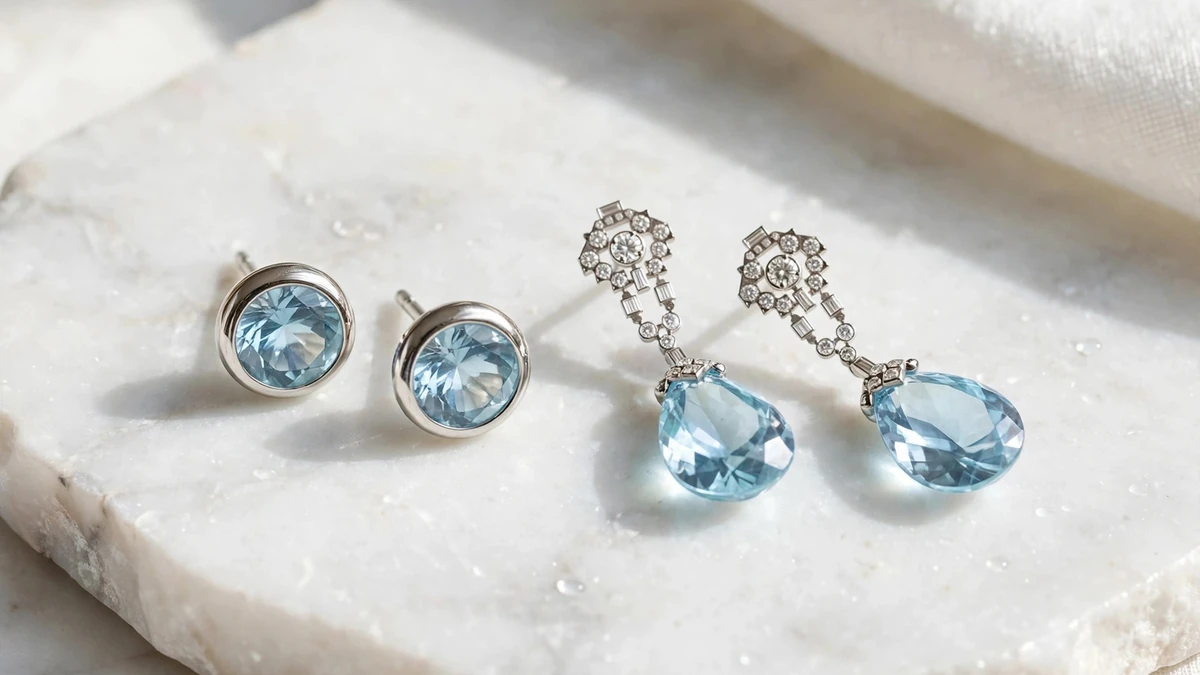
Aquamarine is the pale blue of shallow water, and as an earring stone it does something few gems manage: it reads as both calm and noticeable. It is the March birthstone, a member of the beryl family, and its colour comes from iron, not from dye or coating. In earrings it sits close to the face, where that soft blue lightens the skin and picks up the colour of the eyes. It works with silver, white gold, yellow gold and rose gold, and it suits a white shirt as easily as an evening dress.
The problem is that aquamarine varies far more than its gentle colour suggests. A pale, almost colourless stone can look washed out, while a deeply saturated blue commands a much higher price. Size matters too. A small stud is an everyday piece, but a large drop can look heavy on a small ear, and a poorly cut stone can look dull even when the colour is good. Settings, backs and metal choice decide whether a pair is worn daily or left in a drawer. A pair that is too heavy will also pull at the earlobe over a long day, which is why weight matters as much as looks when you are choosing between two similar pairs.
Below are nine pairs of aquamarine earrings worth considering in 2027, from classic studs to statement drops. Each one is described by what it does well, what to watch for, and who it suits best, so you can choose with your ears, your wardrobe and your budget in mind, not just a bestseller list.
Key takeaways
- Aquamarine is a beryl, coloured blue by iron, and its value rises with colour saturation, clarity and cut.
- Studs are the easiest everyday choice, while drops and chandeliers suit evenings and special occasions.
- Secure backs matter as much as the stone: screw backs and la poussette clasps are safer than push backs for valuable pairs.
- Yellow gold warms pale aquamarine, while white gold and platinum make the blue look cooler and sharper.
- Aquamarine is hard enough for daily wear at 7.5 to 8 on the Mohs scale, but it can still chip if knocked against a hard surface, and heat-treated stones are the norm, not the exception.
What aquamarine actually is
Aquamarine is the blue variety of beryl, the same mineral family as emerald, and its name comes from the Latin for seawater. Its colour ranges from almost colourless to a deep sea blue, and the most prized stones are a clear, medium blue with no hint of grey or green. Most aquamarine on the market has been gently heated to remove yellowish tones and bring out the blue, and this is a standard, stable treatment that jewellers disclose as a matter of course.
On the Mohs hardness scale aquamarine sits at 7.5 to 8, which makes it durable enough for earrings worn every day. Earrings take far less wear than rings, so even a large aquamarine drop is a practical choice, provided the setting protects the stone. Look for a bezel or a well-made prong setting, and check that the stone sits straight and does not wobble in its mount.
As a March birthstone, aquamarine carries a long association with calm seas and clear skies, and it is a popular choice for March birthdays, for gifts marking a nineteenth wedding anniversary, and for anyone who wants a blue stone without the formality of sapphire. It is also one of the more affordable blue gemstones, which means a good-sized stone is within reach at a mid-range price. Larger aquamarines are more common than large sapphires or rubies, so a generous stone does not always mean a luxury price, and a clean, well-cut stone of two or three carats can be found without spending a fortune.
How we chose these earrings and what to look for
Look first at the colour. A good aquamarine should be a clear, even blue with no grey cast and no patchy areas. Hold it against a white background in daylight if you can: a stone that looks blue in the shop and grey at home is usually too pale. Deeper colour costs more, but a medium blue with good clarity often looks better on the ear than a very dark stone, which can read as navy in low light.

Look next at the cut and the size. A well-cut stone returns light evenly across its face, while a poorly cut one looks flat or windowed, with a pale patch in the middle. For studs, five to seven millimetres suits most ears; for drops, length matters more than carat weight, and a pair that ends at or above the jawline flatters most face shapes. Our guide to the best diamond earrings of 2027 covers the same questions of cut, setting and proportion, and the same checks apply here.
Finally, look at the setting and the back. A four-prong or bezel setting holds the stone securely and suits daily wear, while a halo setting adds sparkle and makes a smaller stone look larger. Screw backs and la poussette clasps are the safest choices for valuable pairs, and a butterfly push back should fit snugly, not loosely. Check that the pair is matched in colour and size, because two stones cut from different rough can look noticeably different on the ears.
The 9 best aquamarine earrings of 2027
Tiffany & Co. Aquamarine Stud Earrings
What we like: A classic four-prong stud in platinum or 18k gold, with a clean, evenly coloured stone and a secure screw back. The setting is deliberately simple, so the colour of the aquamarine is the whole point, and the pair works from a workday to a wedding.
What to consider: Premium price for the size of stone, and the design is so simple that it will not suit anyone looking for a statement piece. Stone: Aquamarine, round cut. Setting: Platinum or 18k gold, four-prong. Best for: Everyday elegance and March birthdays. Price range: High.
Cartier Aquamarine Drop Earrings
What we like: A long, graceful drop with a faceted aquamarine suspended from a slim gold or platinum chain of links. The movement of the stone catches the light as you turn your head, and the design reads as dressy without being heavy.
What to consider: Drops suit longer necks and updos best, and the price reflects the house as much as the stone. Stone: Aquamarine, faceted drop. Setting: 18k gold or platinum. Best for: Evenings and formal occasions. Price range: High.
Monica Vinader Aquamarine Huggie Hoops
What we like: A small hoop with a single aquamarine charm, light enough for all-day wear and easy to stack with other hoops. The charm is removable on some styles, so the hoops work on their own too.
What to consider: The stone is small, so the colour reads as a hint rather than a statement, and the hoops are best kept away from heavy knitwear that can snag. Stone: Aquamarine, small faceted charm. Setting: Gold vermeil on recycled sterling silver. Best for: Everyday stacking and casual outfits. Price range: Mid-range.
Mejuri Aquamarine Stud Earrings
What we like: A fine, understated stud in 14k gold with a well-cut aquamarine, sold as a pair at a fair price. The scale is small and neat, which makes it a good first pair of aquamarine earrings or a gift for a teenager.
What to consider: The stone is modest in size, so it will not read as a luxury piece from across a room, and the push backs need checking for a snug fit. Stone: Aquamarine, round cut. Setting: 14k solid gold, four-prong. Best for: Everyday wear and first aquamarine pieces. Price range: Mid-range.
David Yurman Aquamarine Drop Earrings
What we like: A sculptural drop that pairs aquamarine with the house’s signature cable detailing, giving a classic stone a recognisably modern frame. The proportions are generous without being heavy, and the pair works with both tailored and evening looks.
What to consider: The cable motif is distinctive, so it will not suit anyone who prefers plain settings, and the price sits at the higher end of the mid-range. Stone: Aquamarine, faceted drop. Setting: Sterling silver with 14k gold accents. Best for: Statement everyday and evening wear. Price range: High mid-range.
Bulgari Aquamarine Dangle Earrings
What we like: A bold, colourful dangle that treats aquamarine as a jewel in its own right, often paired with pavé diamonds for extra light. The design is unmistakably Bulgari, and the colour of the stone is the centre of the piece.
What to consider: A statement piece at a statement price, and the length means it suits special occasions more than daily wear. Stone: Aquamarine, faceted. Setting: 18k gold with diamond pavé. Best for: Gala evenings and milestone gifts. Price range: High.
Kendra Scott Aquamarine Stud Earrings
What we like: A friendly, well-priced stud in a cushion or oval cut, with a bright, even blue and a comfortable butterfly back. The scale is generous for the price, and the pair is easy to wear with everything from denim to a summer dress.
What to consider: The setting is fashion jewellery rather than fine jewellery, so it is best treated as a style piece rather than an heirloom. Stone: Aquamarine, cushion or oval cut. Setting: 14k gold-plated brass. Best for: Everyday colour on a budget. Price range: Affordable.
Piaget Aquamarine Chandelier Earrings
What we like: A chandelier design with several graduated aquamarines, cut to catch the light from every angle. The effect is festive and unmistakably luxurious, and the pair is the kind of piece that defines an outfit.
What to consider: Chandelier earrings are heavy by nature, so they are best saved for short evenings, and the price is firmly at the top of the range. Stone: Aquamarine, graduated faceted drops. Setting: 18k white gold. Best for: Black tie and red-carpet occasions. Price range: High.
Astrid & Miyu Aquamarine Huggies
What we like: A small, neat huggie with a single aquamarine, designed for stacking and for second piercings. The stone adds a flash of blue without dominating, and the price makes it easy to buy a pair and wear them daily.
What to consider: The stone is tiny, so the blue is subtle, and the huggie style will not suit anyone who wants a visible statement earring. Stone: Aquamarine, small faceted. Setting: Gold-plated sterling silver. Best for: Stacking and everyday wear. Price range: Affordable.
Which aquamarine earrings are right for you
Start with how you will wear them. If you want a pair for every day, a stud or a small huggie is the sensible choice: it will not catch on clothing, it will sit comfortably under headphones, and it will suit a workday as well as a weekend. If you want a pair for evenings, a drop or a chandelier gives you movement and presence, and the stone has room to show its colour.
Face shape matters more than most people expect. Longer drops lengthen a round face, while studs and short drops suit a longer face. Small ears suit small stones, and a large drop can overwhelm a petite frame, so try the pair on with your hair up and down before deciding. Skin tone matters too: pale aquamarine looks fresh against warm skin in yellow gold, while cooler skin tones suit the stone in white gold or platinum.
Budget is the last question, and it is worth answering honestly. A well-cut aquamarine in a simple gold setting will look better than a large, dull stone in an elaborate mount, so put the money into the stone first. Our guide to the best gold jewellery for everyday wear is a useful companion here, because the metal you choose will decide how often you reach for the pair.
The caveats that matter
Aquamarine is a durable stone, but it is not indestructible, and most of the problems that arise with aquamarine earrings are easy to avoid. The table below sets out the main points to check before you buy, and the habits that will keep a pair looking good for years.
| Detail | What is known |
|---|---|
| Hardness | 7.5 to 8 on the Mohs scale, hard enough for daily wear but able to chip if knocked hard. |
| Heat treatment | Most aquamarine is gently heated to improve the blue; this is standard, stable and should be disclosed. |
| Colour | Value rises with saturation; very pale stones can look grey indoors, very dark stones can look navy. |
| Backs | Screw backs and la poussette clasps are the most secure; check push backs regularly for a snug fit. |
| Cleaning | Warm water, mild soap and a soft brush are enough; avoid ultrasonic cleaners for set stones. |
| Storage | Store pairs separately in a soft pouch so the stones do not scratch each other or other jewellery. |
| Skin sensitivity | Nickel in some gold-plated settings can irritate sensitive ears; choose solid gold or sterling silver if in doubt. |
| Certification | Ask for a certificate or a written description of the stone and setting for high-value pairs. |
Checklist: choosing aquamarine earrings honestly
- Check the colour in daylight against a white background, not only under shop lights.
- Look for an even cut with no pale window in the middle of the stone.
- Choose a secure back, and test that it holds before you leave the shop.
- Match the metal to your skin tone and to the jewellery you already wear.
- Try the pair with your hair up and down, and check the weight on your ears.
- Ask for the stone’s treatment and certification in writing for higher-value pairs.
Frequently asked questions
Is aquamarine a good stone for everyday earrings?
Yes. At 7.5 to 8 on the Mohs scale, aquamarine is hard enough for daily wear, and earrings take far less knocks than rings. Studs and huggies are the most practical everyday styles, while drops and chandeliers are better saved for evenings.
How can I tell a good aquamarine from a poor one?
Look for a clear, even blue with no grey cast, a cut that returns light evenly, and no visible cracks or cloudy patches. A pale stone that looks grey indoors is usually too light, and a stone with a pale window in the middle is poorly cut, whatever its colour.
Does aquamarine need special care?
No. Warm water, mild soap and a soft brush will keep it clean, and a soft pouch will stop it scratching other jewellery. Avoid harsh chemicals and ultrasonic cleaners, and take earrings off before swimming in a chlorinated pool.
Is heat-treated aquamarine worth less?
Heat treatment is standard for aquamarine and does not reduce its value in the way it might for some other stones. What matters is the colour, clarity and cut of the finished stone, and a reputable seller will disclose the treatment in writing.
What metal suits aquamarine best?
Yellow gold warms a pale stone, while white gold and platinum make the blue look cooler and sharper. Rose gold sits in between and suits warmer skin tones. The best choice is the metal you already wear most, so the pair fits your existing jewellery. For a fuller explanation of how to judge a stone before buying, see our diamond buying guide, which covers the same questions of colour, cut and certification.
Are aquamarine earrings a good gift?
Yes, especially for a March birthday or a nineteenth wedding anniversary, both of which are traditionally marked with aquamarine. Studs are the safest gift, because they suit almost everyone, while drops are better chosen with the wearer’s taste in mind.
The bottom line
Aquamarine earrings are one of the easiest ways to wear colour. The stone is durable, affordable for its size, and flattering against the skin, and a well-chosen pair works from a weekday to a wedding. Put the money into colour and cut first, choose a setting and a back that you can wear all day, and match the metal to the jewellery you already own.
Start with a stud or a small huggie if you are buying your first pair, and save the drops and chandeliers for occasions when you want the earrings to be the point of the outfit. Check the colour in daylight, ask for the treatment in writing, and buy from a seller you trust. The right pair is the one you reach for without thinking.