

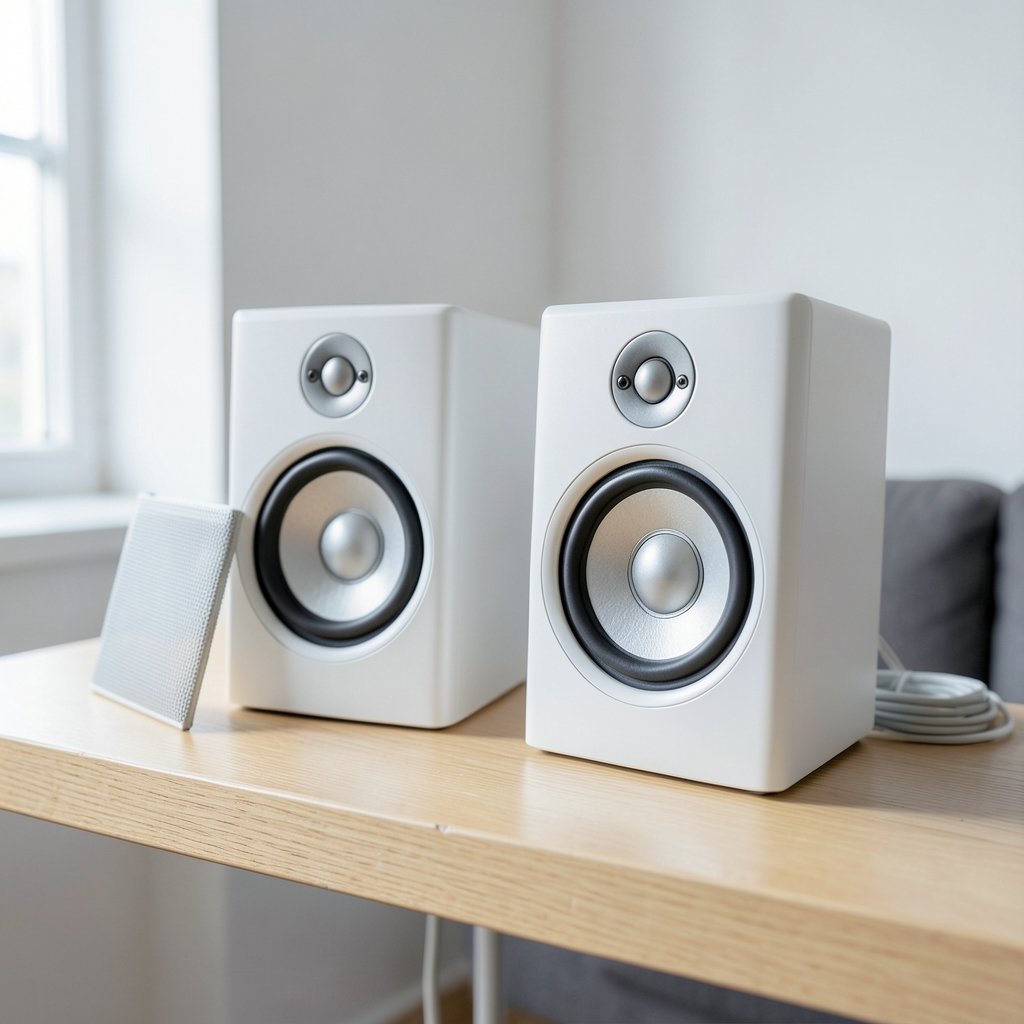
What if the speaker you choose matters far more than the price you pay for it? That is the strange truth about audio gear. A $150 pair of bookshelf speakers can embarrass a $500 soundbar, and a $60 Bluetooth puck can make a kitchen sing. Meanwhile, a big-name tower with a big-name price tag can leave you cold. The trick is not spending more. It is matching the speaker to the room, the source, and the way you actually listen. (Best buy jobs retail geek squad warehouse roles really pay)
Below is a shortlist of specific speakers worth considering, grouped by how people really use them. Each pick gets a plain explanation of who it suits, what it does well, one honest drawback, and a price only where a published review states one. A comparison table up top gives the quick view. A short buying guide follows the picks, not before them, so you can see the options first and then learn what separates them.
Comparison Table: Best Buy Speakers at a Glance
| Speaker | Best for | Standout strength | Watch out for | Stated price |
|---|---|---|---|---|
| Sonos Era 300 | Spatial audio and multiroom | Dolby Atmos from one box, room-filling sound | No Google Assistant or Cast support | $399 (listed at $499, save $100) |
| Sony ULT Tower 10 | Parties and big rooms | Enormous output, deep bass | Needs space and budget | $898 (listed at $1,199.99, save $301.99) |
| Klipsch The Sevens | Premium powered stereo | Plug-in-and-play hi-fi with streaming built in | Premium price tier | Not stated |
| Edifier R1280DB | Budget bookshelf stereo | Warm, full sound with Bluetooth and wired inputs | Modest bass from a 4-inch driver | Around EUR177.73 |
| Onkyo Creator GX-10DB | Desktop and near-field listening | Warm, rich sound with USB-C, optical, RCA, Bluetooth 5.3 | Awkward rear volume knob, odd remote | $250 |
| JBL Go 5 | Pocket-size portability | IP68 rating, 8 hours plus 2 with Playtime Boost | Small driver limits bass | Not stated |
| Ultimate Ears Wonderboom 4 | Outdoor portability | Balanced 360-degree sound, IP67, 14 hours | Not a critical-listening speaker | Not stated |
Sonos Era 300: The Best Pick for Spatial Audio

The Era 300 is the speaker to shortlist if Dolby Atmos interests you. It delivers room-filling spatial audio on its own, and it slots easily into a larger Sonos system for a theater-like result. Bass runs deep, highs stay bright, and the companion app offers room analysis plus adjustable EQ. Voice control works through Alexa and Sonos’s own commands, and streaming service support is wide.
The limitation is ecosystem politics. There is no Google Assistant and no Cast support, so Android households deep in Google’s world should think twice. The published price is $399, marked down from $499.
Sony ULT Tower 10: The Best Party Speaker
Some speakers are built for critical listening. This one is built for a crowd. The ULT Tower 10 throws enormous sound with serious low-end weight, which makes it the obvious pick for a basement, a garage, or a backyard gathering where volume is the point. If you have the floor space and the budget, it can carry a party on its own.
The catch is exactly what you would expect: it is large, it is loud by design, and it is not subtle. The listed price is $898, down from $1,199.99. Buyers shopping smaller rooms should look elsewhere.
Klipsch The Sevens: The Best Premium Powered Stereo Pair
Powered speakers, also called active speakers, carry their own amplification and often their own streaming smarts. You plug them in and play. The Sevens sit at the premium end of that category and are a sensible editor’s pick for anyone who wants serious stereo sound without assembling a stack of separate components.
What they do well is remove friction. Turntables, TVs, phones, and streaming all have a path in, and the sound quality steps up accordingly. The drawback is the premium tier itself. If your budget is modest, this is not the pair to stretch for, and the published research does not state a price, so check the official product page before committing.
Edifier R1280DB: The Best Budget Bookshelf Pair
This is the value pick that keeps showing up on affordable hi-fi lists, and for good reason. The R1280DB pairs crisp, rich sound with genuine versatility: Bluetooth for wireless playback, plus wired inputs for sources that need a cable. A 4-inch bass driver with a front-facing reflex port produces bass that is deeper than the size suggests, and the treble stays clear. Mids round things out into a warm, full presentation.
The system is one active speaker plus one passive, with three knobs on the active unit for source, bass, treble, and volume, and a remote for muting and track skipping. The limitation is scale. A 4-inch driver can only move so much air, so don’t expect club-level punch. The listed price is around EUR177.73.
Onkyo Creator GX-10DB: The Best Desktop Pair
Desktop listening has its own rules. Speakers sit close, angle matters, and inputs matter more than raw power. The GX-10DB fits that brief well. It produces a warm, rich sound, comes with angled stands to aim sound at your ears, and offers USB-C, optical, and stereo RCA inputs plus Bluetooth 5.3. It plays louder than some rivals in its class.
Two quirks keep it from being perfect. The volume knob sits on the back of the right speaker, which is a reach, and the slim remote has a layout that takes getting used to. Bass lovers will want to add a subwoofer, though there is a subwoofer-out port to make that easy. The stated price is $250.
JBL Go 5: The Best Tiny Bluetooth Speaker
The Go 5 is the speaker you toss in a bag and forget about until you need it. It carries the familiar JBL sound with deeper bass than its size implies, runs up to 8 hours on a charge, and adds roughly 2 more hours through Playtime Boost. Two units can pair for stereo, ambient lighting adds a bit of fun, and the IP68 rating means dust and water are not a concern. Color options are plentiful.
The trade-off is physics. A speaker this small cannot fill a large room, and bass is limited by the driver. For a pocket-sized companion, though, it is hard to argue with.
Ultimate Ears Wonderboom 4: The Best Outdoor Companion
The Wonderboom 4 leans on balance rather than boom. Its 360-degree sound spreads evenly, so it works whether it sits in the middle of a picnic table or on a shelf. Dedicated Outdoor and Boost modes adjust the tuning for open air or extra punch, and pairing two speakers widens the sound further. Battery life is rated up to 14 hours, charging runs over USB-C, and the IP67 rating covers dust and water resistance.
The honest limitation is that it is a portable speaker, not a hi-fi one. It will not reveal detail the way a bookshelf pair does. For outdoor use, that trade is usually worth it.
How to Choose Without Overpaying
Start with the room, not the spec sheet. A small bedroom and a large living room demand very different speakers, and buying for a room you don’t have is the most common mistake. Next, decide whether you want one box or two. A single wireless speaker is simple and portable. A stereo pair, even a modest one, images music far better.
The Wirecutter’s podcast on leveling up a sound system lays out a useful ladder: a wireless Bluetooth speaker first, then a pair of stereo or computer speakers, then proper bookshelf speakers on stands, which is where serious sound quality begins. Climbing that ladder deliberately beats jumping straight to the top.
Three practical mistakes show up again and again. People buy a speaker with no plan for where it will sit, then fight reflections and boominess forever. People ignore inputs and discover their turntable or TV has no way in. And people chase watts instead of listening, when placement and driver quality matter more than a number on a box. (Best buy black friday deals spot real savings)
If you are shopping at a big-box retailer, timing and coupons do real work. Speaker discounts are frequent, so patience pays. Check the current price against the normal street price, and treat a suspiciously large percentage off a suspiciously high list price with skepticism.
Finally, match the speaker to your other gear. If you already stream through one ecosystem, stay inside it. If you are building a desktop setup, prioritize inputs and ergonomics. And if you are outfitting a home gym or a corner for recovery, the same logic about fit and placement applies: the specs only matter once they match how you will use the thing.
Conclusion
The best speaker is not the most expensive one. It is the one that fits your room, your sources, and your habits. For spatial audio, the Sonos Era 300 earns the shortlist spot. For parties, the Sony ULT Tower 10 brings the noise. For budget stereo, the Edifier R1280DB punches far above its price, and the Onkyo Creator GX-10DB handles desktop duty with warmth. On the move, the JBL Go 5 and Ultimate Ears Wonderboom 4 cover portability without drama.
Pick the category first, then the model. That order of operations saves more money than any single discount.
Frequently Asked Questions
Are powered speakers better than passive speakers for most people?
For most people, yes. Powered speakers have built-in amplification, so you plug them in and play without sourcing an amp and cables. That simplicity is why powered models dominate desktop and small-room setups. Passive speakers offer more upgrade flexibility, but they demand more knowledge and more boxes.
How much should I spend on my first good pair of speakers?
Spend enough to get a real step up, but not so much that you skip the learning phase. Budget bookshelf pairs deliver surprising quality, and a pair like the Edifier R1280DB shows how much sound modest money buys. Upgrade later once you know what you actually value. (Best buy discount code actually saves you money)
Do I need a subwoofer with bookshelf speakers?
Not always, but often. Small drivers can only produce so much low-end, so a subwoofer fills in the bottom octave. Some desktop speakers, including the Onkyo Creator GX-10DB, include a subwoofer-out port to make adding one simple. Start without one and add it if bass feels thin.
Is Dolby Atmos worth it in a single speaker?
It can be. The Sonos Era 300 produces room-filling spatial audio on its own and integrates with other Sonos speakers for a wider effect. Whether it is worth it depends on how much you watch movies and whether your sources actually deliver Atmos content.
What is the most common mistake when buying speakers?
Buying for a room you don’t have. People choose speakers by price or reviews, then discover they are too large, too small, or badly placed. Measure the space, decide where the speakers will sit, and choose for that reality rather than for an imaginary listening room.
Should I wait for a sale to buy speakers?
Often, yes. Speaker discounts are common around major shopping events, and list prices are frequently marked down. Check the current price against the normal street price before buying, and treat a big percentage off a suspiciously high list price with skepticism.











