What if the highest-rated coffee shop on the map is actually the wrong place to walk into today?
That sounds like a strange question. Most people tap “best coffee near me,” scan the star ratings, pick the closest cluster of four-and-a-half stars, and go. It feels efficient. It also quietly hands the decision to a ranking system that was never designed to measure coffee quality.
The result is predictable. People end up in a crowded shop with mediocre espresso, a line out the door, and a pastry case doing more work than the barista. Meanwhile, the small roaster two blocks further out sits half empty, pulling shots that would make a trained taster sit up straight.
This guide is about closing that gap. It covers what “best” should actually mean when applied to coffee, how local search really works, which signals are worth trusting, and which ones are noise. It also covers the practical stuff nobody writes down: how to read a menu in ten seconds, when to walk out, and why a roast date matters more than a five-star average.
Why “best coffee near me” is a harder question than it looks
The phrase bundles two unrelated problems into one search box. The first is location: which coffee shops are physically close. The second is quality: which of those is actually good. Search engines are excellent at the first and structurally incapable of the second.
Google’s own explanation of local ranking makes this clear. Local results are ordered mainly by relevance, distance, and prominence. Relevance means how well a business matches what was searched. Distance means how far it is. Prominence means how well known and well regarded a place appears to be. None of those three is a measure of whether the espresso tastes good.
That distinction matters because it explains a pattern most people notice but rarely articulate. A shop can rank first for “coffee near me” and still serve a flat, bitter cup. It ranked well because it is close, its listing is complete, and it has accumulated a lot of reviews. Those are real signals. They are just not flavor signals.
There is a second trap. Ratings from different platforms are not comparable. A 4.6 built from 40 reviews is a different statistical animal from a 4.6 built from 4,000. Reviewers select themselves, moods vary, and a single bad Tuesday can drag a score down for months. Treating a star average as a quality grade is a category error, and it is the most common mistake in coffee searching.
What “best” should mean when you apply it to coffee
Here is where the conversation gets more useful. Coffee has a real, technical quality standard, and it is not a star rating.
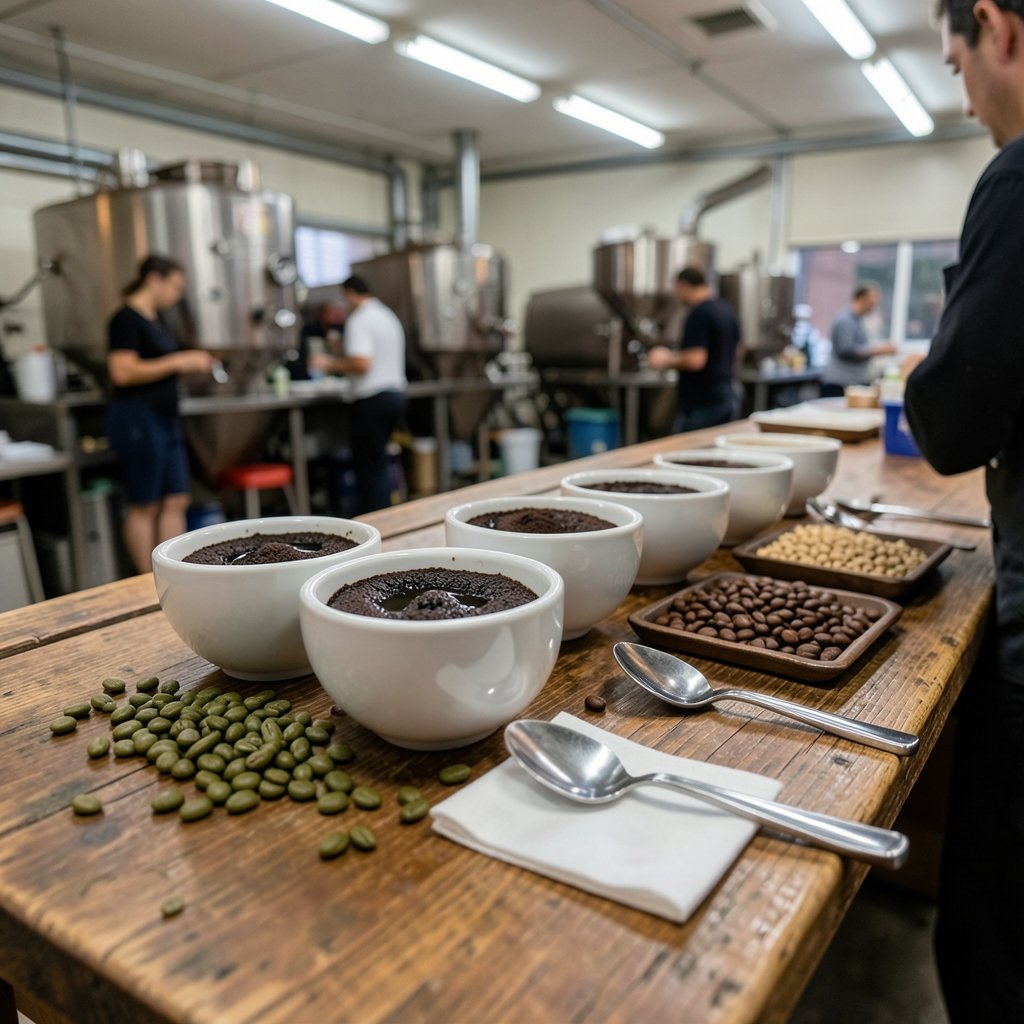
The specialty coffee grade is tied to green coffee grading. In broad terms, it means Arabica beans free of primary defects that score 80 or above on a 100-point scale in a controlled cupping. That score comes from a trained panel assessing defined attributes: fragrance and aroma, flavor, acidity, body, balance, sweetness, and aftertaste, among others.
Two things follow from this. First, “specialty” is a defined term, while “best” is not. Conflating them is the single most common error in coffee writing. A shop can serve specialty-grade coffee and still brew it badly. Second, a cupping score is a trained judgment, not an objective measurement. It is a much better judgment than a crowd average, but it is still a judgment.
For a person standing on a sidewalk with a phone, the practical translation is this: look for evidence of standards, not evidence of popularity. A shop that names its roaster, states the origin and process, and puts a roast date on the bag is signaling that it treats coffee as a product with a supply chain. That signal is worth more than half a star.
The criteria that actually predict a good cup
| Signal | Why it matters | How to check it in 30 seconds |
|---|---|---|
| Roast date on the bag | Coffee stales with exposure to oxygen, moisture, and time | Look for a printed roast date rather than only a “best before” date |
| Named roaster and origin | Shows the shop knows and stands behind its supply | Read the retail shelf or the menu header |
| Grinder setup | Fresh grinding per order protects flavor | Listen for the grinder running per drink |
| Menu focus | A short, confident menu usually beats a 60-item one | Count the espresso options |
| Staff knowledge | Baristas who can describe the coffee have usually tasted it | Ask one question about the current bean |
| Seating and hours | “Best” includes whether you can actually stay | Check before you commit to a long visit |
That last row is not a joke. If the plan is to work for two hours, a shop with three seats and no outlets is not the best coffee shop near you, no matter how good the espresso is. Criteria come first. Rankings come second.
How to read local search results without being misled
Local search is a tool, and like any tool it works better when the user understands its limits. A few habits make it far more reliable.
Start by searching for what you actually want, not the generic phrase. “Espresso bar near me,” “pour over coffee near me,” and “coffee shop with wifi near me” return meaningfully different results because relevance is part of the ranking. If a specific brew method matters to you, say so. The same logic applies to the filter coffee crowd: if the goal is a straightforward, well-made drip cup rather than a milk drink, it helps to know what actually makes the best instant coffee worth drinking when the shop option falls through, because the same freshness and grind principles carry over.
Second, read reviews for content, not score. Skip the five-star “great vibes!” entries and the one-star rants. Look for reviews that mention specific drinks, specific staff, or specific problems. Three reviews mentioning that the batch brew sits too long tell you more than a hundred generic compliments.
Third, treat review fraud as a real possibility. Fake and incentivized reviews are a documented problem, serious enough that regulators have acted. In the United States, a rule banning the sale or purchase of fake reviews and certain forms of review suppression took effect in October 2024. That does not mean every glowing review is fake. It does mean a wall of identical, overenthusiastic praise deserves a second look.
Fourth, check the things platforms do not rank. Local health inspection results are often public, and a posted inspection score is a more concrete signal than a star average. Hours, seating, noise level, and whether there is a queue at 8 a.m. on a Tuesday all live outside the ranking system.
And if the plan runs late, the search changes entirely. Night owls are better served by knowing which late night coffee shops actually stay open and serve properly rather than guessing at closing times.
Practical tips that separate a good coffee run from a wasted one
Experience, not theory, teaches most of this. These are the habits that consistently produce better cups.
Go at the right hour. Batch brew is at its best shortly after it is made. A shop that brews at 7 a.m. and holds the pot until noon is serving a different drink by 11. If drip is the plan, ask when the next batch goes on.
Watch the bar before you order. Are shots being pulled to order or sitting in a pitcher? Is milk being steamed per drink? A busy bar with a queue is often a better sign than an empty one, because volume keeps the coffee moving.
Ask one specific question. “What’s the current espresso, and how is it tasting?” is a fair question that any serious barista can answer. A blank look is information. So is a confident, detailed reply.
Do not judge a shop by its milk drinks alone. A very sweet latte can mask a lot. If you want to know whether the coffee is good, order it black once.
Check the retail shelf. If the shop sells beans, look at the roast dates. A shelf of bags dated two months ago tells you what the shop thinks about freshness, and that thinking usually shows up in the cup.
Avoid the trap of the crowded mediocre shop. High foot traffic can reflect location and marketing rather than quality. A shop near a transit stop will always be busy. That tells you about the transit stop.
Know when to walk out. No visible roast date anywhere, a grinder hopper full of dark, oily beans, a menu that lists eleven flavored syrups before the espresso, and a barista who cannot say what the house blend is. Any two of those together is a reasonable excuse to keep walking.
A note on caffeine and what you are actually ordering
Caffeine content varies widely between espresso, filter, and cold brew, and it varies again with dose, bean, and brew ratio. Most shops do not label it at the point of sale. For a public-health reference point, a widely cited European Food Safety Authority opinion from 2015 set 400 mg per day as a level of no safety concern for most adults. That is a daily ceiling, not a per-cup target, and it is worth keeping in mind if the plan involves a large cold brew at 4 p.m.
If the goal is to stay alert without overdoing it, the same reasoning applies to coffee at home. There is real interest in butter coffee and who should skip it, and the honest answer is that it is a preference with tradeoffs, not a universal upgrade. Knowing your own limits beats following a trend.
What to do when you find a shop you like
The single most useful thing a coffee drinker can do is build a short list and stop searching from scratch every time.
Keep three or four places, each with a defined role: the fast morning espresso, the sit-down work spot, the weekend destination, and the emergency backup. Note the roast date pattern, the busy hours, and which drink each shop does best. That list will outperform any search engine, because it is built on your own taste rather than a crowd average.
It also helps to understand what you are buying when you go deeper. Choosing beans for home brewing follows the same logic as choosing a shop: roast level, origin, and freshness do most of the work, and the guide to picking espresso beans by roast, origin, and freshness covers the details. Once you know how those variables behave, reading a shop’s menu becomes much faster.
For anyone who wants to go further, spent grounds have a second life beyond the cup, and the practical uses for spent coffee grounds in the garden are a decent place to start. It is a small thing, but it turns a daily habit into something slightly less wasteful.
Conclusion
The best coffee near you is not the highest-rated result on the map. It is the shop that can tell you what it is serving, when it was roasted, and why it chose it, and that happens to be within a walkable distance of where you are standing.
Search engines will keep ranking by relevance, distance, and prominence, and that is fine. Those are useful filters. They are just not a quality grade, and treating them as one is how people end up disappointed in a shop with a 4.7 average. Use the map to narrow the field. Use roast dates, menu focus, staff knowledge, and your own taste to make the call.
Then write the good ones down. A short personal list beats a fresh search every single time.
Frequently Asked Questions
How do I find the best coffee near me quickly?
Search for the specific thing you want rather than the generic phrase, then filter by signals that predict quality. Look for a printed roast date, a named roaster, and a short focused menu. Read a handful of reviews for specific details rather than the overall score, and check the hours before you commit. A shop that answers one question about its current espresso confidently is usually a safe bet.
Are high star ratings a reliable sign of good coffee?
No. Star ratings reflect self-selected reviewers, and averages from different platforms are not comparable. A 4.6 from 40 reviews and a 4.6 from 4,000 are different measurements. Ratings are also vulnerable to fake and incentivized reviews, which is why regulators have moved to ban their sale and purchase. Treat ratings as one weak signal among many, not as a quality grade.
What does “specialty coffee” actually mean?
It is a defined grade rather than a marketing word. In broad terms, specialty coffee means Arabica beans free of primary defects that score 80 or above on a 100-point scale in a controlled cupping assessed by trained tasters. A shop can serve specialty-grade coffee and still brew it poorly, so the label is a starting point, not a guarantee.
Does the roast date on a bag really matter?
Yes, and it is one of the few signals you can check in seconds. Roasted coffee loses quality with exposure to oxygen, moisture, and time. Specific recommended windows vary by roaster and brewing method, so there is no single universal number, but a bag with a recent printed roast date is a much better sign than one with only a vague best-before stamp.
How much caffeine is in a cup of coffee?
It varies widely. Espresso, filter, and cold brew differ substantially per serving, and the numbers shift again with dose, bean, and brew ratio. Most shops do not label caffeine at the point of sale. As a general public-health reference, a 2015 European Food Safety Authority opinion set 400 mg per day as a level of no safety concern for most adults, which is a daily ceiling rather than a per-cup target.
Is it worth trying a shop’s plain black coffee first?
It is the fastest way to judge the coffee rather than the milk and syrup. A sweet latte can hide a lot of problems, while a black filter coffee or a plain espresso shows the roast, the grind, and the brewing in full. If the black coffee is good, the milk drinks almost certainly will be too.