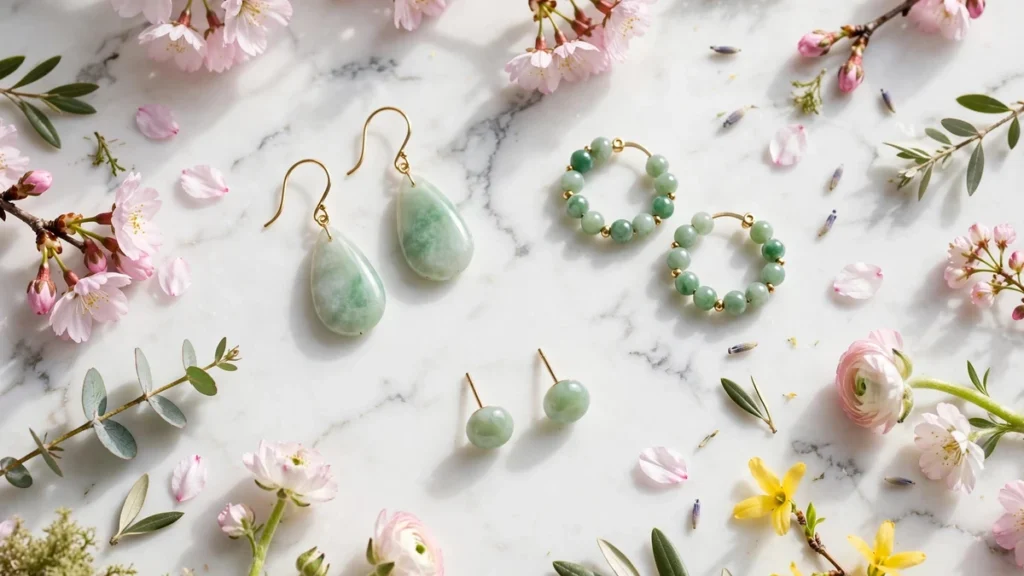
Jade earrings are the green note of spring jewellery. They bring a calm, cool colour that works with white linen, pale denim and soft neutrals, and they have a smooth, polished feel that no other stone quite matches. The problem is not finding jade earrings. It is finding a pair made from real, untreated jade with an even colour and a good polish, rather than a dyed or heavily treated stone that looks bright in the shop and dull at home.
That is why this guide is organised by jade type and treatment, not just by brand name. A small pair of well-polished nephrite studs can look better than a large pair of dyed jadeite, and a good pair of natural jadeite drops can be worth the price if you wear them often. Price alone is a poor guide. Some of the most wearable pairs are mid-priced, and some of the most expensive are the hardest to wear every day.
Below are nine jade earrings worth considering for spring 2027, from classic nephrite studs to modern jadeite drops and statement carved pairs. Each one is described by what it is good at, what to watch for, and who it suits best, so you can choose with your wardrobe and your budget in mind, not just a bestseller list.
Key takeaways
- Jade earrings suit spring because their cool green works with light fabrics, pale colours and bare necks, from everyday studs to occasion drops.
- Colour and polish matter more than size: an even, translucent green with a smooth, glassy polish looks better than a larger stone with a dull or blotchy surface.
- Nephrite is the tougher, more affordable jade, while jadeite is the rarer, more vivid and more expensive one, and both can be beautiful when untreated.
- Ask about treatment: bleaching, polymer filling and dyeing are common, and a reputable seller should disclose them plainly.
- No jade is an investment, and no jade has proven healing properties, and a pair that is heavily dyed, cloudy, or coated to hide its surface should be avoided.
What jade actually is
Jade is not one stone. It is two different minerals that look similar and have been used in the same way for centuries. Nephrite is a tough, fibrous mineral that is usually a soft, even green, sometimes with a creamy or grey tone. Jadeite is a rarer mineral that can be a vivid, almost glowing green, as well as lavender, white and yellow. Both are called jade, but they behave differently and they are priced very differently.
Nephrite is the tougher of the two. Its interlocking fibres make it very resistant to chipping, which is why it has been carved for thousands of years. It is usually a softer, more muted green, and it is the more affordable choice for everyday earrings. Jadeite is harder and can take a brighter, glassier polish, and the finest jadeite, a vivid, even, translucent green, is among the most expensive gemstones in the world. Most jadeite earrings sold at ordinary prices are a paler or more mottled green, which is normal and honest, as long as the seller says so.
What matters when you buy is not the label but the look and the treatment. Hold the earrings in daylight and look for an even colour, a smooth surface, and a polish that reflects light cleanly. A good piece of jade has a soft, deep glow rather than a flat, painted look. If the green looks unnaturally bright and uniform, ask whether the stone has been dyed. If the surface looks cloudy or waxy, ask whether it has been bleached or filled with polymer.
How we chose these earrings and what to look for
Look first at the colour and the polish. An even, translucent green with a smooth, glassy surface is the best sign of a good piece of jade, and it matters more than size. A small stud with a clean, even colour will look better than a large drop with a blotchy, dull surface. If you can, compare pairs side by side in daylight, not under shop spotlights, which flatter everything.

Look next at the treatment. Jade is often treated, and not all treatments are bad, but all of them should be disclosed. Bleaching followed by polymer filling, known in the trade as Grade B jade, removes brown stains and makes the stone look cleaner, but it is less durable and less valuable than untreated jade. Dyeing, known as Grade C, adds colour to a pale stone and can fade or look unnatural. The best choice for most buyers is untreated jade, often called Grade A, with its natural colour and a good polish.
Finally, look at the setting and the clasp. Jade is tough, so it does not need as much protection as a soft stone, but the setting should still hold it securely and suit its colour. A bezel setting shows off a cabochon well, while a prong setting suits a faceted stone. For studs, a secure butterfly or screw back matters, because a lost jade stud is a lost jade stud. Our guide to the best diamond earrings of 2027 uses the same setting checks, because a good setting protects any stone, and a weak one lets it go.
The 9 best jade earrings for spring 2027
Tiffany & Co. Studs
What we like: Classic nephrite studs in a clean, understated setting, with an even green colour and a smooth polish, from a house that discloses its materials plainly. What to consider: Premium price, and the setting is deliberately simple, so you are paying for the stone and the name. Stone: Nephrite jade, soft even green. Setting: 18k gold bezel setting. Best for: Everyday elegance and occasions. Price range: Premium.
The classic choice for a reason. These are the studs to buy if you want one pair that works with everything, from a white shirt to a wedding guest dress, and you want the grading to be done for you.
Cartier Studs
What we like: Well-matched jadeite studs with an even colour and a bright, glassy polish, set in a refined, secure mount with the house’s usual attention to finish. What to consider: A luxury price for a simple design, and the stones are on the smaller side for the cost. Stone: Jadeite, even green. Setting: 18k gold bezel setting. Best for: Classic, understated dressing. Price range: Premium.
A quiet, polished pair that does not try to be fashionable. If your style is classic and you wear jade studs most days, these are a strong, if expensive, choice.
David Yurman Studs
What we like: Nephrite studs with a soft, even green in the house’s signature cable setting, which adds a distinctive detail without overwhelming the stone. What to consider: The cable detail is not to every taste, and the green is softer than a vivid jadeite. Stone: Nephrite jade, soft green. Setting: Sterling silver or 14k gold cable setting. Best for: Everyday wear with a designer detail. Price range: Mid to premium.
A good middle ground between a plain stud and a statement piece. The cable work gives the earrings character, and the nephrite keeps the price below a luxury jadeite pair.
Mejuri Stud Earrings
What we like: Nephrite studs at a fair price, with a clean, modern setting and a straightforward, honest description of the stone. What to consider: The stones are smaller and the green is softer than a premium jadeite pair, and the setting is minimal. Stone: Nephrite jade, soft green. Setting: 14k gold vermeil or solid gold bezel setting. Best for: Everyday wear and first jade studs. Price range: Affordable to mid.
One of the best value pairs in this guide. If you are buying your first jade studs, or you want a pair you can wear daily without worrying, start here.
Monica Vinader Studs
What we like: Nephrite studs with a soft, even green, in a clean setting that suits both casual and smart outfits. What to consider: The stones are on the smaller side, and the vermeil setting needs more care than solid gold. Stone: Nephrite jade, soft green. Setting: 18k gold vermeil bezel setting. Best for: Daily wear and spring outfits. Price range: Affordable to mid.
Missoma Stud Earrings
What we like: Jadeite studs with a fresh, slightly brighter green and a modern, clean setting, at a fair price for the stone. What to consider: The colour is paler than a fine imperial green, and the pair will not be perfectly matched in the way a premium pair is. Stone: Jadeite, pale to mid green. Setting: 18k gold vermeil bezel setting. Best for: Relaxed, modern spring looks. Price range: Affordable to mid.
Maria Black Studs
What we like: A single nephrite stone on a fine, minimal post, with a contemporary, sculptural feel that suits spring’s clean lines. What to consider: The design is deliberately minimal, so the stone does all the work, and the pair is small. Stone: Nephrite jade, soft green. Setting: Sterling silver or gold-plated post setting. Best for: Minimal, modern outfits. Price range: Affordable to mid.
Astrid & Miyu Drops
What we like: Jadeite drops on a fine chain, with a soft movement that catches the light when you turn your head, at a fair price. What to consider: Drops are less practical than studs for everyday wear, and the chain needs care to avoid tangling. Stone: Jadeite, mid green. Setting: Gold-plated drop setting on a fine chain. Best for: Spring occasions and evenings. Price range: Affordable to mid.
The prettiest pair in this guide for an occasion. The drops move gently and the green glows in evening light, which makes them a good choice for weddings and spring parties.
Thomas Sabo Drops
What we like: Nephrite drops with a clean, classic shape and a secure hook, offering a dressier look without a luxury price. What to consider: The stones are smaller than a jadeite pair, and the hook style needs a secure fit to sit straight. Stone: Nephrite jade, soft green. Setting: Sterling silver or gold-plated drop setting. Best for: Occasions and smart spring outfits. Price range: Affordable to mid.
Which jade earrings are right for you
If you want one pair for every day, choose a nephrite stud in a small to medium size. Nephrite is tough, it resists chipping, and its soft green suits most skin tones and most outfits. It is also the more affordable jade, so you can buy a good pair without a luxury budget. A bezel setting protects the stone and shows off its colour well.
If you want a pair for occasions, consider jadeite drops. Jadeite takes a brighter polish and can be a more vivid green, which makes it stand out at a wedding or a spring party. Drops suit hair worn up and bare necks, which is exactly how spring dressing often works. For everyday gold jewellery that pairs well with jade, our guide to the best gold jewellery for everyday wear is a useful starting point, because a simple gold chain or bracelet keeps the look balanced.
If you have sensitive ears, check the metal before you buy. Gold posts are usually the safest choice, and a screw back or a secure butterfly back will keep the earring in place. Avoid nickel-plated posts if your ears react easily, and try the earrings on for an hour before you commit to wearing them all day.
The caveats that matter
Jade is tough, but it is not immune to damage or to dishonest selling. Nephrite sits at Mohs 6 to 6.5 and jadeite at 6.5 to 7, which makes both harder than pearl and most soft stones, but they can still chip if dropped on a hard floor or knocked against a metal surface. A bezel setting protects the edges, which is where chips usually start, and it is worth choosing for a stone you plan to wear often.
| Detail | What is known |
|---|---|
| What jade is | Two minerals: nephrite (tougher, softer green, more affordable) and jadeite (rarer, brighter, more expensive) |
| Best value for everyday wear | Nephrite: tough, even green, fair price, resists chipping well |
| Luxury choice | Fine jadeite: vivid, even, translucent green, among the most expensive gemstones |
| Hardness | Nephrite Mohs 6 to 6.5, jadeite Mohs 6.5 to 7: hard, but can still chip if dropped |
| Treatments to ask about | Grade A is untreated; Grade B is bleached and polymer-filled; Grade C is dyed |
| What to avoid | Heavily dyed stones, cloudy or waxy surfaces, mismatched pairs, sellers who will not disclose treatment |
| Care | Clean with warm soapy water and a soft cloth, store separately, avoid hard knocks |
| What jade does not do | It is not an investment and has no proven healing properties |
Treatment is the biggest trap in jade buying. A stone that has been bleached and filled with polymer can look clean and bright, but it is less durable and less valuable than untreated jade, and the filling can yellow or crack over time. A dyed stone can look unnaturally vivid, and the colour can fade or look patchy under magnification. Always ask whether the jade is untreated, and buy from a seller who answers plainly. If a seller cannot or will not say, walk away.
Checklist: choosing jade earrings honestly
Use these checks before you buy, and again when the earrings arrive.
- Check the colour in daylight: look for an even, translucent green, not a blotchy, cloudy or unnaturally bright surface.
- Check the polish: the surface should be smooth and glassy, reflecting light cleanly, not dull or waxy.
- Check the pair matches: the two stones should be the same size, colour and polish.
- Check the treatment: ask whether the jade is untreated (Grade A) and avoid undisclosed bleaching, filling or dyeing.
- Check the setting: a bezel setting protects the edges of a cabochon, and a secure back keeps studs in place.
- Check the metal and the back: gold posts suit sensitive ears, and a secure butterfly or screw back keeps studs in place.
Frequently asked questions
What is the difference between nephrite and jadeite?
They are two different minerals, both called jade. Nephrite is tougher, usually a softer green, and more affordable. Jadeite is rarer, can be a brighter and more vivid green, and is more expensive. Both are real jade, and both can be beautiful when untreated.
How can I tell if jade is dyed?
Dyed jade often looks unnaturally bright and uniform, with colour concentrated in cracks or veins. Under a loupe, the colour may look patchy. The safest check is to ask the seller directly and buy from a reputable source that discloses treatment in writing.
Can I wear jade earrings every day?
Yes. Jade is hard and tough, so it stands up to daily wear better than most soft stones. Keep the earrings clean with warm soapy water and a soft cloth, store them separately from harder jewellery, and avoid dropping them on hard floors.
How do I clean jade earrings?
Wash them in warm water with a drop of mild soap, rinse, and dry with a soft cloth. Avoid ultrasonic cleaners if the jade has been treated, and never use harsh chemicals or abrasive cloths.
Do jade earrings suit spring?
Very well. Their cool green suits light fabrics, pale colours and bare necks, and they work with everything from a linen shirt to a wedding guest dress. Studs are the everyday choice, drops are the occasion choice. For more seasonal jewellery ideas, our guide to the best diamond necklaces of 2027 shows how the same setting checks apply across the seasons.
Are jade earrings a good investment?
No. Jade is jewellery to wear and enjoy, not an investment. Only the finest untreated jadeite holds high value, and most jade earrings do not increase in value over time. Buy them because you love wearing them, not because you expect a return.
The bottom line
The best jade earrings for spring 2027 are not the biggest or the most expensive. They are the pair with an even colour, a smooth glassy polish, a matched pair and a secure setting that you will actually wear. For most people, that means an untreated nephrite stud for every day, with a jadeite drop kept for occasions.
Choose one pair, check the colour in daylight, ask about treatment, and look after them with warm soapy water and a soft cloth. Jade rewards honest buying with years of calm, cool green, and spring is the season it suits best.