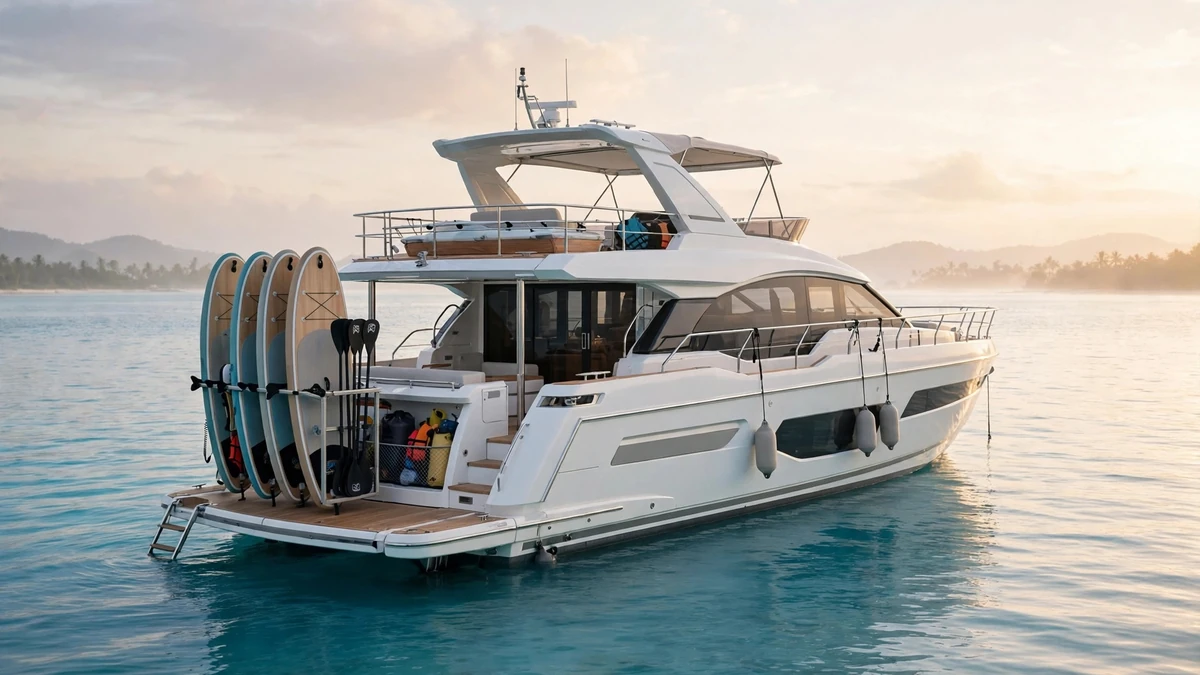

Paddleboarding from a yacht is the calmest way to start a day at sea. You step onto a board from the swim platform, find your balance on flat water, and glide over a reef or along a cliff face while the yacht sits at anchor behind you. There is no engine, no spray and no rush, just the board, the paddle and the coastline, and when you are done you climb back on board for breakfast.
The problem is that not every yacht is good at it. Some carry a single inflatable board and a pump, and call that a paddleboarding programme. Others carry a fleet of rigid and inflatable boards in different sizes, plus a crew member who can teach a beginner to stand up in ten minutes and plan a route that suits the wind. The difference between those two yachts is the difference between a wobbly ten minutes and a trip you actually enjoy.
Below are nine yachts worth considering for a paddleboarding trip in 2027, from a 162-metre flagship with a full watersports deck to a 67-metre yacht built for active days. Each one is described by what it is good at, what to watch for, and who it suits best, so you can choose with your balance in mind, not just a brochure.
Key takeaways
- A good paddleboarding yacht carries several boards in different sizes, including wide stable boards for beginners, and a crew member who can teach.
- Early morning is usually the best paddling window, before the wind picks up, and flat, sheltered water makes learning far easier than open sea.
- Rigid boards are faster and more stable in a breeze, while inflatable boards are softer to fall on and easier to store and launch.
- Charter rates are weekly and indicative, and they usually exclude tax, fuel, food, drinks and tips, so ask for the full figure in writing before you book.
- No yacht can guarantee calm water, good visibility or a particular route, and paddleboarding always depends on the weather on the day.
What a paddleboarding trip from a yacht actually means
A paddleboarding yacht trip is a charter where stand-up paddleboarding is a real part of the day, not a token toy. The yacht anchors in a sheltered bay, the crew launches boards from the swim platform, and you paddle for an hour or two, usually in the morning, before the wind rises. Routes follow the coast: a reef edge, a mangrove channel, a quiet beach, a cliff base. You return to the yacht for lunch and a swim, and the yacht moves to a new anchorage for the afternoon or the next day.
What makes it work is the combination of a stable board and local knowledge. A good crew knows which bays are flat in the morning, which channels are safe at low tide, and which beaches are worth the paddle. They also know when not to go: a rising wind, a strong current or a busy boat lane is a reason to stay on board, not a challenge to push through. That judgement is what you are really chartering, as much as the yacht itself.
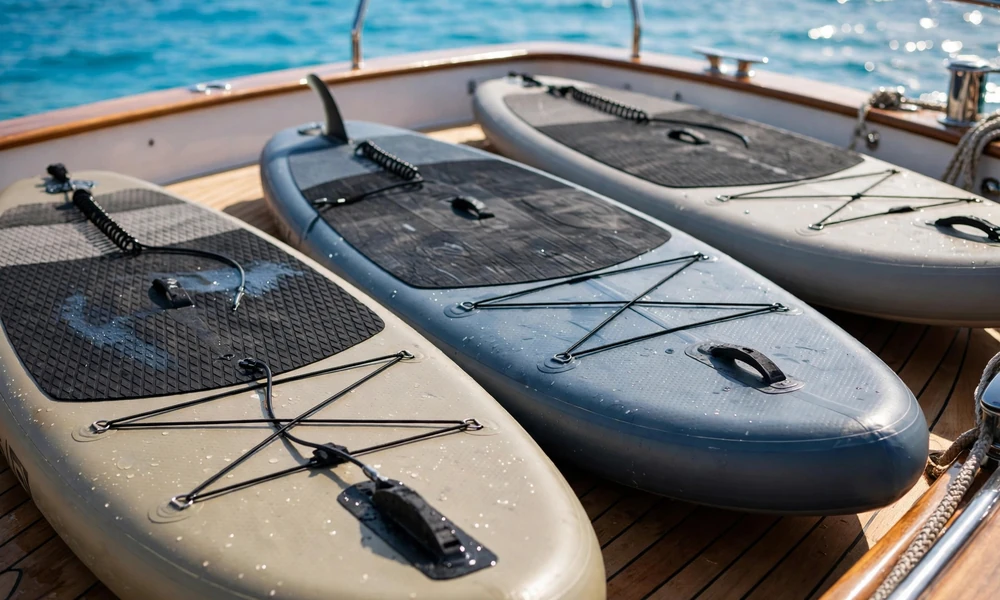
The boards themselves matter more than most people expect. A wide, thick board is forgiving for a first-timer and comfortable for a longer paddle, while a narrow touring board is faster but tippier. Inflatable boards are soft to fall on and easy to launch, while rigid boards track better in a breeze. Ask what the yacht carries before you book, and match it to who is paddling: beginners, children and nervous swimmers need stability first, while confident paddlers can ask for touring boards and longer routes.
How we chose these yachts and what to look for
Look first at the board fleet. A yacht that is serious about paddleboarding carries at least four boards in different sizes, including wide beginner boards, and stores them where they can be launched quickly. A single board on a yacht that also lists jet skis, seabobs and a slide is a sign that paddleboarding is a footnote. Ask how many boards there are, what type they are, and whether the crew includes someone who teaches and plans routes, rather than simply handing you a paddle.
Look next at the platform and the tender. A wide swim platform at water level makes launching and landing easy, especially for beginners and older guests. A capable tender matters too, because it can drop you at the start of a one-way paddle and collect you at the other end, which turns a short out-and-back into a proper coastal journey. Our guide to chartering a luxury yacht explains the basics of how a charter is put together, and it is worth reading before you start comparing boats.
Finally, look at the cruising ground. Paddleboarding is best where the water is flat and the coast is interesting: the lagoons of the Seychelles, the bays of Croatia and Greece, the mangroves of the Bahamas, the calm mornings of the Mediterranean. A yacht that spends its season in open, exposed water will offer fewer good paddling days than one based in a sheltered archipelago. Ask the broker where the yacht will be, what the typical conditions are, and what the plan is on a windy day.
The 9 best luxury yachts for paddleboarding trips of 2027
M/Y Eclipse
What we like: A 162-metre flagship with a huge watersports deck, several paddleboards and a crew used to planning full activity days, plus a pool, spa and cinema. What to consider: A very large yacht with a very large rate, and paddleboarding is one of many activities. Length: 162 m. Guests: 24. Best For: Large groups who want everything. Charter Price Range: From about €2,000,000 per week.
M/Y Flying Fox
What we like: A 136-metre yacht with a generous beach club, several paddleboards and a crew that takes watersports seriously, plus two helipads and a large spa. What to consider: High demand in peak season, so book early for the best weeks. Length: 136 m. Guests: 25. Best For: Groups who want variety. Charter Price Range: From about €1,800,000 per week.
M/Y Serene
What we like: A 134-metre yacht with a full watersports setup, including paddleboards, and a crew that plans proper coastal days, plus a large sun deck and spa. What to consider: A large yacht, so it needs a capable local agent to find the best anchorages. Length: 134 m. Guests: 24. Best For: Families who want paddleboarding plus comfort. Charter Price Range: From about €1,500,000 per week.
M/Y Dilbar
What we like: A 156-metre yacht with one of the largest watersports inventories afloat, including several paddleboards, and a crew used to running a full activity programme. What to consider: A very large yacht, so anchorages need to be chosen with care. Length: 156 m. Guests: 36. Best For: Very large groups and celebrations. Charter Price Range: From about €1,900,000 per week.
M/Y Kismet
What we like: A 122-metre yacht with a strong watersports setup, including paddleboards and a good tender, and a striking, design-led interior. What to consider: A high rate for a yacht of this size, reflecting its finish and capability. Length: 122 m. Guests: 12. Best For: Design-led cruising with active mornings. Charter Price Range: From about €1,400,000 per week.
M/Y Amadea
What we like: A 106-metre yacht with paddleboards, a good beach club and a crew that takes watersports seriously, plus a pool and a large sun deck. What to consider: Popular in peak season, so the best weeks go early. Length: 106 m. Guests: 16. Best For: Active groups who paddle daily. Charter Price Range: From about €1,100,000 per week.
Amadea suits a group that wants to paddle every morning. The boards are well maintained, the beach club makes launching easy, and the crew is happy to plan a different route each day.
M/Y Here Comes The Sun
What we like: An 83-metre yacht with a solid paddleboard setup, a good swim platform and a crew that plans gentle coastal days, plus a bright, comfortable interior. What to consider: Smaller than the flagships, so it suits sheltered waters best. Length: 83 m. Guests: 12. Best For: Families in the Mediterranean or Caribbean. Charter Price Range: From about €700,000 per week.
Here Comes The Sun is a comfortable, unpretentious choice for a family paddleboarding week. The boards are easy to launch, the crew is friendly, and the yacht is the right size for island-hopping in calm water.
M/Y Seawolf X
What we like: A modern explorer with paddleboards, a beach club and a crew used to active days, plus a striking catamaran-style layout with huge deck space. What to consider: A newer design, so availability can be limited in peak weeks. Length: 43 m. Guests: 12. Best For: Active groups who want deck space. Charter Price Range: From about €350,000 per week.
Seawolf X is for paddlers who want space and stability. The wide decks make launching easy, the boards are well kept, and the yacht is designed around life outdoors, which is exactly what a paddleboarding trip needs.
M/Y Callisto
What we like: A yacht with paddleboards, a good tender and a crew that knows how to run a relaxed coastal day, plus a comfortable interior and a large sun deck. What to consider: Limited to sheltered waters in a breeze. Length: 63 m. Guests: 12. Best For: Couples and small families. Charter Price Range: From about €450,000 per week.
Callisto is a good mid-size choice for a first paddleboarding charter. The paddling is gentle, the crew is attentive, and the yacht is comfortable without being overwhelming.
Which paddleboarding yacht is right for you
Beginners and families should look for wide, stable boards, a wide swim platform and a crew that teaches. The yacht does not need to be the biggest; it needs to be the easiest to launch from, with a crew that is patient and a tender that can collect you if you get tired. A smaller yacht in a sheltered bay will give you more good paddling days than a huge flagship in open water.
Confident paddlers can ask for touring boards, longer routes and one-way paddles with a tender pickup. Larger yachts with a proper watersports deck suit this best, because their crews are used to planning around wind and tide, and their tender fleets can support a proper coastal journey. If you want to paddle for two hours and cover real distance, say so before you book, and ask what the yacht can actually support.
Groups with mixed abilities need a yacht with boards in different sizes, and a crew that splits the group without fuss. One person gliding confidently while another kneels and finds their balance is normal, and a good crew plans for it. A luxury hotel in Santorini can be a useful backup if the weather turns, but the real answer is a crew that has a plan B for a windy day, whether that is a sheltered lagoon, a different anchorage or a morning ashore.
The caveats that matter
Paddleboarding from a yacht is safe and enjoyable when it is planned well, but it is still an activity on open water. Wind, tide and current change through the day, and water that is flat in the morning can be choppy by midday. A good crew plans around that, keeps the group together, and carries a radio and a safety tender. If a crew seems relaxed about weather, currents or life jackets, that is a warning sign, not a sign of confidence.
| Detail | What is known |
|---|---|
| Best time to paddle | Early morning, before the wind picks up, usually for one to two hours |
| Best boards for beginners | Wide, thick inflatable boards, launched from a swim platform |
| What the rate usually excludes | Tax, fuel, food, drinks, tips and local licences or park fees |
| Who should be cautious | Non-swimmers, young children and anyone with a medical condition should tell the crew first |
| What the crew should provide | Life jackets, a leash, a radio, a safety tender and a route planned around wind and tide |
| Best cruising grounds | Sheltered bays and lagoons: Croatia, Greece, the Seychelles, the Bahamas, the Mediterranean |
| What to pack | Reef-safe sunscreen, a hat, water shoes and a dry bag for phone and camera |
| What no yacht can guarantee | Calm water, a particular route, good visibility or good weather on a given day |
If you are travelling with children, check the age and swimming requirements before you book, and make sure there are life jackets in children’s sizes. If you take medication or have a medical condition, tell the captain, not just the broker, so the crew can plan properly. And wear reef-safe sunscreen: it protects the reef you are paddling over as well as your skin.
Checklist: choosing a paddleboarding yacht honestly
Use these checks before you book, and again when you step on board.
- Check the board fleet: at least four boards in different sizes, including wide beginner boards.
- Check the launch: a wide swim platform at water level, or a tender that can drop and collect you.
- Check the crew: someone who teaches and plans routes, not just someone who hands out boards.
- Check the cruising ground: sheltered water with interesting coast, not open sea with few anchorages.
- Check the full price: weekly rate, tax, fuel, food, drinks, tips and any licences, all in writing.
- Check the plan B: what happens on a windy day, and whether the crew has a sheltered alternative.
Frequently asked questions
Do I need paddleboarding experience to charter a paddleboarding yacht?
No. Most guests are beginners, and a good crew starts with a short, sheltered session on a wide board, often kneeling first and standing up when you are ready. Tell the crew your experience level honestly, and they will plan a route that suits you.
What should I wear for paddleboarding from a yacht?
Light, quick-drying clothes, water shoes and a hat, plus reef-safe sunscreen. The crew will provide a life jacket and a leash. Bring a dry bag for your phone and camera, and a light windproof layer for the return if the breeze picks up.
Can children paddleboard from a yacht?
Yes, usually on a wide board with an adult nearby, and only with a properly fitting life jacket. Check the age and swimming requirements with the broker before you book, and tell the crew if a child is a nervous swimmer so they can plan a short, calm session.
What happens if the weather is bad?
The crew will change the plan: a sheltered lagoon, a different anchorage, a shorter paddle, or a morning ashore. Paddleboarding is weather-dependent, and a good crew would rather change the route than push through a rising wind. Ask about the plan B before you book.
Are paddleboards included in the charter rate?
Usually yes, as part of the yacht’s watersports equipment, but confirm it in writing. The weekly rate itself usually excludes tax, fuel, food, drinks, tips and any local licences or park fees, so ask for the full figure before you commit.
Which is better for a first trip, the Mediterranean or the Caribbean?
Both work well. The Mediterranean suits island-hopping in Croatia and Greece, with short paddles between anchorages, while the Caribbean suits longer, warmer days in the Bahamas and the Grenadines. Our St Barts travel guide can help you pick a region if you are combining the trip with a celebration, but the real deciding factor is where the yacht will be and what the local conditions are in your chosen week.
The bottom line
The best luxury yacht for a paddleboarding trip in 2027 is not the biggest or the most expensive. It is the one with a proper board fleet, a crew that teaches and plans routes around the wind and tide, and a cruising ground with flat, sheltered water and an interesting coast. For a big group celebration, a flagship like Eclipse or Flying Fox is the right call. For a family week in the Mediterranean or the Caribbean, a mid-size yacht like Here Comes The Sun or Callisto will give you more good paddling days for less money.
Ask about the boards, the launch, the crew and the plan B before you book, and get the full price in writing. Then paddle early, wear reef-safe sunscreen, and let the yacht do what it does best: carry you to a coastline you could never reach any other way.