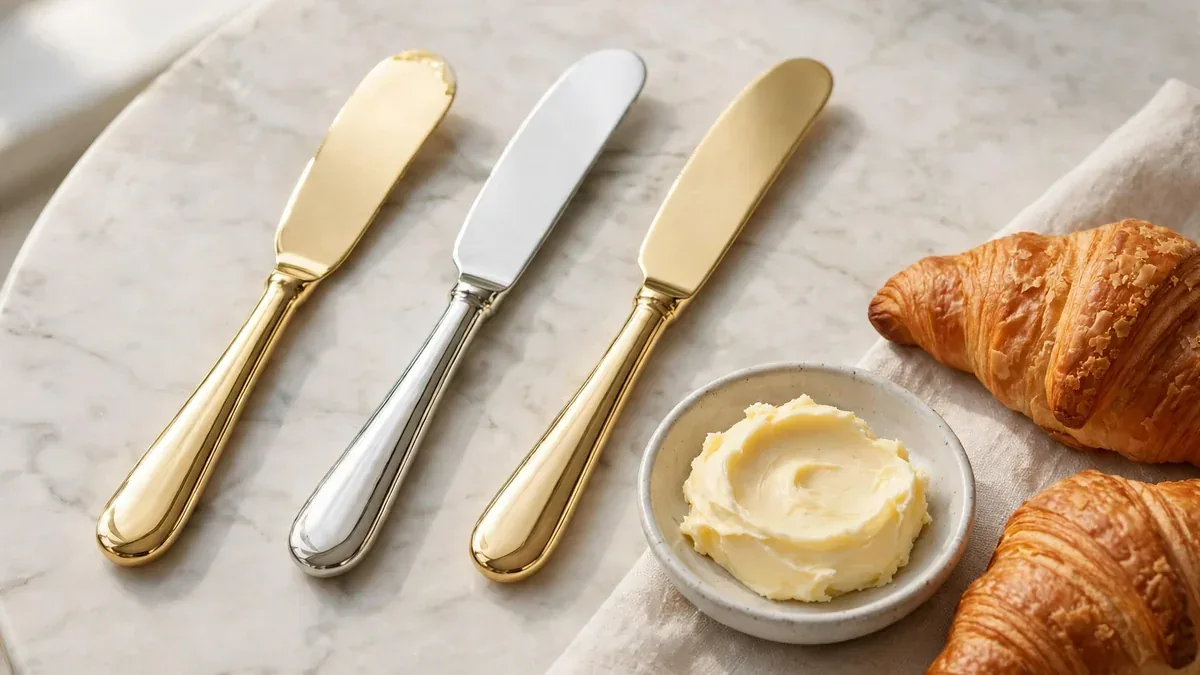

The Best Luxury Butter Knife Brands turn a small, everyday tool into a quiet statement of taste. A butter knife is used at almost every breakfast, brunch and dinner table, yet it is the piece of flatware most people never think about until they hold a truly fine one. The best luxury butter knife brands understand this: they craft spreaders with the same care they give to their grandest serving pieces, using sterling silver, heavy silverplate or polished 18/10 stainless steel.
A luxury butter knife is not a sharp knife, and that distinction matters. Its blade is flat, broad and deliberately blunt, with a rounded tip, designed to scoop, spread and serve rather than cut. The finest examples feel substantial in the hand, carry a mirror or satin finish that survives years of use, and sit comfortably beside formal china as well as everyday stoneware.
This guide looks at the brands that do butter knives best, from French silver houses to Scandinavian design studios and Italian steel makers. It compares materials, craftsmanship, design and price, and explains how to choose a butter knife that matches your table, your habits and your budget.
Key takeaways
- Christofle, Georg Jensen and Puiforcat lead the field in sterling silver and silverplate butter knives, with heritage craftsmanship and prices to match.
- A true butter knife has a flat, blunt blade with a rounded tip; it spreads and serves butter, and it is not a cutting knife or a cheese knife.
- Sterling silver offers the most prestigious finish but needs regular polishing, while 18/10 stainless steel is the practical choice for daily use.
- Weight and balance matter more than decoration: a good butter knife should feel solid, sit comfortably in the hand and rest neatly on a butter dish.
- Buy butter knives to match the flatware you already own, or choose a single statement piece if your table is a mix of styles.
What Makes a Butter Knife Luxury
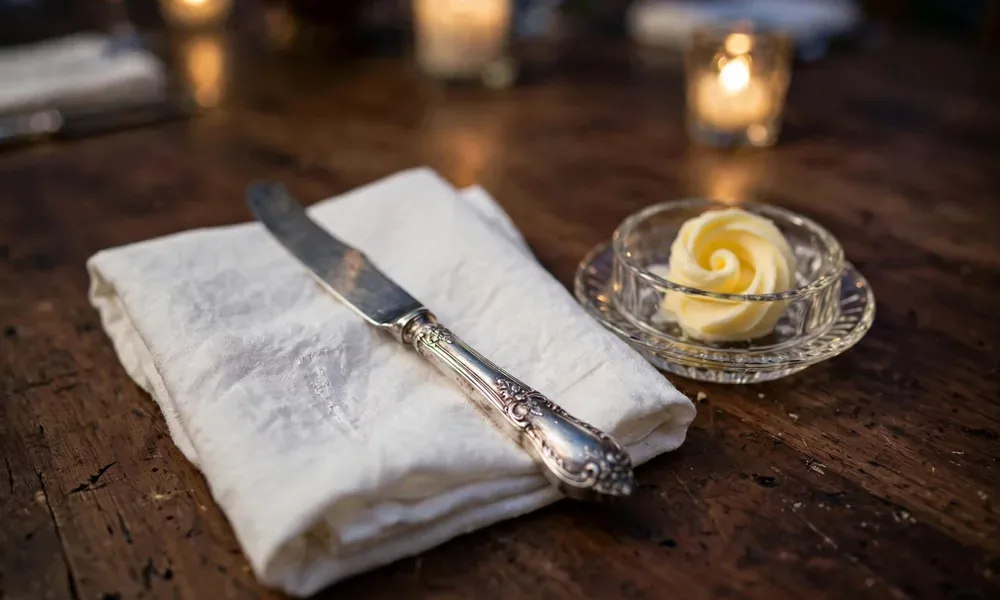
A luxury butter knife begins with material. Sterling silver, which is 92.5 percent pure silver, remains the most prestigious choice, prized for its soft lustre, its weight and the way it develops a gentle patina over time. Silverplate, a layer of pure silver bonded over a base metal core, offers much of the same look at a lower price. High-grade 18/10 stainless steel, an alloy of 18 percent chromium and 10 percent nickel, is the modern standard for everyday luxury: it resists corrosion, holds a bright polish and needs almost no maintenance.
Craftsmanship is the second marker. The best makers forge or cast their blades and handles rather than stamping them from thin sheet, and they finish each piece by hand. Look for a blade thick enough to hold its shape, a handle with no sharp edges or visible seams, and a smooth, secure join between blade and handle. In hollow-handle silver pieces, the handle is often weighted so the knife balances evenly, neither tipping forward nor feeling hollow in the hand.
Design is the third element. Luxury butter knives tend to be restrained: clean lines, a gently rounded tip, a blade wide enough to carry a generous curl of butter and a handle shaped to the hand. Ornament is usually subtle, a fine engraved line or a softly sculpted handle, rather than heavy decoration that catches on bread or cloth.
How the Best Luxury Butter Knife Brands Compare
The table below compares the leading makers on the points that matter most: the materials they use for butter knives, the style they are known for, and the price you can expect to pay for a single piece. Prices are approximate and vary by pattern, retailer and whether you buy one knife or a set.
| Brand | Main materials | Signature style | Typical price per knife |
|---|---|---|---|
| Christofle | Silverplate, sterling silver | French elegance, refined patterns | $120–$450 |
| Georg Jensen | Sterling silver, stainless steel | Scandinavian simplicity, sculptural handles | $95–$400 |
| Tiffany & Co. | Sterling silver, stainless steel | American classic, clean and understated | $150–$500 |
| Puiforcat | Sterling silver, silverplate | Parisian silversmithing, sculptural forms | $250–$700 |
| Sambonet | 18/10 stainless steel, silverplate | Italian modern, polished and practical | $40–$150 |
| Alessi | 18/10 stainless steel | Contemporary Italian design | $35–$120 |
| Robbe & Berking | Sterling silver, silverplate, stainless steel | German precision, classic patterns | $90–$450 |
| Sabre Paris | Stainless steel, acrylic, horn | Colourful French chic, slim handles | $30–$90 |
The Best Luxury Butter Knife Brands
Each brand below earns its place for a different reason: one for heritage silver, another for modern design, another for everyday value at a luxury standard.
Christofle
Christofle has made fine silver in France since 1830, and its butter knives carry the same polish and precision as the flatware it supplies to palaces, hotels and fine restaurants. The house is best known for its silverplate, produced by electroplating pure silver onto a base metal, which gives a deep, warm lustre at a price below solid sterling. Its butter knives appear in classic patterns such as Malmaison and Albi, with slender handles and broad blades.
What sets Christofle apart is consistency: a butter knife bought today will match a set bought twenty years ago, because the house keeps its historic patterns in production. Prices start around $120 for silverplate and rise to $450 or more for sterling silver.
Georg Jensen
Georg Jensen, founded in Copenhagen in 1904, brings Scandinavian design to the breakfast table. Its butter knives are recognisably Jensen: soft, organic lines, sculptural handles and a complete absence of fuss. The house makes butter knives in both sterling silver and stainless steel, in best-known patterns including Bernadotte and Cobra.
The sterling silver knives are the showpieces, while the stainless steel versions bring the same design to everyday use. Expect $95 for stainless steel to $400 for sterling silver — ideal for a modern table of clean lines and natural materials.
Tiffany & Co.
Tiffany & Co. has been an American name in sterling silver since 1837, and its butter knives are among the most quietly correct pieces the house makes. They are typically understated: a plain polished blade, a handle with a simple monogram-ready panel or a restrained pattern, and a weight that feels generous without being heavy. The house sells them individually and as part of its classic flatware patterns.
Tiffany sterling is made to the 925 standard the house helped establish in the United States, with a bright, even, durable finish. Prices run from about $150 for stainless steel to $500 for sterling silver — a classic American piece built to last decades.
Puiforcat
Puiforcat is the most artisanal name on this list. The Paris silversmith, founded in 1820 and part of the Hermès group, makes butter knives that are closer to small sculptures than to ordinary flatware. Its pieces are often hand-raised and hand-chased by silversmiths whose training takes years.
Puiforcat butter knives are made in sterling silver and silverplate, from severe architectural lines to soft organic curves. At $250 to $700 per piece, they are heirloom objects, bought once and passed on — the benchmark for fine craftsmanship.
Sambonet
Sambonet, founded in Italy in 1856, is the practical luxury choice. The house makes most of its butter knives in 18/10 stainless steel, with some silverplate pieces, at a scale that keeps prices sensible without cutting corners on finish. Its butter knives are polished to a bright mirror and made in a wide range of patterns, so it is easy to find one that matches an existing flatware service.
Where Sambonet wins is daily use: stainless steel needs no polishing, survives the dishwasher and stands up to a busy household. At $40 to $150 per knife, it is the best value among the heritage makers in this guide.
Alessi
Alessi is the design-led Italian brand, and its butter knives look it. Founded in 1921, the house works with leading designers to produce tableware that is playful, modern and instantly recognisable. Expect slim, elegant profiles, unexpected handle shapes and a polished 18/10 stainless steel finish that catches the light.
Alessi butter knives are lighter than the silver pieces here, deliberately so: the brand designs for the contemporary table, where flatware should feel effortless. Prices run from about $35 to $120 per knife — a good pick if you love modern design and entertain often.
Robbe & Berking
Robbe & Berking has made silver in Flensburg, Germany, since 1874, and it is one of the few makers still producing flatware entirely in its own workshops. Its butter knives are made in sterling silver, silverplate and stainless steel, and the house is known for the precision of its work: crisp pattern detail, even polishing and handles weighted to balance the blade exactly.
The range is unusually broad, from classic Alt-Chippendale to simpler modern patterns, and the house makes pieces to order in patterns it has produced for generations. Prices range from about $90 for stainless steel to $450 for sterling silver.
Sabre Paris
Sabre Paris brings colour and charm to the butter knife. The French house, founded in 1993, is known for slim-handled flatware in stainless steel with handles in acrylic, horn and wood, in a palette that runs from ivory and tortoiseshell to vivid blues, greens and pinks. Its butter knives are lighter and more casual than the silver pieces in this guide, but they are made to a high standard and they are genuinely useful.
A Sabre butter knife suits a relaxed table: weekend breakfasts, summer lunches or a table that mixes patterns and colours. At $30 to $90 per knife, it is the most accessible in this guide — beautiful and well made without the formality of silver.
Butter Knives, Cheese Knives and Knife Sets: What Is Different
It is easy to confuse a butter knife with its neighbours in the drawer, so it is worth being clear about the differences. A butter knife is a single-purpose spreader: a flat, blunt blade with a rounded tip, made to scoop butter from a dish and spread it on bread, toast or scones. It has no cutting edge, no point and no serration, and it is used at the table rather than in the kitchen.
A cheese knife is a different tool. Cheese knives have sharper edges, pointed or forked tips, and holes or cut-outs in the blade to stop soft cheese sticking, with shapes designed for cutting through firm or crumbly cheese. Using a butter knife on a hard cheese will bend or blunt it, and using a cheese knife to spread butter is awkward and unnecessary. Keep the two separate, and buy each for its own job.
A knife set is a different purchase again. A full flatware or cutlery set contains dinner knives, forks, spoons and often serving pieces, and a butter knife may be one small part of it. Buying a set is the right move when you are starting a table from scratch. Buying a single luxury butter knife is the right move when your table is already set and you want one beautiful, well-made piece. If you are still building the wider table, our guide to the best silverware sets will help you compare complete services before you decide.
How to Choose a Luxury Butter Knife
Choosing well comes down to a few practical checks. Work through them before you buy, and you will end up with a knife that suits your table and your habits rather than one that looks good in a photograph and disappoints in the hand.
- Match the material to your routine. Choose sterling silver or silverplate for formal occasions and for a table you enjoy maintaining; choose 18/10 stainless steel if the knife will be used daily and washed in the dishwasher.
- Check the weight and balance. Hold the knife if you can, or check its listed weight: it should feel solid, sit level when laid across your fingers, and not tip toward the blade or the handle.
- Look at the blade shape. A good butter knife has a broad, flat blade with a rounded tip, wide enough to carry butter and smooth enough to spread it without tearing bread.
- Match your existing flatware. A butter knife should sit comfortably beside your forks, spoons and dinner knives, either in the same pattern or in a complementary style that does not clash.
- Consider the butter dish. A longer knife suits a large butter dish or a board shared by several people; a shorter, lighter knife suits an individual place setting.
- Buy from a maker that stands behind its work. Prefer brands that keep patterns in production, offer replating or repair, and sell individual pieces so you can add or replace one knife later.
Care and Maintenance
Stainless steel butter knives are the easiest to care for. Wash them in warm soapy water or in the dishwasher, dry them promptly and store them where the blades do not rub against other metal. Avoid harsh scouring pads, which can dull a mirror finish over time, and keep them away from bleach-based cleaners. If your steel knives ever lose their shine, our guide on how to polish stainless steel explains the steps that restore a bright finish without scratching the surface.
Silver butter knives need a little more attention, and they repay it. Wash silver by hand in warm water with a mild detergent, dry it immediately with a soft cloth, and polish it regularly with a silver cloth or a gentle silver polish to keep tarnish from building up. Never put sterling silver in the dishwasher, where heat and detergent can damage the finish and loosen hollow handles. Store silver pieces in a tarnish-resistant pouch or a lined drawer, and use them often: regular handling slows tarnish. Hallmarks and dark marks on old silver also reveal the maker and silver content, which matters when buying vintage pieces, and our guide to what dark marks on silver really mean explains how to read those signs.
Frequently Asked Questions
What is the difference between a butter knife and a butter spreader?
The two terms describe the same tool. A butter spreader is the traditional name for a butter knife: a flat, blunt-bladed knife with a rounded tip, made to scoop butter from a dish and spread it on bread. Some makers call their wider, shorter versions spreaders and their longer versions butter knives, but the function is identical.
Is sterling silver worth it for a butter knife?
Sterling silver is worth it if you value the look, the weight and the heritage of fine silver, and if you are willing to polish the piece regularly. A sterling butter knife feels noticeably more substantial than a steel one, it develops a soft patina that many collectors love, and it holds its value as a piece of fine silver. If you want a knife for daily use with almost no maintenance, 18/10 stainless steel is the better choice.
Can luxury butter knives go in the dishwasher?
Stainless steel butter knives can usually go in the dishwasher, though hand washing keeps a mirror finish brighter for longer. Silverplate and sterling silver butter knives should be washed by hand: dishwasher heat and detergent can dull silver, damage the finish and loosen hollow handles.
How long should a butter knife be?
Most butter knives are between 15 and 20 centimetres long. A knife around 17 to 18 centimetres suits most tables: long enough to reach across a butter dish, short enough to sit neatly at a place setting. Shorter knives suit individual servings, while longer ones suit a shared butter board.
Should butter knives match the rest of the flatware?
Matching is the classic choice and it looks best at a formal table, where a butter knife in the same pattern as your forks and spoons completes the setting. At a relaxed table, a contrasting butter knife can work well, especially a single statement piece in sterling silver or a colourful Sabre knife beside plain steel flatware. Either match deliberately or contrast deliberately, and avoid a near-match that looks accidental.
How much should I spend on a luxury butter knife?
A good luxury butter knife costs from about $30 for a well-made stainless steel piece to $700 for a hand-finished sterling silver knife from a house such as Puiforcat. For most buyers, $90 to $250 buys an excellent knife: a silverplate piece from Christofle or Robbe & Berking, or a sterling silver piece from Georg Jensen or Tiffany & Co. Spend more if you are buying an heirloom or completing a silver service, and spend less if you want a beautiful daily-use knife in stainless steel.
Bottom Line
The Best Luxury Butter Knife Brands prove that even the smallest piece of flatware deserves to be made well. Christofle and Puiforcat set the standard for French silver, Georg Jensen and Tiffany & Co. offer timeless sterling pieces that suit almost any table, Robbe & Berking brings German precision to classic patterns, and Sambonet, Alessi and Sabre Paris show that a butter knife in stainless steel can be just as considered and just as beautiful. Choose the material that fits your routine, match the knife to your table, and the butter knife you choose now will be spreading butter at your table for decades.