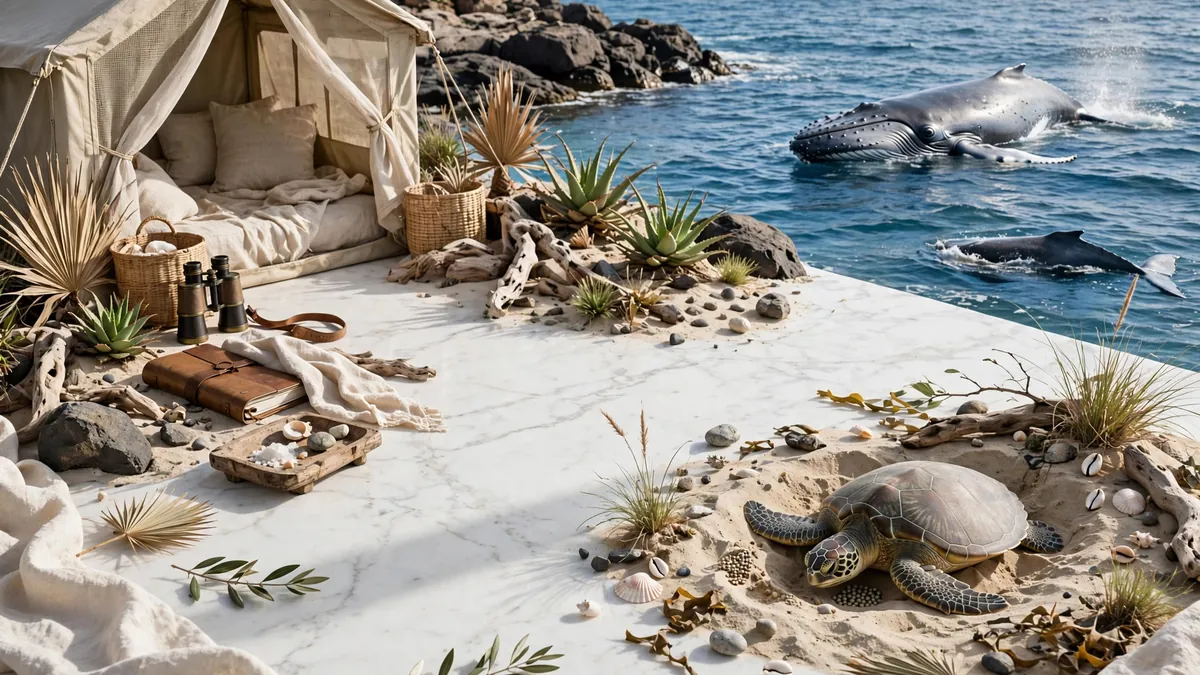

Cape Verde does not have a Big Five safari, and that is the first honest thing to say about it. There are no lions on the islands, no elephants, and no open savannah to drive across at dawn. What Cape Verde does have is something rarer: an Atlantic archipelago where the wildlife worth travelling for lives in the water and in the sky. Humpback whales pass close to the coast between March and May, loggerhead turtles come ashore to nest on the beaches of Boa Vista and Sal, and the islands hold birdlife you will not see anywhere else.
A luxury safari in Cape Verde is therefore a different kind of trip. It is a boat at sunrise watching a whale breach off Boa Vista, a guided night walk to watch a turtle lay her eggs, and a hike through the green valleys of Santo Antão with a local guide who knows where the rare birds feed. The luxury is in the access, the guides, and the lodges, not in a game drive.
Below are nine luxury safaris in Cape Verde worth considering in 2027, from whale watching and turtle nesting to birding and volcano hiking. Each one is described by what it is good at, what to watch for, and who it suits best.
Key takeaways
- Cape Verde’s best wildlife is marine and avian: humpback whales, loggerhead turtles, dolphins, and endemic birds, not Big Five land animals.
- Whale season runs roughly March to May, turtle nesting peaks from June to October, and birding is best from November to April.
- Boa Vista and Sal are the main bases for whale and turtle trips, while Santo Antão and Santiago suit hiking and birding.
- Choose small-group, licensed operators with local guides, and book the wildlife outings before you book your flights.
- No safari in Cape Verde guarantees a sighting, and a trip sold as a guaranteed whale or turtle encounter should be treated with caution.
What a luxury safari in Cape Verde actually covers
A safari in Cape Verde is a wildlife trip built around the ocean and the islands, rather than a savannah. The classic experiences are whale watching, turtle watching, dolphin encounters, snorkelling with reef fish and turtles, birdwatching, and hiking through volcanic and valley landscapes. Most trips are half-day or full-day outings from a hotel base, with a boat or a guided walk, and they are usually combined with beach time and island touring.
The season matters more here than in most safari destinations. Humpback whales visit the waters around Boa Vista and Sal mainly from March to May, when mothers and calves shelter in the warm shallows. Loggerhead turtles nest on the beaches of Boa Vista, Sal and Maio from June to October, with the peak in July and August. Birding is strongest from November to April, when the weather is dry and the migrant species arrive. A trip booked in the wrong month can still be enjoyable, but it will not be a wildlife trip.
The other thing to understand is scale. Cape Verde is a small country of ten islands, and the wildlife industry is small too. There are no vast reserves and no fleets of safari vehicles. The best operators are local, small, and licensed, which means small groups, knowledgeable guides, and trips that are honest about what you are likely to see. It also means the good trips book up early in the peak months.
How we chose these safaris and what to look for
Look first at the operator and the guide. A good Cape Verde safari is led by a local guide who knows the waters, the beaches, and the birds, and who works under a licence that limits group size and protects the animals. Ask how many people are on the boat, whether the operator follows the national turtle-watching code, and whether the guide is local. A trip that cannot answer those questions is not a luxury trip, whatever the price.

Look next at the timing and the base. Whale trips run from Boa Vista and Sal, turtle trips from Boa Vista, Sal and Maio, birding from Santiago and Santo Antão, and hiking from Santo Antão and Fogo. If you want birds, Santiago and Santo Antão are the islands to choose. Our guide to the best luxury safaris in Mauritius makes the same point about island wildlife: the island you choose decides the animals you see.
Finally, look at what is included. A luxury safari should include transfers, a licensed guide, permits where required, and clear safety equipment. It should not promise guaranteed sightings, and it should be honest about the weather, the sea state, and the chance of a cancelled trip. Boats do not go out in rough seas, and a good operator will reschedule rather than take you out in bad conditions.
The 9 best luxury safaris in Cape Verde of 2027
Boa Vista Humpback Whale Watching
What we like: A small-boat whale watching trip off Boa Vista in peak season, with a local marine guide, hydrophone listening, and a good record of close encounters with mothers and calves. What to consider: The sea can be rough, the trip is weather dependent, and sightings are never guaranteed. Location: Boa Vista, departing from Sal Rei. Best for: Whale lovers and first-time safari travellers. Price range: From around 90 to 150 euros per person. Standout feature: Humpback mothers and calves in warm, shallow water.
Boa Vista Loggerhead Turtle Nesting Night Walk
What we like: A guided night walk on a Boa Vista nesting beach with a licensed turtle guide, small group, red-light torches only, and a respectful distance from the animals. What to consider: Late nights, long walks on soft sand, and no guarantee a turtle will come ashore on your night. Location: Boa Vista, nesting beaches near Sal Rei. Best for: Wildlife watchers and patient travellers. Price range: From around 60 to 100 euros per person. Standout feature: Watching a loggerhead lay her eggs under the stars.
Sal Humpback Whale and Dolphin Watching
What we like: A combined whale and dolphin trip from Santa Maria, with a good chance of bottlenose dolphins as well as humpbacks, and a comfortable boat with shade and a local crew. What to consider: Sal is busier than Boa Vista, and the boats can be larger, so check the group size before you book. Location: Sal, departing from Santa Maria. Best for: Families and travellers based on Sal. Price range: From around 70 to 120 euros per person. Standout feature: Dolphins riding the bow wave alongside the boat.
Santo Antão Birdwatching and Valley Hiking
What we like: A guided birding and hiking trip through the green valleys of Santo Antão, with endemic species, terraced fields, and a local guide who knows the calls and the feeding spots. What to consider: The hiking is steep in places, and the best birding starts early in the morning. Location: Santo Antão, Paul and Ribeira Grande valleys. Best for: Birders and keen walkers. Price range: From around 80 to 140 euros per person. Standout feature: The Cape Verde warbler and the green, terraced valleys.
Sal Snorkelling with Turtles and Reef Fish
What we like: A snorkelling trip from Santa Maria to a sheltered bay where green turtles feed, with a guide, good equipment, and a calm, clear-water setting that suits beginners. What to consider: The bay can be busy in peak season, and the water is cooler than the Caribbean. Location: Sal, Santa Maria bay. Best for: Snorkellers and families with older children. Price range: From around 40 to 80 euros per person. Standout feature: Green turtles feeding in clear, shallow water.
Fogo Volcano Hiking Safari
What we like: A guided hike to the crater of Pico do Fogo, the highest peak in Cape Verde, with a local guide, a stay in the crater village of Chã das Caldeiras, and a landscape that feels like another planet. What to consider: The climb is long and steep, the altitude is over 2,800 metres, and the weather can change quickly. Location: Fogo, Pico do Fogo. Best for: Fit walkers and geology lovers. Price range: From around 100 to 180 euros per person. Standout feature: Standing on the rim of an active volcano.
Santiago Island Nature and Birding Trek
What we like: A guided nature trek on Santiago, the largest island, covering the endemic Cape Verde warbler, the grey-headed kingfisher, and the mountain scenery of Serra Malagueta. What to consider: Santiago is less developed for tourism than Sal or Boa Vista, so the logistics need more planning. Location: Santiago, Serra Malagueta and Tarrafal. Best for: Serious birders and travellers who want the real Cape Verde. Price range: From around 90 to 150 euros per person. Standout feature: The endemic warbler in its mountain habitat.
São Vicente Whale and Dolphin Watching
What we like: A whale and dolphin trip from Mindelo, with a local crew, a good chance of several dolphin species, and the cultural bonus of Mindelo itself, the most musical city in Cape Verde. What to consider: The whale season is shorter here than on Boa Vista, and the sea can be choppy. Location: São Vicente, departing from Mindelo. Best for: Culture lovers who want wildlife too. Price range: From around 70 to 120 euros per person. Standout feature: Dolphins off Mindelo, followed by live music in the evening.
Maio Island Turtle and Bird Safari
What we like: A quiet, low-key turtle and bird safari on Maio, the least visited island in the archipelago, with empty beaches, nesting turtles, and excellent birding, all with a local guide. What to consider: Maio has few hotels and limited transport, so the trip needs careful planning and a flexible schedule. Location: Maio, nesting beaches and Salinas. Best for: Experienced travellers and solitude seekers. Price range: From around 80 to 140 euros per person. Standout feature: Empty nesting beaches and undisturbed birdlife.
Which Cape Verde safari is right for your trip
If you want whales, go to Boa Vista between March and May, and book the morning boat. If you want turtles, go to Boa Vista or Maio between June and October, and choose a licensed night walk rather than an unregulated beach visit. If you want birds, go to Santiago or Santo Antão between November and April, and hire a local guide who knows the endemic species. If you want a landscape that will stay with you, hike Fogo, and stay overnight in the crater village.
Families with children should choose the Sal snorkelling trip or the Sal whale and dolphin trip, both half-day, comfortable, and suitable for older children. Keen walkers should choose Santo Antão or Fogo, and allow a full day for each. Birders should base themselves on Santiago, and travellers who want quiet should choose Maio, accepting that the logistics will take more effort.
Whatever you choose, build in a spare day. Boats are cancelled by weather, turtles do not come ashore on demand, and a safari that allows for a second attempt is worth more than a packed itinerary. Our guide to the best luxury safaris in the Seychelles makes the same point about island wildlife: the weather decides the day, and the traveller who plans for that enjoys the trip far more.
The caveats that matter
Cape Verde is a safe and welcoming destination, but it is also a small island nation with limited infrastructure, and the wildlife is genuinely wild. The sea can be rough, the sun is strong, and the islands are far from a major hospital, so travel insurance that covers boat trips and medical evacuation is worth having.
| Detail | What is known |
|---|---|
| Best whale season | March to May, around Boa Vista and Sal, when humpback mothers and calves shelter inshore |
| Best turtle season | June to October, peaking July and August, on Boa Vista, Sal and Maio |
| Best birding season | November to April, dry season, when migrants arrive and the weather is settled |
| What to avoid | Unlicensed turtle walks, large-group boats, and any trip that guarantees a sighting |
| Sea conditions | Calmest in the morning; boats are cancelled in rough seas, so keep a spare day |
| Health and safety | Strong sun, rough seas, and long walks; take sun protection, water, and travel insurance |
| What to pack | Warm layer for night walks, closed shoes for sand and lava, binoculars for birding |
| What it does not offer | No Big Five land safari, no game drives, and no guaranteed wildlife sightings |
Turtle watching deserves a special note. Loggerhead turtles are protected in Cape Verde. Only use licensed guides, never use white light or flash photography on a nesting beach, keep your distance, and never touch a turtle or a nest. A guide who lets you get close for a photograph is breaking the rules that keep the turtles coming back, and the right response is to choose a different operator next time.
Checklist: planning a Cape Verde safari honestly
Use these checks before you book, and again before you travel.
- Check the season: whales March to May, turtles June to October, birding November to April.
- Check the operator: licensed, local guide, small group, and a clear policy on turtle-watching rules.
- Check the group size: ask how many people are on the boat or the walk before you pay.
- Check the weather policy: confirm what happens if the boat is cancelled, and whether you can reschedule.
- Check your insurance: cover for boat trips, hiking, and medical evacuation from a small island.
- Keep a spare day: boats are cancelled by weather and turtles do not come ashore on demand.
Frequently asked questions
When is the best time to see whales in Cape Verde?
March to May is the main humpback season, with April usually the best month. The whales come to the warm waters around Boa Vista and Sal to calve, and the morning boats have the calmest seas. Book early, because the small boats fill up in peak season.
Can I see turtles in Cape Verde?
Yes, from June to October, with the peak in July and August. Loggerheads nest on the beaches of Boa Vista, Sal and Maio. Only go with a licensed guide, use red light only, and keep your distance.
Does Cape Verde have a Big Five safari?
No. Cape Verde has no lions, elephants, or other large land mammals. Its wildlife is marine and avian: whales, dolphins, turtles, and endemic birds. If you want a Big Five safari, you need a mainland African destination. If you want whales and turtles, Cape Verde is excellent.
Which island is best for a first trip?
Sal is the easiest to reach and the most developed, with good whale and dolphin trips and snorkelling. Boa Vista is better for whales and turtles, and quieter. Santo Antão is best for hiking and birding, and Santiago is best for travellers who want the real Cape Verde.
Is it safe to swim with turtles in Cape Verde?
Yes, with a licensed guide and in the right places. The snorkelling trips from Sal visit sheltered bays where green turtles feed, and the guides know how to keep a respectful distance. Do not chase a turtle, do not touch one, and do not use flash photography underwater. A calm, quiet approach gives you a longer and better encounter.
How much should I budget for a luxury safari in Cape Verde?
Allow around 70 to 150 euros per person per wildlife outing, plus the cost of your hotel and flights. A week with three or four outings will usually cost more than a beach-only holiday, but far less than a mainland African safari. The biggest cost is usually the flight, so book that early. A honeymoon destination guide can help with the wider planning, because many of the same island bases suit a wildlife trip and a romantic break alike.
The bottom line
The best luxury safari in Cape Verde in 2027 is not the one with the biggest boat or the lowest price. It is the one with a licensed local guide, a small group, the right season, and enough time to try again if the weather turns. Boa Vista for whales and turtles, Santo Antão and Santiago for birds and hiking, and Sal for an easy first trip are the choices that work most reliably, and they work because they match the island to the wildlife.
Choose one island, book the wildlife outings before the flights, keep a spare day, and treat every sighting as a privilege rather than a purchase. That is the honest way to enjoy Cape Verde, and it is the way that keeps the whales and the turtles coming back.